
 © 2026 JSH Law Ltd. All rights reserved.
https://jshlaw.co.uk/wp-content/uploads/2026/02/ChatGPT-Image-Feb-3-2026-03_26_42-AM.png
1024
1536
Jessica Susan Hill
https://jshlaw.co.uk/wp-content/uploads/2026/01/jsh-law-logo-new-black-300x67.png
Jessica Susan Hill2026-10-06 12:08:392026-10-12 13:03:58If AI Does the Junior Work, Who Trains the Lawyers of 2035?
 © 2026 JSH Law Ltd. AI-assisted original artwork created for JSH Law using supplied JSH Law branding and portrait photography. All rights reserved.
https://jshlaw.co.uk/wp-content/uploads/2026/10/AI-and-Evidence-in-Court.png
1254
1254
Jessica Susan Hill
https://jshlaw.co.uk/wp-content/uploads/2026/01/jsh-law-logo-new-black-300x67.png
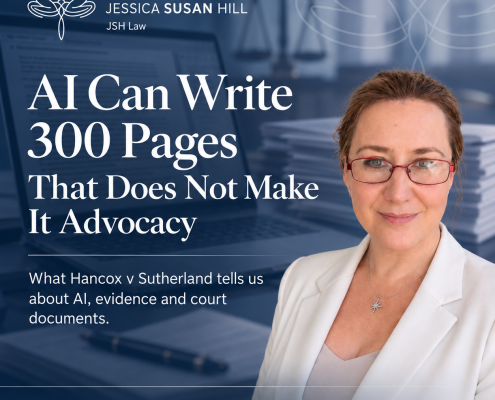
Jessica Susan Hill2026-10-02 09:52:132026-10-12 11:23:19AI Can Write 300 Pages. That Does Not Make It Advocacy.© 2026 JSH Law Ltd. All rights reserved.
https://jshlaw.co.uk/wp-content/uploads/2026/02/ChatGPT-Image-Feb-3-2026-03_26_42-AM.png
1024
1536
Jessica Susan Hill
https://jshlaw.co.uk/wp-content/uploads/2026/01/jsh-law-logo-new-black-300x67.png
Jessica Susan Hill2026-09-15 14:28:382026-10-12 11:28:51AI Agents in Family Court: How Much Control Are You Giving Them?© 2026 JSH Law Ltd. All rights reserved.
https://jshlaw.co.uk/wp-content/uploads/2026/02/ChatGPT-Image-Feb-3-2026-03_26_42-AM.png
1024
1536
Jessica Susan Hill
https://jshlaw.co.uk/wp-content/uploads/2026/01/jsh-law-logo-new-black-300x67.png
Jessica Susan Hill2026-09-15 13:27:132026-10-12 11:28:56AI Agents & Family Court: A Guide for Litigants in Person© 2026 JSH Law Ltd. All rights reserved.
https://jshlaw.co.uk/wp-content/uploads/2026/02/ChatGPT-Image-Feb-3-2026-03_26_42-AM.png
1024
1536
Jessica Susan Hill
https://jshlaw.co.uk/wp-content/uploads/2026/01/jsh-law-logo-new-black-300x67.png
Jessica Susan Hill2026-08-04 14:58:212026-10-12 11:29:00The JSH Law Legal Tech Test: Which Platforms Actually Improve Access to Justice?© 2026 JSH Law Ltd. All rights reserved.
https://jshlaw.co.uk/wp-content/uploads/2026/02/ChatGPT-Image-Feb-3-2026-03_26_42-AM.png
1024
1536
Jessica Susan Hill
https://jshlaw.co.uk/wp-content/uploads/2026/01/jsh-law-logo-new-black-300x67.png
Jessica Susan Hill2026-07-24 14:54:512026-10-12 11:29:05Family Law Technologists: Where AI Meets Evidence, Safeguarding and Justice. My Two Penneth.