
Court Documents, Statements & Submissions
Turn a complicated family court case into clear, focused written material
Practical support preparing, structuring and reviewing family court documents when you are representing yourself.
A strong family court document does not need to sound dramatic or overly legalistic. It needs to help the reader understand what has happened, what is evidenced, what remains disputed, why it matters and what you are asking the court to do.
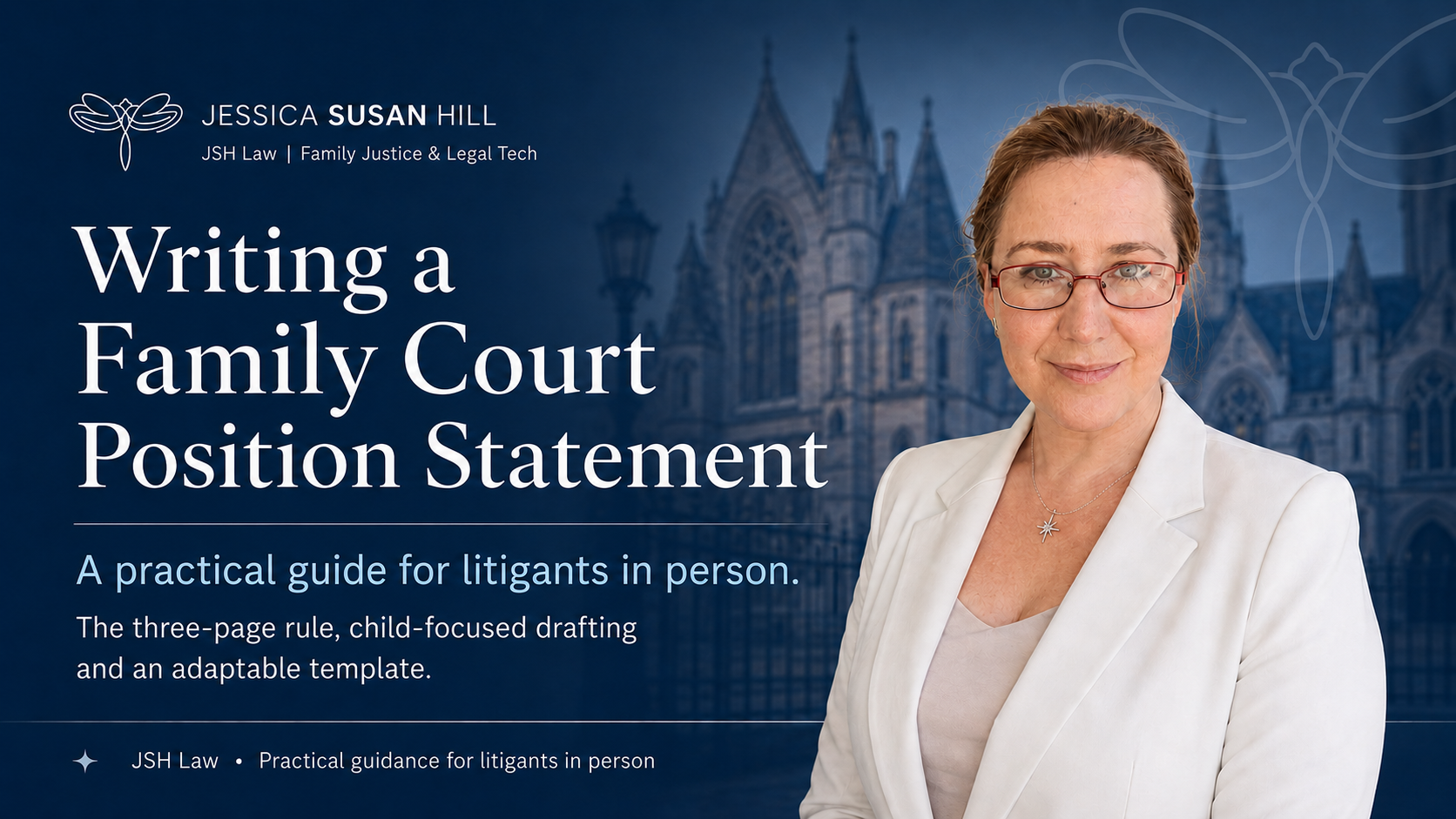
The court cannot work with evidence it cannot find, follow or understand.
Litigants in person often have a large amount of important information but no clear way to turn it into usable court material. There may be years of messages, previous orders, safeguarding information, professional reports, allegations, disputed events and documents from several stages of proceedings.
JSH Law helps organise that material into something more disciplined: relevant facts, identifiable evidence, clear issues and focused written documents. The objective is not to make a document longer. It is to make the important parts easier for the court to see.
Document support
What can JSH Law help you prepare?
Support can be limited to one document or form part of wider case preparation. These are the five core areas within this service.
Position Statements & Schedules of Issues
Help setting out the current position clearly before a hearing: what has happened, what remains disputed, what has changed and what orders or directions you are asking the court to consider.
Witness Statements
Support turning your factual account into a structured statement that distinguishes what you personally know, what is supported by documents and what remains disputed.
Skeleton Arguments & Written Submissions
Where appropriate, support structuring written argument around the actual legal, procedural and evidential issues before the court rather than reproducing the entire history of the dispute.
Appeal Groundwork & Document Preparation
Support organising orders, reasons, transcripts, procedural history and relevant documents where you are considering whether an appeal or procedural challenge requires further specialist advice or preparation.
Document Review for Tone, Relevance & Legal Coherence
Already written the document yourself? JSH Law can help review structure, relevance, chronology, repetition, evidential support and tone. This is often particularly useful where a document has become long, emotionally charged or difficult to navigate after months or years of conflict.
Making the court's job easier
A court document should reduce confusion — not reproduce it
Family proceedings can generate enormous volumes of information. The difficult task is identifying what matters to the decision the court is being asked to make.
Separate fact from allegation
A document should make clear what is established, what you say happened, what the other party disputes and where supporting evidence can be found.
Link evidence to the issue
Evidence becomes more useful when the reader can understand why it matters to the particular question currently before the court.
Be proportionate
More pages do not necessarily make a stronger case. Repetition can hide the points that genuinely need judicial attention.
Evidence-led preparation
What I am looking for when I review a court document
The precise requirements depend on the document and the stage of proceedings, but the same disciplines appear repeatedly.
- Purpose: what is this particular document supposed to achieve?
- Relevance: does this point assist with an issue the court actually needs to determine?
- Evidence: can important factual assertions be traced to a document, event or other evidential source where appropriate?
- Accuracy: are allegations, findings, professional opinion and established facts properly distinguished?
- Chronology: can the reader understand when significant events happened?
- Proportionality: can repetition, background or emotional commentary be reduced without losing something important?
- Child focus: where children are involved, is the welfare relevance clear rather than assumed?
- Outcome: is it clear what you are asking the court to consider doing?
More than proofreading
Document preparation may involve work behind the document itself
Often the problem cannot be solved simply by rewriting a paragraph. The underlying evidence may first need to be understood and organised.
Reviewing court orders
Identifying what has previously been ordered, what directions remain outstanding and what the current document needs to address.
Building the chronology
Creating a reliable sequence of relevant events before trying to explain them in prose.
Reviewing evidence
Looking at messages, correspondence, reports and other agreed material to identify what supports or contradicts an important factual point.
Identifying the live issues
Separating historic disputes from the matters the court is actually being asked to determine now.
Removing unnecessary heat
Reframing emotionally understandable but unhelpful wording into clear, evidence-focused language suitable for court.
Cross-referencing documents
Making it easier to identify where key information appears in the evidence or supporting papers.
Before sending hundreds of pages
Start with enough information to identify the task
You do not normally need to send the entire history of the proceedings at first contact. A targeted initial set of documents is usually more useful.
Useful starting documents may include
- the most recent court order;
- the date and type of the next hearing;
- the deadline for the document;
- the existing draft, if there is one;
- a relevant Cafcass or professional report; and
- the particular evidence you believe the document needs to address.
Please tell me immediately if
- a filing or service deadline is imminent;
- a hearing is already listed;
- the document must comply with a specific court direction;
- there are safeguarding or domestic abuse issues; or
- the material is unusually large or complex.
Experiences of working with JSH Law
What people who have worked with me say
Practical support is intended to create clarity and structure at a point when the proceedings may feel anything but clear.
Jessica broke the process down in a way that finally made sense. I stopped panicking about every letter from the court and was able to focus on what mattered at each stage.
Mark
Having someone explain the procedure and help me organise my case gave me confidence as a litigant in person. I finally felt like I was engaging with the process properly.
Daniel
I felt completely lost in the process before speaking with Jessica. She helped me understand where my case sat procedurally and what the court was actually expecting next.
Sophie
The support wasn’t about telling me what to do, but helping me understand my options and the risks. I felt calmer and more prepared going into each hearing.
Helen
Prefer to understand the process first?
Read the free JSH Law guidance
If you are not ready to instruct JSH Law, these guides may help you understand the principles behind effective family-court preparation.
How to Write a Family Court Position Statement
A practical guide to purpose, structure, relevance and common mistakes.
Read the guide →Family Court Document Checklist
A practical starting point for keeping court papers and preparation under control.
Read the checklist →Preparing Your Case Like a Barrister
Learn how issue identification, evidence discipline and structured preparation can make a case easier to present.
Read the guide →Explore JSH Law services
Your case may need more than one kind of support
Move between the four core service areas depending on what is happening in your case.
Family Court Navigation & Case Analysis
Understand where the case has reached, what the orders mean and what needs doing next.
Explore →Safeguarding, Cafcass & Professional Reports
Support dealing with reports, allegations, safeguarding evidence and professional involvement.
Explore →Court Documents, Statements & Submissions
Turn the relevant facts, evidence and issues into clear written material for your case.
Current serviceHearing Support & McKenzie Friend Services
Prepare for the hearing and receive practical assistance before and during court.
Explore →Clear boundaries
You remain responsible for your own proceedings
JSH Law provides non-reserved legal services, litigation support and McKenzie Friend assistance. JSH Law is not an SRA-authorised solicitors' firm.
JSH Law can
- review agreed documents and evidence;
- help structure and prepare drafts;
- research relevant legal and procedural material;
- identify clarity, relevance and evidential issues;
- help organise chronologies, schedules and case papers; and
- provide other agreed non-reserved litigation support.
You remain responsible for
- checking that the factual content is accurate;
- approving any document before it is used;
- signing statements of truth or court forms where required;
- filing and serving documents unless another lawful arrangement has been expressly agreed;
- complying with your court orders and deadlines; and
- conducting your proceedings as the litigant in person.
Sending a document to JSH Law does not by itself mean that responsibility for that document or any associated deadline has been accepted. The task, scope, deadline and fee must be expressly agreed.
Defined work
You can instruct JSH Law for one document
You do not need to instruct JSH Law for the whole case. Document support may be charged at the standard hourly rate or, where the scope can be identified clearly, quoted as a fixed-fee task before you commit.
Larger document-review exercises may require an initial assessment of the volume of material before a realistic scope and fee can be agreed.
View JSH Law PricingNeed help with a court document?
Start with a 15-minute consultation
Tell me what document you need, when it is due, what stage the proceedings have reached and what material already exists. That is usually enough to identify whether JSH Law can help.
A clear first step
Request your consultation
You do not need to explain your entire case in the booking form.
Tell me the type of proceedings, the document you need help with, the next hearing or deadline and the main difficulty you are facing. If further documents are needed, I can tell you what to send.
Please note: JSH Law provides non-reserved legal services, litigation support and McKenzie Friend assistance. It is not an SRA-authorised solicitors' firm and does not provide regulated solicitor representation or conduct litigation on your behalf.
Choose a convenient time
Include any imminent court or filing deadline in your booking notes.
Your enquiry will be handled in accordance with the JSH Law Privacy Policy .
JSH Law
Clear documents help the court see the case you are actually trying to present.
If the evidence is there but the structure is not, JSH Law can help you organise the material, identify what matters and prepare clearer written documents for you to review and use in your own proceedings.
Please see the Pricing, Terms of Service, Privacy Policy, Disclaimer and Complaints Procedure.
Paid client work is governed by the applicable JSH Law Client Agreement and Terms of Business and any matter-specific Task Confirmation.