
Posts
 © 2026 JSH Law Ltd. All rights reserved.
https://jshlaw.co.uk/wp-content/uploads/2026/02/ChatGPT-Image-Feb-3-2026-03_26_42-AM.png
1024
1536
Jessica Susan Hill
https://jshlaw.co.uk/wp-content/uploads/2026/01/jsh-law-logo-new-black-300x67.png
Jessica Susan Hill2026-10-04 15:12:302026-10-12 13:20:50From Incidents to Trajectories: What Robert Kaiser’s Research Could Teach the Family Court About Coercive Control Evidence
 © 2026 JSH Law Ltd
https://jshlaw.co.uk/wp-content/uploads/2026/10/Jessica-Susan-Hill-Technology-Abuse-Graphic.png
1254
1254
Jessica Susan Hill
https://jshlaw.co.uk/wp-content/uploads/2026/01/jsh-law-logo-new-black-300x67.png
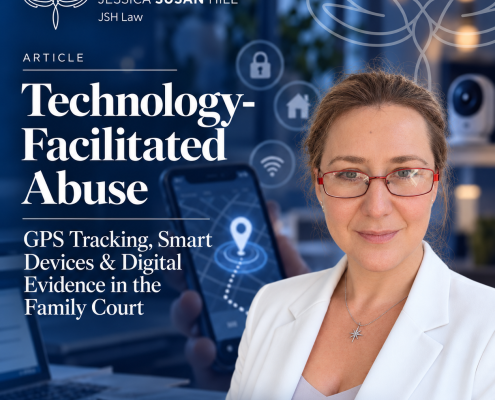
Jessica Susan Hill2026-10-04 09:02:502026-10-12 11:26:28Technology-Facilitated Abuse in the Family Court: GPS Tracking, Smart Devices & Digital Evidence© 2026 JSH Law Ltd. All rights reserved.
https://jshlaw.co.uk/wp-content/uploads/2026/02/ChatGPT-Image-Feb-3-2026-03_26_42-AM.png
1024
1536
Jessica Susan Hill
https://jshlaw.co.uk/wp-content/uploads/2026/01/jsh-law-logo-new-black-300x67.png
Jessica Susan Hill2026-09-30 20:36:202026-10-12 11:27:07Domestic Abuse in the Family Court: What the IDAS Family Court Report 2026 Reveals Five Years After the Harm Panel© 2026 JSH Law Ltd. All rights reserved.
https://jshlaw.co.uk/wp-content/uploads/2026/02/ChatGPT-Image-Feb-3-2026-03_26_42-AM.png
1024
1536
Jessica Susan Hill
https://jshlaw.co.uk/wp-content/uploads/2026/01/jsh-law-logo-new-black-300x67.png
Jessica Susan Hill2026-09-27 13:22:312026-10-12 11:27:21Does the Family Court Need a Fact-Finding Hearing? Cafcass, PD12J and Domestic Abuse Allegations© 2026 JSH Law Ltd. All rights reserved.
https://jshlaw.co.uk/wp-content/uploads/2026/02/ChatGPT-Image-Feb-3-2026-03_26_42-AM.png
1024
1536
Jessica Susan Hill
https://jshlaw.co.uk/wp-content/uploads/2026/01/jsh-law-logo-new-black-300x67.png
Jessica Susan Hill2026-09-27 12:48:292026-10-10 13:08:06Reproductive Coercion, Pregnancy and the Family Court: When “Historic” Abuse Still Matters© 2026 JSH Law Ltd. All rights reserved.
https://jshlaw.co.uk/wp-content/uploads/2026/02/ChatGPT-Image-Feb-3-2026-03_26_42-AM.png
1024
1536
Jessica Susan Hill
https://jshlaw.co.uk/wp-content/uploads/2026/01/jsh-law-logo-new-black-300x67.png
Jessica Susan Hill2026-09-20 15:02:562026-10-22 14:10:45Cafcass, Domestic Abuse Allegations and Fact-Finding: Lessons from Re D© 2026 JSH Law Ltd. All rights reserved.
https://jshlaw.co.uk/wp-content/uploads/2026/02/ChatGPT-Image-Feb-3-2026-03_26_42-AM.png
1024
1536
Jessica Susan Hill
https://jshlaw.co.uk/wp-content/uploads/2026/01/jsh-law-logo-new-black-300x67.png
Jessica Susan Hill2026-09-17 18:34:432026-10-12 11:27:30Clare’s Law: Does Domestic Abuse Disclosure Keep Women Safe? | JSH Law© 2026 JSH Law Ltd. All rights reserved.
https://jshlaw.co.uk/wp-content/uploads/2026/02/ChatGPT-Image-Feb-3-2026-03_26_42-AM.png
1024
1536
Jessica Susan Hill
https://jshlaw.co.uk/wp-content/uploads/2026/01/jsh-law-logo-new-black-300x67.png
Jessica Susan Hill2026-09-12 16:09:112026-10-12 14:28:50When a Child Says “No Contact”© 2026 JSH Law Ltd. All rights reserved.
https://jshlaw.co.uk/wp-content/uploads/2026/01/jsh-law-logo-new-black-300x67.png
0
0
Jessica Susan Hill
https://jshlaw.co.uk/wp-content/uploads/2026/01/jsh-law-logo-new-black-300x67.png
Jessica Susan Hill2026-09-05 15:18:352026-10-10 13:08:28Putting Children First in Family Law | JSH Law© 2026 JSH Law Ltd. All rights reserved.
https://jshlaw.co.uk/wp-content/uploads/2026/02/ChatGPT-Image-Feb-3-2026-03_26_42-AM.png
1024
1536
Jessica Susan Hill
https://jshlaw.co.uk/wp-content/uploads/2026/01/jsh-law-logo-new-black-300x67.png
Jessica Susan Hill2026-09-03 13:10:482026-10-10 13:08:43Your Nervous System Is Not Separate From Your Family Court Case