
Posts
 https://jshlaw.co.uk/wp-content/uploads/2026/10/create-a-serious-contemporary-editorial-photograph-for-an-england-and.png
941
1672
Jessica Susan Hill
https://jshlaw.co.uk/wp-content/uploads/2026/01/jsh-law-logo-new-black-300x67.png
Jessica Susan Hill2026-10-12 18:41:402026-10-12 18:41:44Missed a Family Court Deadline? How to File Late Evidence, Request More Time and Protect Your Case
 https://jshlaw.co.uk/wp-content/uploads/2026/10/person-reviewing-documents-with-a-ruler-and-pen-at-a-desk.png
941
1672
Jessica Susan Hill
https://jshlaw.co.uk/wp-content/uploads/2026/01/jsh-law-logo-new-black-300x67.png
Jessica Susan Hill2026-10-12 18:37:102026-10-23 11:16:11Family Court Order Wrong? How to Correct Mistakes, Use the Slip Rule and Protect Your Appeal Rights
 https://jshlaw.co.uk/wp-content/uploads/2026/10/create-a-serious-contemporary-editorial-photograph-for-a-uk-family-justice.png
887
1774
Jessica Susan Hill
https://jshlaw.co.uk/wp-content/uploads/2026/01/jsh-law-logo-new-black-300x67.png
Jessica Susan Hill2026-10-12 17:17:162026-10-12 19:49:14How to Get Police Evidence for Family Court: C2 Applications, Body-Worn Video and the 2026 Disclosure Protocol
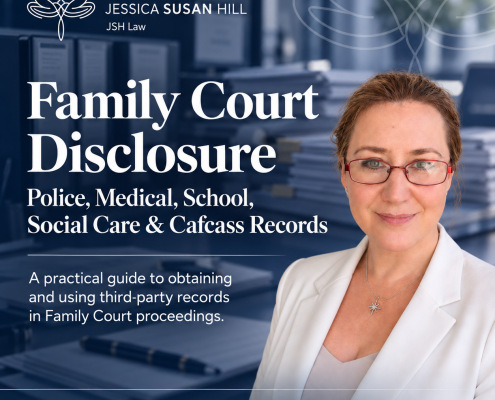 © 2026 JSH Law Ltd / Jessica Susan Hill
https://jshlaw.co.uk/wp-content/uploads/2026/10/Family-Court-Disclosure-Guide.png
1254
1254
Jessica Susan Hill
https://jshlaw.co.uk/wp-content/uploads/2026/01/jsh-law-logo-new-black-300x67.png
Jessica Susan Hill2026-10-09 21:37:402026-10-12 13:25:48Your Family Court Case Needs a System: CRM, AI and Evidence for Litigants in Person
 https://jshlaw.co.uk/wp-content/uploads/2026/10/let-down-by-a-mckenzie-friend-what-mazur-baxter-and-wright-v-troy-lucas-mean-for.jpg
1024
1536
Jessica Susan Hill
https://jshlaw.co.uk/wp-content/uploads/2026/01/jsh-law-logo-new-black-300x67.png
Jessica Susan Hill2026-10-09 21:30:002026-10-22 14:10:58Let Down by a McKenzie Friend? What Mazur, Baxter and Wright v Troy Lucas Mean for Your Case
 https://jshlaw.co.uk/wp-content/uploads/2026/10/direct-access-barristers-facebook-groups-and-legal-tech-how-litigants-in-person.jpg
1024
1536
Jessica Susan Hill
https://jshlaw.co.uk/wp-content/uploads/2026/01/jsh-law-logo-new-black-300x67.png
Jessica Susan Hill2026-10-09 21:26:442026-10-19 15:21:43Direct Access Barristers, Facebook Groups and Legal Tech: How Litigants in Person Are Trying to Survive Family Court
 https://jshlaw.co.uk/wp-content/uploads/2026/10/jsh-law-cafcass-letter-wrong-2026.jpg
1080
1920
Jessica Susan Hill
https://jshlaw.co.uk/wp-content/uploads/2026/01/jsh-law-logo-new-black-300x67.png
Jessica Susan Hill2026-10-09 21:17:202026-10-26 12:33:20Cafcass Safeguarding Letter Wrong? How to Challenge Errors Before Your First Hearing (2026)
 © 2026 JSH Law Ltd. All rights reserved.
https://jshlaw.co.uk/wp-content/uploads/2026/02/ChatGPT-Image-Feb-3-2026-03_26_42-AM.png
1024
1536
Jessica Susan Hill
https://jshlaw.co.uk/wp-content/uploads/2026/01/jsh-law-logo-new-black-300x67.png
Jessica Susan Hill2026-10-05 09:38:572026-10-12 13:03:46AI Slop, Costs and Litigants in Person: Should Courts Sanction Bad AI Use?© 2026 JSH Law Ltd. All rights reserved.
https://jshlaw.co.uk/wp-content/uploads/2026/02/ChatGPT-Image-Feb-3-2026-03_26_42-AM.png
1024
1536
Jessica Susan Hill
https://jshlaw.co.uk/wp-content/uploads/2026/01/jsh-law-logo-new-black-300x67.png
Jessica Susan Hill2026-10-05 09:19:012026-10-12 11:26:06Behaviour Is Not Need: Why Family Lawyers Need Cross-Disciplinary Literacy© 2026 JSH Law Ltd. All rights reserved.
https://jshlaw.co.uk/wp-content/uploads/2026/02/ChatGPT-Image-Feb-3-2026-03_26_42-AM.png
1024
1536
Jessica Susan Hill
https://jshlaw.co.uk/wp-content/uploads/2026/01/jsh-law-logo-new-black-300x67.png
Jessica Susan Hill2026-10-05 09:12:112026-10-12 11:26:11Seeing the Pattern: What the Major Coercive-Control Frameworks Can — and Cannot — Tell the Family Court