
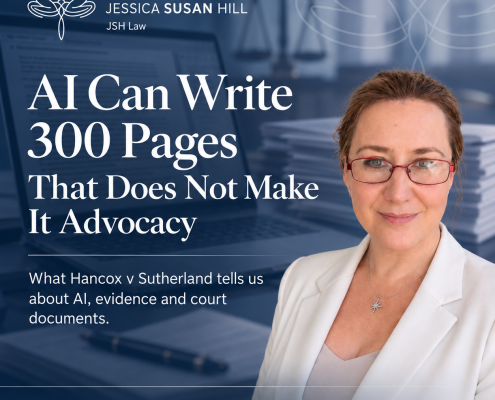
 © 2026 JSH Law Ltd. AI-assisted original artwork created for JSH Law using supplied JSH Law branding and portrait photography. All rights reserved.
https://jshlaw.co.uk/wp-content/uploads/2026/10/AI-and-Evidence-in-Court.png
1254
1254
Jessica Susan Hill
https://jshlaw.co.uk/wp-content/uploads/2026/01/jsh-law-logo-new-black-300x67.png
Jessica Susan Hill2026-10-09 21:34:432026-10-12 13:00:57Legal AI Is Rebuilding the Legal Services Market — But Who Will It Serve?
 © 2026 JSH Law Ltd. All rights reserved.
https://jshlaw.co.uk/wp-content/uploads/2026/06/ChatGPT-Image-Jun-3-2026-07_54_56-PM.png
1055
1491
Jessica Susan Hill
https://jshlaw.co.uk/wp-content/uploads/2026/01/jsh-law-logo-new-black-300x67.png
Jessica Susan Hill2026-10-09 21:32:472026-10-12 13:01:00AI in Justice Must Be People-Centred — Not Just Another Tool to Process Vulnerable People Faster
 © 2026 JSH Law Ltd. All rights reserved.
https://jshlaw.co.uk/wp-content/uploads/2026/02/ChatGPT-Image-Feb-3-2026-03_26_42-AM.png
1024
1536
Jessica Susan Hill
https://jshlaw.co.uk/wp-content/uploads/2026/01/jsh-law-logo-new-black-300x67.png
Jessica Susan Hill2026-10-08 10:43:552026-10-15 15:36:49A Human in the Loop Is Not Enough: “Humanwashing”, AI and the Future of Judicial Decision-Making© 2026 JSH Law Ltd. All rights reserved.
https://jshlaw.co.uk/wp-content/uploads/2026/02/ChatGPT-Image-Feb-3-2026-03_26_42-AM.png
1024
1536
Jessica Susan Hill
https://jshlaw.co.uk/wp-content/uploads/2026/01/jsh-law-logo-new-black-300x67.png
Jessica Susan Hill2026-10-06 12:15:482026-10-21 11:24:27AI May Democratise Legal Drafting. Can the Courts Survive the Volume?© 2026 JSH Law Ltd. All rights reserved.
https://jshlaw.co.uk/wp-content/uploads/2026/02/ChatGPT-Image-Feb-3-2026-03_26_42-AM.png
1024
1536
Jessica Susan Hill
https://jshlaw.co.uk/wp-content/uploads/2026/01/jsh-law-logo-new-black-300x67.png
Jessica Susan Hill2026-10-06 12:12:212026-10-21 11:24:33When AI Stops Answering and Starts Acting: Agentic AI, Legal Responsibility and the Next Professional Risk© 2026 JSH Law Ltd. All rights reserved.
https://jshlaw.co.uk/wp-content/uploads/2026/02/ChatGPT-Image-Feb-3-2026-03_26_42-AM.png
1024
1536
Jessica Susan Hill
https://jshlaw.co.uk/wp-content/uploads/2026/01/jsh-law-logo-new-black-300x67.png
Jessica Susan Hill2026-10-06 12:08:392026-10-12 13:03:58If AI Does the Junior Work, Who Trains the Lawyers of 2035?© 2026 JSH Law Ltd. All rights reserved.
https://jshlaw.co.uk/wp-content/uploads/2026/02/ChatGPT-Image-Feb-3-2026-03_26_42-AM.png
1024
1536
Jessica Susan Hill
https://jshlaw.co.uk/wp-content/uploads/2026/01/jsh-law-logo-new-black-300x67.png
Jessica Susan Hill2026-10-05 09:26:512026-10-12 11:26:02Should AI Become a Legal Person? Imogen Rivers, Robot Rights and the Responsibility Gap© 2026 JSH Law Ltd. All rights reserved.
https://jshlaw.co.uk/wp-content/uploads/2026/02/ChatGPT-Image-Feb-3-2026-03_26_42-AM.png
1024
1536
Jessica Susan Hill
https://jshlaw.co.uk/wp-content/uploads/2026/01/jsh-law-logo-new-black-300x67.png
Jessica Susan Hill2026-10-05 09:08:092026-10-12 11:26:15Can AI Feel Pain? What the “Pain Axis” Study Really Means for Human Safety and Legal AI© 2026 JSH Law Ltd. AI-assisted original artwork created for JSH Law using supplied JSH Law branding and portrait photography. All rights reserved.
https://jshlaw.co.uk/wp-content/uploads/2026/10/AI-and-Evidence-in-Court.png
1254
1254
Jessica Susan Hill
https://jshlaw.co.uk/wp-content/uploads/2026/01/jsh-law-logo-new-black-300x67.png
Jessica Susan Hill2026-10-02 09:52:132026-10-12 11:23:19AI Can Write 300 Pages. That Does Not Make It Advocacy.© 2026 JSH Law Ltd. All rights reserved.
https://jshlaw.co.uk/wp-content/uploads/2026/02/ChatGPT-Image-Feb-3-2026-03_26_42-AM.png
1024
1536
Jessica Susan Hill
https://jshlaw.co.uk/wp-content/uploads/2026/01/jsh-law-logo-new-black-300x67.png
Jessica Susan Hill2026-09-29 08:53:372026-10-15 15:36:35AI Evidence in the Family Court: Deepfakes, Screenshots & Digital Evidence