
Posts
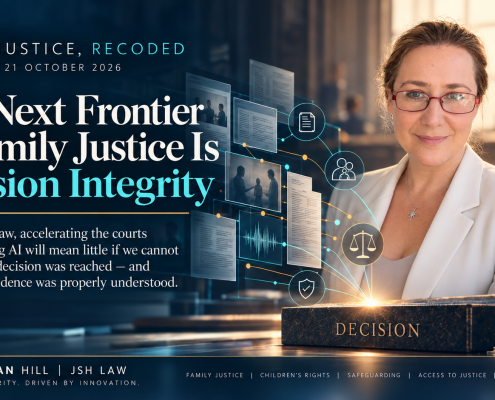 https://jshlaw.co.uk/wp-content/uploads/2026/10/family-justice-recoded-edition-10-decision-integrity.png
941
1672
Jessica Susan Hill
https://jshlaw.co.uk/wp-content/uploads/2026/01/jsh-law-logo-new-black-300x67.png
Jessica Susan Hill2026-10-21 16:09:352026-10-21 16:15:36The Next Frontier in Family Justice Is Decision Integrity
 https://jshlaw.co.uk/wp-content/uploads/2026/10/person-working-at-a-desk-with-a-laptop-displaying-a-document-workflow.png
941
1672
Jessica Susan Hill
https://jshlaw.co.uk/wp-content/uploads/2026/01/jsh-law-logo-new-black-300x67.png
Jessica Susan Hill2026-10-17 08:08:432026-10-23 15:32:58Microsoft Copilot for Legal: Who Controls the Future of Legal AI?
 https://jshlaw.co.uk/wp-content/uploads/2026/10/woman-reviewing-a-laptop-displaying-a-document-workflow-and-checklist-at-a.png
941
1672
Jessica Susan Hill
https://jshlaw.co.uk/wp-content/uploads/2026/01/jsh-law-logo-new-black-300x67.png
Jessica Susan Hill2026-10-15 12:55:452026-10-15 15:36:53AI Liability in UK Legal Practice: SRA Duties, Court Evidence and Data Protection
 © 2026 JSH Law Ltd. All rights reserved.
https://jshlaw.co.uk/wp-content/uploads/2026/02/ChatGPT-Image-Feb-3-2026-03_26_42-AM.png
1024
1536
Jessica Susan Hill
https://jshlaw.co.uk/wp-content/uploads/2026/01/jsh-law-logo-new-black-300x67.png
Jessica Susan Hill2026-10-08 10:43:552026-10-15 15:36:49A Human in the Loop Is Not Enough: “Humanwashing”, AI and the Future of Judicial Decision-Making© 2026 JSH Law Ltd. All rights reserved.
https://jshlaw.co.uk/wp-content/uploads/2026/02/ChatGPT-Image-Feb-3-2026-03_26_42-AM.png
1024
1536
Jessica Susan Hill
https://jshlaw.co.uk/wp-content/uploads/2026/01/jsh-law-logo-new-black-300x67.png
Jessica Susan Hill2026-10-08 10:40:062026-10-15 15:36:44Can AI Prove Coercive Control? No — But It Can Help the Court See the Pattern© 2026 JSH Law Ltd. All rights reserved.
https://jshlaw.co.uk/wp-content/uploads/2026/02/ChatGPT-Image-Feb-3-2026-03_26_42-AM.png
1024
1536
Jessica Susan Hill
https://jshlaw.co.uk/wp-content/uploads/2026/01/jsh-law-logo-new-black-300x67.png
Jessica Susan Hill2026-10-06 12:15:482026-10-21 11:24:27AI May Democratise Legal Drafting. Can the Courts Survive the Volume?© 2026 JSH Law Ltd. All rights reserved.
https://jshlaw.co.uk/wp-content/uploads/2026/02/ChatGPT-Image-Feb-3-2026-03_26_42-AM.png
1024
1536
Jessica Susan Hill
https://jshlaw.co.uk/wp-content/uploads/2026/01/jsh-law-logo-new-black-300x67.png
Jessica Susan Hill2026-10-06 12:08:392026-10-12 13:03:58If AI Does the Junior Work, Who Trains the Lawyers of 2035?© 2026 JSH Law Ltd. All rights reserved.
https://jshlaw.co.uk/wp-content/uploads/2026/02/ChatGPT-Image-Feb-3-2026-03_26_42-AM.png
1024
1536
Jessica Susan Hill
https://jshlaw.co.uk/wp-content/uploads/2026/01/jsh-law-logo-new-black-300x67.png
Jessica Susan Hill2026-10-05 09:38:572026-10-12 13:03:46AI Slop, Costs and Litigants in Person: Should Courts Sanction Bad AI Use?© 2026 JSH Law Ltd. All rights reserved.
https://jshlaw.co.uk/wp-content/uploads/2026/02/ChatGPT-Image-Feb-3-2026-03_26_42-AM.png
1024
1536
Jessica Susan Hill
https://jshlaw.co.uk/wp-content/uploads/2026/01/jsh-law-logo-new-black-300x67.png
Jessica Susan Hill2026-10-05 09:26:512026-10-12 11:26:02Should AI Become a Legal Person? Imogen Rivers, Robot Rights and the Responsibility Gap© 2026 JSH Law Ltd. All rights reserved.
https://jshlaw.co.uk/wp-content/uploads/2026/02/ChatGPT-Image-Feb-3-2026-03_26_42-AM.png
1024
1536
Jessica Susan Hill
https://jshlaw.co.uk/wp-content/uploads/2026/01/jsh-law-logo-new-black-300x67.png
Jessica Susan Hill2026-10-05 09:23:502026-10-10 13:06:15AI Can State Facts. Can It Tell the Truth? Why the Difference Matters in Law