
Posts
 https://jshlaw.co.uk/wp-content/uploads/2026/10/two-adults-review-documents-together-at-a-table-beside-an-open-laptop.png
1024
1536
Jessica Susan Hill
https://jshlaw.co.uk/wp-content/uploads/2026/01/jsh-law-logo-new-black-300x67.png
Jessica Susan Hill2026-10-20 14:12:382026-10-20 14:12:42How to Navigate Family Court Without Losing Yourself
 https://jshlaw.co.uk/wp-content/uploads/2026/10/woman-reviewing-messages-on-a-smartphone-and-laptop-at-a-desk-with.png
941
1672
Jessica Susan Hill
https://jshlaw.co.uk/wp-content/uploads/2026/01/jsh-law-logo-new-black-300x67.png
Jessica Susan Hill2026-10-13 10:13:322026-10-13 10:13:36Can You Use WhatsApp Messages as Evidence in Family Court? The 2026 Rules Explained
 © 2026 JSH Law Ltd / Jessica Susan Hill
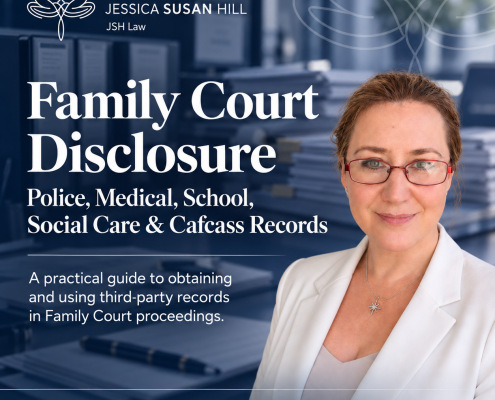
https://jshlaw.co.uk/wp-content/uploads/2026/10/Family-Court-Disclosure-Guide.png
1254
1254
Jessica Susan Hill
https://jshlaw.co.uk/wp-content/uploads/2026/01/jsh-law-logo-new-black-300x67.png
Jessica Susan Hill2026-10-09 21:37:402026-10-12 13:25:48Your Family Court Case Needs a System: CRM, AI and Evidence for Litigants in Person
 © 2026 JSH Law Ltd. All rights reserved.
https://jshlaw.co.uk/wp-content/uploads/2026/02/ChatGPT-Image-Feb-3-2026-03_26_42-AM.png
1024
1536
Jessica Susan Hill
https://jshlaw.co.uk/wp-content/uploads/2026/01/jsh-law-logo-new-black-300x67.png
Jessica Susan Hill2026-09-29 08:53:372026-10-15 15:36:35AI Evidence in the Family Court: Deepfakes, Screenshots & Digital Evidence© 2026 JSH Law Ltd. All rights reserved.
https://jshlaw.co.uk/wp-content/uploads/2026/02/ChatGPT-Image-Feb-3-2026-03_26_42-AM.png
1024
1536
Jessica Susan Hill
https://jshlaw.co.uk/wp-content/uploads/2026/01/jsh-law-logo-new-black-300x67.png
Jessica Susan Hill2026-09-15 14:28:382026-10-12 11:28:51AI Agents in Family Court: How Much Control Are You Giving Them?© 2026 JSH Law Ltd. All rights reserved.
https://jshlaw.co.uk/wp-content/uploads/2026/02/ChatGPT-Image-Feb-3-2026-03_26_42-AM.png
1024
1536
Jessica Susan Hill
https://jshlaw.co.uk/wp-content/uploads/2026/01/jsh-law-logo-new-black-300x67.png
Jessica Susan Hill2026-09-15 13:27:132026-10-12 11:28:56AI Agents & Family Court: A Guide for Litigants in Person© 2026 JSH Law Ltd. All rights reserved.
https://jshlaw.co.uk/wp-content/uploads/2026/02/ChatGPT-Image-Feb-3-2026-03_26_42-AM.png
1024
1536
Jessica Susan Hill
https://jshlaw.co.uk/wp-content/uploads/2026/01/jsh-law-logo-new-black-300x67.png
Jessica Susan Hill2026-09-03 11:55:332026-10-12 11:27:39Justice System “National Emergency”: What the Crisis Means for Domestic Abuse Survivors and Family Court Users© 2026 JSH Law Ltd. All rights reserved.
https://jshlaw.co.uk/wp-content/uploads/2026/02/ChatGPT-Image-Feb-3-2026-03_26_42-AM.png
1024
1536
Jessica Susan Hill
https://jshlaw.co.uk/wp-content/uploads/2026/01/jsh-law-logo-new-black-300x67.png
Jessica Susan Hill2026-05-09 10:13:332026-10-10 14:42:02Preparing Your Case Like a Barrister: A Practical Guide for Litigants in Person
 jsh law ltd
https://jshlaw.co.uk/wp-content/uploads/2026/01/ChatGPT-Image-Jan-14-2026-04_05_31-PM.png
1024
1536
Jessica Susan Hill
https://jshlaw.co.uk/wp-content/uploads/2026/01/jsh-law-logo-new-black-300x67.png
Jessica Susan Hill2026-01-14 16:08:302026-02-03 03:41:39Support for Litigants in Person in the Family Court – What the system expects — and where parents are most often let down.