
Posts
 https://jshlaw.co.uk/wp-content/uploads/2026/10/create-a-serious-contemporary-editorial-photograph-for-an-england-and.png
941
1672
Jessica Susan Hill
https://jshlaw.co.uk/wp-content/uploads/2026/01/jsh-law-logo-new-black-300x67.png
Jessica Susan Hill2026-10-12 18:41:402026-10-12 18:41:44Missed a Family Court Deadline? How to File Late Evidence, Request More Time and Protect Your Case
 https://jshlaw.co.uk/wp-content/uploads/2026/10/jsh-law-cafcass-letter-wrong-2026.jpg
1080
1920
Jessica Susan Hill
https://jshlaw.co.uk/wp-content/uploads/2026/01/jsh-law-logo-new-black-300x67.png
Jessica Susan Hill2026-10-09 21:17:202026-10-26 12:33:20Cafcass Safeguarding Letter Wrong? How to Challenge Errors Before Your First Hearing (2026)
 https://jshlaw.co.uk/wp-content/uploads/2026/07/jsh-law-position-statement-crop-safe-2026.jpg
1080
1920
Jessica Susan Hill
https://jshlaw.co.uk/wp-content/uploads/2026/01/jsh-law-logo-new-black-300x67.png
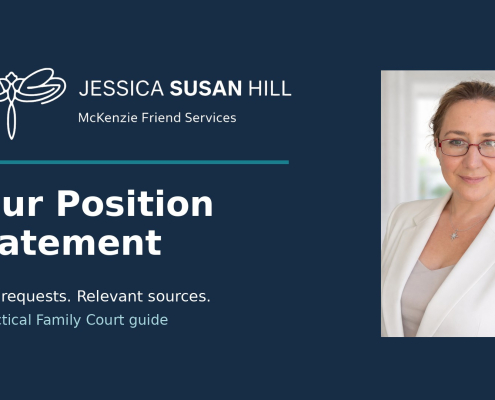
Jessica Susan Hill2026-07-19 20:04:062026-10-25 12:09:36How to Write a Position Statement for Family Court: A Practical Guide for Litigants in Person
 © 2026 JSH Law Ltd. All rights reserved.
https://jshlaw.co.uk/wp-content/uploads/2026/02/ChatGPT-Image-Feb-3-2026-03_26_42-AM.png
1024
1536
Jessica Susan Hill
https://jshlaw.co.uk/wp-content/uploads/2026/01/jsh-law-logo-new-black-300x67.png
Jessica Susan Hill2026-06-03 19:25:432026-10-12 11:57:16Family Court Papers Arrived? Don’t Panic — Here’s How to Get Organised Fast
Portfolio Items
 © 2026 JSH Law Ltd. All rights reserved.
https://jshlaw.co.uk/wp-content/uploads/2026/01/statement-preparation-and-structure.png
1024
1536
Jessica Susan Hill
https://jshlaw.co.uk/wp-content/uploads/2026/01/jsh-law-logo-new-black-300x67.png
Jessica Susan Hill2026-01-21 17:04:152026-09-24 12:42:1227. Statement preparation and structure
 https://jshlaw.co.uk/wp-content/uploads/2011/12/uk-supreme-court.webp
807
1232
Jessica Susan Hill
https://jshlaw.co.uk/wp-content/uploads/2026/01/jsh-law-logo-new-black-300x67.png
Jessica Susan Hill2026-01-21 17:04:042026-09-25 07:26:1029. Position statements
 https://jshlaw.co.uk/wp-content/uploads/2026/10/woman-reviewing-a-laptop-displaying-a-document-workflow-and-checklist-at-a.png
941
1672
Jessica Susan Hill
https://jshlaw.co.uk/wp-content/uploads/2026/01/jsh-law-logo-new-black-300x67.png
Jessica Susan Hill2026-01-21 17:02:152026-10-19 14:58:1434. Identifying relevance and proportionality