
Posts
 © 2026 JSH Law Ltd. All rights reserved.
https://jshlaw.co.uk/wp-content/uploads/2026/07/ChatGPT-Image-Jul-27-2026-11_30_44-PM.png
908
1733
Jessica Susan Hill
https://jshlaw.co.uk/wp-content/uploads/2026/01/jsh-law-logo-new-black-300x67.png
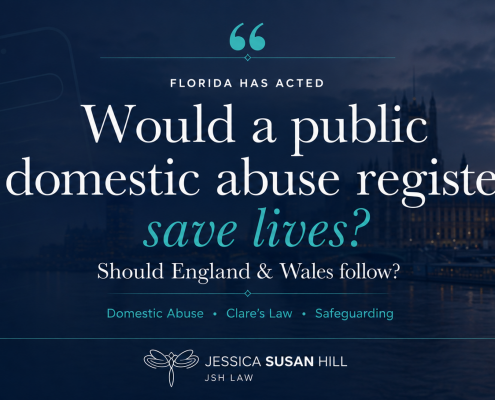
Jessica Susan Hill2026-11-06 14:52:282026-11-06 14:52:28Zoe Dronfield’s Call for a Public Register: Why Serial Domestic Abusers and Stalkers Must Not Remain Invisible
 https://jshlaw.co.uk/wp-content/uploads/2026/10/two-people-review-documents-and-a-timetable-at-a-table-with-folders.png
1024
1536
Jessica Susan Hill
https://jshlaw.co.uk/wp-content/uploads/2026/01/jsh-law-logo-new-black-300x67.png
Jessica Susan Hill2026-10-28 20:51:342026-10-28 20:51:34£15m to Tackle Misogyny: Why Economic Abuse Matters in Family Court
https://jshlaw.co.uk/wp-content/uploads/2026/10/two-people-review-documents-and-a-timetable-at-a-table-with-folders.png
1024
1536
Jessica Susan Hill
https://jshlaw.co.uk/wp-content/uploads/2026/01/jsh-law-logo-new-black-300x67.png
Jessica Susan Hill2026-10-23 14:53:172026-10-23 14:53:17When the Family Court Process Becomes Part of the Harm: Domestic Abuse, Solicitors’ Letters and Litigation Pressure
 https://jshlaw.co.uk/wp-content/uploads/2026/10/woman-reviewing-messages-on-a-smartphone-and-laptop-at-a-desk-with.png
941
1672
Jessica Susan Hill
https://jshlaw.co.uk/wp-content/uploads/2026/01/jsh-law-logo-new-black-300x67.png
Jessica Susan Hill2026-10-21 11:15:532026-10-21 11:17:19JADEing and Coercive Control: When You Are Forced to Explain Yourself, Even After Separation
 https://jshlaw.co.uk/wp-content/uploads/2026/10/person-looking-out-of-a-window-while-a-headset-wearing-colleague-works-at.png
1024
1536
Jessica Susan Hill
https://jshlaw.co.uk/wp-content/uploads/2026/01/jsh-law-logo-new-black-300x67.png
Jessica Susan Hill2026-10-09 21:31:052026-10-12 20:12:56GPS Tagging for Domestic Abuse: Can Proximity Alerts Protect Survivors in the UK?
 © 2026 JSH Law Ltd. All rights reserved.
https://jshlaw.co.uk/wp-content/uploads/2026/02/ChatGPT-Image-Feb-3-2026-03_26_42-AM.png
1024
1536
Jessica Susan Hill
https://jshlaw.co.uk/wp-content/uploads/2026/01/jsh-law-logo-new-black-300x67.png
Jessica Susan Hill2026-10-08 10:48:402026-10-12 14:35:45When “Fairness” Becomes a Weapon: What Dr Emma Katz’s New Work Teaches Us About Coercive Control© 2026 JSH Law Ltd. All rights reserved.
https://jshlaw.co.uk/wp-content/uploads/2026/02/ChatGPT-Image-Feb-3-2026-03_26_42-AM.png
1024
1536
Jessica Susan Hill
https://jshlaw.co.uk/wp-content/uploads/2026/01/jsh-law-logo-new-black-300x67.png
Jessica Susan Hill2026-09-30 20:36:202026-10-12 11:27:07Domestic Abuse in the Family Court: What the IDAS Family Court Report 2026 Reveals Five Years After the Harm Panel© 2026 JSH Law Ltd. All rights reserved.
https://jshlaw.co.uk/wp-content/uploads/2026/02/ChatGPT-Image-Feb-3-2026-03_26_42-AM.png
1024
1536
Jessica Susan Hill
https://jshlaw.co.uk/wp-content/uploads/2026/01/jsh-law-logo-new-black-300x67.png
Jessica Susan Hill2026-09-17 18:34:432026-10-12 11:27:30Clare’s Law: Does Domestic Abuse Disclosure Keep Women Safe? | JSH Law© 2026 JSH Law Ltd. All rights reserved.
https://jshlaw.co.uk/wp-content/uploads/2026/02/ChatGPT-Image-Feb-3-2026-03_26_42-AM.png
1024
1536
Jessica Susan Hill
https://jshlaw.co.uk/wp-content/uploads/2026/01/jsh-law-logo-new-black-300x67.png
Jessica Susan Hill2026-09-12 16:09:112026-10-12 14:28:50When a Child Says “No Contact”© 2026 JSH Law Ltd. All rights reserved.
https://jshlaw.co.uk/wp-content/uploads/2026/02/ChatGPT-Image-Feb-3-2026-03_26_42-AM.png
1024
1536
Jessica Susan Hill
https://jshlaw.co.uk/wp-content/uploads/2026/01/jsh-law-logo-new-black-300x67.png
Jessica Susan Hill2026-09-03 13:10:482026-10-10 13:08:43Your Nervous System Is Not Separate From Your Family Court Case