
Posts
 © 2026 JSH Law Ltd. All rights reserved.
https://jshlaw.co.uk/wp-content/uploads/2026/01/11-safeguarding-allegations-and-responses-watermarked.png
1024
1536
Jessica Susan Hill
https://jshlaw.co.uk/wp-content/uploads/2026/01/jsh-law-logo-new-black-300x67.png
Jessica Susan Hill2026-10-09 21:35:422026-10-12 13:25:52Supporting Male Victims Does Not Require Us to Disbelieve Women
 https://jshlaw.co.uk/wp-content/uploads/2026/10/person-looking-out-of-a-window-while-a-headset-wearing-colleague-works-at.png
1024
1536
Jessica Susan Hill
https://jshlaw.co.uk/wp-content/uploads/2026/01/jsh-law-logo-new-black-300x67.png
Jessica Susan Hill2026-10-09 21:31:052026-10-12 20:12:56GPS Tagging for Domestic Abuse: Can Proximity Alerts Protect Survivors in the UK?
 https://jshlaw.co.uk/wp-content/uploads/2026/10/what-did-the-child-see-domestic-abuse-fear-and-the-misuse-of-parental-alienation.jpg
1024
1536
Jessica Susan Hill
https://jshlaw.co.uk/wp-content/uploads/2026/01/jsh-law-logo-new-black-300x67.png
Jessica Susan Hill2026-10-09 21:28:502026-10-12 13:01:11What Did the Child See? Domestic Abuse, Fear and the Misuse of Parental Alienation in Family Court
 https://jshlaw.co.uk/wp-content/uploads/2026/10/form-c1a-explained-2026-domestic-abuse-allegations-and-family-court-featured.jpg
1024
1536
Jessica Susan Hill
https://jshlaw.co.uk/wp-content/uploads/2026/01/jsh-law-logo-new-black-300x67.png
Jessica Susan Hill2026-10-09 21:11:562026-10-12 13:01:07Form C1A Explained (2026): Domestic Abuse Allegations and Family Court
 © 2026 JSH Law Ltd. All rights reserved.
https://jshlaw.co.uk/wp-content/uploads/2026/02/ChatGPT-Image-Feb-3-2026-03_26_42-AM.png
1024
1536
Jessica Susan Hill
https://jshlaw.co.uk/wp-content/uploads/2026/01/jsh-law-logo-new-black-300x67.png
Jessica Susan Hill2026-10-08 14:28:552026-10-12 13:20:09When the Towels Are “Wrong”: What Biderman’s Chart of Coercion Can Teach the Family Court© 2026 JSH Law Ltd. All rights reserved.
https://jshlaw.co.uk/wp-content/uploads/2026/02/ChatGPT-Image-Feb-3-2026-03_26_42-AM.png
1024
1536
Jessica Susan Hill
https://jshlaw.co.uk/wp-content/uploads/2026/01/jsh-law-logo-new-black-300x67.png
Jessica Susan Hill2026-10-08 10:48:402026-10-12 14:35:45When “Fairness” Becomes a Weapon: What Dr Emma Katz’s New Work Teaches Us About Coercive Control© 2026 JSH Law Ltd. All rights reserved.
https://jshlaw.co.uk/wp-content/uploads/2026/02/ChatGPT-Image-Feb-3-2026-03_26_42-AM.png
1024
1536
Jessica Susan Hill
https://jshlaw.co.uk/wp-content/uploads/2026/01/jsh-law-logo-new-black-300x67.png
Jessica Susan Hill2026-10-08 10:40:062026-10-15 15:36:44Can AI Prove Coercive Control? No — But It Can Help the Court See the Pattern© 2026 JSH Law Ltd. All rights reserved.
https://jshlaw.co.uk/wp-content/uploads/2026/02/ChatGPT-Image-Feb-3-2026-03_26_42-AM.png
1024
1536
Jessica Susan Hill
https://jshlaw.co.uk/wp-content/uploads/2026/01/jsh-law-logo-new-black-300x67.png
Jessica Susan Hill2026-10-08 10:31:412026-10-12 13:20:25Domestic Abuse Will No Longer Disappear Behind the Offence: What the New Court Flag Really Changes© 2026 JSH Law Ltd. All rights reserved.
https://jshlaw.co.uk/wp-content/uploads/2026/02/ChatGPT-Image-Feb-3-2026-03_26_42-AM.png
1024
1536
Jessica Susan Hill
https://jshlaw.co.uk/wp-content/uploads/2026/01/jsh-law-logo-new-black-300x67.png
Jessica Susan Hill2026-10-07 19:22:142026-10-12 13:03:09How to Keep Your Address Confidential in Family Court: C8, Evidence and the Mistake That Can Reveal Your Location
 © 2026 Jessica Susan Hill / JSH Law. All rights reserved.
https://jshlaw.co.uk/wp-content/uploads/2026/10/When-Domestic-Abuse-Becomes-Normal.png
1254
1254
Jessica Susan Hill
https://jshlaw.co.uk/wp-content/uploads/2026/01/jsh-law-logo-new-black-300x67.png
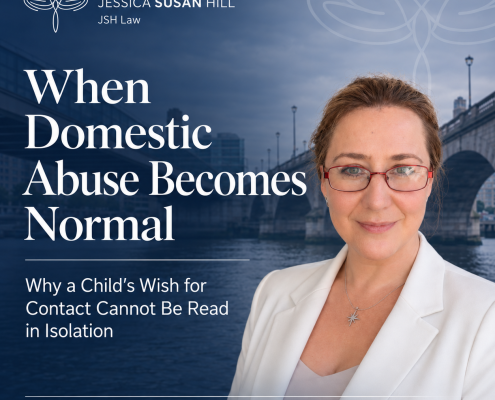
Jessica Susan Hill2026-10-06 08:27:552026-10-12 13:03:53When Domestic Abuse Becomes Normal: Why a Child’s Wish for Contact Cannot Be Read in Isolation