
 © 2026 JSH Law Ltd. All rights reserved.
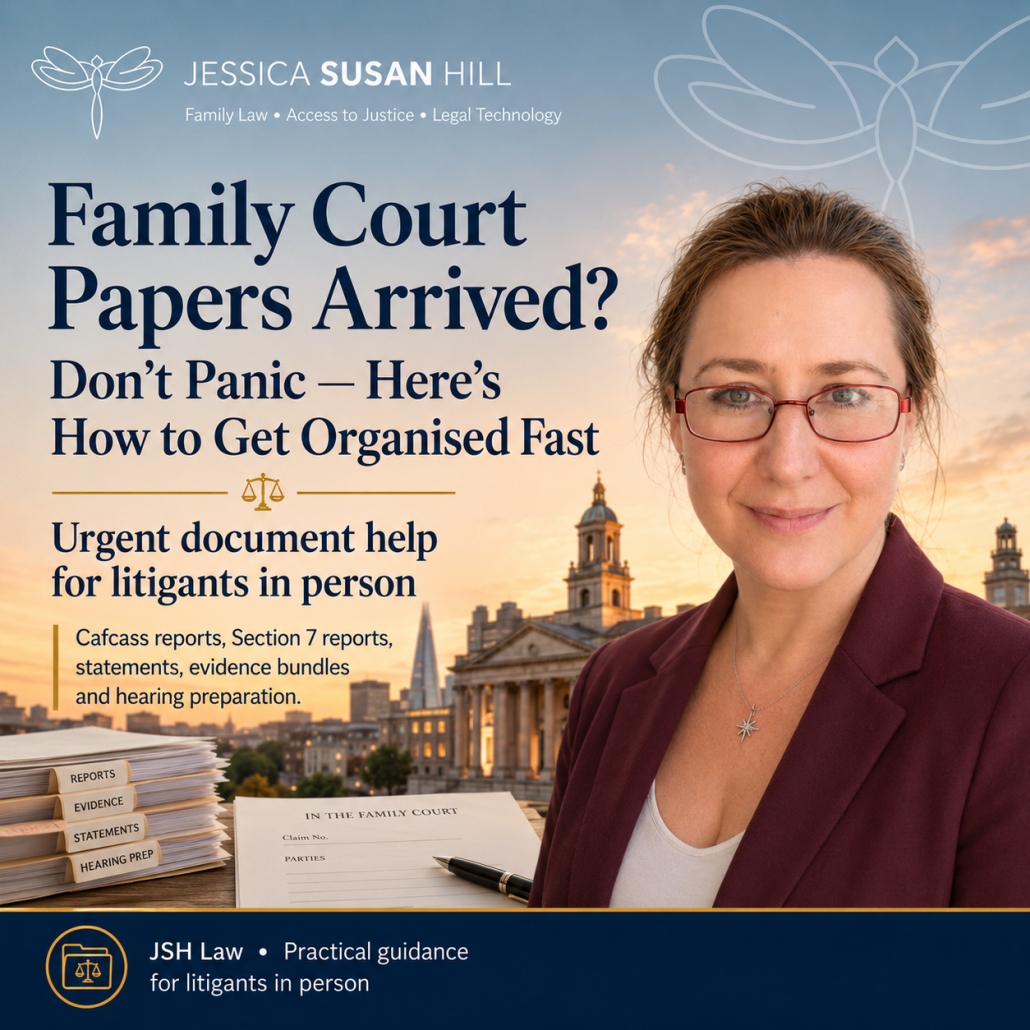
Family Court Papers Arrived? Don’t Panic — Here’s How to Get Organised Fast
When family court papers arrive, panic can set in fast. One moment you are trying to manage ordinary life; the next, you are staring at a C100, C1A, Cafcass letter, Section 7 report, hearing notice or order telling you to file a statement by a deadline you barely understand. If you are representing yourself, the system can feel brutal: pages of allegations, legal language, screenshots, reports, dates, evidence and directions — all landing on you at once. This article is for the moment when the paperwork feels bigger than you. It explains how to slow the panic, find the most important documents, organise the evidence and start preparing for court with a clear plan.
Start Here · Family Court Papers · Litigants in Person
Just Received Family Court Papers? What to Do Next
If a C100, C1A, hearing notice, court order, Cafcass letter or direction to file a statement has just landed in your inbox or through your door, you may feel as though you are expected to understand the Family Court overnight.
You do not need to answer everything at once. Your first job is to work out what the documents are, what the court is asking you to do, what deadlines matter, and what needs preparing next.
If this has just happened to you
You have received court papers and cannot afford a solicitor for the whole case.
You can represent yourself in the Family Court. You can also obtain focused help with particular documents, evidence or hearings without paying for full legal representation from beginning to end.
JSH Law provides practical, non-reserved litigation support for litigants in person: helping you understand the papers, identify deadlines, organise evidence, prepare documents and get ready for the next hearing.
If you have just received Family Court papers, do these five things first
Find the deadline
Look for a hearing date, filing date, response date or direction telling you when something must be done.
Identify the documents
Is it an application, court order, hearing notice, Cafcass document, statement or request for evidence?
Read the latest order
If an order has already been made, read it before trying to respond to everything else.
Preserve the evidence
Save messages, emails, documents and screenshots. Do not start filing hundreds of pages simply because you have them.
Work out the next task
The immediate task may be preparing for the first hearing, responding to allegations, filing a statement or simply understanding what happens next.
When people are frightened, they often respond by writing everything they have ever wanted the court to know. That usually creates more work. Start with the document in front of you and the next deadline.
First identify the paperwork
What Family Court papers have you received?
Different documents mean different things. Do not assume every document requires the same response.
C100 application
Usually an application asking the Family Court to make or change an order concerning a child, such as a child arrangements, prohibited steps or specific issue order.
C1A allegations of harm
This may contain allegations concerning domestic abuse, harm or risk to a child. Read each allegation carefully and avoid responding in anger.
Your response usually needs to distinguish what you admit, what you deny, what requires context and what evidence may be relevant.
Hearing notice
This tells you when and where the hearing will take place and may identify the type of hearing.
Put the hearing date in your calendar immediately and check whether any documents must be filed beforehand.
Court order
The order records what the court has decided or directed. Read every numbered paragraph and identify anything you personally have been ordered to do.
Cafcass safeguarding letter
Cafcass may carry out safeguarding checks and speak with the parties before providing initial advice to the court.
Direction to file a statement
The order should tell you what document is required and when it must be filed. Read the wording carefully before drafting.
Section 7 or Child Impact Report
A professional report may contain factual material, analysis and recommendations. Do not respond simply by saying that the report is wrong.
Identify specific factual errors, omissions, unsupported assumptions, safeguarding gaps and recommendations with which you agree or disagree.
Something else
Family proceedings generate many different forms, notices and directions. If you do not understand what a document requires, find that out before trying to answer it.
Is this the start of a private children case?
In many private-law children cases, once an application has been issued the case will move towards a first hearing, often called a First Hearing Dispute Resolution Appointment (FHDRA).
Cafcass will usually undertake initial safeguarding work and provide information and advice to the court. What happens after the first hearing depends on the issues, safeguarding concerns, evidence and whether any agreement can safely be reached.
Access to justice
What if you cannot afford a solicitor?
This is the position many litigants in person find themselves in.
You are allowed to represent yourself in court without a solicitor or barrister. That does not mean you are expected to know everything a family lawyer knows. It means you remain responsible for your own case and can obtain different forms of help around that.
You do not necessarily have to choose between “pay a solicitor for the whole case” and “get no help at all”.
Focused litigation support can be used for a particular problem: understanding papers, organising evidence, preparing a chronology, reviewing a Cafcass report, working on a statement or position statement, or preparing for a hearing.
Check legal aid before assuming you cannot get representation
Depending on your finances and the circumstances of the case, legal aid may be available. This is particularly important to check where there has been domestic abuse or child safeguarding concerns.
GOV.UK: legal aid and domestic abuse →
Check whether you can get Help with Fees
If you need to make an application that attracts a court fee and you have a low income or receive certain benefits, you may be eligible for the HMCTS Help with Fees scheme.
Free support also exists
Depending on what you need, you may also be able to obtain free information or practical support from:
- Support Through Court;
- Citizens Advice;
- Advocate, where pro bono barrister assistance may be available; and
- GOV.UK guidance on representing yourself in court.
These services do different things. Check the scope of each service before relying on it for a deadline or document.
You have received a C100 or C1A: what should you actually look for?
Do not begin by writing a long reply. Begin by working out what the application says.
Read the documents and identify:
- who has made the application;
- what orders they want the court to make;
- what arrangements currently exist for the child;
- what facts or allegations the applicant relies upon;
- whether domestic abuse or safeguarding concerns are alleged;
- what you agree with;
- what you dispute;
- what needs context rather than a simple admission or denial;
- what evidence may be relevant; and
- what you want the court to do instead.
Allegations should not be answered by retaliating with a longer list of accusations. The court needs a structured response tied to the issues, evidence and welfare of the child.
If you have received a court order or hearing notice
Court orders matter because they create the procedural roadmap for the next stage of the case.
Go through the order paragraph by paragraph and mark:
- anything you must file;
- anything you must serve on another party;
- the deadline for doing it;
- any evidence another party must provide;
- any work Cafcass or another professional has been asked to undertake;
- the date and purpose of the next hearing; and
- anything the court has specifically prohibited or required.
Do not rely on what you remember the judge saying if you have a sealed written order available. Read the order itself.
Read: filing, service and sealed documents in the Family Court →
You have received something from Cafcass
A Cafcass safeguarding letter, Section 7 report or Child Impact Report can feel enormously significant — particularly where you believe important evidence has been missed, allegations have been accepted too readily or the recommendations do not reflect the child’s welfare or experience.
The strongest response is usually not:
“Cafcass is wrong about everything.”
It is a structured analysis of what is wrong, why it matters and what evidence supports your position.
Look separately for:
- factual inaccuracies;
- important evidence that appears not to have been considered;
- contradictions within the report;
- assumptions unsupported by the evidence identified;
- domestic abuse or coercive-control dynamics that may have been overlooked;
- safeguarding concerns;
- the child’s wishes and feelings and how they have been interpreted;
- recommendations you can agree with;
- recommendations you oppose; and
- what you want the court to do about the disputed points.
Statements, position statements and chronologies
Different court documents do different jobs. One of the quickest ways to create confusion is to use the wrong document to try to say everything.
| Document | Main purpose | Common mistake |
|---|---|---|
| Witness statement | Sets out relevant factual evidence. | Turning it into argument rather than evidence. |
| Position statement | Helps the judge understand your position and what you seek at a particular hearing. | Trying to retell the entire history. |
| Chronology | Shows important events in date order. | Including every event rather than the relevant sequence. |
| Schedule of allegations | Structures allegations and responses where directed or appropriate. | Using vague narrative without dates, particulars or evidence references. |
Useful JSH Law guides:
What should you do with all your evidence?
Save it. Preserve it. Organise it. But do not assume that every screenshot, email or message should immediately be sent to the court.
Evidence becomes useful when the court can understand:
- what the document is;
- when it was created;
- who created or received it;
- which issue it relates to;
- what fact you say it helps establish; and
- why that fact matters to the decision the court is being asked to make.
A useful starting folder structure
- Current court orders
- Applications and responses
- Cafcass / professional reports
- Your statements
- Other party’s statements
- Messages and emails
- School / medical / police / local-authority material
- Chronology
- Documents for the next hearing
Seven mistakes people make after receiving Family Court papers
- Responding while angry. Draft it if you need to, but do not automatically send it.
- Ignoring the latest court order. The order may contain the most important deadline in the case.
- Sending hundreds of screenshots. Volume is not the same as evidential value.
- Trying to prove that the other parent is a bad person. Focus on the issues the court needs to determine and the child’s welfare.
- Answering allegations vaguely. Important allegations usually need a specific, structured response.
- Missing a deadline because the document is not perfect. If you cannot comply, deal with the procedural problem rather than simply ignoring it.
- Trying to manage the whole case at once. Work from the next hearing or deadline backwards.
Safeguarding matters
Domestic abuse, coercive control and safe participation
If the case involves domestic abuse, coercive control, stalking, harassment, intimidation or fear of the other party, do not treat that simply as a communication problem.
Consider whether the court needs to know about the safeguarding issue and whether participation directions or special measures may be relevant.
Read JSH Law’s guide to participation directions and special measures →
If you or a child is in immediate danger, call 999.
If domestic abuse is involved and you believe you cannot afford representation, check legal-aid eligibility before assuming that you must proceed without a lawyer.
Practical support without funding an entire case
How JSH Law can help when the papers have just arrived
JSH Law is designed for litigants in person who remain responsible for their own proceedings but need structured help with particular parts of the case.
You can ask for focused help rather than committing to full representation from beginning to end.
Court papers triage
Identify what you have received, the immediate issue, important dates and the likely next task.
Document review
Review key applications, orders, statements or reports and identify the issues that need attention.
Evidence organisation
Bring structure to messages, emails, professional records and other evidence so that the relevant material can be found and explained.
Statements and chronologies
Help with structure, relevance, clarity and court-ready presentation.
Cafcass report analysis
Identify factual errors, evidential gaps, safeguarding concerns and issues that may need putting before the court.
Hearing preparation
Clarify what the hearing is for, what the live issues are and what documents or points you need readily available.
McKenzie Friend support
Where suitable and agreed, JSH Law can provide McKenzie Friend assistance subject to the proper limits of that role and the court’s control of proceedings.
Urgent deadline support
Where capacity allows, focused help may be available where a hearing or filing deadline is approaching.
You do not need to send your entire case file before asking for help.
Start with the document that created the immediate problem.
Paying for focused support rather than full representation
The amount of help you need depends on the papers, the deadline, the complexity of the issues and the volume of material.
JSH Law’s pricing is intended to allow litigants in person to purchase defined pieces of support where appropriate rather than automatically funding an entire case.
Fees and scope should be agreed before substantive work begins. Urgent or document-heavy matters may require an estimate or specific task confirmation.
What should you send JSH Law first?
Please do not begin by sending hundreds of screenshots or years of correspondence.
Start with these five things
- The document you have just received.
- The latest court order, if there is already an ongoing case.
- The next hearing date, if one has been listed.
- The nearest filing or response deadline.
- A short explanation of what you need help with now.
If more material is needed, it can be identified after the immediate issue has been understood.
This saves time and avoids paying for somebody to work through material that is not relevant to the current task.
Your first 48-hour Family Court checklist
| Task | Done? | Why it matters |
|---|---|---|
| Save every document you received | ☐ | Creates a reliable starting file. |
| Record when and how the papers arrived | ☐ | May matter to procedural timing. |
| Put every hearing date and deadline in your calendar | ☐ | Reduces the risk of accidental non-compliance. |
| Read the latest court order | ☐ | Shows what has actually been directed. |
| Make a one-page list of the main issues | ☐ | Prevents the history overwhelming the current task. |
| Preserve relevant evidence | ☐ | You can organise and select it later. |
| Check legal aid if relevant | ☐ | Do not assume representation is unaffordable without checking. |
| Get focused help if you are stuck | ☐ | Early triage is usually easier than emergency repair just before a hearing. |
If you only do one thing today
Find the next deadline and work backwards from it.
You do not need to solve the whole case today. You need to understand the next thing the court expects you to do.
Frequently asked questions after Family Court papers arrive
I’ve just received a C100. What do I do?
Read the application carefully, identify what orders are being requested, note any hearing date or directions, and preserve the documents. Do not assume you need to write a long response immediately unless the papers or an order require one.
Do I have to respond immediately?
There is no safe universal answer because different documents and orders carry different requirements. Check the actual paperwork for a hearing date, deadline or direction. If you are unsure what the document requires, obtain clarification rather than guessing.
Can I represent myself in the Family Court?
Yes. A person conducting their own case is usually described as a litigant in person. You remain responsible for the proceedings but can obtain legal advice or other appropriate support where available.
What if I cannot afford a solicitor?
Check whether you qualify for legal aid, particularly where domestic abuse or child safeguarding issues are involved. Free support organisations may also be able to help. JSH Law provides focused paid litigation support for defined tasks rather than requiring you to fund full representation for the whole case.
Should I send the court all my screenshots now?
Usually, no. Preserve them, but check what evidence the court has directed and how it is supposed to be filed. Evidence should be selected and explained by relevance rather than submitted as an unstructured document dump.
What if there are allegations against me?
Read them carefully. A useful response distinguishes what is admitted, denied or requires context and identifies relevant evidence. Avoid responding with abuse, threats or retaliatory allegations.
What if I think the Cafcass report is wrong?
Identify precise factual errors, omissions, assumptions, safeguarding concerns and disputed recommendations. A focused evidential response is usually more useful than a general attack on the author or report.
My hearing is in a few days. Is it too late to get help?
Not necessarily, but urgent capacity cannot be assumed. The sooner the relevant documents and deadline are identified, the easier it is to determine what meaningful work can still be completed.
Can JSH Law take over my case?
No. JSH Law provides non-reserved litigation support to litigants in person. You remain responsible for the proceedings, filing, service, deadlines and presentation of your case unless a specific lawful support task has been expressly agreed.
Need to work out what happens next?
Book a focused 15-minute initial consultation
You do not need to explain years of litigation before booking.
Tell JSH Law:
- what document you have just received;
- your next hearing date, if there is one;
- your nearest deadline; and
- what you need help with now.
The purpose of the initial consultation is to identify the immediate issue and whether JSH Law is an appropriate fit for the support you need.
Booking does not itself transfer responsibility for a court deadline, filing or hearing to JSH Law. Any substantive work must be separately agreed and paid for in accordance with the applicable client agreement or task confirmation.
Useful JSH Law guides for the next stage
What happens at the first hearing and how to prepare. Position Statement Guide
How to prepare a focused document for a hearing. Chronology Templates
Turn a long history into a usable sequence of events. Witness Statement Guide
Structure factual evidence clearly. Special Measures & Participation
Support where vulnerability or domestic abuse affects participation. After a Hearing
Orders, deadlines and practical next steps.
Official information
Useful official sources
Final thought: structure before strategy
Family Court papers can make an already difficult situation feel suddenly unmanageable.
But you do not need to understand the whole justice system on the day the envelope arrives.
Start with five questions:
What have I received?
What is the court asking me to do?
When must I do it?
What evidence actually matters to that task?
What do I need help with next?
Once those questions are clear, the case usually becomes more manageable. You can move from panic to preparation — one task at a time.

About Jessica Susan Hill
Jessica Susan Hill is the founder of JSH Law. JSH Law provides practical litigation support for litigants in person navigating Family Court proceedings in England and Wales, with particular focus on evidence organisation, safeguarding, Cafcass material, court documents, hearing preparation and access to justice.
JSH Law’s approach is evidence-led, child-focused, trauma-informed and designed to make complex proceedings easier to understand and manage.
Important legal and regulatory information
This page provides general public legal information and practical guidance about Family Court proceedings in England and Wales. It is not individual legal advice and should not be treated as a substitute for advice from an appropriately qualified and authorised legal professional on the facts of a particular case.
JSH Law Ltd provides non-reserved litigation support, document preparation assistance, procedural support and McKenzie Friend assistance. JSH Law Ltd is not an SRA-authorised solicitors’ firm and does not conduct litigation or undertake reserved legal activities on a client’s behalf.
Litigants in person remain responsible for their own proceedings, including checking and approving documents, filing and service, compliance with court orders and procedural deadlines, and presenting their case unless a particular lawful support task has expressly been agreed otherwise.
Court procedure and the appropriate response to any document depend on the facts of the case, the order made, the stage of proceedings and judicial case-management decisions.
Legal and procedural information reviewed: October 2026.

 © 2026 JSH Law Ltd. All rights reserved.
 © 2026 JSH Law Ltd. All rights reserved.
Leave a Reply
Want to join the discussion?Feel free to contribute!