

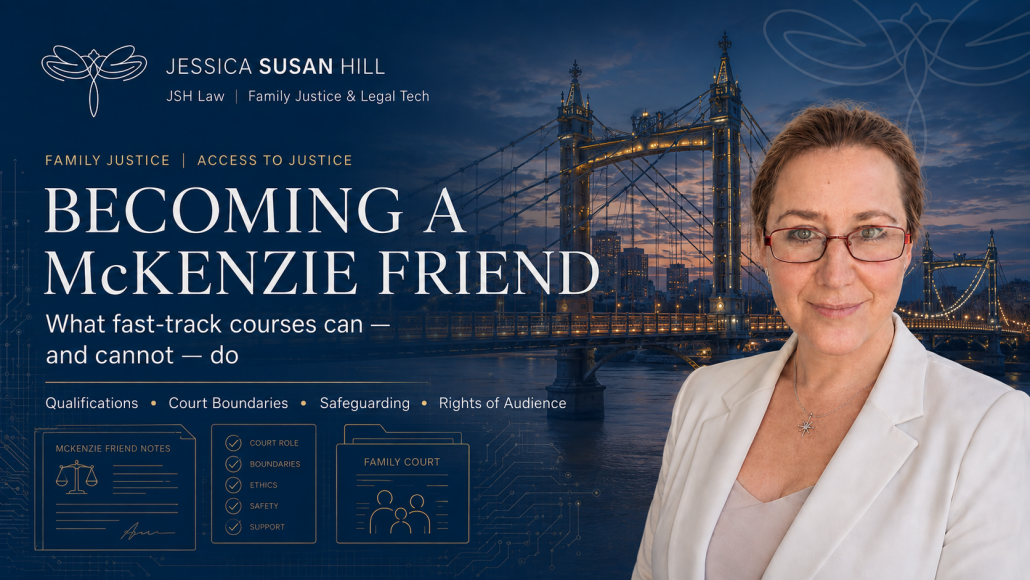
Can You Qualify as a McKenzie Friend Online? What Fast-Track Courses Can—and Cannot—Do
A short online course may teach useful court skills, but it cannot confer rights of audience, authorise someone to conduct litigation or guarantee that a judge will allow them to speak. This guide explains the truth about becoming a McKenzie Friend in England and Wales—and why competence, safeguarding and professional boundaries matter more than a fast-track certificate.
McKenzie Friend Support | Family Court Skills | Access to Justice
Can You Qualify as a McKenzie Friend Online? What Fast-Track Courses Can—and Cannot—Do
There is no statutory fast-track qualification that turns somebody into a court advocate or regulated legal professional. A good course may teach valuable skills, but a certificate does not create rights of audience, confer authority to conduct litigation or guarantee that a court will permit a particular person to assist.
Updated August 2026 | England and Wales
The direct answer
No official government, judicial or statutory qualification is required before someone can assist a litigant in person as a McKenzie Friend.
However, that does not mean the work is simple, risk-free or suitable for anyone who has completed a few hours of online training. The absence of compulsory regulation makes competence, honesty, safeguarding awareness and clear professional boundaries even more important.
What is a McKenzie Friend?
A McKenzie Friend is a layperson who provides reasonable assistance to somebody representing themselves in court. The person receiving the help remains a litigant in person. The McKenzie Friend does not become the litigant’s legal representative simply by sitting beside them, helping with their papers or giving them quiet advice.
The current judicial guidance says that litigants ordinarily have a right to reasonable assistance from a layperson. However, the McKenzie Friend has no independent right to participate. The court retains control over the hearing and may limit or refuse assistance where this is necessary in the interests of justice or because the assistance is disrupting the proper administration of the case.
In private family proceedings, including cases concerning children, hearings will often take place in private. The litigant should tell the court as early as possible that they wish to be assisted. The proposed McKenzie Friend should be ready to provide a short CV or written statement explaining their relevant experience and confirming that they:
- understand the limits of the role;
- have no improper personal interest in the case;
- understand the duty of confidentiality;
- will not disrupt the hearing or attempt to control the litigant; and
- will comply with the judge’s directions.
A McKenzie Friend is a function performed in a particular case. It is not a professional status awarded by purchasing a certificate.
Do you need a qualification to become a McKenzie Friend?
There is no prescribed legal qualification, licence or statutory training route which a person must complete before offering ordinary McKenzie Friend assistance.
That means a friend, relative, support worker, charity volunteer or paid professional may potentially act as a McKenzie Friend. It does not mean that every person using that description is competent to advise on family proceedings, evidence, domestic abuse, safeguarding or court procedure.
Private organisations may provide courses and certificates. Those courses may be useful. They may show that someone has undertaken study or passed a private assessment. What they cannot do is:
- grant a right to address the court;
- authorise someone to question witnesses;
- grant a right to conduct litigation;
- make the person a solicitor, barrister or regulated legal executive;
- guarantee admission to a private family hearing;
- guarantee that a judge will accept the person’s assistance in every case; or
- remove the individual’s responsibility to work within their competence.
What may a McKenzie Friend do?
The judicial guidance identifies four core forms of assistance.
Moral support
Helping a litigant remain calm, focused and able to participate in an unfamiliar and stressful process.
Taking notes
Keeping an accurate note of what was said, what directions were made and what deadlines now apply.
Helping with papers
Helping the litigant organise, locate and understand the documents needed during the hearing.
Quiet advice
Quietly prompting or advising the litigant about the conduct of their own case.
What may a McKenzie Friend not do automatically?
A McKenzie Friend does not automatically have permission to:
- address the judge or magistrates;
- make oral submissions;
- question or cross-examine witnesses;
- act as the litigant’s agent;
- take over management of the case;
- sign court documents in place of the litigant;
- issue proceedings in the litigant’s name;
- accept formal responsibility for conducting the litigation; or
- describe themselves in a way which falsely suggests that they are regulated or authorised.
The right to speak in court is a right of audience. The right to carry responsibility for formal steps in proceedings is the right to conduct litigation. These are separate reserved legal activities under the Legal Services Act 2007.
A court can grant a layperson a right of audience or a right to conduct litigation in a particular case. However, neither right should be treated as routine. Each must be requested and justified separately.
The judicial guidance says courts should be slow to grant these rights to laypeople. Where someone holds themselves out as a professional advocate or regularly seeks to exercise those rights, permission will be granted only in exceptional circumstances.
Helping someone present their case is not the same as taking their case over
The litigant must remain the decision-maker and the person conducting their own proceedings. A McKenzie Friend who treats the litigant as a vehicle for the McKenzie Friend’s arguments risks crossing the legal boundary and may be removed from the hearing.
How to assess a McKenzie Friend course before paying
The question is not simply whether a course is described as accredited, certified or fast-track. The important question is what the course actually teaches, who teaches it, how competence is assessed and whether the provider is honest about the legal limitations of the role.
1. Check exactly what the certificate represents
Ask who awards the certificate, whether that organisation is a statutory regulator and whether the qualification is listed on any recognised qualifications framework. A private certificate may still be valuable, but it should be described accurately.
2. Examine the syllabus
A credible family court course should cover more than courtroom etiquette. At minimum, it should address:
- the 2010 McKenzie Friend Practice Guidance;
- the Family Procedure Rules and relevant practice directions;
- the distinction between assistance, advocacy and conducting litigation;
- court structure and the stages of family proceedings;
- applications, responses, statements, position statements, schedules and orders;
- the purpose and limits of bundles;
- evidence, relevance, hearsay, allegations and findings of fact;
- confidentiality and the restrictions applying to family proceedings;
- professional boundaries, conflicts and complaints;
- domestic abuse, coercive control and trauma-informed practice;
- child safeguarding and welfare;
- vulnerable parties and participation directions;
- data protection and secure document handling;
- when to refer a person to a regulated lawyer, IDVA, ISVA or safeguarding agency; and
- how to work calmly and constructively without escalating conflict.
3. Check the tutors
Look for transparent biographies and verifiable experience. Relevant experience may include legal practice, family court work, advocacy, safeguarding, domestic abuse services, court administration or supervised support for litigants in person.
A vague statement that a tutor is a “family law expert” or “court professional” is not enough. Check what that description actually means.
4. Look for real assessment and feedback
Watching videos and answering a short multiple-choice quiz is not the same as demonstrating competence. A serious programme should assess practical tasks such as:
- identifying the issues in a case;
- distinguishing evidence from assertion;
- preparing a clear chronology;
- organising a hearing file;
- recognising safeguarding concerns;
- explaining the limits of the role to a client;
- responding to an ethical problem; and
- knowing when not to advise.
5. Check whether the materials are current
Family procedure, legal aid, domestic abuse law, transparency rules, bundle requirements and court practice change. The course should identify when its materials were last reviewed and explain how updates will be provided.
6. Read the claims made in the advertising
Treat the following claims as warning signs:
- “Become a qualified court advocate in a weekend.”
- “Represent clients in any family court.”
- “Guaranteed right to speak for clients.”
- “Equivalent to a solicitor or barrister.”
- “The court must let you attend.”
- “You can manage the whole case for the litigant.”
- “No legal background or further supervision is needed.”
7. Check the provider’s own professional standards
A training provider teaching professional conduct should itself have clear terms, transparent prices, a complaints process, a privacy notice and an honest refund or cancellation policy.
What does the 2026 Mazur judgment mean for McKenzie Friends?
The Court of Appeal’s decision in Julia Mazur and another v Charles Russell Speechlys LLP and others [2026] EWCA Civ 369 considered when an unauthorised person working within a regulated legal organisation may carry out litigation tasks under the supervision of an authorised individual.
The Court of Appeal held that an unauthorised employee may lawfully perform delegated litigation tasks for and on behalf of an authorised solicitor or other appropriately authorised individual, provided that proper management, supervision and control are in place. The authorised professional remains responsible for the work.
That does not create a parallel right for independent McKenzie Friends.
The critical distinction
A solicitor has statutory authorisation and professional responsibility for the conduct of litigation. The solicitor may delegate work while retaining responsibility and supervision.
A litigant in person has a personal right to conduct their own litigation. They cannot simply transfer that right to an unauthorised third party by calling the third party a McKenzie Friend, caseworker or representative.
The court also declined to produce an exhaustive definition of every task that amounts to conducting litigation. Issuing proceedings and certain formal steps are clearly within the statutory territory. Other activities may depend on who is assuming responsibility, the nature of the task and the surrounding facts.
The practical lesson is straightforward: do not use Mazur as authority for an independent McKenzie Friend to take control of somebody’s proceedings. It is a judgment about supervised delegation within an authorised legal service structure, not a licence for unregulated representation.
The family court requires more than procedural knowledge
Family proceedings involve human beings under pressure. A litigant may be frightened, traumatised, angry, exhausted or struggling to understand what is happening. Children may be living through conflict, disrupted relationships, allegations of abuse or significant uncertainty.
A McKenzie Friend must not become another source of escalation.
Good support is calm, evidence-led and focused on what the court needs to decide. It helps the litigant separate:
- facts from suspicion;
- evidence from opinion;
- relevant history from general grievance;
- the child’s welfare from the parents’ conflict;
- a pattern of behaviour from an isolated disagreement; and
- the order actually required from every other problem in the family.
Domestic abuse and coercive control
Domestic abuse cases require specific competence. Coercive control is rarely explained adequately by reducing everything to one dramatic incident. The relevant picture may involve isolation, monitoring, financial control, threats, manipulation through children, repeated breaches of boundaries, litigation abuse and post-separation conduct.
Equally, allegations must not be embellished or treated as findings before the court has determined them. A responsible McKenzie Friend helps the litigant identify dates, examples, supporting records, impact and the safeguarding relevance of the conduct.
They should also understand that apparently neutral suggestions may be unsafe. Direct negotiation, joint meetings, shared waiting areas or unrestricted disclosure of addresses may expose an abused party to further risk.
Children’s welfare
In children proceedings, the child’s welfare is central. A McKenzie Friend should not encourage a parent to:
- question a child repeatedly about the other parent;
- ask the child to gather evidence;
- share adult court documents with the child without proper reason;
- turn the child’s expressed view into a slogan without considering age, understanding, pressure or context;
- post details of the proceedings online; or
- use inflammatory language which makes safe co-parenting or judicial decision-making more difficult.
Confidentiality is not optional
Family court documents frequently contain intimate information about adults and children. A McKenzie Friend must understand the restrictions on communicating and publishing information from family proceedings.
Files should not be stored casually, forwarded through insecure channels or reused as marketing material. Names and identifying details should not be published merely because a case is interesting or because one party feels that public exposure would be strategically useful.
Confidentiality should also be distinguished from legal professional privilege. A promise to keep information confidential does not automatically give communications with an unregulated adviser the same legal status as privileged communications with a lawyer.
Trauma-informed practice does not mean agreeing with everything a distressed person says. It means listening properly, avoiding further harm, identifying risk, maintaining boundaries and helping the person present their evidence accurately.
Can a McKenzie Friend charge fees?
Yes. The judicial guidance recognises that a litigant may agree to pay a McKenzie Friend for lawful assistance, including reasonable help in or out of court, clerical or mechanical assistance and advice connected with proceedings.
However, payment does not expand the McKenzie Friend’s legal powers. A paid McKenzie Friend has no greater automatic right to speak in court or conduct litigation than an unpaid friend or relative.
The guidance also states that McKenzie Friend fees cannot ordinarily be recovered from the opposing party. Fees for unlawfully conducting litigation without the necessary authorisation or case-specific permission cannot lawfully be recovered.
A paid service is a real business with real responsibilities
Someone charging members of the public should have, at minimum:
- clear written terms of engagement;
- an accurate description of the service;
- a defined scope of work;
- transparent fees and payment terms;
- a cancellation and refund policy;
- a complaints procedure;
- a conflicts-of-interest process;
- secure file storage and communication systems;
- a privacy notice and data retention policy;
- appropriate professional indemnity and public liability insurance;
- a procedure for safeguarding disclosures; and
- a reliable method of recording instructions, advice, deadlines and work completed.
Under consumer law, paid services must be provided with reasonable care and skill. A provider should not assume that describing themselves as unregulated removes contractual, consumer protection or negligence risks.
A commercial provider who processes client information may also need to pay a data protection fee to the Information Commissioner’s Office unless an exemption applies. Family cases routinely involve special category data, allegations, health information, children’s details and highly confidential records. Data protection must be designed into the service from the beginning.
What should a prospective client check?
Litigants in person should not be embarrassed to ask direct questions before handing over money or confidential documents.
| Question to ask | Why it matters |
|---|---|
| Are you regulated by a legal services regulator? | The answer affects professional duties, complaints routes, insurance and consumer protection. |
| What does your qualification actually certify? | A private course certificate does not automatically create legal authority or regulated status. |
| What family court experience do you have? | General confidence is not a substitute for relevant procedural and safeguarding experience. |
| Do you have professional indemnity insurance? | This may matter if negligent advice or document handling causes loss. |
| Who is responsible for filing and serving documents? | The litigant must understand who is doing what and avoid unlawful delegation of formal litigation steps. |
| What happens if you are unavailable before a deadline? | A litigant remains responsible for complying with the court timetable. |
| How do you protect confidential information? | Family court files contain highly sensitive personal and children’s information. |
| What is your complaints process? | An unregulated provider may not fall within the Legal Ombudsman’s jurisdiction. |
A responsible route into McKenzie Friend work
There may be no compulsory route, but there is a responsible one.
-
Read the official guidance in full.
Do not rely on social media summaries or the wording used by a course provider. -
Learn the limits of reserved legal activities.
Understand the separate concepts of legal advice, rights of audience and the conduct of litigation. -
Study the procedure relevant to the cases you intend to support.
Family, civil, employment and tribunal work have different rules, forms and expectations. -
Complete safeguarding and domestic abuse training.
This is particularly important before accepting private children or protective injunction cases. -
Seek supervised experience.
Volunteering, mentoring, supervised casework and observing public hearings where permitted are safer than immediately charging vulnerable people. -
Develop document and evidence skills.
Learn how to create accurate chronologies, schedules, indexes and concise case summaries without rewriting the evidence to suit a preferred narrative. -
Set up proper business systems before charging.
Put contracts, insurance, data protection, complaints, secure storage and conflicts procedures in place. -
Build a referral network.
Know when a case requires a solicitor, barrister, IDVA, ISVA, social worker, mental health professional or emergency safeguarding response. -
Maintain ongoing learning.
A one-off course cannot keep somebody competent in a changing area of law and procedure.
Start with competence, not branding. The most trustworthy McKenzie Friend is not the person with the grandest title. It is the person who understands the limits of the role, protects the client, respects the court and knows when specialist legal advice is required.
Frequently asked questions
Is there an official McKenzie Friend qualification?
No statutory or court-created qualification confers the status of McKenzie Friend. Private organisations may award their own course certificates, but these do not create regulated status, rights of audience or authority to conduct litigation.
Can anyone call themselves a McKenzie Friend?
The term describes a person giving lay assistance to a litigant. However, nobody should use it in a misleading way or imply that it carries powers, regulation or qualifications which they do not possess.
Does completing a course guarantee entry to family court?
No. The litigant ordinarily has a strong right to reasonable assistance, but the court controls attendance and participation in each case. The judge may limit or refuse assistance where there are sufficient reasons connected with fairness or the proper administration of justice.
Can a McKenzie Friend speak to the judge?
Not automatically. Speaking for the litigant, making submissions or examining witnesses requires a right of audience. A court may grant one in a particular case, but it should not be assumed and must be requested and justified.
Can a McKenzie Friend conduct the case for the litigant?
Not automatically. The litigant remains responsible for conducting their own proceedings. Formal responsibility for issuing proceedings and carrying out other litigation steps cannot simply be transferred to an unauthorised person.
Can a McKenzie Friend prepare a witness statement?
A person may help a litigant organise information and put a statement into a clear structure. The statement must remain the witness’s own evidence, expressed honestly and approved by that witness. The McKenzie Friend must not invent evidence, coach a false account or take over responsibility for the proceedings. Because the boundary between assistance and conducting litigation can be fact-sensitive, formal case management should not be assumed to be lawful merely because it is described as drafting support.
Can a McKenzie Friend charge money?
Yes, a fee may be agreed for lawful assistance. Payment does not create additional rights. The provider should use clear terms, transparent fees, appropriate insurance, secure data systems and a complaints process.
Can the client recover McKenzie Friend fees from the other party?
The judicial guidance states that McKenzie Friend fees cannot be lawfully recovered from the opposing party.
Is a McKenzie Friend the same as an IDVA?
No. An Independent Domestic Violence Adviser provides specialist domestic abuse support. Practice Direction 27C makes specific provision for the attendance of IDVAs and ISVAs in family proceedings. An IDVA may also have a separate role from any person assisting as a McKenzie Friend.
Is a fast-track course worthwhile?
It may provide a useful introduction if the course is accurate, current, properly assessed and honest about the limits of the role. It should be treated as the beginning of learning, not proof that somebody is ready to handle complex family cases alone.
The wider access-to-justice issue
McKenzie Friends exist because people often have to navigate serious proceedings without representation. Many litigants cannot afford full legal services, do not qualify for legal aid or need practical support between limited appointments with a lawyer.
Good McKenzie Friends can help people organise overwhelming evidence, understand the hearing process, remain calm and communicate their position more effectively. That work can make a real difference.
But access to justice is not improved by replacing one inaccessible system with an unaccountable one.
Vulnerable litigants should not be sold false certainty, inflated credentials or advocacy rights which the provider does not possess. Responsible support requires transparency about regulation, competence, limits, fees and redress.
“A course may teach someone how to support a litigant. It cannot, by itself, authorise them to become the litigant’s lawyer.”
What this means in practice
Someone considering this work should not ask only, “How quickly can I obtain a certificate?”
They should ask:
- Do I understand the legal boundary of the role?
- Can I identify when a case is beyond my competence?
- Do I understand safeguarding and domestic abuse?
- Can I protect confidential information properly?
- Can I help without taking control away from the litigant?
- Can I remain calm when the client is distressed or angry?
- Can I distinguish evidence from assumption?
- Will my involvement make the court’s job easier rather than harder?
- Am I prepared to be honest when the client needs regulated legal advice instead?
Those questions matter considerably more than how quickly a course can be completed.
Practical support for litigants in person
JSH Law provides practical, evidence-led and safeguarding-aware support for people navigating family proceedings without full representation. Support may include evidence organisation, chronologies, schedules, position statements, witness statement preparation, Cafcass material, hearing preparation and appeal paperwork.
The scope of any work should be agreed clearly in advance. Court outcomes always depend on the facts, evidence, procedural position, applicable law and judicial discretion.
Book a consultationOfficial sources and further reading
- Courts and Tribunals Judiciary: Practice Guidance—McKenzie Friends (Civil and Family Courts)
- Family Procedure Rules: Practice Direction 12B—Child Arrangements Programme
- Legal Services Act 2007: Schedule 2—Reserved Legal Activities
- Legal Services Act 2007: Schedule 3—Exempt Persons
- Julia Mazur and another v Charles Russell Speechlys LLP and others [2026] EWCA Civ 369
- Practice Direction 27C: Attendance of IDVAs and ISVAs
- Legal Services Board: Mapping Unregulated Legal Services
- GOV.UK: Consumer Protection Guidance for Unregulated Legal Services
- Information Commissioner’s Office: Data Protection Fee Guidance
















Leave a Reply
Want to join the discussion?Feel free to contribute!