• Link to Facebook
  • Link to X
  • Link to Facebook
  • Link to LinkedIn
  • Link to LinkedIn
  • Link to Mail
  • Link to Instagram
  • Link to WhatsApp
  • Link to Rss this site
Whatsapp : (+44) 07564 236528
JSH Law | Family Court Support & Litigation Assistance
  • Home
  • Services
    • Family Court Navigation & Case Strategy – Procedural clarity for litigants in person
      • Case overview and procedural mapping
      • Court form support (C100, C79, C2, C1A, etc.)
      • Case timelines and structured chronologies
      • Hearing preparation and expectation-setting
      • Strategic options reviews (next steps, risks, proportionality)
    • Safeguarding, Cafcass & Local Authority Matters – Focused support where risk, reports, and allegations arise
      • Cafcass report analysis and response planning
      • Safeguarding allegation review (including PD12J context)
      • Local authority involvement and threshold guidance
      • Preparing written responses to professional reports
      • Evidence organisation for safeguarding-related issues
    • Court Documents, Statements & Submissions – Clear, compliant, and credible written advocacy support
      • Position statements and schedules of issues
      • Witness statements (fact-based, court-ready structure)
      • Skeleton arguments and written submissions
      • Appeal groundwork and document preparation
      • Document review for tone, relevance, and legal coherence
    • Hearing Support & McKenzie Friend Services – Calm, practical support before and during court
      • McKenzie Friend assistance (subject to court permission)
      • Remote and in-person hearing preparation
      • Note-taking and real-time procedural support
      • Post-hearing debriefs and order explanations
      • Referrals and signposting to appropriate professionals
  • Resources
    • 1. Start Here
      • Before You Apply to Court
      • Common Mistakes
      • Family Court Reality
      • FAQs for Litigants in Person
      • Litigants in Person – Family Court Guidance
    • 2. Family Court Procedure
      • Court Etiquette
      • Forms & Applications
      • Hearing Types
      • MIAM & Mediation
      • Procedural Updates
      • Urgent Applications
    • 3. Cafcass & Reports Cluster
      • Challenging Cafcass Reports
      • Child Impact Analysis
      • Safeguarding Checks
      • Section 7 Reports
      • The Child’s Voice
    • 4. Domestic Abuse & Safeguarding Cluster
      • Child Safety & Emotional Harm
      • Coercive Control
      • PD12J & Fact Finding
      • Post Separation Abuse
      • Protective Orders
      • Safeguarding & Child Protection
      • Safety Planning
    • 5. Court Skills for Litigants in Person
      • Advocacy Skills
      • Bundles & Documents
      • Evidence Explained
      • Evidence Readiness
      • Family Court Procedure
      • Litigants in Person Support
      • McKenzie Friend Support
      • Remote Hearings
    • 6. Tools Templates Research & Cases
      • AI & Legal Process
      • Judicial Review & AI
      • Case Studies (Anonymised)
      • Family Court Accountability
      • Safeguarding Reform
      • Templates & Checklists
  • Matters
    • Core Private Law Children Matters
      • 1. Child Arrangements (Lives With / Spends Time With)
      • 2. Variation of child arrangements orders
      • 3. Enforcement of child arrangements orders
      • 4. Contact breakdown or refusal of contact
      • 5. Urgent / without notice applications
      • 6. Indirect contact disputes (letters, cards, calls)
      • 7. Holiday contact and travel disputes
      • 8. Parental Responsibility disputes
      • 9. Supervised and supported contact disputes
      • 10. Specific Issue Orders
      • 11. Relocation within England & Wales
      • 12. Relocation abroad (procedural preparation only)
      • 13. Prohibited Steps Orders
      • 14. Disputes involving older children / wishes and feelings
      • 15. Children resisting or refusing contact (distinct from breakdown)
      • 16. Reintroduction / rebuilding contact
      • 17. Allegations affecting child arrangements (procedural handling)
      • 18. PD12J Domestic Abuse framework cases
      • 19. Post-separation abuse / litigation abuse
      • 20. Grandparents / extended family applications
      • 21. Challenging Cafcass recommendations
      • 22. Local Authority pre-proceedings (PLO)
      • 23. Transparency orders / reporting restrictions
      • 24. Abuse of process / vexatious litigation
    • Safeguarding, Welfare & Professional Involvement
      • 25. Safeguarding allegations and responses
      • 26. Cafcass involvement and reports
      • 27. Understanding Cafcass recommendations
      • 28. Responding to safeguarding letters
      • 29. Preparing for Cafcass interviews
      • 30. Managing professional concerns raised mid-proceedings
      • 31. Disputed safeguarding narratives
      • 32. Threshold-related concerns (private law context)
    • Hearings, Process & Court Navigation
      • 33. Preparing for first hearings (FHDRA)
      • 34. Preparing for directions hearings
      • 35. Preparing for fact-finding hearings (procedural support)
      • 36. Preparing for final hearings
      • 37. Understanding court orders and directions
      • 38. Managing adjournments and delays
      • 39. Remote / hybrid hearing preparation
      • 40. In-court support as a McKenzie Friend (subject to permission)
    • Documentation, Evidence & Case Preparation
      • 41. Statement preparation and structure
      • 42. Chronologies and timelines
      • 43. Position statements
      • 44. Schedules of issues
      • 45. Organising evidence and exhibits
      • 46. Preparing court-compliant bundles
      • 47. Reviewing and organising large volumes of documents
      • 48. Identifying relevance and proportionality
      • 49. Avoiding common document mistakes
    • Appeals, Reviews & Procedural Challenges
      • 50. Understanding appeal routes and thresholds
      • 51. Preparing procedural material for appeals
      • 52. Transcript management and review
      • 53. Time-limit issues and extensions
      • 54. Applications to vary or revisit orders
      • 55. Procedural irregularities and fairness concerns
    • High-Conflict or Complex Case Dynamics
      • 56. High-conflict co-parenting situations
      • 57. Cases involving repeated applications
      • 58. Managing proceedings involving litigants with representatives
      • 59. Allegations of coercive control (procedural framing)
      • 60. Parallel proceedings and overlapping issues
      • 61. Long-running or stalled cases
    • Additional Procedural Matters Litigants Ask About
      • 62. Making or responding to applications (C100, C2, etc.)
      • 63. Understanding court forms and notices
      • 64. Preparing for court without legal representation
      • 65. Understanding what the court is (and isn’t) deciding
      • 66. Managing anxiety and overwhelm during proceedings (procedural focus)
  • Latest Updates
    • Latest Family Court Articles for Litigants in Person
    • Family Procedure Rules – What’s New
    • Practice Directions Explained
  • Pricing
    • Emergency Family Court Support
  • About
  • Contact JSH Law
  • Click to open the search input field Click to open the search input field Search
  • Menu Menu

Archive for category: Protective Orders

You are here: Home1 / Blog2 / 4. Domestic Abuse & Safeguarding Cluster3 / Protective Orders

Procedural guidance relating to protective measures and orders that may arise alongside safeguarding concerns in family court cases.

When a Parent Discloses Strangulation and has a SEN Child: What to Do Next (UK Family Court)
February 10, 2026/0 Comments/in 4. Domestic Abuse & Safeguarding Cluster, Protective Orders/by jessica susan hill

When a Parent Discloses Strangulation and You Have SEN Children: What to Do Next (UK Family Court)

Safety note: If you are in immediate danger, call 999. If it is not an emergency, consider calling 101. If you cannot speak safely, use the Silent Solution (dial 999 and follow the operator’s prompts).

This article is written for litigants in person who find themselves in one of the most frightening situations a parent can face:

  • you have children (often with Special Educational Needs (SEN)),
  • the other parent is angry, aggressive, and unsafe, and
  • you have disclosed that the other parent has strangled you (including where that has been admitted to professionals, such as social services or Cafcass).

If that is you: you do not need to “handle this better”. You need protection, stability, and a clear procedural plan.

Strangulation (non-fatal strangulation/suffocation) is treated in law and safeguarding practice as a serious risk indicator. It is also a criminal offence. (legislation.gov.uk)

This is why the priority in family law is often not “contact arrangements first” — it is safety first.

Key Takeaways (for litigants in person)

  • Strangulation is treated as a serious risk indicator in safeguarding and family proceedings.
  • A 15-minute consultation is triage and orientation: safety, urgency, next steps.
  • Most situations like this require a protection-first approach before child arrangements litigation.
  • Legal aid and specialist domestic abuse support should be pursued in parallel.

What you can expect from a 15-minute consultation with JSH Law

A 15-minute consultation is triage and orientation, not full casework.

In this call, JSH Law will help you:

  1. Check immediate safety (for you and the children).
  2. Identify the legal category of your problem (protective injunctions vs. children proceedings vs. both).
  3. Confirm whether there are deadlines, active proceedings, or court orders.
  4. Map the fastest lawful route to protection and stability.
  5. Signpost the right next step, including legal aid and specialist domestic abuse support.

What this call is not

It is not:

  • drafting your witness statement,
  • advising you what to “say to the judge”,
  • telling you the outcome,
  • or running your whole case.

That work is longer-form, and it must be done safely and properly.

Why strangulation changes everything

If a parent says, “He strangled me,” that is not “relationship conflict”. It is a serious safeguarding disclosure.

In UK law:

  • The Domestic Abuse Act 2021 sets a statutory definition of domestic abuse (and recognises patterns of controlling/coercive behaviour). (legislation.gov.uk)
  • Non-fatal strangulation/suffocation is recognised as a specific offence (via the Domestic Abuse Act’s amendments). (legaladvicecentre.london)

In family proceedings, the court must approach child arrangements through a safeguarding lens where domestic abuse is raised (see Practice Direction 12J). (justice.gov.uk)

The procedural approach JSH Law takes in this situation

When the disclosure is: SEN children + father unsafe/aggressive + strangulation admitted to professionals, the “best practice” procedural mindset is:

  • Protect first (injunctions)
  • Stabilise housing if needed
  • Only then open or progress child arrangements litigation, unless the children’s arrangements must be stabilised urgently

That is why our priority sequence usually looks like this:

Priority Summary

  • 1️⃣ FL401 – Non-Molestation Order (immediate) (legislation.gov.uk)
  • 2️⃣ Occupation Order (if housing risk exists) (legislation.gov.uk)
  • 3️⃣ C100 + C1A (only if children’s arrangements must be stabilised now) (legislation.gov.uk)
  • 4️⃣ Legal aid solicitor + specialist DA support (in parallel) (legislation.gov.uk)
PriorityActionWhy it mattersKey legal reference
1️⃣FL401 – Non-Molestation Order (immediate)Creates a legal firewall to stop abuse, threats, intimidation and unwanted contact.Family Law Act 1996 s.42
2️⃣Occupation Order (if housing risk exists)Regulates occupation of the home; can exclude an unsafe person where justified.Family Law Act 1996 s.33
3️⃣C100 + C1A (only if children’s arrangements must be stabilised now)Only used urgently when children’s arrangements require immediate court control.Children Act 1989 s.8
4️⃣Legal aid solicitor + specialist DA support (in parallel)Secures specialist representation/support where domestic abuse gateway applies (subject to means).LASPO 2012 Sch 1 para 12

Step 1: FL401 – Non-Molestation Order (IMMEDIATE)

What it is

A Non-Molestation Order is a protective injunction under the Family Law Act 1996. (legislation.gov.uk)

It can prohibit the other person from:

  • using or threatening violence,
  • harassing, intimidating, pestering,
  • contacting you (including via third parties),
  • coming to your home, workplace, or the children’s school (if appropriate).

Why it is the first priority in high-risk disclosures

Because it creates a legal firewall. It is designed to stop further abuse and reduce immediate risk.

Breach is a criminal offence

Breach of a non-molestation order is a criminal offence under s.42A Family Law Act 1996. (legislation.gov.uk)

Can it be made “without notice”?

Yes. In urgent cases, the court can consider the application without the respondent being told first (a “without notice” / ex parte application). The criteria are set out in s.45 Family Law Act 1996, and the Family Procedure Rules require your supporting evidence to explain why notice was not given. (legislation.gov.uk)

Practical reality: without-notice orders exist because sometimes warning the other person increases risk, pressure, or intimidation.

What you need procedurally

An application for a non-molestation order is made on Form FL401 and must be supported by a witness statement (your statement of facts). (justice.gov.uk)

What your witness statement should cover (high-level)

  • the relationship and living situation (briefly)
  • the pattern of behaviour (keep it factual)
  • the strangulation disclosure (what happened, when, injuries if any, what was said to professionals)
  • the children’s needs and exposure (especially SEN needs and routine stability)
  • why you need protection now
  • why you seek the order without notice (if applicable)

Step 2: Occupation Order (IF HOUSING RISK EXISTS)

What it is

An Occupation Order is an injunction that regulates who can live in, enter, or be excluded from the family home. It also arises under the Family Law Act 1996 (commonly under s.33 and related provisions depending on your property/occupancy status). (legislation.gov.uk)

When it becomes urgent

Consider it immediately if:

  • the other parent still lives in the home,
  • is trying to return,
  • is turning up, refusing to leave, or making the home unsafe,
  • you are being forced to flee with SEN children (disruption can be extremely harmful),
  • the home is the only stable base for schooling, EHCP support, therapies, etc.

How the court assesses it

In some scenarios (notably s.33 cases), the court applies the “balance of harm” approach and considers the likely harm if the order is not made versus harm to the respondent if it is made. (This sits within the statutory framework of the Family Law Act’s occupation order provisions.) (legislation.gov.uk)

Practical point: occupation orders can be “harder” than NMOs

Courts treat excluding someone from their home as a major interference with rights — it can be granted, but it must be properly evidenced and proportionate, especially if sought without notice.

Step 3: C100 + C1A (ONLY if children’s arrangements must be stabilised now)

This is where people often make a costly mistake: they rush into a children application too early, and it unintentionally triggers pressure around contact before safety is stabilised.

The legal basis

A Child Arrangements Order is a s.8 Children Act 1989 order. (legislation.gov.uk)

You apply using Form C100 (private law children application). Cafcass will usually be involved in initial safeguarding checks. (cafcass.gov.uk)

What is Form C1A?

Form C1A is supplemental information used to tell the court about allegations of harm and domestic abuse (or to respond to them). (gov.uk)

When you should file C100 + C1A urgently

Usually only if one of these is true:

  • the other parent is threatening to remove the children,
  • there is an immediate dispute about where the children live / are collected from,
  • contact is being demanded in a way that creates immediate risk,
  • the school, GP, or professionals need court-backed clarity quickly,
  • there is already chaos around handovers that is escalating.

PD12J: why domestic abuse matters in child arrangements

Where domestic abuse is raised, the court must consider safeguarding and risk, and handle contact decisions accordingly under Practice Direction 12J. (justice.gov.uk)

This is especially relevant where:

  • there are serious allegations,
  • the children may have witnessed incidents,
  • or the abusive parent seeks to use proceedings to continue coercive control.

Step 4: Legal aid solicitor + specialist DA support (IN PARALLEL)

If strangulation has been admitted to professionals (social services/Cafcass), you should assume legal aid may be available (subject to means and evidence requirements) and you should pursue it immediately, not after you’ve struggled alone for months.

Legal aid: the legal framework

Legal aid remains available for certain family matters involving domestic abuse under LASPO 2012 Schedule 1, Part 1, paragraph 12, subject to providing evidence of domestic abuse as required by the regulations. (legislation.gov.uk)

Government guidance confirms you may be eligible for legal aid for domestic abuse matters if you have evidence and meet the financial criteria. (gov.uk)

Why specialist DA support matters (even if you are “strong”)

A specialist domestic abuse service (often via an IDVA) can help with:

  • safety planning,
  • liaison with police and children’s services,
  • refuge/housing options,
  • documenting risk properly.

For SEN children, that wrap-around support can be the difference between coping and collapse.

A simple decision map (quick reference)

If you are unsafe now: emergency services first.

Otherwise:

  • Need immediate protection from abuse/harassment? → FL401 non-molestation (legislation.gov.uk)
  • Need the abuser kept out of the home / housing stability? → add occupation order (legislation.gov.uk)
  • Need urgent court control over children’s living/contact arrangements? → C100 + C1A (legislation.gov.uk)
  • Want representation and safety-informed strategy? → legal aid solicitor + DA support (legislation.gov.uk)

What evidence and documents help (without drowning yourself)

You do not need a 200-page bundle on day one. You need credible, relevant, time-anchored evidence.

Examples:

  • a letter/email note from social services/Cafcass referencing the disclosure (if available)
  • police incident numbers (if any)
  • GP/A&E notes (if any)
  • photos of injuries (if any)
  • a short chronology of key incidents (dates + 1–2 lines each)
  • school/SEN documents only where they show vulnerability/routine impact

What to expect in court (high-level)

  • Injunction applications (FL401) require your witness statement and can be dealt with urgently, including without notice where justified. (justice.gov.uk)
  • Children applications (C100) will usually trigger initial safeguarding checks and a first hearing process. PD12J is central where domestic abuse is raised. (justice.gov.uk)

Call to Action: Book a 15-Minute Consultation with JSH Law

If you are in this situation — especially with SEN children — you do not need to “power through”. You need a clear procedural plan and the right support around you.

Book a 15-minute consultation here:
👉

15-minute introductory telephone call (free)
New enquiries only · UK & international timezones supported
This short call is for new enquiries only. It allows us to:
  • Understand the nature of your issue
  • Explain the type of support available
  • Confirm next steps, if appropriate
Important: This call does not constitute legal advice and does not create a solicitor-client relationship.

What to include in your booking notes (so we can help faster)

  • Are the children safe today?
  • Is the other parent in the home / turning up?
  • Any deadlines, hearings, or existing orders?
  • Any professional involvement (police / social services / Cafcass)?
  • One sentence: what is your biggest fear right now?

Regulatory & Editorial Notice (JSH Law)

This article is general information for public education. It is not legal advice and should not be relied on as a substitute for advice on your specific facts. Reading this article does not create a solicitor-client relationship. If you are at immediate risk of harm, contact the police or emergency services. Where third-party sources are referenced, they are provided for convenience and do not necessarily reflect endorsement by JSH Law.

Key legal references (for readers who want sources)

  • Family Law Act 1996:
    • Non-molestation orders s.42 (legislation.gov.uk)
    • Breach offence s.42A (legislation.gov.uk)
    • Without notice criteria s.45 (legislation.gov.uk)
    • Occupation orders framework (including s.33) (legislation.gov.uk)
  • Family Procedure Rules: Part 10 (applications under FLA 1996; witness statement; without notice) (justice.gov.uk)
  • Children Act 1989: s.8 orders (Child Arrangements / Prohibited Steps / Specific Issue) (legislation.gov.uk)
  • Practice Direction 12J (domestic abuse and harm in child arrangements proceedings) (justice.gov.uk)
  • Domestic Abuse Act 2021: statutory definition s.1 and related provisions (legislation.gov.uk)
  • Non-fatal strangulation / suffocation offence (commencement and prosecution guidance) (legaladvicecentre.london)
  • Legal aid: LASPO 2012 Sch 1 para 12 + evidence requirements reg.33; GOV.UK guidance (legislation.gov.uk)
  • Form C1A (allegations of harm/domestic abuse) (gov.uk)
https://jshlaw.co.uk/wp-content/uploads/2026/02/ChatGPT-Image-Feb-3-2026-04_07_33-AM.png 1024 1536 jessica susan hill https://jshlaw.co.uk/wp-content/uploads/2026/01/jsh-law-logo-new-black-300x67.png jessica susan hill2026-02-10 12:47:092026-02-10 13:29:42When a Parent Discloses Strangulation and has a SEN Child: What to Do Next (UK Family Court)
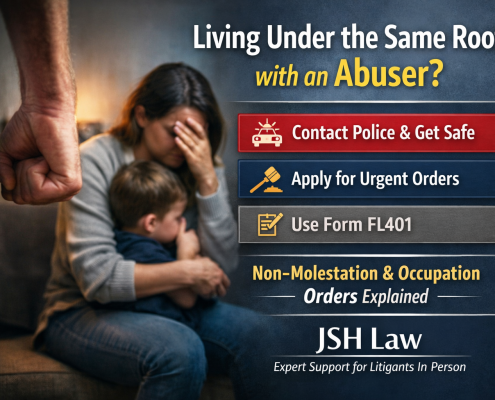
Woman and young child sitting in fear while an abusive partner raises a fist, illustrating domestic abuse while living under the same roof and the need for urgent family court protection.jsh law ltd

He Raised His Fist While We’re Still Living Together — What Do I Do Now?

January 28, 2026/0 Comments/in 4. Domestic Abuse & Safeguarding Cluster, Protective Orders/by jessica susan hill

A real Facebook comment, and the urgent legal steps that follow

**“HELP!
Going through divorce / domestic abuse / living under the same roof / completing financial forms for a consent order / have a 6-year-old child.

This morning my ex raised his fist to me and squared up to me earlier this week.

School know and have referred to MASH. I’ve been told to log it with the police.

What do I do?
Do I move out to protect myself and my child?
How does this impact the divorce?

Should he be moving out?
Do I apply for a non-molestation order and an occupation order?
How quickly does this happen?”*

This is not a theoretical question.
This is a live safeguarding situation.

If this is you, or someone you support, the priority is simple and non-negotiable:

Safety comes first — always.

Everything else (divorce paperwork, finances, consent orders) comes second.


Step 1: Immediate safety comes first

If someone has raised their fist, squared up, or made you fear violence:

  • That is domestic abuse
  • You do not have to wait for physical injury
  • You do not have to “see what happens next”

If there is immediate risk

  • Call the police
  • Get yourself and your child to a safe place if you can
  • Do not worry about “over-reacting” — courts and safeguarding agencies take threats of violence seriously

The school has already referred to MASH. That means:

  • Professionals are concerned about risk to a child
  • You should keep records of all school communications
  • This strengthens the need for formal protective steps

Step 2: What protective orders are available (England & Wales)

The Family Court has emergency powers designed for exactly this situation.

1. Non-Molestation Order (NMO)

A non-molestation order is a protective injunction that:

  • Prohibits threats, intimidation, harassment or violence
  • Can protect you and your child
  • Is a criminal offence to breach

This is the primary legal tool where there are threats or fear of harm.


2. Occupation Order

An occupation order deals with the home. It can:

  • Decide who stays and who must leave
  • Exclude the abusive party from the property or part of it
  • Be made even if both names are on the tenancy or mortgage

This is how the court answers the question:

“Who should move out — me or him?”

You do not have to decide that alone.


3. Domestic Abuse Protection Orders (DAPOs)

DAPOs exist but are currently:

  • Only available in pilot areas
  • Not yet the main route for most people

For most litigants in person, non-molestation + occupation orders remain the correct route.


Step 3: How quickly can this be done?

Emergency (without-notice) applications

If there is risk of significant harm, the court can:

  • Make orders without telling him first
  • Act the same day or within days
  • Rely on your sworn written evidence

The law explicitly allows this where it is “just and convenient” to do so.

This is not unusual.
It exists because waiting can be dangerous.


On-notice hearings

If the court decides notice is appropriate:

  • A hearing should normally be listed within 21 days
  • Interim protection can still be put in place

Step 4: What form is used?

Protective injunctions are applied for using:

Form FL401

This form can include:

  • A non-molestation order
  • An occupation order
  • Both together

It must be supported by a clear witness statement setting out:

  • What has happened
  • Why you fear harm
  • Why urgent protection is needed

Step 5: Evidence and documentation — do this now

You do not need perfect evidence.
You need clear, contemporaneous records.

Start immediately:

  • Write down dates, times, words used, actions
  • Note who saw or heard what
  • Keep copies of:
    • School emails
    • MASH correspondence
    • Police reference numbers
  • Save messages, voicemails, or threats

This is not about proving everything beyond doubt.
It is about showing risk.


“Do I move out? How does this affect the divorce?”

This is one of the most common — and most misunderstood — questions.

The honest answer:

  • Your safety and your child’s safety come first
  • The Family Court has specific powers (occupation orders) to decide housing without you having to flee
  • Whether leaving affects finances depends on the wider facts — and cannot be safely answered in a Facebook comment

What matters right now is this:

Do not stay somewhere unsafe out of fear of “damaging your case.”

The court’s primary concern in protective injunctions is risk, not tactical advantage.


Costs and enforcement

  • There is no court fee to apply for a non-molestation or occupation order
  • Legal aid may be available depending on eligibility
  • Breaching a non-molestation order is a criminal offence and can result in arrest

These orders have teeth.


What you can do today (practical checklist)

If you are in this position today, do the following:

  1. Contact police if there is immediate risk
  2. Keep yourself and your child safe
  3. Start a written incident log
  4. Preserve school and MASH communications
  5. Prepare an FL401 application
  6. Seek urgent support with drafting if needed — this is not the time for guesswork

How JSH Law can help immediately

I support litigants in person who are:

  • Living under the same roof as an abusive ex
  • Navigating divorce alongside safeguarding risk
  • Preparing urgent FL401 applications
  • Unsure whether to seek a non-molestation order, an occupation order, or both

I can help with:

  • Structuring your witness statement
  • Risk-focused drafting for without-notice applications
  • Explaining what the court is likely to prioritise
  • Helping you act quickly, calmly, and strategically

You do not need to handle this alone.


    Links

    1. Get an injunction: Overview

      UK Government · GOV.UK · 2025

      2. FJC Best Practice: Protective Injunctions

      Family Justice Council (Judiciary) · Guidance PDF · 2025

      3. Form FL401 page

      HM Courts & Tribunals Service · GOV.UK · 2025

      4. Family Law Act 1996 § 42

      UK Parliament · legislation.gov.uk · 1996 (as amended)

      Regulatory & Editorial Notice

      This article is provided for general information only and does not constitute legal advice.
      Family-law outcomes depend on individual facts and circumstances.
      Nothing in this article creates a solicitor-client relationship.
      If you are in immediate danger, contact the police or emergency services without delay.

      https://jshlaw.co.uk/wp-content/uploads/2026/01/ChatGPT-Image-Jan-28-2026-02_50_51-PM.png 1024 1536 jessica susan hill https://jshlaw.co.uk/wp-content/uploads/2026/01/jsh-law-logo-new-black-300x67.png jessica susan hill2026-01-28 14:53:512026-02-03 03:32:52He Raised His Fist While We’re Still Living Together — What Do I Do Now?

      Jessica Susan Hill – McKenzie Friend Services Logo

      How I Can Help

      I provide independent, procedural family court support for litigants in person and professionals navigating complex or high-conflict cases.

      My work focuses on:

      – Case strategy and procedural clarity

      – Evidence review, chronology building, and issue framing

      – Statement drafting and refinement

      – Court-ready bundles and document compliance

      – Support alongside solicitors, counsel, or directly with litigants in person

      Support is provided remotely, on an hourly basis, with clear boundaries and no false promises.

      This is about structure, preparation, and informed decision-making.


      Book a Case Review

      About the Author

      About the Author

      Jessica Susan Hill

      McKenzie Friend · Family Court Support

      I support litigants in person and professionals in complex private children and
      safeguarding-related family court proceedings
      .

      My work is procedural, strategic, and evidence-focused — helping clients understand process,
      prepare properly, and present their case clearly and coherently.

      I regularly work alongside solicitors and counsel, or directly with litigants in person,
      providing structured support in cases where clarity, preparation, and proportionality matter.

      This site exists to reduce confusion, not create false hope.


      → About JSH Law

      Procedural support · Evidence preparation · Court-ready documentation

      Start Here (Key Guides)

      Start Here

      If you’re new to family court or feeling overwhelmed, begin with these guides:

      • Before You Apply to Court
      • Understanding Cafcass and Section 7 Reports
      • Safeguarding, Domestic Abuse, and Risk Framing
      • Preparing Your Evidence, Chronology, and Statements
      • Common Mistakes Litigants in Person Make

      Practical, procedural guidance — written for real cases, not theory.

      Categories

      Family Court Procedure
      Litigants in Person Guidance

      Cafcass & Reports

      Safeguarding & Domestic Abuse

      Case Studies (Anonymised)

      Family Court Accountability

      AI & Legal Process

      Free Resource

      Family Court Preparation Checklist (PDF)

      A practical, procedural checklist covering:

      • what to organise before issuing or responding
      • evidence and chronology basics
      • common preparation mistakes to avoid


      → Download Free Checklist

      Procedural guidance only · Not legal advice

      Authorities Used

      – Family Procedure Rules 2010, SI 2010/2955 (U.K.), rr. 1.1, 1.3, pts. 3, 6, 17, 22, 25, 9.
      – Practice Direction 3A (MIAM).
      – Practice Direction 12B (Child Arrangements Programme).
      – Practice Direction 12J (Domestic Abuse and Harm).
      – Practice Direction 22A (Evidence).
      – Practice Direction 27A (Court Bundles).
      – Children Act 1989, c. 41 (U.K.)

      Related Reading

      You may also find these articles helpful:

      • Understanding Cafcass Reports and Common Errors
      • How Evidence Is Weighed in Family Court
      • Safeguarding Allegations and Risk Assessment
      • Preparing a Chronology the Court Can Follow

      Articles are grouped by topic for clarity.

      Latest news

      • If Victims Need Legal Advisers in Crown Court, Why Are Parents Still Facing Family Court Alone?June 5, 2026 - 9:13 pm

        The Government has announced a £5 million pilot scheme to provide independent legal advisers for domestic abuse victims in Crown Court cases. While the move is welcome, many family court litigants continue to face complex proceedings without legal representation or meaningful support. What does this reform mean, and what lessons could family justice learn from it?

      • Contact With Your Child Has Stopped: What to Do Before the Family Court Treats It as the New NormalJune 4, 2026 - 4:32 pm

        Has contact with your child suddenly stopped, or is an existing child arrangements order no longer being followed? This guide explains why delay can make a safe parent-child relationship harder to repair, what evidence the court will examine, when enforcement may be appropriate and how litigants in person can prepare a clear, child-focused case.

      • Your Family Court Case Is Taking Too Long: How to Stop Delay Damaging Your Child and Your PositionJune 4, 2026 - 2:40 pm

        Has your family court case stalled while your child’s life continues to change? This guide explains why delay matters, what the Children Act 1989 says, how to distinguish necessary delay from avoidable drift, and the practical steps litigants in person can take to protect their position and keep the court focused on the child.

      FAMILY LAW NEWS & UPDATES:

      • 1. Start Here (11)
        • Before You Apply to Court (2)
        • Common Mistakes (1)
        • Family Court Reality (4)
        • FAQs for Litigants in Person (1)
        • Litigants in Person – Family Court Guidance (3)
      • 2. Family Court Procedure (21)
        • Court Etiquette (1)
        • Court Process & Judicial Approach (2)
        • Forms & Applications (3)
        • Hearing Types (3)
        • MIAM & Mediation (1)
        • Procedural Updates (8)
        • Transparency & Reporting (2)
        • Urgent Applications (2)
      • 3. Cafcass & Reports Cluster (6)
        • Challenging Cafcass Reports (1)
        • Child Impact Analysis (1)
        • Safeguarding Checks (2)
        • Section 7 Reports (1)
        • The Child’s Voice (1)
      • 4. Domestic Abuse & Safeguarding Cluster (20)
        • Child Safety & Emotional Harm (1)
        • Coercive Control (3)
        • PD12J & Fact Finding (2)
        • Post Separation Abuse (3)
        • Protective Orders (2)
        • Safeguarding & Child Protection (4)
        • Safety Planning (2)
      • 5. Court Skills for Litigants in Person (37)
        • Advocacy Skills (1)
        • Bundles & Documents (1)
        • Evidence Explained (1)
        • Evidence Readiness (1)
        • Family Court Procedure (8)
        • Litigants in Person Support (2)
        • McKenzie Friend Support (15)
        • Personal Development for LiPs (5)
        • Remote Hearings (1)
      • 6. Tools Templates Research & Cases (32)
        • AI & Legal Process (17)
          • AI & Justice Reform (4)
          • Judicial Review & AI (8)
        • Case Studies (Anonymised) (2)
        • Family Court Accountability (3)
        • Legal Reflections (5)
        • Safeguarding Reform (3)
        • Templates & Checklists (2)

      Important Notice

      Information on this site is provided for procedural guidance and general information only.
      It does not constitute legal advice and does not create a solicitor–client relationship.

      If you require legal advice, you should consult a qualified solicitor.

      SUBSTACK SIGNUP

      FOLLOW | SHARE | CONTACT

      USEFUL LINKS

      If you are representing yourself in family court, the following independent and authoritative resources may assist you in understanding procedure, safeguarding processes, and available support.

      • – GOV.UK – Family Court Guidance 
      • – HM Courts & Tribunals Service – Court Forms & Fees
      • – Cafcass – Understanding Cafcass
      • – Advicenow – Practical Guides for LiPs
      • – McKenzie Friends Official Guidance
      • – Support Through Court
      • – Rights of Women – Family Law & Abuse Guidance
      • – Family Law in the 21st Century (Baroness Hale)
      • – Inside the UK Supreme Court
      X Logo X Logo Followon X RSS Feed Logo RSS Feed Logo Subscribeto RSS Feed

      FOLLOW | SHARE | CONTACT

      Companies, Charities, Groups

      • Child Law Project (Ireland)

      Petitions

      • Make all court and tribunal transcripts available free of charge

      CLIENT DOCUMENTS

      Standard Client Agreement & Terms of Business

      Compliance & Protection

      • Terms of Service
      • Privacy Policy
      • Disclaimer
      • Complaints Procedure
      • Safeguarding Statement

      Services

      • Services
      • Family Court Navigation & Case Strategy – Procedural clarity for litigants in person
      • Safeguarding, Cafcass & Local Authority Matters
      • Court Documents, Statements & Submissions
      • Hearing Support & McKenzie Friend Services

      Do You Need to Talk?

      We’re a Christ-focused community, doing our best to love and serve others.  Meet online or in person. We’ll answer your questions and introduce you to your local church community. All are welcome.

      CATCH THE LATEST JSH LAW ON SUBSTACK

      News Categories

      Resources Hub

      • 1. Start Here
      • 2. Family Court Procedure
      • 3. Cafcass & Reports Cluster
      • 4. Domestic Abuse & Safeguarding Cluster
      • 5. Court Skills for Litigants in Person
      • 6. Tools Templates Research & Cases

      Matters I Support

      • Matters I Can Help With
      • Core Private Law Children Matters
      • Safeguarding, Welfare & Professional Involvement
      • Hearings, Process & Court Navigation
      • Documentation, Evidence & Case Preparation
      • Appeals, Reviews & Procedural Challenges
      • High-Conflict or Complex Case Dynamics
      • Additional Procedural Matters Litigants Ask About

      Business Hours

      Our support Hotline is available 24 Hours a day: (+44) 07564 236528

      • Monday-Friday: 9am to 5pm
      • Saturday: 10am to 2pm
      • Sunday: Closed

      WORKING WITH JSH LAW

      What is a McKenzie Friend

      Working With JSH Law

      UK Family Court Preparation Checklist

      My Qualifications – What are the SQE’s?

      Message me on WhatsApp

      For direct, confidential support:


      Message me on WhatsApp

      Sign Into Clio to View Your Case Progress

      Secure client portal & documents


      Download the Clio for Clients app

      Review Us On Google

      © Copyright - JSH Law | Family Court Support & Litigation Assistance - Enfold WordPress Theme by Kriesi
      • Terms of Service
      • Privacy Policy
      • Disclaimer
      • Complaints Procedure
      • Safeguarding Statement
      Scroll to top Scroll to top Scroll to top