

• Link to Facebook
  • Link to X
  • Link to Facebook
  • Link to LinkedIn
  • Link to LinkedIn
  • Link to Mail
  • Link to Instagram
  • Link to WhatsApp
  • Link to Rss this site
Whatsapp : (+44) 07564 236528
JSH Law | Family Court Support & Litigation Assistance
  • Home
  • Services
    • Family Court Navigation & Case Strategy – Procedural clarity for litigants in person
      • Case overview and procedural mapping
      • Court form support (C100, C79, C2, C1A, etc.)
      • Case timelines and structured chronologies
      • Hearing preparation and expectation-setting
      • Strategic options reviews (next steps, risks, proportionality)
    • Safeguarding, Cafcass & Local Authority Matters – Focused support where risk, reports, and allegations arise
      • Cafcass report analysis and response planning
      • Safeguarding allegation review (including PD12J context)
      • Local authority involvement and threshold guidance
      • Preparing written responses to professional reports
      • Evidence organisation for safeguarding-related issues
    • Court Documents, Statements & Submissions – Clear, compliant, and credible written advocacy support
      • Position statements and schedules of issues
      • Witness statements (fact-based, court-ready structure)
      • Skeleton arguments and written submissions
      • Appeal groundwork and document preparation
      • Document review for tone, relevance, and legal coherence
    • Hearing Support & McKenzie Friend Services – Calm, practical support before and during court
      • McKenzie Friend assistance (subject to court permission)
      • Remote and in-person hearing preparation
      • Note-taking and real-time procedural support
      • Post-hearing debriefs and order explanations
      • Referrals and signposting to appropriate professionals
  • Resources
    • 1. Start Here
      • Before You Apply to Court
      • Common Mistakes
      • Family Court Reality
      • FAQs for Litigants in Person
      • Litigants in Person – Family Court Guidance
    • 2. Family Court Procedure
      • Court Etiquette
      • Forms & Applications
      • Hearing Types
      • MIAM & Mediation
      • Procedural Updates
      • Urgent Applications
    • 3. Cafcass & Reports Cluster
      • Challenging Cafcass Reports
      • Child Impact Analysis
      • Safeguarding Checks
      • Section 7 Reports
      • The Child’s Voice
    • 4. Domestic Abuse & Safeguarding Cluster
      • Child Safety & Emotional Harm
      • Coercive Control
      • PD12J & Fact Finding
      • Post Separation Abuse
      • Protective Orders
      • Safeguarding & Child Protection
      • Safety Planning
    • 5. Court Skills for Litigants in Person
      • Advocacy Skills
      • Bundles & Documents
      • Evidence Explained
      • Evidence Readiness
      • Family Court Procedure
      • Litigants in Person Support
      • McKenzie Friend Support
      • Remote Hearings
    • 6. Tools Templates Research & Cases
      • AI & Legal Process
      • Judicial Review & AI
      • Case Studies (Anonymised)
      • Family Court Accountability
      • Safeguarding Reform
      • Templates & Checklists
  • Matters
    • Core Private Law Children Matters
      • 1. Child Arrangements (Lives With / Spends Time With)
      • 2. Variation of child arrangements orders
      • 3. Enforcement of child arrangements orders
      • 4. Contact breakdown or refusal of contact
      • 5. Urgent / without notice applications
      • 6. Indirect contact disputes (letters, cards, calls)
      • 7. Holiday contact and travel disputes
      • 8. Parental Responsibility disputes
      • 9. Supervised and supported contact disputes
      • 10. Specific Issue Orders
      • 11. Relocation within England & Wales
      • 12. Relocation abroad (procedural preparation only)
      • 13. Prohibited Steps Orders
      • 14. Disputes involving older children / wishes and feelings
      • 15. Children resisting or refusing contact (distinct from breakdown)
      • 16. Reintroduction / rebuilding contact
      • 17. Allegations affecting child arrangements (procedural handling)
      • 18. PD12J Domestic Abuse framework cases
      • 19. Post-separation abuse / litigation abuse
      • 20. Grandparents / extended family applications
      • 21. Challenging Cafcass recommendations
      • 22. Local Authority pre-proceedings (PLO)
      • 23. Transparency orders / reporting restrictions
      • 24. Abuse of process / vexatious litigation
    • Safeguarding, Welfare & Professional Involvement
      • 25. Safeguarding allegations and responses
      • 26. Cafcass involvement and reports
      • 27. Understanding Cafcass recommendations
      • 28. Responding to safeguarding letters
      • 29. Preparing for Cafcass interviews
      • 30. Managing professional concerns raised mid-proceedings
      • 31. Disputed safeguarding narratives
      • 32. Threshold-related concerns (private law context)
    • Hearings, Process & Court Navigation
      • 33. Preparing for first hearings (FHDRA)
      • 34. Preparing for directions hearings
      • 35. Preparing for fact-finding hearings (procedural support)
      • 36. Preparing for final hearings
      • 37. Understanding court orders and directions
      • 38. Managing adjournments and delays
      • 39. Remote / hybrid hearing preparation
      • 40. In-court support as a McKenzie Friend (subject to permission)
    • Documentation, Evidence & Case Preparation
      • 41. Statement preparation and structure
      • 42. Chronologies and timelines
      • 43. Position statements
      • 44. Schedules of issues
      • 45. Organising evidence and exhibits
      • 46. Preparing court-compliant bundles
      • 47. Reviewing and organising large volumes of documents
      • 48. Identifying relevance and proportionality
      • 49. Avoiding common document mistakes
    • Appeals, Reviews & Procedural Challenges
      • 50. Understanding appeal routes and thresholds
      • 51. Preparing procedural material for appeals
      • 52. Transcript management and review
      • 53. Time-limit issues and extensions
      • 54. Applications to vary or revisit orders
      • 55. Procedural irregularities and fairness concerns
    • High-Conflict or Complex Case Dynamics
      • 56. High-conflict co-parenting situations
      • 57. Cases involving repeated applications
      • 58. Managing proceedings involving litigants with representatives
      • 59. Allegations of coercive control (procedural framing)
      • 60. Parallel proceedings and overlapping issues
      • 61. Long-running or stalled cases
    • Additional Procedural Matters Litigants Ask About
      • 62. Making or responding to applications (C100, C2, etc.)
      • 63. Understanding court forms and notices
      • 64. Preparing for court without legal representation
      • 65. Understanding what the court is (and isn’t) deciding
      • 66. Managing anxiety and overwhelm during proceedings (procedural focus)
  • Latest Updates
    • Latest Family Court Articles for Litigants in Person
    • Family Procedure Rules – What’s New
    • Practice Directions Explained
  • Pricing
    • Emergency Family Court Support
  • About
  • Contact JSH Law
  • Click to open the search input field Click to open the search input field Search
  • Menu Menu

Archive for category: Safeguarding Reform

You are here: Home1 / Blog2 / 6. Tools Templates Research & Cases3 / Safeguarding Reform

This section explores proposed reforms, policy discussions, and systemic issues relating to safeguarding within family court proceedings. It focuses on how safeguarding frameworks operate in practice, where gaps or tensions may arise, and how reform discussions seek to improve child protection, procedural fairness, and consistency.

Content in this category is analytical and forward-looking. It is intended to help litigants in person, practitioners, and interested readers understand the broader safeguarding landscape, including how legal processes, professional roles, and policy developments interact within the family justice system.

Non-Fatal Strangulation: Why Family Courts Must Treat It as a Lethal Risk Warning

May 7, 2026/0 Comments/in 4. Domestic Abuse & Safeguarding Cluster, 6. Tools Templates Research & Cases, Safeguarding & Child Protection, Safeguarding Reform, Safety Planning/by jessica susan hill

Non-fatal strangulation is one of the most serious warning signs in domestic abuse and intimate partner violence. It may leave no visible injury, but it can signal escalating coercive control and lethal risk. For litigants in person in the family court, understanding how to present strangulation evidence properly can be critical to safeguarding, child arrangements and risk assessment.

Non-Fatal Strangulation: Why Family Courts Must Treat It as a Lethal Risk Warning

Non-fatal strangulation is one of the most dangerous warning signs in domestic abuse and intimate partner violence. It is not “just another assault”. It is not “rough handling”. It is not something that should be minimised because there is no visible injury. It is a high-risk indicator that may show the situation has already escalated towards lethal danger.

This article was prompted by a LinkedIn article by Robert Kaiser, Founder & Executive Chairman of PPSS Group, Founder of the Women’s Safety Institute, and PhD researcher in criminology focusing on Escalation Pattern Analysis in intimate partner violence. His article, Non-Fatal Strangulation: A Critical Warning Sign of Lethal Risk in Intimate Partner Violence, discusses his peer-reviewed paper, Escalation Pattern Analysis in Nonfatal Strangulation: Lethality Risk and Safeguarding in Intimate Partner Violence, published in Partner Abuse.

Kaiser’s core point is stark: non-fatal strangulation is not merely an incident to record. It is a critical warning sign of escalation. His work argues that risk assessment must move beyond a simple yes-or-no question and instead examine the pattern, context, repetition, intensity and trajectory of abuse.

For litigants in person in the family court, that point matters enormously.

Because if non-fatal strangulation is misunderstood, minimised or treated as one allegation among many, the court may fail to recognise the level of risk. That can affect child arrangements, interim contact, fact-finding decisions, police disclosure, Cafcass recommendations, safety planning and the survivor’s ability to protect themselves and the children.

Key Takeaways for Litigants in Person
  • Non-fatal strangulation is a serious criminal offence in England and Wales and should be treated as a major safeguarding concern.
  • It may leave little or no visible injury, so lack of bruising does not mean lack of danger.
  • In domestic abuse cases, strangulation can indicate escalating coercive control and increased lethality risk.
  • Family courts should not treat strangulation as an isolated incident; they should examine the full pattern of behaviour before, during and after the event.
  • Litigants in person should organise evidence carefully, including police records, medical records, photographs, messages, witness evidence, chronology and impact on children.
  • Where non-fatal strangulation is alleged, PD12J risk analysis, police disclosure and safeguarding evidence may be central to the case.

Non-Fatal Strangulation Is Not a Minor Assault

In England and Wales, non-fatal strangulation and suffocation became a specific criminal offence under section 70 of the Domestic Abuse Act 2021, which inserted section 75A into the Serious Crime Act 2015. The offence came into force on 7 June 2022.

The Crown Prosecution Service guidance on strangulation and suffocation makes clear that the offence is not limited to domestic abuse cases. It should be considered wherever there is evidence of strangulation or suffocation. However, in domestic abuse cases, it often sits within a wider pattern of coercive control, intimidation and escalating violence.

The Government described the offence as aimed at abusers who strangle partners in order to control or induce fear, with perpetrators facing up to five years in prison. That recognition was long overdue.

Before the specific offence was introduced, non-fatal strangulation was too often charged as a lower-level assault, even where the behaviour was terrifying, controlling and potentially lethal. One of the reasons this happened was because visible injuries may be absent or minimal.

That is precisely why this issue is so dangerous.

If professionals rely on bruises, marks or visible injury as the main proxy for seriousness, they can miss one of the clearest warning signs of lethal risk.

The absence of visible injury is not evidence that strangulation was not serious. It may be evidence that the system is looking for the wrong thing.

Why Strangulation Is So Dangerous

Non-fatal strangulation is dangerous because it directly interferes with breathing, blood flow or oxygen supply. Survivors often describe it as the moment they believed they were going to die.

That fear is not overreaction.

It reflects the reality of what is happening to the body.

Pressure to the neck can affect breathing, blood vessels, nerves, the brain, the voice, swallowing and consciousness. Loss of consciousness can happen quickly. Serious injury can occur internally even where the skin does not show obvious injury.

The Institute for Addressing Strangulation works to improve professional awareness of the risks associated with strangulation and suffocation. Its professional guidance emphasises that non-fatal strangulation should be taken seriously as both a medical and safeguarding issue.

Healthcare and safeguarding responses must therefore avoid the dangerous assumption that “no marks” means “no harm”.

Some symptoms may not appear immediately. Survivors may experience difficulty swallowing, voice changes, breathing difficulties, dizziness, memory problems, confusion, headaches, neck pain, incontinence, loss of consciousness, psychological trauma or neurological symptoms. Some survivors may not understand the medical significance of what happened to them. Others may minimise it because they are frightened, ashamed, traumatised or still under the control of the perpetrator.

That is why any disclosure of strangulation should be treated as urgent.

In an emergency, or where there are symptoms such as breathing difficulty, difficulty swallowing, weakness, confusion or worsening symptoms, medical help should be sought immediately.

The Family Court Problem: Strangulation Gets Treated as an Incident

The family court often works by allegations. A Scott Schedule may list one incident per row. A witness statement may divide events into dates. A Cafcass report may summarise “allegations made by the mother” and “denials by the father”.

That structure can be useful.

But it can also flatten risk.

Non-fatal strangulation should not be treated as merely one entry in a list of allegations. It should make the court pause and ask a different set of questions.

What happened before the strangulation?

Was there a pattern of coercive control?

Were there earlier threats?

Was there stalking, harassment, sexual violence, isolation, financial control or intimidation?

Was the incident connected to separation, pregnancy, contact disputes, jealousy, perceived loss of control or litigation?

Was it accompanied by threats such as “I’ll kill you”, “you won’t wake up next time”, or “no one will believe you”?

Was the pressure increasing?

Had the behaviour happened before?

Was there a pattern of remorse reducing over time?

Was the survivor’s fear increasing?

Did the children see, hear or experience the aftermath?

Those questions matter because domestic abuse is rarely a random collection of disconnected incidents. It is often a pattern.

And in coercive control cases, the pattern is the point.

Robert Kaiser’s Point: From Incidents to Escalation

Robert Kaiser’s work on Escalation Pattern Analysis is helpful because it challenges the limitations of incident-based thinking.

In the article that prompted this blog, Kaiser explains that risk assessment often records whether strangulation has occurred as a binary variable: yes or no. That is important, but insufficient. A yes-or-no answer tells us that the event happened. It does not tell us enough about the trajectory of the abuse.

His Escalation Pattern Analysis framework focuses on three dimensions:

  • Frequency: how often abusive behaviours occur and whether the gaps between them are shortening;
  • Intensity: whether the behaviours are becoming more severe, intrusive, frightening or potentially lethal;
  • Inhibitory decline: whether the perpetrator appears to be showing reduced restraint, increased entitlement, greater volatility or less concern about consequences.

That framework is highly relevant to family court.

A litigant in person may know that something is escalating but struggle to explain it in legal terms. They may say “it got worse” or “I knew something had changed” or “I felt he was capable of killing me”. Professionals may dismiss that as subjective fear unless the evidence is properly organised.

Escalation analysis gives language to what survivors often experience before the system catches up.

It helps the court see not only what happened, but where the behaviour appears to be going.

In family court, the question should not be only “did strangulation happen?” The question should be “what does this reveal about the pattern, trajectory and risk?”

Why Visible Injury Is the Wrong Test

One of the most dangerous myths about non-fatal strangulation is that it must leave obvious marks.

It often does not.

The SafeLives non-fatal strangulation training materials highlight that non-fatal strangulation can be difficult to evidence because of a lack of visible injury and that professionals need to understand its link with domestic abuse and sexual violence.

For family court purposes, this matters because respondents may say:

  • “There were no bruises.”
  • “She did not go to hospital.”
  • “There is no medical evidence.”
  • “She is exaggerating.”
  • “It was consensual.”
  • “It was just a heated argument.”
  • “If it was serious, she would have reported it immediately.”

Those arguments can be powerful if the court does not understand non-fatal strangulation properly.

A survivor may not report immediately because they are frightened. They may not seek medical help because they do not realise there could be internal injury. They may be under coercive control. They may fear losing the children. They may have been told no one will believe them. They may have no visible marks. They may be confused, disorientated or unable to remember parts of the incident clearly.

The absence of immediate reporting or visible injury should not automatically be treated as undermining credibility.

The court must look at the full context.

Non-Fatal Strangulation and PD12J

In private law children cases in England and Wales, allegations of domestic abuse should be considered under Practice Direction 12J.

PD12J requires the court to consider the nature of alleged domestic abuse, the impact on the child and parent, and whether a fact-finding hearing is necessary before decisions about child arrangements are made.

Where non-fatal strangulation is alleged, the court should not rush past it.

It may be directly relevant to:

  • whether interim contact is safe;
  • whether contact should be supervised or suspended pending findings;
  • whether a fact-finding hearing is necessary;
  • whether police disclosure is required;
  • whether medical evidence is needed;
  • whether Cafcass has properly assessed risk;
  • whether the child has been exposed to domestic abuse;
  • whether there is a risk of post-separation abuse;
  • whether the parent alleging abuse needs special measures;
  • whether there is a pattern of coercive and controlling behaviour.

The court’s welfare analysis under section 1 of the Children Act 1989 cannot be meaningful if serious risk indicators are minimised.

Non-fatal strangulation should be treated as a significant safeguarding issue, not a side allegation.

What Litigants in Person Should Record

If non-fatal strangulation has occurred, the evidence needs to be organised carefully. This is not because the survivor should have to prove everything perfectly. It is because the court process is evidence-led, and serious risk can be missed if it is presented in a fragmented way.

Where safe and possible, a litigant in person should try to gather and preserve:

  • the date and approximate time of the incident;
  • where it happened;
  • how it happened — hands, arm, object, pressure to neck, pressure to mouth or nose, restriction of breathing;
  • how long it lasted, if known;
  • whether consciousness was lost or affected;
  • whether there was dizziness, confusion, memory loss, incontinence, vomiting, headache, neck pain, voice change, swallowing difficulty or breathing difficulty;
  • any photographs of visible injury, taken safely and with date records where possible;
  • any GP, hospital, ambulance, SARC or medical records;
  • any police report, crime reference number, body-worn video, 999 call or officer notes;
  • any messages sent before or after the incident;
  • any admissions, apologies, threats or minimising messages from the perpetrator;
  • whether children saw, heard or were affected by the incident;
  • whether the perpetrator made threats during or after the strangulation;
  • whether there were previous similar incidents;
  • whether the behaviour has increased in frequency or severity;
  • whether separation, court proceedings or contact arrangements triggered escalation.

This information can then be used to create a chronology, position statement, C1A safeguarding form, witness statement, police disclosure request or schedule of allegations.

The purpose is not to overwhelm the court.

The purpose is to make the risk visible.

Do Not Let the Allegation Be Reframed as “High Conflict”

One of the recurring problems in family court is that serious domestic abuse can be reframed as parental conflict.

That is particularly dangerous where non-fatal strangulation is alleged.

“High conflict” suggests mutual hostility. It implies two people who cannot get along. It often leads to co-parenting language, communication apps, separated parenting courses and pressure to move forward.

But non-fatal strangulation is not a communication problem.

It is not poor conflict management.

It is not two parents needing to be more child-focused.

It is potentially lethal violence.

If it sits within coercive control, threats, stalking, harassment or sexual abuse, the correct analysis is safeguarding and risk — not parental conflict.

Litigants in person should be alert to language that minimises the allegation. Examples include:

  • “There are allegations on both sides.”
  • “Both parents need to move on.”
  • “The parents need to communicate better.”
  • “The mother is anxious.”
  • “The father denies the allegation and wants contact.”
  • “There is no visible evidence.”
  • “The child was not directly involved.”
  • “This is historic.”

Some of those observations may be relevant in a proper evidential analysis. But none of them should be used to bypass risk.

The court must ask what the allegation means for safety now.

Police Disclosure May Be Critical

Where non-fatal strangulation has been reported to the police, disclosure may be critical in the family court.

Relevant material may include:

  • incident logs;
  • 999 call recordings;
  • body-worn video;
  • officer notes;
  • photographs;
  • risk assessments;
  • witness statements;
  • custody records;
  • interview summaries;
  • charging decisions;
  • bail conditions;
  • restraining orders;
  • victim personal statements;
  • medical evidence obtained as part of the criminal investigation.

Family courts should be cautious about progressing child arrangements where key police evidence has not been obtained or considered.

That does not mean every case must wait indefinitely for the criminal process. But it does mean the court should not make unsafe decisions in an evidential vacuum.

Where a litigant in person asks for police disclosure, the request should be specific. It should explain why the material is relevant to child welfare, domestic abuse, PD12J, risk assessment and interim safety.

Cafcass Reports Must Be Scrutinised

Cafcass has an important role in private law children cases, but its reports should not be accepted uncritically where serious domestic abuse is alleged.

If non-fatal strangulation is part of the history, the court should ask:

  • Did Cafcass identify non-fatal strangulation as a high-risk factor?
  • Did Cafcass ask targeted questions about context, repetition and escalation?
  • Did Cafcass consider coercive control?
  • Did Cafcass consider the child’s exposure to domestic abuse?
  • Did Cafcass rely too heavily on visible injury or criminal charge status?
  • Did Cafcass distinguish between parental conflict and domestic abuse?
  • Did Cafcass consider whether contact could be used for ongoing control?
  • Did Cafcass recommend safe interim arrangements?
  • Did Cafcass explain why any proposed contact is safe?

A report that minimises non-fatal strangulation should be challenged carefully and respectfully, with reference to evidence, risk, PD12J and the child’s welfare.

The issue is not whether a parent “likes” the recommendation.

The issue is whether the risk analysis is adequate.

Children Are Affected Even If They Did Not See It

Children do not have to witness strangulation directly to be harmed by it.

They may hear it. They may see the aftermath. They may notice fear, injury, silence, panic, police attendance or parental distress. They may become hypervigilant. They may be used as emotional leverage. They may be pressured to maintain contact with a parent who has made the household feel unsafe.

Under the Domestic Abuse Act 2021, a child can be recognised as a victim of domestic abuse if they see, hear or experience the effects of abuse and are related to the victim or perpetrator.

That matters in family court.

The question is not only whether the child was physically present in the room. The question is whether the child has experienced the effects of the abuse and what that means for welfare, safety and future arrangements.

Medical Evidence: Why It Should Not Be Overlooked

Medical evidence can be important, but it must be understood properly.

A lack of medical attendance does not mean the incident did not happen.

A lack of visible injury does not mean there was no danger.

But where medical evidence exists, it can help establish symptoms, injury, timing and impact.

The clinical guidelines on the management of non-fatal strangulation produced through the Institute for Addressing Strangulation provide detailed professional guidance for acute and emergency healthcare responses.

For litigants in person, the practical point is this: if medical help was sought, obtain the records where possible. If symptoms were reported to a GP, hospital, ambulance service, sexual assault referral centre or mental health professional, those records may be relevant.

If medical help was not sought, explain why. Fear, shock, coercive control, lack of visible injury, confusion and not understanding the medical risk may all be relevant context.

When Strangulation Is Raised in a Family Court Statement

A family court statement should not simply say: “He strangled me.”

That may be true, but it may not be enough to help the court understand the risk.

A clearer structure is usually:

  • what happened;
  • how breathing or consciousness was affected;
  • what was said during the incident;
  • what symptoms followed;
  • what the perpetrator did afterwards;
  • whether the children were exposed to it or affected by it;
  • whether there had been earlier abuse;
  • whether there has been escalation;
  • what evidence supports the account;
  • what protective orders or directions are requested.

For example, instead of presenting the allegation as an isolated event, a litigant in person may need to explain:

“This incident occurred after a period of escalating control, including threats, monitoring my movements, financial control and repeated intimidation. It was the first time he placed his hands around my neck. I believed I was going to die. Afterwards, his behaviour did not stop. He continued to threaten me and later used child contact arrangements to pressure me. I ask the court to treat this as part of a pattern of coercive control and escalating risk, not as a one-off argument.”

The wording must always be accurate to the evidence. But the principle is important: the court needs the trajectory, not just the incident.

What Orders or Directions Might Be Relevant?

Depending on the facts, a litigant in person may need to consider asking the family court for directions or orders such as:

  • a fact-finding hearing under PD12J;
  • police disclosure before any progression of contact;
  • medical disclosure where relevant;
  • Cafcass safeguarding analysis that specifically addresses non-fatal strangulation;
  • special measures at hearings;
  • separate waiting arrangements or screens;
  • remote attendance where appropriate;
  • supervised or supported contact only;
  • suspension of direct contact pending findings where risk requires it;
  • indirect contact only where necessary for safety;
  • a prohibited steps order;
  • a non-molestation order where appropriate;
  • clear communication boundaries to prevent post-separation abuse.

These are not automatic. The court will consider the evidence, welfare, proportionality and the specific facts of the case. But where non-fatal strangulation is alleged, the court should not approach interim arrangements as if this is an ordinary parental dispute.

False Certainty Helps No One

It is important to be clear: allegations still need to be considered fairly.

The family court cannot simply assume every allegation is proved. Respondents are entitled to due process. Findings must be made on evidence. The court must avoid prejudging contested facts.

But fairness does not require naivety.

Fairness does not require the court to ignore risk.

Fairness does not require a survivor to keep facilitating unsafe arrangements while the system slowly gathers the evidence it should have prioritised from the start.

The proper approach is not to assume guilt. It is to manage risk intelligently while the facts are being determined.

That distinction matters.

Why This Matters for Litigants in Person

Litigants in person are often expected to navigate complex safeguarding issues without legal representation.

That is difficult in any case.

It is especially difficult where non-fatal strangulation is involved because the survivor may be traumatised, frightened, cognitively affected, financially controlled or still dealing with post-separation abuse.

They may also be facing a respondent who appears calm, articulate and child-focused in court.

That contrast can be devastating. The survivor may appear anxious or emotional. The perpetrator may appear reasonable. The court may then misread presentation as credibility.

This is why evidence structure matters.

A clear chronology, focused statement, targeted disclosure requests and careful PD12J submissions can help prevent serious risk from being lost in the noise of family court proceedings.

Practical Checklist for Litigants in Person

If non-fatal strangulation is part of your case, consider the following practical steps:

  • Seek urgent medical advice if there are symptoms or concerns, even if there are no visible injuries.
  • Report the incident to police if it is safe to do so.
  • Keep a record of crime reference numbers, officer names and dates.
  • Take photographs of any visible injuries, where safe.
  • Save messages, emails, voicemails and social media evidence.
  • Write down your memory of the incident as soon as you safely can.
  • Record symptoms, including voice changes, swallowing difficulty, headaches, dizziness, confusion, memory loss or loss of consciousness.
  • Record what the perpetrator said before, during and after the incident.
  • Record whether children saw, heard or were affected by the incident.
  • Build a chronology showing the wider pattern of coercive control and escalation.
  • Ask the family court for police disclosure where relevant.
  • Ensure the issue is clearly addressed in your C1A, statement or position statement.
  • Challenge any report that minimises strangulation or treats it as ordinary conflict.
  • Ask for special measures if attending court with the alleged perpetrator causes fear or distress.
  • Seek specialist domestic abuse support where possible.

If you are in immediate danger, call 999. If you are not in immediate danger but need domestic abuse support, the National Domestic Abuse Helpline and Women’s Aid provide information and support.

Final Thought

Non-fatal strangulation is not a side issue.

It is not a minor assault.

It is not made safe by the absence of bruising.

It is not properly assessed by ticking “yes” on a risk form and moving on.

It is a critical warning sign.

Robert Kaiser’s work is important because it reminds professionals to stop thinking only in isolated incidents and start analysing escalation. That shift matters in policing, healthcare, safeguarding, advocacy and family court.

For litigants in person, the lesson is practical and urgent: where non-fatal strangulation is part of the history, the court must be helped to see the full pattern.

The frequency.

The intensity.

The loss of restraint.

The threats.

The fear.

The children’s exposure.

The post-separation behaviour.

The risk if it is minimised.

Because when strangulation occurs, the question is not merely whether a past incident happened.

The question is what it tells us about future danger.

And in family court, future danger is exactly what safeguarding is supposed to prevent.

Related Reading

You may also find our article on coercive control, family court and post-separation abuse helpful if your case involves ongoing control after separation.

You may also find our article on Ontario’s Integrated Domestic Violence Court and why the UK should be watching useful when considering how criminal and family court systems should respond to overlapping domestic abuse and safeguarding issues.

Useful External Sources

  • Robert Kaiser: Escalation Pattern Analysis in Nonfatal Strangulation, Partner Abuse
  • Robert Kaiser and the Women’s Safety Institute
  • CPS Guidance: Strangulation and Suffocation
  • Domestic Abuse Act 2021, section 70
  • Serious Crime Act 2015, section 75A: Strangulation or Suffocation
  • Institute for Addressing Strangulation
  • Clinical Guidelines for Non-Fatal Strangulation
  • SafeLives: Non-Fatal Strangulation Training
  • Practice Direction 12J: Domestic Abuse in Child Arrangements Cases
  • National Domestic Abuse Helpline
  • Women’s Aid

Need Support Preparing for Family Court?

JSH Law Ltd provides litigation support and McKenzie Friend services for litigants in person dealing with family court, safeguarding, domestic abuse, coercive control, police disclosure, Cafcass reports and child arrangements issues.

If your case involves non-fatal strangulation, coercive control, serious safeguarding concerns, unsafe contact proposals or post-separation abuse, it is important to organise the evidence clearly and frame the risk properly for the court.

JSH Law can assist with position statements, chronologies, C1A preparation, evidence organisation, safeguarding summaries, Cafcass report analysis, police disclosure requests, hearing preparation and family court documentation.

Contact JSH Law Ltd to discuss litigation support for your case.

Regulatory & Editorial Notice

This article is published by JSH Law Ltd for general information and public legal education only. It is not legal advice, medical advice, safeguarding advice or crisis support, and should not be relied upon as a substitute for advice from a qualified solicitor, barrister, healthcare professional, police officer, safeguarding professional or specialist domestic abuse service about the facts of an individual case.

If you are in immediate danger, call 999. If you have experienced strangulation or suffocation and have symptoms such as breathing difficulty, difficulty swallowing, weakness, confusion, loss of consciousness, worsening headache, voice changes or neurological symptoms, seek urgent medical help.

JSH Law Ltd provides litigation support and McKenzie Friend services to litigants in person. JSH Law Ltd is not authorised or regulated by the Solicitors Regulation Authority or any other approved legal services regulator. It does not conduct litigation, does not carry out reserved legal activities, and has no automatic right of audience. Where court attendance or advocacy support is requested, any right to address the court is subject to the court’s permission.

This article credits and discusses the work of Robert Kaiser for public-interest commentary and legal education. External references are included for context and further reading. Inclusion of a source does not imply endorsement by that author or organisation, nor endorsement of this article by them.
https://jshlaw.co.uk/wp-content/uploads/2026/02/ChatGPT-Image-Feb-3-2026-03_26_42-AM.png 1024 1536 jessica susan hill https://jshlaw.co.uk/wp-content/uploads/2026/01/jsh-law-logo-new-black-300x67.png jessica susan hill2026-05-07 14:45:042026-05-07 14:45:06Non-Fatal Strangulation: Why Family Courts Must Treat It as a Lethal Risk Warning

Ontario’s Integrated Domestic Violence Court: Why the UK Should Be Watching

May 7, 2026/1 Comment/in 4. Domestic Abuse & Safeguarding Cluster, 6. Tools Templates Research & Cases, Coercive Control, Safeguarding Reform/by jessica susan hill

Ontario’s move toward an Integrated Domestic Violence Court should make England and Wales pay attention. Survivors of coercive control and domestic abuse do not experience criminal proceedings, family court, protection orders and child arrangements as separate realities. Yet our systems often force them to navigate exactly that. This article explores why integrated court models could be transformational for litigants in person and why the UK should now consider serious reform.

If the Harm Is Integrated, the Court Response Must Be Too

Ontario’s Integrated Domestic Violence Court model should make England and Wales ask a difficult question: why are survivors and litigants in person still being forced to join up fragmented criminal and family court systems themselves?

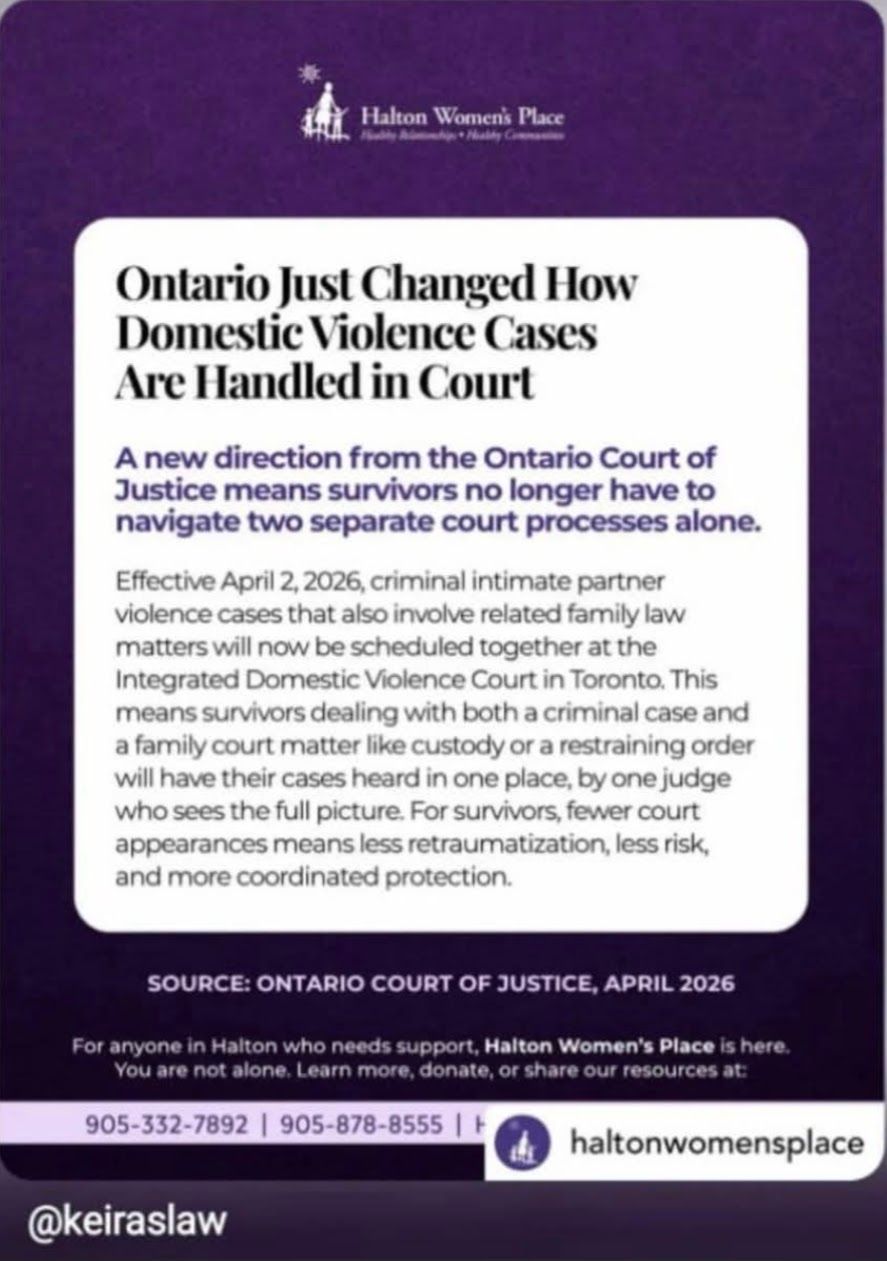
This article was prompted by a LinkedIn post shared by Trish Guise MSc, MBA, discussing Ontario’s move toward an Integrated Domestic Violence Court model. The post immediately stood out because the same fragmentation problem is visible in England and Wales, particularly for litigants in person trying to navigate family court where coercive control, post-separation abuse and criminal proceedings overlap.

Graphic from Halton Women’s Place stating that Ontario has changed how domestic violence cases are handled in court through an Integrated Domestic Violence Court model.
Image credit: Halton Women’s Place, citing Ontario Court of Justice, April 2026. Post seen via Trish Guise MSc, MBA on LinkedIn. Shared here for public-interest commentary on domestic abuse court reform and integrated family and criminal court responses.
Key Takeaways for Litigants in Person
  • Ontario is moving toward a more coordinated model for eligible domestic violence cases involving both criminal and family law issues.
  • Survivors of coercive control often experience the legal system as fragmented, repetitive and retraumatising.
  • Criminal proceedings, police evidence, bail conditions and family court decisions should not be treated as disconnected issues where risk overlaps.
  • Integrated court models may help judges see the full pattern of behaviour rather than isolated incidents.
  • England and Wales should consider whether a properly designed Integrated Domestic Abuse Court pilot could improve safety, evidence management and access to justice.

Ontario has just made a change that should make family justice reformers in England and Wales sit up and pay attention.

From 2 April 2026, certain criminal intimate partner violence cases in Toronto, where there are related family law proceedings, are being scheduled together in the Integrated Domestic Violence Court at 10 Armoury Street.

In practical terms, this means that eligible criminal domestic abuse cases and connected family law issues can be brought before one coordinated court process, with one judge case-managing the connected matters rather than survivors being forced to navigate fragmented proceedings in different places, with different professionals, different timetables, and sometimes completely different understandings of risk.

This matters.

It matters because survivors do not experience domestic abuse as a criminal file over here, a children case over there, a safeguarding concern somewhere else, and a protection issue sitting in another system altogether. They experience it as one lived reality. The legal system, however, often slices that reality into separate jurisdictions, separate applications, separate hearings, separate evidence bundles and separate narratives.

That fragmentation is not a minor administrative inconvenience. In coercive control cases, it can become part of the harm.

Credit and source note: This article was prompted by a LinkedIn post shared by Trish Guise MSc, MBA, Litigation Support & Expert Witness, whose work focuses on coercive control across family, civil and criminal law in Canada and internationally. The image referenced in this article was originally shared by Halton Women’s Place, citing the Ontario Court of Justice, April 2026.

This article is a UK-focused commentary on why the Ontario development matters for family justice reform in England and Wales, particularly for litigants in person dealing with coercive control, post-separation abuse and parallel criminal and family proceedings.

The Ontario Development: What Has Changed?

The Ontario Court of Justice has issued a Practice Direction confirming that, effective 2 April 2026, specified criminal intimate partner violence cases and related family law matters will be scheduled in the Integrated Domestic Violence Court in Toronto.

The key point is coordination. The model is designed for cases where there is both:

  • a criminal intimate partner violence case; and
  • a related family law matter involving issues under the relevant Ontario family law framework.

The Practice Direction is not a magic wand. It does not mean every domestic abuse case will be absorbed into one court. It does not mean all trials will be heard there. In fact, the Ontario direction makes clear that where there are triable issues under the Criminal Code, the Children’s Law Reform Act or the Family Law Act, the proceeding may be referred back to the originating court for trial.

The Integrated Domestic Violence Court is therefore best understood as a coordinated judicial case-management model for connected domestic abuse proceedings.

But even that is significant.

Because in domestic abuse cases, especially cases involving coercive control and post-separation abuse, judicial case management is not just about administrative efficiency. It is about pattern recognition. It is about risk. It is about whether the court understands the case as a whole, or whether it sees only disconnected fragments.

If the harm is integrated, the court response must be integrated too.

The Problem: Survivors Are Forced Through Fragmented Systems

In England and Wales, survivors of domestic abuse can find themselves dealing with several legal processes at the same time. For example:

  • a criminal investigation or prosecution;
  • bail conditions or restraining order issues;
  • private law children proceedings under the Children Act 1989;
  • non-molestation or occupation order proceedings;
  • social care involvement;
  • school or safeguarding concerns;
  • financial control, housing insecurity or immigration issues;
  • police disclosure requests in the family court;
  • Cafcass safeguarding checks and reports;
  • allegations of “parental alienation” or “implacable hostility” being raised in response to abuse allegations.

Each process may have its own language, threshold, burden of proof, timetable and culture. Criminal justice asks whether an offence can be proved. Family justice asks what arrangements are in the child’s welfare interests. Civil protective proceedings focus on risk and protection. Social care may focus on parenting capacity, child protection thresholds and safeguarding plans.

Those differences matter. But the problem is that the systems often do not communicate with each other properly.

The result is that survivors, many of whom are litigants in person, are left carrying the burden of joining up the evidence themselves. They are expected to explain the same history again and again. They are expected to remember dates, incidents, messages, patterns, threats, safeguarding reports, police logs, school issues and children’s reactions. They are expected to understand which evidence matters in which court. They are expected to know how to raise criminal bail conditions in family proceedings, how to ask for police disclosure, how to challenge a report, and how to frame coercive control as a pattern rather than a list of isolated incidents.

That is not access to justice. That is system navigation under trauma.

Fragmentation Minimises Coercive Control

Coercive control is not properly understood by looking at incidents in isolation. It is a pattern of domination, intimidation, restriction, surveillance, threat, punishment, manipulation and control. It often escalates after separation, precisely because the perpetrator has lost direct access to the victim.

In family court, that pattern can become dangerously blurred.

A survivor may describe years of control, intimidation and fear. The alleged perpetrator may present as calm, reasonable and child-focused. Professionals may see two parents in conflict and conclude that the case is “high conflict”. But “high conflict” and coercive control are not the same thing.

High conflict suggests mutual hostility. Coercive control involves a pattern of power, fear and domination.

That distinction matters because the wrong label leads to the wrong intervention.

If the court sees the case as mutual conflict, it may push for communication, co-parenting, mediation-style thinking, parental education, contact progression or “both parents need to move on” reasoning. If the court sees the case as coercive control, it should be asking different questions:

  • What is the history of power and control?
  • What happened during the relationship?
  • What changed after separation?
  • Has the family court process itself become a vehicle for continued control?
  • Are repeated applications, emails, allegations, disclosure demands or contact disputes being used as litigation abuse?
  • Are children being exposed directly or indirectly to fear, manipulation or emotional pressure?
  • Are professionals seeing the full pattern or only the latest application?

That is why integrated case management matters. Not because it solves everything, but because it creates a better chance that someone in the system is holding the whole picture.

The UK Already Knows There Is a Problem

This is not a new issue in England and Wales.

The Ministry of Justice’s 2020 Harm Report examined how the family courts respond to allegations of domestic abuse and other serious harm in private law children cases. The report identified serious structural issues, including the way domestic abuse can be minimised in private law proceedings. It also recognised the problem of silo working.

The Domestic Abuse Act 2021 gave England and Wales a statutory definition of domestic abuse that goes beyond physical violence and includes coercive or controlling behaviour, economic abuse, emotional abuse and psychological abuse. It also recognises children as victims of domestic abuse in their own right where they see, hear or experience the effects of abuse.

On paper, therefore, the legal framework has moved forward.

In practice, litigants in person still encounter a fragmented system.

That gap between legal recognition and courtroom reality is where much of the harm sits.

Pathfinder Is Not Enough If the System Remains Fragmented

The Pathfinder model, now being rolled out more widely under the language of “Child Focused Courts”, is an important development in private law children proceedings. It has been promoted as a less adversarial, more child-focused approach, with earlier information gathering and stronger attention to domestic abuse and safeguarding.

But Pathfinder is still primarily a family court reform.

It does not, on its own, solve the fragmentation between family court and criminal court. It does not automatically place criminal proceedings, police evidence, bail conditions, risk assessment, Cafcass safeguarding, domestic abuse support, children’s welfare, enforcement issues and litigation abuse before one coordinated judicial structure.

That is why the Ontario model is worth watching.

England and Wales should not simply copy and paste another jurisdiction’s approach. Our legal system is different. Our court structures are different. Our family and criminal jurisdictions operate differently. But the principle is directly relevant:

Where domestic abuse gives rise to linked criminal and family proceedings, the system should not require survivors and children to carry the burden of joining up the courts themselves.

Why This Matters So Much for Litigants in Person

For represented parties, fragmentation is difficult. For litigants in person, it can be devastating.

A solicitor can identify which court needs which document. A barrister can frame the relevance of criminal bail conditions to child arrangements. A legally trained advocate can explain why police disclosure is necessary before the court progresses contact. A specialist domestic abuse lawyer can challenge minimising language in a report. A professional can distinguish between isolated allegations and a pattern of coercive control.

A litigant in person is often expected to do all of that alone.

They may be traumatised. They may be frightened. They may be financially controlled. They may have children to protect. They may have no legal aid. They may be dealing with an alleged perpetrator who is calm, articulate and strategic. They may be accused of exaggerating, obstructing contact or failing to co-parent. They may be cross-referencing police incidents, WhatsApp messages, school concerns, GP notes, MARAC referrals, Cafcass safeguarding letters and court orders late at night, while trying to hold their life together.

That is the reality for many litigants in person.

And it is why system design matters.

A fragmented system favours the party with stamina, resources, confidence and procedural knowledge. In coercive control cases, that can mean the system unintentionally advantages the person already using process as power.

The Family Court Must Stop Treating Criminal Proceedings as Background Noise

One of the recurring problems in private law children proceedings is that criminal justice information is often treated as something separate, delayed or peripheral.

There may be an ongoing police investigation. There may be bail conditions. There may be a pending charging decision. There may be digital evidence. There may be body-worn camera footage, 999 calls, DASH risk assessments, officer notes, witness statements or admissions. But the family court timetable may continue moving.

In some cases, the family court is being asked to make decisions about children before the relevant criminal evidence has been obtained, understood or tested.

That is dangerous.

Not because every allegation is automatically proved. Not because the family court must wait indefinitely for the criminal process. Not because contact should be suspended forever simply because a criminal investigation exists.

But because risk cannot be properly assessed if the court refuses to look at the whole evidential landscape.

If a criminal case contains evidence relevant to coercive control, violence, threats, harassment, stalking, non-fatal strangulation, child exposure to abuse, breach of protective conditions or post-separation intimidation, that evidence may be directly relevant to welfare.

It is not background noise. It may be central.

The Same Judge Seeing the Whole Picture Is Not a Luxury

The idea of one judge seeing the connected picture is powerful because coercive control is cumulative.

A single judge who understands the linked family and criminal context is better placed to identify:

  • inconsistent orders between courts;
  • contact proposals that conflict with bail or protective conditions;
  • risk minimisation in professional reports;
  • litigation behaviour that mirrors the abuse pattern;
  • repeated applications used as pressure;
  • children being used as conduits for control;
  • attempts to reframe abuse as parental conflict;
  • whether professional intervention is reducing risk or simply moving the case along.

Domestic abuse cases require more than diary management. They require judicial memory. They require continuity. They require pattern recognition.

Too often, family court hearings are treated as isolated events. One judge deals with an urgent application. Another handles a directions hearing. Another hears a fact-finding issue. Another considers interim contact. Each judge sees part of the file. Each professional sees part of the picture. The survivor keeps having to start again.

That is not a trauma-informed system.

It is a system that repeatedly asks survivors to prove the same context to new people.

Coordination Alone Is Not Enough

There is an important caution here.

An integrated domestic abuse court is only as good as the understanding of the professionals within it.

If judges, lawyers, Cafcass officers, court staff, domestic abuse workers and liaison professionals do not understand coercive control, integration will not be enough. A coordinated court that still mislabels coercive control as conflict will simply process the wrong analysis more efficiently.

That is why any UK model must include specialist training in:

  • coercive and controlling behaviour;
  • post-separation abuse;
  • litigation abuse;
  • economic abuse;
  • trauma presentation;
  • risk assessment;
  • child impact;
  • perpetrator tactics;
  • how abuse can be disguised as concern, reasonableness or child-focused litigation;
  • the difference between conflict and coercive control;
  • the limits of unsupported “parental alienation” narratives where abuse is alleged;
  • how to scrutinise professional reports properly.

This cannot be tokenistic training. It cannot be a one-hour webinar and a laminated checklist. Coercive control is sophisticated. Perpetrators can be sophisticated. Court misuse can be sophisticated. The professional response must be equally sophisticated.

What a UK Integrated Domestic Abuse Court Model Could Look Like

A serious model for England and Wales would need more than branding. It would need structure.

At minimum, a proper integrated domestic abuse court pilot should consider the following features:

1. Linked Family and Criminal Case Identification

There should be a clear mechanism for identifying where parties have connected family and criminal proceedings. This should not depend solely on a distressed litigant in person telling each court what is happening elsewhere.

2. Judicial Continuity

Where domestic abuse and coercive control are alleged, judicial continuity should be treated as a safeguarding feature, not an administrative preference. The same judge, or a small specialist judicial team, should manage the linked proceedings where possible.

3. Domestic Abuse Liaison Support

The court should include trained domestic abuse liaison professionals who understand both court process and survivor safety. Their role should include signposting, safety planning, procedural navigation and coordination with community support services.

4. Early Evidence Mapping

At the start of the case, the court should identify what evidence exists across the systems: police logs, body-worn footage, bail conditions, MARAC information, GP records, school safeguarding material, social care documents, Cafcass safeguarding checks and digital communications.

5. Proper Police Disclosure Pathways

Police disclosure in family proceedings is often slow, inconsistent and poorly understood. A specialist integrated model should have clear disclosure pathways and realistic timetables so that family court decisions are not made in an evidential vacuum.

6. Specialist Risk Assessment

Risk should not be assessed merely by asking whether there has been a recent incident. Coercive control risk is often embedded in patterns: escalation, separation, threats, stalking, harassment, legal intimidation, financial pressure, child contact demands and breach behaviour.

7. Scrutiny of Reports

Cafcass, local authority and expert reports must be properly scrutinised. Reports should not be accepted simply because they carry professional letterhead. The court should ask whether the report writer has understood coercive control, whether they have considered the full evidence, whether they have minimised risk, and whether their recommendations are safe.

8. LiP-Friendly Procedure

If the model is not usable by litigants in person, it will fail the very people who need it most. Orders must be clear. Directions must be practical. Evidence requirements must be explained. Safety measures must be proactive. The court must not assume that a survivor can navigate multi-track proceedings alone.

9. No Automatic Push to Contact Progression

In domestic abuse cases, contact should not be progressed simply because time has passed or because the court wants momentum. Progression must be tied to safety, insight, accountability, child welfare and evidence.

10. Accountability and Data

A UK pilot must publish meaningful data. Not just speed. Not just disposal rates. Not just how quickly cases conclude. The court must measure safety, recurrence, breach, survivor experience, child outcomes, re-litigation and whether allegations of domestic abuse were properly identified and addressed.

Speed Is Not the Same as Justice

This point matters.

There is a real risk that court reform becomes obsessed with speed. Faster hearings. Faster reports. Faster disposal. Faster case closure.

But a fast unsafe decision is not justice.

For survivors and children, the question is not simply “how quickly was the case resolved?” The question is:

  • Was the risk understood?
  • Was the evidence properly gathered?
  • Was coercive control recognised?
  • Were children protected?
  • Was the survivor heard without being retraumatised?
  • Did the court prevent litigation abuse?
  • Were orders safe, clear and enforceable?

Pathfinder and Child Focused Courts will be judged not by branding, but by outcomes. If cases conclude faster but unsafe contact is ordered, risk is minimised, evidence is not properly tested, and survivors are left feeling steamrolled, then the reform will not have solved the problem.

It will simply have made the machinery move faster.

Why England and Wales Need More Ambition

The family justice system in England and Wales is currently trying to reform itself while still operating inside deeply fragmented structures. That is the difficulty.

We have domestic abuse legislation recognising coercive control. We have PD12J in private law children cases. We have Pathfinder reform. We have increased public discussion about post-separation abuse. We have growing criticism of parental alienation arguments being used to obscure domestic abuse. We have more awareness of litigation abuse.

But awareness is not enough.

The court structure itself must change.

It is not reasonable to expect litigants in person to coordinate the criminal court, family court, police disclosure, safeguarding evidence, Cafcass reports, domestic abuse support and children’s welfare issues while also trying to survive the abuse itself.

That is the work of a system. It should not be pushed onto the shoulders of the survivor.

What Ontario Gets Right in Principle

Ontario’s model is not perfect. It has eligibility limits. It is geographically specific. It does not hear all trials. It does not cover every type of family law case. It will need proper evaluation.

But the principle is right.

The principle is that connected domestic abuse proceedings should be seen as connected.

The principle is that survivors should not be sent from one process to another as though each hearing exists in a vacuum.

The principle is that one judge seeing the full picture may reduce inconsistency, duplication, retraumatisation and risk.

The principle is that domestic abuse is not just a collection of incidents. It is a pattern. And a pattern cannot be properly understood if the system only looks at pieces.

The UK Should Pilot Proper Integrated Domestic Abuse Courts

England and Wales should now be looking seriously at a properly designed Integrated Domestic Abuse Court pilot.

Not merely a renamed family court process.

Not merely a faster case management pathway.

Not merely a domestic abuse “flag” on a file.

A genuinely integrated model should bring together the criminal and family dimensions of domestic abuse where proceedings are connected. It should include specialist judicial continuity, domestic abuse liaison, police disclosure pathways, evidence mapping, safeguarding oversight, proper report scrutiny and LiP-friendly procedural design.

It should be built around the lived reality of coercive control, not around the convenience of court silos.

For Litigants in Person, This Could Be Transformational

For represented parties, integrated domestic abuse courts would improve coordination.

For litigants in person, they could be transformational.

They could mean fewer repeated hearings. Fewer inconsistent orders. Less need to explain the same abuse history to different professionals. Better understanding of bail conditions and protective measures. Better scrutiny of contact proposals. Better recognition of litigation abuse. Better identification of coercive control as a pattern. Better protection for children.

Most importantly, they could shift the burden of coordination away from survivors and onto the justice system where it belongs.

That is the real issue.

Litigants in person do not need more slogans about access to justice. They need a system that is actually designed for the reality they are living through.

Related Reading

You may also find our related article on coercive control, family court and post-separation abuse helpful if you are trying to understand how abuse can continue through litigation after separation.

Useful External Sources

  • Ontario Court of Justice Practice Direction: Integrated Domestic Violence Court
  • Ministry of Justice: Assessing Risk of Harm to Children and Parents in Private Law Children Cases
  • Domestic Abuse Act 2021
  • Practice Direction 12J: Child Arrangements and Contact Orders where Domestic Abuse is Alleged

Final Thought

Ontario’s Integrated Domestic Violence Court development should be watched closely by anyone concerned with family justice reform in England and Wales.

It is not the whole answer. But it points in the right direction.

Domestic abuse cases do not sit neatly inside one legal box. Coercive control does not stop at the boundary between criminal and family law. Post-separation abuse often moves through the very systems that are supposed to protect survivors and children.

If the harm is integrated, the court response must be integrated too.

Until England and Wales confront that reality, litigants in person will continue to be left doing the work that the system itself should be doing: joining the dots, explaining the pattern, chasing the evidence, managing the risk and trying to protect their children while navigating a fragmented court process alone.

That is not good enough.

Ontario has taken a step that recognises the problem. The UK should be brave enough to do the same.

Need Support Navigating Family Court?

JSH Law Ltd provides litigation support and McKenzie Friend services for litigants in person, including support with family court preparation, position statements, evidence organisation, safeguarding issues, coercive control allegations, Cafcass reports and hearing preparation.

If you are dealing with private law children proceedings and feel overwhelmed by the process, you do not have to prepare alone.

Contact JSH Law Ltd to discuss litigation support for your case.

Regulatory & Editorial Notice

This article is published by JSH Law Ltd for general information and public legal education only. It does not constitute legal advice and should not be relied upon as a substitute for advice from a qualified solicitor or barrister about your specific circumstances.

JSH Law Ltd provides litigation support and McKenzie Friend services to litigants in person. JSH Law Ltd is not authorised or regulated by the Solicitors Regulation Authority or any other approved legal services regulator. It does not conduct litigation, does not carry out reserved legal activities, and has no automatic right of audience. Where court attendance or advocacy support is requested, any right to address the court is subject to the court’s permission.

References to third-party posts, organisations, court developments or public materials are included for commentary, analysis and public-interest discussion. Credit is given where known. Inclusion of a third-party source does not imply endorsement by that person or organisation.

https://jshlaw.co.uk/wp-content/uploads/2026/02/ChatGPT-Image-Feb-3-2026-03_26_42-AM.png 1024 1536 jessica susan hill https://jshlaw.co.uk/wp-content/uploads/2026/01/jsh-law-logo-new-black-300x67.png jessica susan hill2026-05-07 09:24:102026-05-07 11:12:46Ontario’s Integrated Domestic Violence Court: Why the UK Should Be Watching

Closing the DBS Loophole: Why Civil Harassment Orders Must Appear on Enhanced DBS Checks

January 17, 2026/0 Comments/in 6. Tools Templates Research & Cases, Safeguarding Reform/by jessica susan hill

A safeguarding gap hiding in plain sight

A current petition before UK Government and Parliament calls for an urgent and necessary reform:
civil harassment orders, including court-issued undertakings, should be disclosed on Enhanced DBS checks.

At present, a person may be subject to serious civil restrictions imposed by a court—often following repeated harassment, intimidation, or coercive conduct—yet still pass an Enhanced Disclosure and Barring Service (DBS) check and lawfully work with children or vulnerable adults.

That is not a technical oversight.
It is a safeguarding failure.


What is the current problem?

The DBS regime is commonly understood—by employers, volunteers, and the public—as a robust safeguarding mechanism. In reality, it is narrower than many assume.

Enhanced DBS checks primarily disclose:

  • criminal convictions and cautions;
  • relevant police intelligence (at the discretion of the chief officer);
  • barred-list status where applicable.

Civil outcomes, however, sit in a grey area.

This includes:

  • civil harassment orders;
  • undertakings given to a court in lieu of findings;
  • non-criminal protective orders arising from family or civil proceedings.

These measures are often imposed precisely because a court has determined that conduct poses a risk, even if it does not meet the criminal standard of proof or has not resulted in prosecution.

Yet in many cases, they are not automatically disclosed.


Why undertakings matter in safeguarding contexts

In family and civil courts, undertakings are not casual promises. They are legally binding court orders.

They are frequently used where:

  • repeated harassment is evidenced;
  • power imbalances make findings difficult;
  • victims are retraumatised by adversarial fact-finding;
  • courts prioritise immediate protection over punitive outcomes.

The absence of findings does not mean the absence of risk.

Courts routinely accept undertakings because:

  • the behaviour alleged is serious enough to justify restriction;
  • the respondent agrees that restraint is necessary;
  • ongoing contact with children or vulnerable people may be relevant.

Failing to reflect this in safeguarding disclosures creates a false sense of safety.


The real-world safeguarding risk

This loophole allows individuals who are under active court-imposed behavioural restrictions to:

  • work in schools, nurseries, and colleges;
  • volunteer with youth organisations;
  • access vulnerable adults in care or support settings.

Employers relying on Enhanced DBS checks are not negligent—they are misled by a system that implies completeness while omitting critical context.

Safeguarding depends on informed risk assessment, not binary criminal labels.


Why police discretion is not enough

It is sometimes argued that police intelligence disclosure fills this gap. In practice, this is unreliable.

Police disclosure depends on:

  • local recording practices;
  • subjective relevance assessments;
  • fragmented information-sharing between civil courts and policing bodies.

Many civil harassment outcomes never reach police databases in a form that triggers discretionary disclosure.

Safeguarding should not depend on chance.


The petition: a proportionate and necessary reform

The petition does not call for:

  • criminalisation by the back door;
  • automatic barring;
  • retrospective punishment.

It calls for transparency.

Disclosure would allow:

  • employers to assess risk proportionately;
  • safeguarding leads to put controls in place;
  • vulnerable people to be protected without stigma or assumption.

Disclosure is not a sanction.
It is information.


Why this matters particularly in family-law contexts

Those familiar with family proceedings know that:

  • abuse often presents as coercive, controlling, or cumulative;
  • victims may withdraw allegations under pressure;
  • findings are not always pursued for child-focused reasons.

A civil court may still conclude that restrictions are essential, even where criminal thresholds are not met.

To ignore those outcomes in safeguarding checks is to misunderstand how harm actually manifests.


A system built for safeguarding must reflect reality

Safeguarding frameworks must align with how risk is identified in practice, not just in criminal law theory.

If a court has deemed it necessary to restrict someone’s behaviour to protect another person, that information is plainly relevant where:

  • children are involved;
  • vulnerable adults are at risk;
  • positions of trust are held.

Anything less undermines public confidence in safeguarding systems.


Final thoughts

This petition highlights a quiet but serious flaw in the safeguarding infrastructure.

Closing the DBS loophole would:

  • strengthen child and vulnerable-adult protection;
  • support employers in making informed decisions;
  • respect due process while prioritising safety;
  • reflect the reality of civil-court risk management.

Safeguarding should never rely on incomplete information.

This is not about punishment.
It is about protection.


Sign the Petition

If you work in safeguarding, family law, education, or care—or if you have experienced the limitations of current disclosure systems—you may wish to review and support the petition calling for reform of Enhanced DBS disclosures.

Require civil harassment orders to be disclosed in enhanced DBS checks – Petitions

Informed systems protect people.
Opaque systems protect risk.


Regulatory & Editorial Notice
This article is published for general information and public-interest discussion only. It does not constitute legal advice. References to safeguarding frameworks, civil orders, or DBS processes are illustrative and may not apply to individual circumstances. Allegations are not findings. Readers should seek independent legal or professional advice where appropriate.

https://jshlaw.co.uk/wp-content/uploads/2026/01/ChatGPT-Image-Jan-17-2026-12_34_17-AM.png 1024 1536 jessica susan hill https://jshlaw.co.uk/wp-content/uploads/2026/01/jsh-law-logo-new-black-300x67.png jessica susan hill2026-01-17 00:37:402026-02-03 03:35:20Closing the DBS Loophole: Why Civil Harassment Orders Must Appear on Enhanced DBS Checks

Jessica Susan Hill – McKenzie Friend Services Logo

How I Can Help

I provide independent, procedural family court support for litigants in person and professionals navigating complex or high-conflict cases.

My work focuses on:

– Case strategy and procedural clarity

– Evidence review, chronology building, and issue framing

– Statement drafting and refinement

– Court-ready bundles and document compliance

– Support alongside solicitors, counsel, or directly with litigants in person

Support is provided remotely, on an hourly basis, with clear boundaries and no false promises.

This is about structure, preparation, and informed decision-making.


Book a Case Review

About the Author

About the Author

Jessica Susan Hill

McKenzie Friend · Family Court Support

I support litigants in person and professionals in complex private children and
safeguarding-related family court proceedings
.

My work is procedural, strategic, and evidence-focused — helping clients understand process,
prepare properly, and present their case clearly and coherently.

I regularly work alongside solicitors and counsel, or directly with litigants in person,
providing structured support in cases where clarity, preparation, and proportionality matter.

This site exists to reduce confusion, not create false hope.


→ About JSH Law

Procedural support · Evidence preparation · Court-ready documentation

Start Here (Key Guides)

Start Here

If you’re new to family court or feeling overwhelmed, begin with these guides:

  • Before You Apply to Court
  • Understanding Cafcass and Section 7 Reports
  • Safeguarding, Domestic Abuse, and Risk Framing
  • Preparing Your Evidence, Chronology, and Statements
  • Common Mistakes Litigants in Person Make

Practical, procedural guidance — written for real cases, not theory.

Categories

Family Court Procedure
Litigants in Person Guidance

Cafcass & Reports

Safeguarding & Domestic Abuse

Case Studies (Anonymised)

Family Court Accountability

AI & Legal Process

Free Resource

Family Court Preparation Checklist (PDF)

A practical, procedural checklist covering:

  • what to organise before issuing or responding
  • evidence and chronology basics
  • common preparation mistakes to avoid


→ Download Free Checklist

Procedural guidance only · Not legal advice

Authorities Used

– Family Procedure Rules 2010, SI 2010/2955 (U.K.), rr. 1.1, 1.3, pts. 3, 6, 17, 22, 25, 9.
– Practice Direction 3A (MIAM).
– Practice Direction 12B (Child Arrangements Programme).
– Practice Direction 12J (Domestic Abuse and Harm).
– Practice Direction 22A (Evidence).
– Practice Direction 27A (Court Bundles).
– Children Act 1989, c. 41 (U.K.)

Related Reading

You may also find these articles helpful:

  • Understanding Cafcass Reports and Common Errors
  • How Evidence Is Weighed in Family Court
  • Safeguarding Allegations and Risk Assessment
  • Preparing a Chronology the Court Can Follow

Articles are grouped by topic for clarity.

Latest news

  • If Victims Need Legal Advisers in Crown Court, Why Are Parents Still Facing Family Court Alone?June 5, 2026 - 9:13 pm

    The Government has announced a £5 million pilot scheme to provide independent legal advisers for domestic abuse victims in Crown Court cases. While the move is welcome, many family court litigants continue to face complex proceedings without legal representation or meaningful support. What does this reform mean, and what lessons could family justice learn from it?

  • Contact With Your Child Has Stopped: What to Do Before the Family Court Treats It as the New NormalJune 4, 2026 - 4:32 pm

    Has contact with your child suddenly stopped, or is an existing child arrangements order no longer being followed? This guide explains why delay can make a safe parent-child relationship harder to repair, what evidence the court will examine, when enforcement may be appropriate and how litigants in person can prepare a clear, child-focused case.

  • Your Family Court Case Is Taking Too Long: How to Stop Delay Damaging Your Child and Your PositionJune 4, 2026 - 2:40 pm

    Has your family court case stalled while your child’s life continues to change? This guide explains why delay matters, what the Children Act 1989 says, how to distinguish necessary delay from avoidable drift, and the practical steps litigants in person can take to protect their position and keep the court focused on the child.

FAMILY LAW NEWS & UPDATES:

  • 1. Start Here (11)
    • Before You Apply to Court (2)
    • Common Mistakes (1)
    • Family Court Reality (4)
    • FAQs for Litigants in Person (1)
    • Litigants in Person – Family Court Guidance (3)
  • 2. Family Court Procedure (21)
    • Court Etiquette (1)
    • Court Process & Judicial Approach (2)
    • Forms & Applications (3)
    • Hearing Types (3)
    • MIAM & Mediation (1)
    • Procedural Updates (8)
    • Transparency & Reporting (2)
    • Urgent Applications (2)
  • 3. Cafcass & Reports Cluster (6)
    • Challenging Cafcass Reports (1)
    • Child Impact Analysis (1)
    • Safeguarding Checks (2)
    • Section 7 Reports (1)
    • The Child’s Voice (1)
  • 4. Domestic Abuse & Safeguarding Cluster (20)
    • Child Safety & Emotional Harm (1)
    • Coercive Control (3)
    • PD12J & Fact Finding (2)
    • Post Separation Abuse (3)
    • Protective Orders (2)
    • Safeguarding & Child Protection (4)
    • Safety Planning (2)
  • 5. Court Skills for Litigants in Person (37)
    • Advocacy Skills (1)
    • Bundles & Documents (1)
    • Evidence Explained (1)
    • Evidence Readiness (1)
    • Family Court Procedure (8)
    • Litigants in Person Support (2)
    • McKenzie Friend Support (15)
    • Personal Development for LiPs (5)
    • Remote Hearings (1)
  • 6. Tools Templates Research & Cases (32)
    • AI & Legal Process (17)
      • AI & Justice Reform (4)
      • Judicial Review & AI (8)
    • Case Studies (Anonymised) (2)
    • Family Court Accountability (3)
    • Legal Reflections (5)
    • Safeguarding Reform (3)
    • Templates & Checklists (2)

Important Notice

Information on this site is provided for procedural guidance and general information only.
It does not constitute legal advice and does not create a solicitor–client relationship.

If you require legal advice, you should consult a qualified solicitor.

SUBSTACK SIGNUP

FOLLOW | SHARE | CONTACT

USEFUL LINKS

If you are representing yourself in family court, the following independent and authoritative resources may assist you in understanding procedure, safeguarding processes, and available support.

  • – GOV.UK – Family Court Guidance 
  • – HM Courts & Tribunals Service – Court Forms & Fees
  • – Cafcass – Understanding Cafcass
  • – Advicenow – Practical Guides for LiPs
  • – McKenzie Friends Official Guidance
  • – Support Through Court
  • – Rights of Women – Family Law & Abuse Guidance
  • – Family Law in the 21st Century (Baroness Hale)
  • – Inside the UK Supreme Court
X Logo X Logo Followon X RSS Feed Logo RSS Feed Logo Subscribeto RSS Feed

FOLLOW | SHARE | CONTACT

Companies, Charities, Groups

  • Child Law Project (Ireland)

Petitions

  • Make all court and tribunal transcripts available free of charge

CLIENT DOCUMENTS

Standard Client Agreement & Terms of Business

Compliance & Protection

  • Terms of Service
  • Privacy Policy
  • Disclaimer
  • Complaints Procedure
  • Safeguarding Statement

Services

  • Services
  • Family Court Navigation & Case Strategy – Procedural clarity for litigants in person
  • Safeguarding, Cafcass & Local Authority Matters
  • Court Documents, Statements & Submissions
  • Hearing Support & McKenzie Friend Services

Do You Need to Talk?

We’re a Christ-focused community, doing our best to love and serve others.  Meet online or in person. We’ll answer your questions and introduce you to your local church community. All are welcome.

CATCH THE LATEST JSH LAW ON SUBSTACK

News Categories

Resources Hub

  • 1. Start Here
  • 2. Family Court Procedure
  • 3. Cafcass & Reports Cluster
  • 4. Domestic Abuse & Safeguarding Cluster
  • 5. Court Skills for Litigants in Person
  • 6. Tools Templates Research & Cases

Matters I Support

  • Matters I Can Help With
  • Core Private Law Children Matters
  • Safeguarding, Welfare & Professional Involvement
  • Hearings, Process & Court Navigation
  • Documentation, Evidence & Case Preparation
  • Appeals, Reviews & Procedural Challenges
  • High-Conflict or Complex Case Dynamics
  • Additional Procedural Matters Litigants Ask About

Business Hours

Our support Hotline is available 24 Hours a day: (+44) 07564 236528

  • Monday-Friday: 9am to 5pm
  • Saturday: 10am to 2pm
  • Sunday: Closed

WORKING WITH JSH LAW

What is a McKenzie Friend

Working With JSH Law

UK Family Court Preparation Checklist

My Qualifications – What are the SQE’s?

Message me on WhatsApp

For direct, confidential support:


Message me on WhatsApp

Sign Into Clio to View Your Case Progress

Secure client portal & documents


Download the Clio for Clients app

Review Us On Google

© Copyright - JSH Law | Family Court Support & Litigation Assistance - Enfold WordPress Theme by Kriesi
  • Terms of Service
  • Privacy Policy
  • Disclaimer
  • Complaints Procedure
  • Safeguarding Statement
Scroll to top Scroll to top Scroll to top