
 © 2026 JSH Law Ltd. All rights reserved.
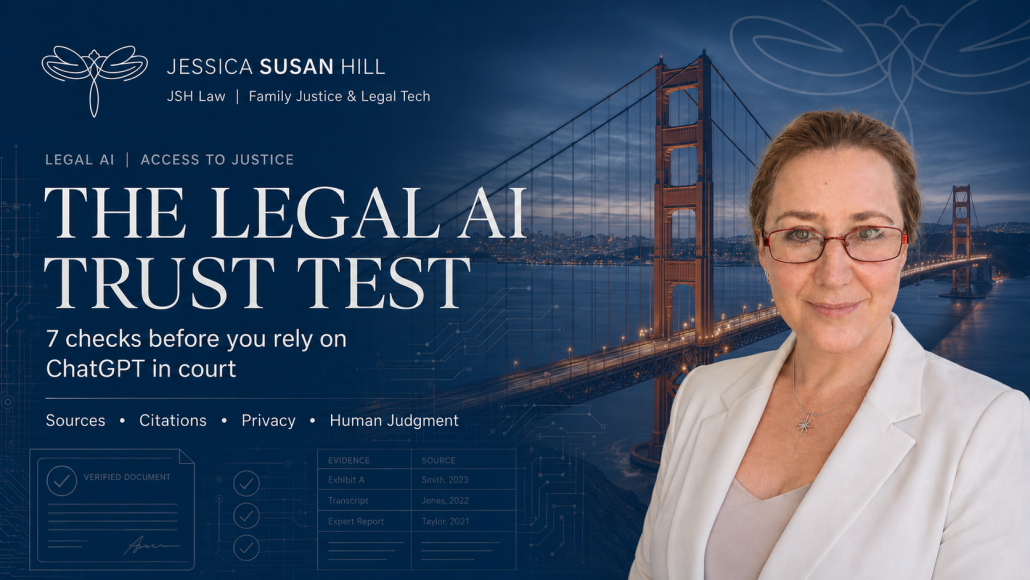
The Legal AI Trust Test: Seven Checks Before You Rely on ChatGPT or Any AI in Court
Published: 31 July 2026 | Last reviewed: 31 July 2026
Using ChatGPT in court can help a litigant in person organise evidence, understand procedure and prepare clearer documents. But an AI-generated answer can appear authoritative while containing invented cases, inaccurate law or distorted facts. Before relying on any AI-assisted statement, chronology or submission, you need a reliable method for checking its accuracy, sources, confidentiality and evidential integrity.
Legal AI • Family Court • Litigants in Person
Using ChatGPT in Court: The Seven-Point Legal AI Trust Test
AI can help organise evidence, explain procedure and improve court documents. But a polished answer is not proof of a correct answer. Before relying on anything generated by ChatGPT, Copilot, Claude or another AI system, verify it.
For many litigants in person, artificial intelligence can be genuinely useful.
It can turn hundreds of pages of notes into a working chronology. It can explain unfamiliar legal terminology. It can identify repetition in a witness statement, suggest a clearer structure for a position statement and help someone who is overwhelmed by paperwork begin to make sense of their case.
That access-to-justice potential matters.
But Family Court proceedings also contain exactly the kinds of material that AI can mishandle most dangerously: disputed allegations, confidential information, children’s records, questions of credibility, domestic abuse, coercive control, professional reports and legal rules that change over time.
A confident answer is therefore not enough.
The right question is not “Did AI write this well?” It is “Can I prove that this is accurate, current, fair and safe to put before the court?”
What do the courts currently say about AI?
The judicial approach is not that generative AI must never be used.
The concern is unverified use.
Current judicial guidance recognises that AI chatbots are being used by unrepresented litigants and that, for some people, they may be the only source of assistance available.
At the same time, the guidance warns that AI systems can produce inaccurate or fabricated material. Where it appears that AI may have been used to prepare submissions or documents, a judge may ask what checks for accuracy have been undertaken.
The litigant remains responsible for what they put before the court.
A Family Court warning from the Court of Appeal
In D (A Child) (Recusal) [2025] EWCA Civ 1570, the Court of Appeal dealt specifically with erroneous citation of authority by a litigant in person in Family Court proceedings.
The court recognised why an unrepresented person might turn to AI for help and acknowledged that AI can be useful when used properly. But it also warned that AI is not an authoritative or infallible source of legal knowledge and highlighted the danger of hallucinated or wrongly applied case law.
The position is still developing
The Civil Justice Council has been examining the use of AI in preparing court documents.
Its June 2026 update identified particular concerns around witness statements, including the risk that AI may reshape, embellish or otherwise influence a witness’s evidence.
The Council also expressly recognised that litigants in person present distinct and evolving issues requiring further consideration.
The JSH Law Seven-Point Legal AI Trust Test
Before relying on AI-generated material in a Family Court statement, position statement, chronology, application, skeleton argument or submission, work through all seven checks.
1. Has the AI used the correct jurisdiction?
“UK law” is not precise enough.
England and Wales, Scotland and Northern Ireland have separate legal systems. Generative AI may also produce American, Canadian or Australian law because legal terminology overlaps between jurisdictions.
Even within England and Wales, the answer may differ according to the proceedings.
Private children proceedings, public law children cases, financial remedies, divorce, domestic abuse injunctions and appeals all have different legal and procedural frameworks.
2. Can you identify an authoritative source?
A legal answer should lead you back to something you can independently check.
Depending on the point, that might include:
- legislation;
- the Family Procedure Rules;
- a current Practice Direction;
- an official form;
- a published judgment;
- Judiciary guidance;
- GOV.UK or HMCTS material;
- Cafcass or Cafcass Cymru guidance; or
- another reliable primary source.
A case name produced by an AI system is not itself verification.
3. Does the source actually support the proposition?
This is where superficial checking fails.
AI can provide:
- a genuine case that says something different;
- a correct quotation attached to the wrong proposition;
- a party’s submission presented as the judge’s conclusion;
- a dissenting observation presented as binding law;
- a procedural rule stripped of an important exception; or
- a case from the wrong factual or procedural context.
If you intend to rely on a judgment, open it and read the relevant paragraphs.
4. Is the law current?
A real source can still be out of date.
A judgment may have been overturned or qualified. A Practice Direction may have been amended. A form may have been replaced. A pilot scheme may have started or ended.
Family procedure changes regularly, which makes “I found a source” different from “I checked the current source”.
5. Has the AI separated allegation, evidence, inference and finding?
This is one of the most important checks in Family Court work.
AI summarisation can quietly turn:
- an allegation into an established fact;
- a suspicion into a conclusion;
- a child’s reported words into a direct quotation;
- a professional observation into a diagnosis;
- an interim judicial comment into a formal finding;
- a parent’s interpretation into “what the child thinks”;
- several disagreements into a finding of coercive control; or
- a recommendation into an order that was never made.
Those distinctions can determine the whole direction of a family case.
6. Is the information being handled safely?
Do not assume that a consumer AI service is confidential simply because you are logged into a personal account.
Different providers, plans and settings may have different arrangements concerning retention, processing, human review, training and use of uploaded material.
Family Court files may contain:
- children’s names and dates of birth;
- addresses and contact information;
- medical information;
- school and SEND records;
- Cafcass reports;
- local-authority material;
- police disclosure;
- domestic-abuse allegations;
- financial information;
- expert reports;
- confidential legal advice; and
- information about third parties who have not consented to its processing.
7. Has there been meaningful human review?
Human review does not mean reading the final document and deciding that it “sounds right”.
Meaningful review means independently checking the work.
That includes:
- checking dates against source documents;
- opening every important authority;
- checking quotations word for word;
- identifying disputed allegations;
- removing unsupported inference;
- checking bundle references;
- testing whether the language overstates the evidence;
- checking that the document answers the actual issues before the court; and
- ensuring the final document remains the litigant’s case rather than the AI’s reconstruction of it.
Why Family Court proceedings require particular care
Family proceedings are unusually vulnerable to poor AI analysis because so much depends on context.
The court may need to evaluate:
- patterns of behaviour;
- domestic abuse and coercive control;
- credibility;
- risk and safeguarding;
- the child’s wishes and feelings;
- professional assessments;
- the effect of delay;
- the welfare consequences of competing proposals; and
- the distinction between historic allegations and findings already made.
AI can help organise the information relevant to those questions.
It cannot safely decide who is telling the truth.
It cannot determine whether a child has been manipulated, whether coercive control is established, whether a witness is credible or what child-arrangements order is in a child’s best interests.
A practical example
Imagine an AI system reads several years of messages and produces this sentence:
“The father has systematically alienated the child from the mother.”
The wording sounds forceful, but several problems may be hidden inside it.
Has “alienation” ever been professionally assessed? Has the court made such a finding? Are there alternative explanations for the child’s reluctance? What specific behaviour is actually evidenced?
“The mother is concerned about the deterioration in the child’s relationship with her following the events set out in the chronology. She relies on the missed arrangements at C42–C49 and the child’s reported comments recorded at paragraph 31 of the Cafcass report. She asks the court to consider the reasons for the deterioration and whether further assessment or directions are required.”
The second version presents the concern without pretending that a disputed explanation has already been proved.
AI and witness statements: particular caution is required
Witness statements are not simply another drafting exercise.
They are evidence.
The Civil Justice Council’s current work on AI has highlighted the importance of preserving the authenticity, integrity and personal recollection of the witness.
That matters because generative AI is designed to produce coherent language. It may therefore:
- smooth out uncertainty that was genuinely present;
- add causal connections the witness never made;
- replace ordinary language with legal conclusions;
- strengthen an allegation beyond the witness’s recollection;
- turn “I think” into “I know”;
- insert emotion the witness did not express;
- create neat chronology where the witness actually remembers events approximately; or
- make every paragraph sound as though it came from a lawyer.
Statements of truth make this especially important
Under Part 17 of the Family Procedure Rules , a witness statement is one of the documents that must be verified by a statement of truth.
The witness is confirming an honest belief in the truth of the facts stated.
AI cannot hold that belief for them.
Confidentiality: the problem is bigger in Family Court
Judicial AI guidance repeatedly stresses the importance of protecting private information when using public AI systems.
The Chancellor of the High Court has also drawn attention to confidentiality and legal professional privilege in the age of AI, noting the importance of using systems whose security has actually been assessed rather than simply assumed.
That has obvious relevance to family proceedings.
Before entering any case material into an AI system, consider whether you can:
- remove names;
- remove dates of birth;
- remove addresses;
- replace parties with Applicant / Respondent;
- remove children’s school details;
- exclude irrelevant medical information;
- summarise the relevant passage rather than upload the whole report; or
- ask the question without supplying the confidential document at all.
Safer and higher-risk uses of AI in Family Court work
| Potentially useful with human checks | Higher-risk use |
|---|---|
| Explaining unfamiliar legal terminology in plain English | Giving a definitive opinion about who will win |
| Creating a blank chronology structure | Deciding which disputed events really happened |
| Sorting verified events by date | Guessing missing dates or inventing connective facts |
| Identifying repetition in a draft | Removing material simply because AI thinks it is unimportant |
| Improving headings and readability | Rewriting evidence until it no longer reflects the witness’s account |
| Suggesting legal research terms | Relying on an AI-generated case summary without reading the judgment |
| Testing whether a position statement identifies the orders sought | Allowing AI to decide what order is in the child’s best interests |
| Creating an evidence-index template | Deciding whether an allegation has been proved |
| Checking whether every paragraph has an evidence reference | Inventing bundle references |
| Turning verified notes into questions for further research | Diagnosing trauma, alienation, personality disorder or coercive control |
What meaningful human review actually looks like
If AI has helped produce an important document, use a structured review rather than simply proofreading it.
- Return to the original evidence. Do not verify an AI summary by reading another AI summary.
- Verify every important date. Check orders, messages, emails and records.
- Verify every quotation. Make sure the words are exact and the context has not changed their meaning.
- Check every authority. Locate the actual legislation, rule or judgment.
- Check the proposition. Make sure the source says what the draft says it says.
- Check the status of factual material. Mark allegations, findings, admissions, professional opinions and disputed evidence accurately.
- Remove AI inference. Delete conclusions that are not supported by evidence.
- Check proportionality. AI often makes documents longer. Remove repetition and irrelevant legal language.
- Restore the human voice. A witness statement should sound like the witness, not a machine imitating a barrister.
- Keep a simple verification record. Note which authorities and important factual propositions were checked.
If you begin the review by assuming that the AI output is probably correct, “human review” can become little more than approval. Start instead with the assumption that every important proposition must be independently justified.
Using AI for common Family Court documents
Chronologies
AI can help sort verified dates and standardise entries, but every event must be checked against the source. Watch for invented dates, duplicated events, changed quotations and allegations presented as facts.
Position statements
AI can help shorten and structure a position statement. Check that it addresses the purpose of the actual hearing, does not introduce new evidence and accurately identifies the orders sought.
Witness statements
Use particular caution. The evidence must remain the witness’s own truthful account and any statement of truth must be understood and honestly adopted.
Schedules of allegations or issues
AI may help create a table structure, but it should not decide which allegations are proved, merge incidents or rewrite allegations in a way that materially changes them.
Cafcass report responses
AI can help organise factual corrections and questions. Do not instruct it to “prove Cafcass is biased”. Identify the paragraph, the evidence, the error or disagreement and why it matters to the child’s welfare.
Legal research
AI can suggest research routes. Treat it as a starting point, not as the authority itself.
- Are the dates correct?
- Are quotations exact?
- Do cited cases actually exist?
- Have you read the relevant passages?
- Is the law current?
- Are disputed allegations labelled fairly?
- Does the document accurately reflect your evidence?
- Can you explain how it was checked?
A safer way to prompt AI about a Family Court case
Better instructions can reduce risk, although no prompt removes the need for verification.
Instead of:
consider a narrower instruction such as:
Or for editing:
Or for research:
The access-to-justice issue cannot be ignored
There is a real inequality emerging around legal AI.
Large organisations can purchase specialist databases, secure systems, professional training and expert supervision.
A litigant in person may instead be using a free consumer chatbot late at night, days before a hearing, while trying to understand a bundle that runs to hundreds of pages.
Simply telling people “do not use AI” is therefore unlikely to solve the problem.
A more realistic access-to-justice model is:
- AI for organisation, explanation and first-stage drafting;
- primary sources for verification of law and procedure;
- careful handling of confidential information;
- clear separation of evidence, allegation and finding;
- human judgment before anything is relied upon; and
- targeted professional support where the risk or complexity justifies it.
Responsible legal AI is not a chatbot that produces impressive prose. It is a verification process.
Frequently asked questions
Can I use ChatGPT to help with Family Court documents?
AI can assist with organisation, explanation, structure and drafting. You remain responsible for the final document and should independently verify important factual and legal material.
Do I have to tell the Family Court that I used AI?
There is currently no general Family Procedure Rule requiring a litigant in person to label every responsibly AI-assisted document simply because AI was used. The position is evolving, particular documents or directions may raise different issues, and the Civil Justice Council continues to consider AI use in court-document preparation.
If a judge asks whether AI was used or what checks were undertaken, answer honestly.
Can a judge ask how I checked an AI-generated document?
Yes. Current judicial AI guidance expressly contemplates judges asking an unrepresented litigant what accuracy checks were undertaken where AI appears to have been used.
Can AI find cases for me?
It can suggest cases and search terms, but you should independently locate and read the judgment. Confirm the neutral citation, court, date, relevant paragraph and whether later authority affects it.
Can I upload my whole Family Court bundle?
Do not assume this is safe. Consider confidentiality, children’s personal data, court restrictions, provider terms, retention and privacy settings. Use the minimum information necessary and redact where appropriate.
Can AI prepare my chronology?
It can assist with sorting verified information and formatting entries. Every date, event and evidence reference must still be checked against the original material.
Can AI write my witness statement?
It can assist with structure and editing, but the evidence must remain yours. You must understand and honestly adopt the factual contents, particularly where the statement is verified by a statement of truth.
Can I rely on a case citation if AI gives me a link?
No. Opening the link is only the first step. Read the judgment and confirm that it actually supports the proposition for which you intend to rely on it.
What if AI and an official source disagree?
Do not treat the AI output as the authority. Check the current legislation, rule, Practice Direction, judgment or official guidance and obtain further help if the position remains unclear.
Want a Human Check Before You File?
JSH Law can help review AI-assisted Family Court work against your source material, identify unsupported assertions, organise evidence and improve the clarity of statements, chronologies, Cafcass responses and position statements.
Book a 15-minute introductory telephone consultation to discuss the document or hearing you are preparing for.
An introductory call does not itself constitute legal advice or create a solicitor-client relationship.
Primary sources and further reading
- Judiciary – Artificial Intelligence (AI): Judicial Guidance, October 2025
- Civil Justice Council – Use of AI in Preparing Court Documents
- D (A Child) (Recusal) [2025] EWCA Civ 1570
- Ayinde v London Borough of Haringey; Al-Haroun v Qatar National Bank [2025] EWHC 1383 (Admin)
- Family Procedure Rules Part 17 – Statements of Truth
- Practice Direction 17A – Statements of Truth
- Chancellor of the High Court – Legal Professional Privilege in the Age of AI
 © 2026 JSH Law Ltd. All rights reserved.

 jsh law ltd
 © 2026 JSH Law Ltd. All rights reserved.
Leave a Reply
Want to join the discussion?Feel free to contribute!