
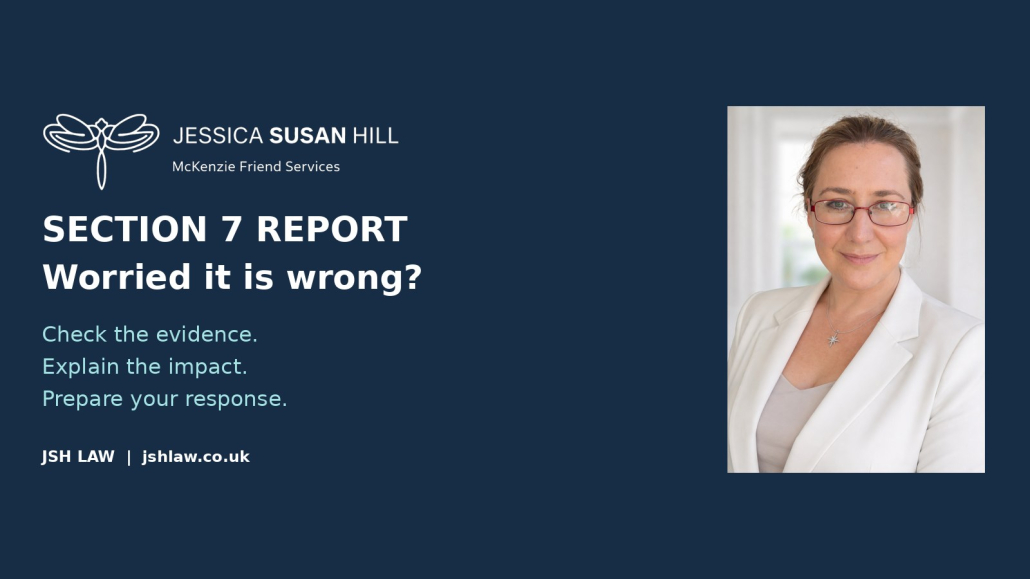
Section 7 Reports in Family Court: What They Are and How to Respond
JSH LAW · CAFCASS & CHILD ARRANGEMENTS · England & Wales · Substantively reviewed 27 October 2026
Received a Section 7 report and worried the court will simply follow it?
A Section 7 report helps the family court assess a child’s welfare. Its recommendations can be influential, but the judge makes the decision. If you disagree, identify the exact passage, the evidence that matters and the action you want the court to consider.
This guide explains the report and gives you a practical way to prepare a clear response—without burying important safeguarding concerns in pages of argument.
What is a Section 7 report in family court?
Under section 7 of the Children Act 1989, the court can request a report about specified aspects of a child’s welfare. Cafcass in England, a Welsh family proceedings officer in Wales, or a local authority may prepare it. The court determines its scope; the legislation allows a written or oral report.
The report is evidence and welfare analysis. It does not itself change an existing child arrangements order. Read its recommendations alongside the actual court orders rather than treating the report as a new set of binding arrangements.
What should the court be considering?
The child’s welfare is paramount. In opposed decisions about making, varying or discharging a section 8 order, the section 1 welfare checklist includes wishes and feelings, assessed in light of age and understanding; physical, emotional and educational needs; the effect of change; relevant personal characteristics; harm; the adults’ ability to meet needs; and the court’s available powers.
Your practical task is to show why a particular point affects this child. “The report is unfair” gives the court less to work with than “The recommendation relies on a school attendance assumption that the attendance record contradicts, and that affects the proposed weekday arrangements.”
Is a safeguarding letter or Child Impact Report the same document?
Check the title and the order requesting it. A safeguarding letter is a different stage of assessment from a full Section 7 report. For that earlier document, see our guide to challenging errors in a Cafcass safeguarding letter.
In the investigative or Pathfinder pathway, you may receive a Child Impact Report. Cafcass Cymru’s introductory letter explains that this summarises its work for the court. Do not assume the timetable or hearing stages in another family’s case apply to yours. Use your own directions and the applicable pathway.
How to prepare before speaking to Cafcass
You do not need a polished performance. You need a manageable account of the child’s life, the disputed arrangements and the information the assessment needs. It is reasonable to ask how the meeting will work and to explain any communication, language, disability or trauma-related needs.
- Read the order commissioning the report. Make a short list of the questions it asks.
- Prepare a brief chronology of events relevant to those questions, with dates and source references.
- Describe the child’s routine, health, education, relationships and practical needs.
- Separate what you personally observed from what somebody told you, and from what you infer.
- Identify the most relevant existing records. Ask how they should be supplied; do not send an unrequested archive.
- Explain the arrangements you propose and how they address safety and the child’s needs.
Cafcass’s Section 7 information describes assessment work with adults and children and possible enquiries with others. The work depends on the child and the court’s questions; it does not mean every person or document you identify will automatically be consulted.
Support your child to speak freely. Do not rehearse answers, repeatedly question them or ask them to choose between parents. If they spontaneously disclose something concerning, record their words and context accurately and raise the concern through an appropriate safeguarding route.
Read the report in three passes
First: understand what is actually recommended
Read the recommendations and the reasons supporting them. Highlight what you agree with as well as what you dispute. Identify any ambiguity: who would supervise contact, how would handovers work, and what would trigger a review?
Second: check the factual foundation
Check names, dates, existing orders and the description of important events. Ask whether an allegation is correctly attributed, whether an admission or finding is accurately recorded, and whether a record of a disclosure has been confused with proof that the reported event occurred.
A police decision to take no further action does not, by itself, decide whether domestic abuse occurred for family proceedings. Equally, a concern recorded by a professional is not automatically a judicial finding. Explain the evidence’s actual status.
Third: test the reasoning
Does the conclusion follow from the material described? Has a relevant change been considered? Does the proposed arrangement address the identified risk? Distinguish a missing enquiry from a disagreement with the weight given to an enquiry that was completed.
You may feel distressed or angry reading an account you believe is wrong. That does not invalidate your concern. Give yourself a little space, if the timetable permits, before turning your notes into a document for the court. Prioritising the strongest points helps them receive attention.
Section 7 report response worksheet
Use this as a private working document first. It is a preparation tool, not a prescribed court form or permission to file extra evidence. Check the court’s directions about the type, length, timing and service of your response.
| Report reference | Issue and source | Child’s welfare | Requested action |
|---|---|---|---|
| Page and paragraph; brief accurate passage | What is wrong or missing? Identify the dated record and page. State any limit to what it proves. | Why does this affect safety, needs, relationships or the proposed arrangements? | Correction, clarification, a specific enquiry, or a direction for the court to consider |
| Hypothetical: paragraph 24 says school has reported no concerns. | A dated school email records distress at collection. It establishes the school’s observation; it does not establish the cause. | The observation may be relevant to the proposed handover arrangements. | Ask whether the email was considered and whether clarification from school is needed. |
Adaptable wording
At paragraph [number], the report states [short accurate summary]. I ask for this point to be [corrected/clarified/reconsidered]. The relevant source is [document, date and page]. It records [precise fact], although it does not establish [important limitation]. This matters to [child’s identified need or risk] because [brief explanation]. I ask the court to consider [specific, proportionate next step].
Replace every placeholder and remove anything you cannot substantiate. A factual correction request to the author may be shorter. A response to the court should also say which recommendations you accept and set out your proposed arrangements. Do not label every disagreement a lie: demonstrate the discrepancy and let the evidence do the work.
Which route should you use?
Cafcass’s current complaints guidance distinguishes service issues from challenges to assessments and recommendations. Use the route that can address your actual problem.
- For a clear factual error, notify the author or manager promptly and identify the correction and source. If it affects the next decision, ensure the court is aware through the proper process.
- For disputed analysis or recommendations, explain your reasons to the court and request appropriate directions. A complaints investigator cannot substitute a different child arrangements decision.
- For administrative failings, conduct or failure to follow policy, consider the relevant organisation’s complaints process. Cafcass Cymru and local authorities have their own procedures; the English Cafcass process is not a universal route.
- If the court has already made an order you disagree with, obtain prompt advice about the relevant court remedy. A complaint about the report does not extend any appeal deadline.
A problem can engage more than one route. For example, a safeguarding omission may require a service concern to be raised and an immediate request for the court to address the evidential gap. Keep the purpose and requested action clear in each communication.
Do not assume the report will be withdrawn, rewritten or disregarded because you challenge it. Ask for the response and directions needed to resolve the specific issue fairly.
Domestic abuse, coercive control and risk
Practice Direction 12J addresses domestic abuse in child arrangements proceedings. Paragraphs 21–23 concern welfare reports and their scope. Where a fact-finding hearing is directed, a Section 7 report will usually follow it; findings or admissions must reach the report author. Paragraph 30 addresses further reporting directions after fact-finding.
If a report describes “parental conflict”, identify any evidence of a pattern of controlling or abusive behaviour that the assessment has not addressed. Explain its child-welfare significance without presenting disputed allegations as established findings. A list of incidents may need a short explanation of the pattern connecting them.
A recommendation for contact needs scrutiny of practical safeguards and risk. Where abuse is established, PD12J requires consideration of safety and the impact on the child and caring parent. Ask what the proposal depends on and how any identified risks will be managed.
Prepare for the hearing, not just the complaint
Check whether the next hearing is intended to resolve disputes, give directions or determine the case. A directions appointment is not automatically an opportunity for full oral evidence. If you need clarification, further assessment or the report author’s attendance, raise that in time for the court to consider it.
The court controls evidence under Family Procedure Rules Part 22. Do not assume an unlimited right to question the author or file a lengthy rebuttal. Ask for the directions you need and comply with the existing order unless it is changed.
- Identify your three to five most important issues. Expand that number only where necessary to avoid omitting a material matter.
- Prepare short questions about evidence and reasoning: “Which source supports this date?” or “How does this proposal address the identified handover risk?”
- Bring a clear alternative proposal, including practical details and safeguards.
- Follow filing and service directions. Do not send private submissions directly to the judge or withhold material from another party without lawful authority.
- Raise participation needs early, including breaks, interpretation or protective arrangements where relevant.
For drafting, see our family court position statement guide and the hearing preparation plan for litigants in person.
The JSH Six-Question Check
This is a practical preparation framework, not a legal test:
- Source: Which dated document or direct observation supports the point?
- Status: Is it an allegation, disclosure, opinion, admission or finding?
- Context: What surrounding information changes its meaning or limits what it proves?
- Participation: Have the child’s views and each party’s opportunity to respond been considered appropriately?
- Consequence: What does this mean for the child’s welfare and the proposed arrangements?
- Responsibility: Who needs to act, what am I asking for, and what do the order and timetable require?
Common questions about Section 7 reports
How long does a Section 7 report take?
Use the deadline in the court’s order. There is no single turnaround that safely answers every case. If the report is late, ask the responsible organisation about its status and notify the court where the delay affects preparation or the hearing.
What if I receive it just before the hearing?
Record when you received it and explain what preparation time you need. Ask the court for a fair opportunity to respond and any necessary directions. An adjournment is not automatic: the court will consider the circumstances, including the child’s welfare and delay.
Can the court disagree with Cafcass?
Yes. The court determines the arrangements after considering the evidence and welfare issues. A useful response explains the evidential or welfare reason for a different conclusion.
Can I publish the report or upload it to AI?
Do not publish it or share identifying family-court material on social media. Restrictions on communicating information from children proceedings may apply even if names are removed. Do not upload protected case documents to an AI service without a lawful basis and appropriate confidentiality and security safeguards. Check all AI-assisted drafts against the original records and current sources.
Primary sources and further reading
- Children Act 1989, section 7: welfare reports.
- Children Act 1989, section 1: welfare principles and checklist.
- PD12J: domestic abuse and child arrangements.
- FPR Part 22: evidence.
- Cafcass: Section 7 assessments and reports.
- Cafcass: current feedback and complaints routes.
- Cafcass Cymru: introductory Child Impact Report letter.
General information for England and Wales, reviewed 27 October 2026; not advice on an individual case. Your court’s orders and applicable procedure govern your case. JSH Law is not an SRA-authorised solicitors’ firm. It provides non-reserved document-preparation, litigation-support and McKenzie Friend assistance; it does not conduct litigation or exercise reserved rights of audience on your behalf.
 © 2026 JSH Law Ltd. All rights reserved.
 © 2026 JSH Law Ltd. All rights reserved.
Leave a Reply
Want to join the discussion?Feel free to contribute!