
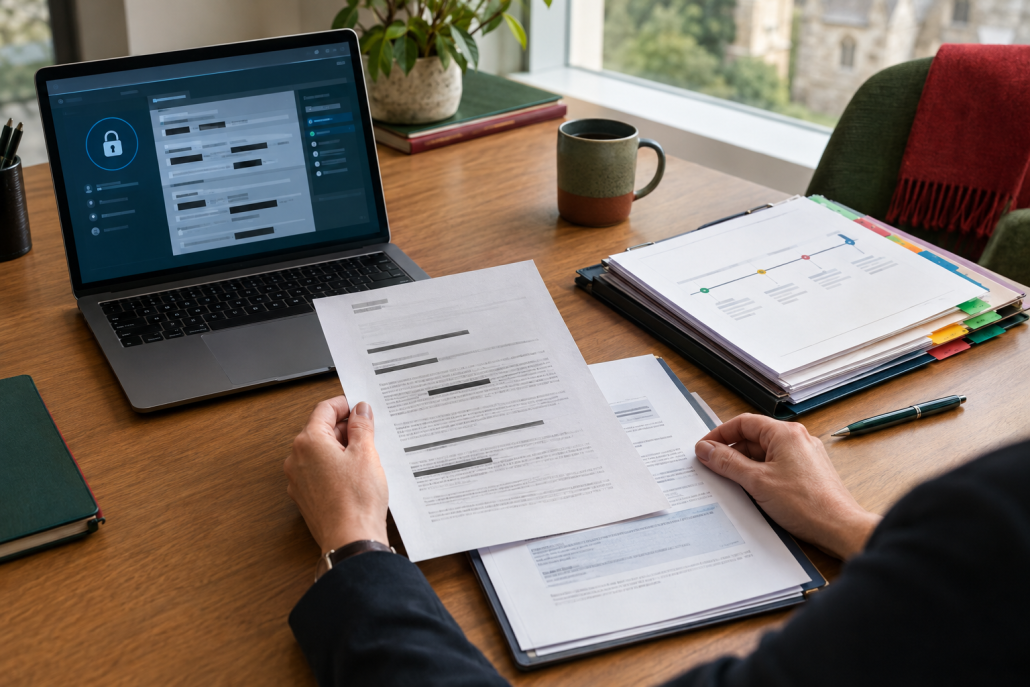
Cafcass Cymru’s August 2026 Guidance: Why a Subject Access Request May Not Give You the Case File
JSH LAW / CAFCASS CYMRU / PROCEDURAL UPDATE
14 October 2026 · Wales · Guidance updated 26 August 2026
You ask for the Cafcass Cymru file. What you receive may be much less than you expected.
Updated Welsh Government guidance spells out why a subject access request cannot simply be treated as a demand for every document gathered during Family Court proceedings.
Cafcass Cymru’s official guidance on accessing personal information was last updated on 26 August 2026. It gives a clear explanation of a distinction that matters to anyone preparing a Family Court case: accessing your personal data and obtaining documents for litigation are different legal exercises.
This is not a new blanket prohibition on case notes, nor a newly created entitlement to see the entire file. It is an important clarification of the route to use when a parent, child or litigant in person needs information.
The practical point
A subject access request under data-protection law gives access to personal information to which you are entitled. It does not automatically provide every original Cafcass Cymru record, document involving another person or confidential item connected with proceedings.
If a particular interview note or document is needed to test a report before a hearing, the court may need to address disclosure through appropriate directions. An SAR does not stop the hearing timetable.
What does the August 2026 guidance actually say?
The Welsh Government confirms that Cafcass Cymru’s information-access guidance was last updated on 26 August 2026. It sets out how to submit a request, its usual timetable, and the circumstances in which information may lawfully be withheld.
- The recommended request address is CafcassCymru@gov.wales, or a request can be made through a practitioner.
- Cafcass Cymru aims to acknowledge a request within three working days.
- Its ordinary SAR response period is one calendar month after the relevant request and necessary identity verification.
- It usually provides electronic responses through the secure Objective Connect system.
These are published administrative arrangements. A case-specific issue concerning the court’s timetable requires separate attention.
Read the official Cafcass Cymru guidance for the latest request procedure.
Why a SAR is not the same as the entire case file
A case file may contain overlapping information about both parents, the child, other family members, professional opinions and material provided in confidence. A right to see personal information about yourself does not automatically entitle you to every unredacted source document.
Cafcass Cymru expressly distinguishes information it may provide through an SAR from complete documents that may need to be obtained through the Family Court. Where someone is not a party to proceedings, further court restrictions may apply.
This is particularly important when a parent disputes a Section 7 assessment or says an interview was misrepresented. The question is not simply whether the full file exists. It is which particular underlying information is relevant to a disputed issue, and what is the correct route to obtain it?
For the complete practical steps for both England and Wales, see the JSH Law evergreen resource: How to Obtain Cafcass Records and Case Notes.
What if your Family Court hearing is approaching?
A parent might request an interview note with only 10 days left before the next hearing. Even a properly made SAR may not arrive before the court expects a response to the report.
A sensible, evidence-led approach is to identify the exact disputed paragraph, any supporting correspondence, the reason the underlying record matters and the minimum direction needed to address the issue fairly.
That might involve asking the court to clarify a report, direct a targeted disclosure or permit a focused response. Which approach is available depends on the proceedings and orders already made. A formal application may sometimes be needed.
Children’s records require a welfare-sensitive approach
A child’s personal data is the child’s information. Cafcass Cymru says that a child aged 12 or over is generally considered capable of making their own access request, while every case still requires an individual assessment.
Parental responsibility is not a guaranteed right to receive a child’s confidential disclosures. The child’s competence, best interests, wishes and relevant court restrictions must be considered. This is particularly significant where domestic abuse, intimidation or monitoring is alleged.
The ICO’s current subject access guidance also emphasises the child’s privacy and the context of any request made on the child’s behalf.
What should litigants in person do now?
- Read the latest sealed order. Identify any response, evidence and hearing deadlines.
- Separate the routes. A request for your personal data is different from a request for a document needed in court.
- Identify the precise record. Name the meeting, date, practitioner or report paragraph where possible.
- Keep the language forensic. Describe a potential discrepancy rather than alleging misconduct without evidence.
- Protect privacy. Use safe contact details and do not share children’s confidential records through insecure systems.
- Ask for proportionate directions where a specific record is necessary before the hearing.
Not every difference in recollection proves that a Cafcass record is false. But a material discrepancy should be examined carefully, particularly where it affects risk, participation or child welfare.
JSH Law can assist with an evidence register, chronology, report comparison and preparation of focused procedural correspondence within an agreed scope.
 © 2026 JSH Law Ltd. All rights reserved.
 JSH LAW LTD



Leave a Reply
Want to join the discussion?Feel free to contribute!