

The Next Frontier in Family Justice Is Decision Integrity
FAMILY JUSTICE, RECODED · EDITION 10 · 21 OCTOBER 2026
Changing the law, accelerating the courts and introducing AI will mean little if we cannot explain how a decision was reached — and whether the evidence was properly understood.
Jessica Susan Hill · JSH Law · Legal and procedural sources checked 21 October 2026
We are changing the rules of family justice. We are redesigning how cases move through the courts. We are introducing artificial intelligence into legal work.
But there is a question I believe deserves considerably more attention.
How do we know whether the resulting decisions are actually better?
Not simply faster. Not cheaper to administer. Not more professionally presented. Better.
Better at identifying risk. Better at distinguishing allegations from findings. Better at understanding a child’s lived experience. Better at examining evidence in context. Better at explaining why a particular outcome was reached.
And better at allowing somebody affected by that outcome to understand — and, where appropriate, challenge — the reasoning.
I have spent considerable time examining the intersection of family justice, digital evidence, safeguarding and responsible artificial intelligence. The more I examine these systems, the more convinced I become that we are approaching a critical point in legal modernisation.
We need to stop measuring technological progress principally by what it can produce and start measuring it by what we can reliably establish, verify and explain.
I call that decision integrity. It is not a new legal test. It is a proposed framework for examining the quality and accountability of decisions in an increasingly technology-assisted justice system.
And developments in October 2026 make the need for it particularly clear.
01 Parliament is reconsidering a fundamental assumption in private children proceedings
On 13 October 2026, the Courts and Tribunals Bill completed its Commons stages. It entered the House of Lords on 14 October.
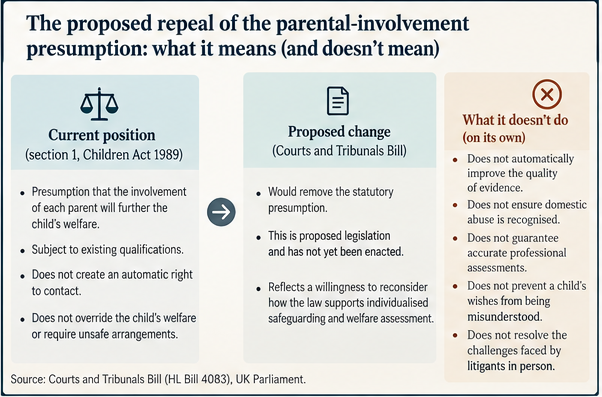
The Bill proposes removing the statutory presumption in section 1 of the Children Act 1989 that, subject to its existing qualifications, the involvement of each parent in a child’s life will further that child’s welfare.
This is proposed legislation. The presumption has not yet been repealed.
The current presumption does not create an automatic right to contact. Nor does it override the child’s welfare or require unsafe arrangements. Nevertheless, its proposed removal is significant.
It reflects a willingness to reconsider whether the statutory framework sufficiently supports individualised safeguarding and welfare assessment, particularly where domestic abuse is relevant.
But I think we need to ask what happens after the legislation changes.
Removing a presumption does not automatically improve the quality of the evidence. It does not ensure that coercive control is recognised. It does not guarantee that professional assessments are accurate. It does not prevent a child’s expressed wishes from being misunderstood. And it does not resolve the difficulties faced by litigants in person attempting to present complex evidence without representation.
The law may change the starting point. The quality of the decision will still depend on what happens between the evidence entering the system and the court reaching its conclusion.
A welfare decision must be based on the particular child, the relevant facts, the applicable law and a reasoned assessment of risk. Not a general assumption that parental involvement is always beneficial. But equally, not an assumption that an allegation necessarily establishes abuse.
The distinction between a concern that requires investigation and a fact that has been proved is fundamental to procedural fairness. And safeguarding depends on getting that distinction right.
02 The Court of Appeal has provided an important reminder about child-focused reform
On 29 September 2026, the Court of Appeal handed down its judgment in Re C (Child Arrangements Orders; Domestic Abuse; Child Focused Court) [2026] EWCA Civ 1216.
The case arose from proceedings within the Child Focused Court model. Its significance extends beyond the individual dispute.
It places domestic-abuse issues, welfare assessment and the requirements of fair decision-making within the context of a reformed private-law process.
The Child Focused Court approach is intended to identify the child’s needs and the relevant issues earlier, reduce unnecessary delay and improve how proceedings are managed. These are important objectives.
Delay can cause real harm. Relationships change while proceedings continue. Uncertainty becomes part of a child’s everyday life.
But reform must not be evaluated solely by how quickly a case reaches disposal.
A streamlined process still needs to identify which facts are disputed, whether those disputes matter to welfare, and what procedural steps are necessary to resolve them fairly.
That is particularly important where domestic abuse is alleged. Coercive control is not always apparent from a single incident. A series of communications may appear innocuous when separated from the surrounding circumstances. An apparently cooperative agreement may require examination of the pressures under which it was reached. A child’s reluctance to spend time with a parent may have several possible explanations.
The court must evaluate the evidence without assuming the answer.
Practice Direction 12J remains central where domestic abuse is relevant. It requires the court to address the allegations and risks appropriately, including considering whether a fact-finding hearing is necessary.
The need for a fact-finding hearing is not automatic in every case. It depends on the issues, the evidence and what must be determined to make a safe welfare decision.
This is a difficult balance. Unnecessary litigation can prolong conflict and harm children. Insufficient scrutiny can leave material risks unresolved.
Good case management is not simply the removal of procedural stages. It is knowing which stages are necessary, and why.
For those designing the next generation of family-court processes, that distinction should be fundamental.
03 The latest figures show why efficiency cannot be our only measure
The Ministry of Justice’s Family Court Statistics Quarterly for April–June 2026 reveals a system under continuing pressure.
These figures tell two stories.
The first is encouraging: average time to disposal has improved compared with the equivalent period in 2025.
The second is more challenging: new private-law cases increased substantially faster than disposals, and the Ministry of Justice reported that the open caseload continued to grow.
The system is becoming quicker in some respects while experiencing increasing demand. That is precisely the environment in which technological efficiency becomes attractive.
Automated document classification. AI-assisted chronologies. Case summaries. Earlier identification of issues. Digital case-management workflows. All potentially valuable.
But the performance measures we choose will influence what these systems optimise.
If we reward only speed, we risk designing systems that process information more quickly without improving how it is understood. If we reward only document completion, we risk mistaking a complete-looking file for a complete evidential picture.
And if we reward only reduced professional time, we may overlook the work transferred to litigants in person, support organisations and families themselves.
A system can become more efficient for the institution while remaining difficult, expensive or unsafe for the person using it.
That is a legal-service design problem as much as a legal problem.
04 The judiciary’s new AI position statement is a significant governance development
On 9 October 2026, the judiciary published its Position Statement on the Judicial Use of Artificial Intelligence.
Its central principles are important. AI may support judicial work, but it must not displace judicial reasoning, evaluation of evidence or the exercise of judicial discretion. Judicial independence, fairness, accountability, confidentiality and security must be preserved.
This is a sound foundation.
Then, on 15 October, the judiciary published a speech by Sir Geoffrey Vos, Master of the Rolls, delivered at the Legal Geek Conference the previous day.
His discussion raised an operational challenge that I believe deserves serious attention.
As AI systems become more capable of analysing material and preparing apparently persuasive legal outputs, how much independent checking will human decision-makers realistically undertake?
This is not an argument against AI. It is a question about the relationship between capability, workload and accountability.
Consider an illustrative family-court bundle containing 2,000 pages.
An AI tool identifies the issues, constructs a chronology, summarises the relevant correspondence and highlights what it considers to be the strongest evidence. The resulting document may be clear, concise and technically impressive.
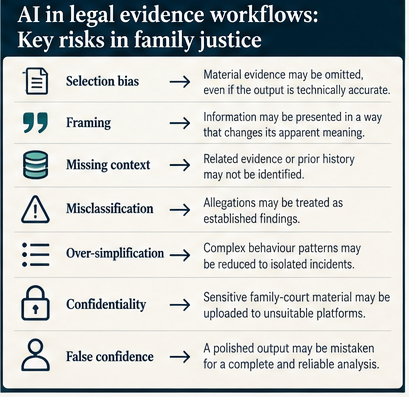
But suppose it omits a message that changes the interpretation of an earlier exchange. Suppose it places an allegation under a heading that implies an established finding. Suppose it extracts a statement from a safeguarding report without the qualification appearing two paragraphs later.
Or suppose it fails to recognise that apparently isolated incidents are alleged to form a sustained pattern of coercive control.
The AI does not need to invent anything for the output to be misleading. Selection, omission and framing can change the apparent meaning of evidence.
This is one of the most important issues in responsible legal AI. The system may produce a technically accurate summary of the material it selected while failing to select the material that matters most.
And if the human reviewer sees only the summary, what exactly are they verifying?
The distinction between human involvement and meaningful human oversight is therefore critical.
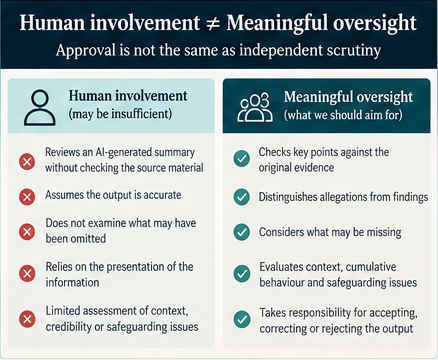
A human being approving an output does not, by itself, establish that the underlying evidence has been independently scrutinised.
For family justice, where context, credibility, safeguarding and the cumulative significance of behaviour can be decisive, this deserves particular care.
05 I think legal AI needs an evidence architecture, not merely a better prompt
Much of the public conversation about legal AI still concentrates on prompting, productivity and the accuracy of generated answers. Those matters are relevant.
But a dependable legal workflow requires more than a fluent model. It requires an evidence architecture.
By that, I mean a structured way of preserving the relationship between the original material, the interpretation placed upon it and the decision for which it is relevant.
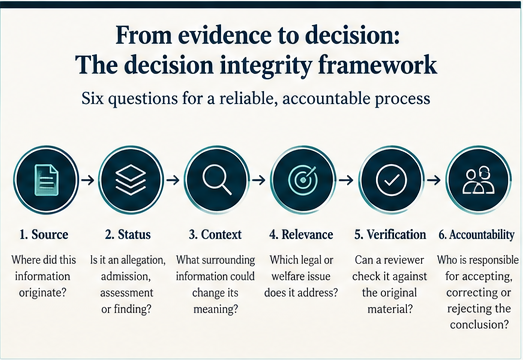
At minimum, I would want a serious AI-assisted evidence workflow to distinguish the following:
| Layer | Question the system must answer |
|---|---|
| Source | Where did this information originate? |
| Status | Is it an allegation, admission, assessment or finding? |
| Context | What surrounding information could change its meaning? |
| Relevance | Which legal or welfare issue does it address? |
| Verification | Can a reviewer check it against the original material? |
| Accountability | Who is responsible for accepting, correcting or rejecting the conclusion? |
These are not statutory requirements presented as a new legal test. They are design questions.
But they are questions that legal-technology teams, legal operations professionals, courts and service providers should be able to answer.
I would go further. Where AI materially influences evidence analysis, the workflow should make it possible to identify what was generated, what was checked, what was changed and which source supports each significant proposition.
Not because every legal task requires an elaborate technical system. But because the greater the potential consequence of an error, the stronger the justification for traceability and review.
A tool that drafts an appointment reminder does not present the same risks as a tool that summarises contested domestic-abuse evidence.
Responsible AI governance must be proportionate to the consequences of getting something wrong.
06 Legal aid and litigants in person cannot be an afterthought in legal innovation
There is another development worth examining.
The Ministry of Justice’s April–June 2026 legal aid statistics reported increases in family civil representation activity, including applications through the domestic-abuse and child-abuse evidence gateway.
However, the bulletin also cautions that some substantial year-on-year changes in civil legal aid data were affected by administrative reporting following the Legal Aid Agency cyberattack.
That is an important reminder not to mistake a headline increase in recorded activity for proof that access to representation has improved to the same extent.
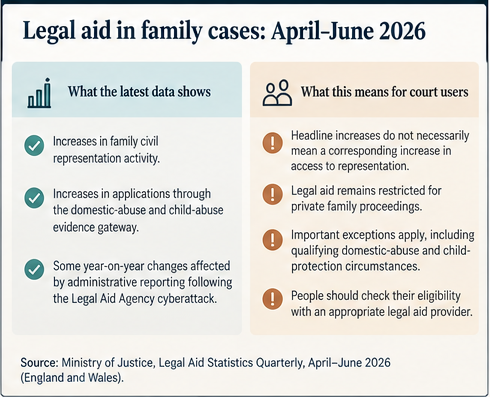
For private family proceedings, legal aid remains restricted, although important exceptions apply, including qualifying domestic-abuse and child-protection circumstances, subject to the relevant evidence, financial and merits requirements.
People should check their eligibility with an appropriate legal aid provider rather than assume they cannot qualify.
But many court users will still need to navigate substantial parts of the process without representation.
For those people, technology offers a genuine opportunity. It can help explain unfamiliar terminology. It can assist with organising documents and identifying missing dates. It can make procedural instructions more understandable. It can help a person prepare focused questions about a professional report.
Yet the user may not have the legal knowledge needed to identify a fabricated authority, a mistaken procedural suggestion or a misleading summary.
And they may not appreciate the confidentiality implications of uploading protected family-court material or children’s personal information into an unsuitable AI service.
That is why I resist the suggestion that simply giving people access to generative AI resolves the access-to-justice problem.
A person who can generate a fifty-page legal document is not necessarily better equipped to participate in proceedings.
They may be worse off if the document is inaccurate, unfocused or gives them confidence in a position that has not been properly checked.
Good legal technology should reduce cognitive and procedural burden. It should help people understand what matters, what remains disputed, what evidence supports their position and what steps are required.
It should not merely enable them to produce more paperwork.
07 The real opportunity is to connect legal expertise, safeguarding knowledge and technology design
I see considerable potential in combining disciplines that have too often developed separately.
Family-law practitioners understand legal tests, procedure and evidential relevance. Safeguarding professionals understand risk, vulnerability and the significance of behavioural patterns. Researchers understand the importance of methodology, limitations and reproducibility.
Technology teams understand how to build usable, scalable systems. AI governance specialists examine accountability, assurance, risk controls and the consequences of system failure. Legal operations professionals understand how work actually moves between people, documents, decisions and deadlines.
Each discipline has something essential to contribute.
The difficulty arises when one is asked to solve problems that require all of them.
A technology team may build an efficient chronology generator without understanding why the distinction between an allegation and a judicial finding matters.
A legal team may adopt a powerful AI tool without sufficiently examining how it handles missing information. A safeguarding workflow may record incidents without making the cumulative pattern intelligible.
A court process may reduce the number of hearings without adequately capturing the child’s experience. And a service designed around professional users may be practically inaccessible to a parent who has no legal representation.
These are not inevitable failures. They are design and governance challenges. But solving them requires more than buying software.
It requires domain expertise, appropriate testing, thoughtful workflow design and a willingness to examine whether the technology is improving the underlying decision process.
The future of legal services will depend not only on what AI systems can do, but on whether the people deploying them understand the legal and human consequences of their outputs.
08 A practical framework: how would we assess decision integrity?
At JSH Law, I have been developing practical approaches to evidence analysis and legal-information organisation, including the JSH Law Six-Question Check.
That work has reinforced my view that the next stage of legal innovation should concentrate on making reasoning and evidence easier to scrutinise.
For professionals developing or evaluating an AI-assisted family-justice workflow, I would propose six assurance questions.
- Can we trace the conclusion to its source?A reviewer should be able to identify the original document, passage or record supporting a material factual proposition.
- Can we distinguish evidence from interpretation?An allegation, a professional assessment and a judicial finding must not be silently treated as interchangeable.
- Can we identify what the system may have missed?Verification should consider omissions, conflicting evidence and context, not simply whether the generated text appears accurate.
- Can we explain why the information matters?The workflow should connect material to a relevant legal issue, safeguarding question or welfare consideration rather than equating volume with significance.
- Can the affected person understand and challenge the process?Usability, accessible explanations and procedural fairness matter, especially for litigants in person and vulnerable court users.
- Is there meaningful accountability?Someone must remain responsible for reviewing the output, correcting errors and making the decision within their lawful role.
These questions are not a substitute for the Children Act, the Family Procedure Rules, professional obligations or judicial discretion. They are an operational framework for examining whether technology-assisted work is dependable.
And they can be adapted beyond family justice: disclosure review, legal research, client intake, complaints analysis, regulatory investigations, professional report assessment and case management.
The principle is consistent.
If a system cannot explain the relationship between the source, the analysis and the conclusion, its apparent efficiency may be concealing an accountability problem.
09 What should we measure instead?
I would like to see legal innovation evaluated against a broader set of outcomes.
Not merely how many documents an AI tool can draft. Not merely how much professional time it saves. Not merely how many cases are concluded within a particular period.
Those measures have value, but they are incomplete.
We should also be asking whether technology reduces material errors, improves source verification, identifies safeguarding concerns more reliably, supports meaningful participation and makes decisions easier to understand.
We should measure the additional review burden created by AI outputs, not only the drafting time saved. We should examine whether errors are being detected earlier.
We should test performance against difficult cases, ambiguous evidence and conflicting accounts — not simply clean examples where the correct answer is obvious.
And we should distinguish between improving a workflow and improving the outcome that workflow is intended to support.
In family justice, the distinction could hardly be more important.
A child does not experience an efficiency statistic. A child experiences the consequences of the arrangements made for their life.
A survivor of domestic abuse does not experience an impressive AI benchmark. They experience whether the relevant risks were recognised and addressed.
A litigant in person does not experience a digital transformation strategy. They experience whether they can understand the process, present their case and receive a fair hearing.
That is where the success or failure of legal innovation becomes real.
My conclusion: decision integrity should become a central measure of legal modernisation
The proposed repeal of the parental-involvement presumption, the development of Child Focused Courts and the judiciary’s evolving approach to AI are not separate stories.
They are different parts of the same challenge.
We are reconsidering the assumptions that influence decisions. We are redesigning the processes through which decisions are reached. And we are introducing technology capable of shaping which information decision-makers see.
That creates an opportunity to build a more accessible, accountable and child-focused justice system. It also creates new risks.
A better statutory framework cannot compensate for misunderstood evidence. A faster process cannot compensate for inadequate safeguarding analysis. And an intelligent AI system cannot compensate for the absence of meaningful human judgment.
The opportunity is to design legal services and justice processes in which these elements reinforce one another.
Where information is traceable. Where risk is properly understood. Where disputed facts remain disputed until determined. Where children are treated as individuals rather than assumptions. Where litigants in person can participate meaningfully. And where AI assists professional reasoning without obscuring responsibility.
I believe this is where the next generation of serious legal innovation should concentrate.
The question is no longer simply whether AI can help us produce more legal work. It is whether we can design systems that help us make better, safer and more accountable decisions.
That is a considerably harder problem. It is also a much more worthwhile one.
Practical takeaways
- For family-law practitioners: Examine how disputed evidence, safeguarding concerns and welfare reasoning move through the case, particularly where streamlined procedures or AI tools are involved.
- For legal-technology teams: Build source traceability, evidence-status distinctions, meaningful review and appropriate safeguards into the workflow from the outset.
- For courts and justice policymakers: Evaluate speed alongside procedural fairness, decision quality, safeguarding and the ability of court users to participate.
- For litigants in person: Preserve original evidence, distinguish allegations from findings, verify AI-generated material and seek appropriate professional assistance where necessary.
- For organisations adopting legal AI: Ask not only what the technology can produce, but how errors are identified, who reviews the output and who remains accountable.
The measure of progress should not be how quickly the system reaches a decision. It should be how reliably the system reaches a decision it can justify.
About Jessica Susan Hill
I am the founder of JSH Law, where my work brings together family justice, evidence-led case analysis, safeguarding, access to justice and responsible legal technology.
My interests extend across legal research, digital evidence, AI governance, legal operations, service design and the practical challenges of building technology that works reliably in high-stakes environments.
I am particularly interested in how legal expertise, technology and human-centred design can be combined to improve the quality, transparency and accessibility of legal processes.
Through JSH Law, I provide defined-scope, non-reserved litigation support, document-preparation assistance and McKenzie Friend support for people navigating family proceedings in England and Wales.
I also welcome substantive discussion with legal professionals, researchers, justice organisations and technology teams working on responsible AI adoption, legal-service innovation and evidence-based decision-making.
JSH Law — Rooted in Integrity. Driven by Innovation.
Primary sources and further reading
- Courts and Tribunals Bill — UK Parliament
- Re C — Judiciary
- Judicial Position Statement on AI
- Master of the Rolls — Legal Geek speech
- Family Court Statistics Quarterly, April–June 2026
- Legal Aid Statistics Quarterly, April–June 2026
- Legal aid and domestic abuse — GOV.UK
- JSH Law Six-Question Check
This newsletter provides general legal and policy commentary, not case-specific legal advice. JSH Law Ltd is not an SRA-authorised solicitors’ firm and does not undertake reserved legal activities.
 © 2026 JSH Law Ltd. All rights reserved.



Leave a Reply
Want to join the discussion?Feel free to contribute!