
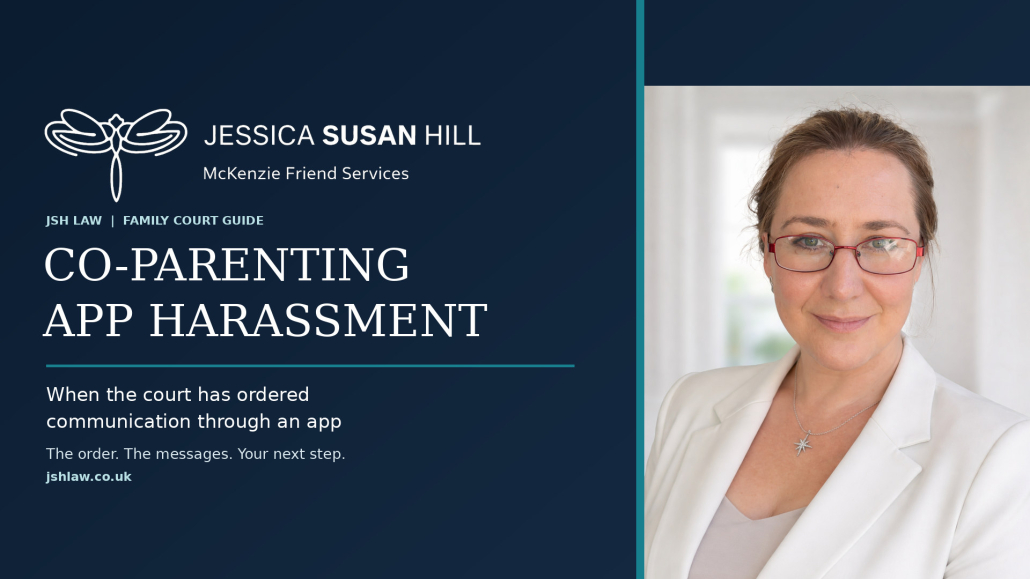
Co-Parenting App Harassment: What Can You Do If the Family Court Has Ordered You to Use an App?
JSH LAW | FAMILY COURT | DIGITAL SAFEGUARDING | CO-PARENTING TECHNOLOGY
England and Wales | Originally drafted 20 October 2026 | Substantively reviewed 22 October 2026 | Jessica Susan Hill
The Family Court tells you to communicate through a co-parenting app. But what happens when the app becomes another way for somebody to control you?
Start with the latest court order, preserve the original messages and identify the safest proper route for asking the court to address the problem. A parenting app can help with practical arrangements, but it does not make threatening or controlling communication safe. Do not assume that deleting the app is legally safe simply because using it is distressing.
Perhaps messages arrive constantly. Perhaps every parenting decision is questioned. Perhaps the other parent uses read receipts to demand immediate replies, repeatedly requests information about your whereabouts, or sends long accusatory messages that leave you frightened to open the application.
And perhaps you feel trapped because the court order says you must use it.
A co-parenting app is a communication tool. It is not a safeguarding assessment, a court order in itself or a guarantee that the communication taking place is safe.
In this guide, I explain what to do when a court-ordered parenting app is allegedly being misused, how to preserve the evidence, how the Family Court approaches domestic abuse and communication arrangements, and what procedural options may be available to a litigant in person.
The objective is not to turn every difficult message into an allegation of abuse. It is to identify what is happening, understand its impact and establish what arrangement is safe, proportionate and consistent with the child’s welfare.
Quick Answer: What If Your Ex Uses a Court-Ordered Parenting App to Harass You?
If a co-parenting app is being used in a way that causes concern, start with the exact wording of the current court order. Identify what communication it requires, preserve the original message record and keep a factual account of concerning incidents. Consider immediate safeguarding risks and whether a request for clarification, a variation or protective directions is appropriate.
Do not assume that an app-generated report automatically proves harassment or breach of an order. Equally, do not assume that a court-ordered app means you must accept threats, intimidation or unnecessary monitoring.
Do not simply stop complying with an order without considering the legal and safeguarding consequences. The appropriate next step depends on the order, the evidence and the urgency of the situation.
1. Why Do Family Courts Use Co-Parenting Apps?
After separation, communication between parents can become difficult. There may be disagreements about collection times, school arrangements, medical appointments, holidays or the practical details of child contact.
Where direct communication is problematic, a structured application may offer practical advantages. Depending on the product and subscription, features may include:
- Messaging between parents.
- Shared calendars.
- Requests to change parenting arrangements.
- Records showing when messages were sent or viewed.
- Expense tracking.
- Document sharing.
- Exportable communication histories.
These features may help parents who can communicate safely but struggle with organisation or disagreements. They can also create a clearer record than messages scattered across several platforms.
However, there is no universal rule requiring every separated parent to use a commercial co-parenting app. The position depends on what the parents have agreed and, where proceedings exist, what the court has ordered.
A court order is not an endorsement of every feature
If an order names an application, that does not necessarily mean the court has assessed every privacy setting, subscription tier, location feature or communication function offered by its provider.
The operative wording of the order matters. An instruction to communicate about the child’s arrangements through an app should not automatically be interpreted as permission to demand unrestricted personal information, monitor another parent’s movements or communicate without reasonable boundaries.
Read the order before making assumptions about what is compulsory.
2. When Can Communication Through a Parenting App Become Abusive?
Not every unpleasant message is domestic abuse. Separated parents may disagree strongly about matters affecting their children. A firm request for information, a complaint about a missed collection or a disagreement over expenses is not automatically coercive control.
The important questions are about behaviour, context, repetition, purpose, impact and risk.
Examples of potentially concerning behaviour
Depending on the circumstances, concerns may arise where an app is used to:
- Send repeated threatening or intimidating messages.
- Demand immediate responses at all hours.
- Monitor when the other parent is online or has viewed a message.
- Demand unnecessary details about the other parent’s movements.
- Use child-related communication as a pretext for personal abuse.
- Repeatedly accuse the other parent of misconduct without a factual basis.
- Threaten court proceedings in a manner forming part of a wider pattern of intimidation.
- Apply financial pressure through repeated or unreasonable demands.
- Use the child’s account, device or communications to monitor the other household.
- Persistently send messages unrelated to the child’s welfare or practical arrangements.
These examples are not a legal checklist that automatically establishes an offence or a finding of domestic abuse. They are behaviours that may require closer examination.
Technology-facilitated domestic abuse is recognised in official guidance
The Home Office’s statutory guidance on controlling or coercive behaviour recognises that technology can be used to monitor, intimidate and control someone, including after separation. The guidance identifies conduct involving digital accounts, online communications, devices and location monitoring. It also recognises that child arrangements and family relationships may be used as mechanisms of post-separation abuse.
Official source: Home Office — Controlling or Coercive Behaviour Statutory Guidance.
The question is not simply whether the messages sound polite. A message can use ordinary language while forming part of a pattern of monitoring or pressure. Equally, an upsetting message may have a legitimate child-related purpose. The surrounding evidence matters.
3. What Does Your Family Court Order Actually Require?
Before deciding what to do about a parenting app, obtain the latest operative court order. Do not rely on your recollection of what the judge said or on what the other parent says the order means. Read the relevant paragraph carefully.
Questions to ask
- Does the order name a particular application?
- Does it require all communication to take place through that application?
- Is the requirement limited to child-related matters?
- Does the order specify response times?
- Does it restrict telephone calls, emails or direct messages?
- Are there exceptions for emergencies?
- Are there separate non-molestation or protective orders?
- Is the provision temporary or subject to review?
- Does the order address who pays for the application?
Example: the difference between two orders
Order A: “The parents shall communicate about child arrangements through the agreed parenting application.”
Order B: “The parents shall use the specified application exclusively for communication concerning the child’s collection, return, education and health, except in an emergency.”
These hypothetical provisions are not identical. Order B is more specific about the permitted subjects and exceptions. Neither example should be read in isolation from the rest of the order or any relevant protective arrangements.
Where wording is genuinely unclear, clarification may be appropriate. Where the existing arrangement is unsafe or no longer workable, variation may need to be considered.
4. How Do You Preserve Evidence From a Co-Parenting App?
This is where careful preparation becomes particularly important. A person may have hundreds of messages but still struggle to explain precisely what happened.
The solution is not necessarily to print everything. Start by preserving the complete underlying record, then organise relevant incidents.
Step One: Preserve the original material
Where the application permits it, retain the original message history and available exports. Do not delete relevant conversations simply because they are distressing. Do not alter the wording of messages. Keep a secure record of when and how any export was created.
Step Two: Check what the export actually contains
Different applications and subscription plans may provide different export functions. A report might contain message text and timestamps but omit attachments, calls, deleted content, system notifications or other information. Do not assume a downloaded report is complete simply because it carries the provider’s branding. Record known limitations.
Step Three: Preserve context
A message that appears unreasonable in isolation may have been sent in response to an important question. Conversely, a series of apparently ordinary messages may reveal a pattern that is not obvious from one screenshot. Keep enough surrounding conversation to understand what happened.
Step Four: Build an incident chronology
A useful working chronology might look like this:
| Date | Communication | Concern | Evidence reference | Impact or response |
|---|---|---|---|---|
| 3 October | Repeated messages between 22:15 and 23:40 | Demand for an immediate reply about a non-urgent issue | APP-001 | Parent reports interrupted sleep; replied next morning |
| 7 October | Request for current location | Location not obviously necessary for stated child-related purpose | APP-002 | Parent requested clarification |
| 11 October | Dispute about school collection | Possible genuine arrangements issue | APP-003 | Collection arrangements subsequently confirmed |
Fictional example. An incident log records what is alleged and what the evidence may show; it does not establish that abuse occurred.
Step Five: Distinguish facts from interpretation
Instead of writing “He used the app to terrorise me every night,” start with verifiable facts, such as:
“Between 3 and 12 October, I received 37 messages after 9pm. The messages concerned [identified subjects]. I responded on [dates]. I say the repeated demands affected me in the following ways…”
The second approach gives the court something it can examine. The court can then consider the conduct, context and significance.
5. AI, Automated Tone Tools and Parenting-App Messages
Some communication platforms offer automated assistance with tone, wording or message preparation. Parents may also use general AI tools to summarise long conversations or draft replies. These features may be useful, but they create additional evidential questions.
An AI-generated summary is not the original evidence
Suppose an AI tool analyses six months of messages and produces the statement “The other parent repeatedly engaged in coercive control.” That is not a judicial finding, an independent professional assessment or a substitute for identifying actual messages and explaining their context.
A safer working method is to use technology to identify potentially relevant dates, themes or passages, then verify each against the original record.
Do not let AI rewrite what happened
Automated drafting should not invent a quotation, turn an approximate date into a precise one without evidence, change a message’s meaning, omit material context, convert suspicion into fact, diagnose another person or present disputed allegations as judicial findings.
If you are preparing a witness statement, its factual evidence must remain yours and must be carefully checked before you sign a statement of truth.
Protect confidential information
Before uploading app messages to an external AI service, consider whether they contain children’s information, protected addresses, medical information, school details, confidential Family Court material or information about third parties.
Check the provider’s data handling and the restrictions applying to your proceedings. Private Family Court documents should not automatically be sent to unfamiliar AI services for convenient summaries. AI can help locate information needing attention; it cannot decide what may lawfully be withheld or what the court should find.
6. Can You Put Parenting-App Messages in a Family Court Bundle?
Potentially, but this requires care. The replacement Practice Direction 27A came into force on 2 March 2026 and governs the preparation and content of Family Court hearing bundles.
Do not put an entire app export into the hearing bundle without the necessary court direction. The Judiciary’s accompanying guide lists correspondence, emails, text messages, WhatsApp messages and other social-media communications among documents that should not be included unless the court orders it. Preserve the underlying material, identify the extracts you say are necessary and seek directions about their inclusion. Relevance alone is not permission to add them.
Read the accessible Judiciary guide to preparing Family Court bundles, particularly the list on page 7, alongside PD27A and your latest order.
Official source: Practice Direction 27A — Family Proceedings: Court Bundles.
Preserving evidence and preparing a bundle are different tasks
You may need to preserve 500 messages. That does not mean 500 messages should automatically appear in the hearing bundle. A more proportionate approach may involve:
- Preserving the complete app record securely.
- Preparing a dated incident chronology.
- Identifying communications relevant to the issues before the court.
- Explaining why particular extracts are necessary.
- Seeking directions where inclusion requires permission, is disputed or unclear.
- Following the applicable bundle order and PD27A requirements.
The court should not be expected to search through months of irrelevant exchanges to find the point you are making.
The objective is to make relevant evidence understandable and testable, not to overwhelm the court with volume.
7. Can You Ask the Family Court to Change the App Arrangements?
Yes, it may be possible to ask the court to reconsider communication arrangements where there is a proper basis. However, the correct route depends on whether proceedings remain open, what order exists and what change is sought.
Option A: Seek clarification or directions in existing proceedings
If proceedings are ongoing and the order is unclear, or circumstances require further directions, Form C2 may be relevant. HMCTS describes Form C2 as a route for requesting orders or directions in existing children proceedings.
Official form: HMCTS — Form C2.
Option B: Apply to vary an existing child arrangements order
Where a final child arrangements order needs substantive variation, Form C100 may be an appropriate route, subject to the applicable requirements, any permission restrictions and procedural rules.
Official form: HMCTS — Form C100.
Choose the task before choosing the form
A complaint about the app provider, a position statement for a hearing, an application for a different order and an application for protection do different jobs. This preparation table helps you identify the question that needs checking; it does not decide which application is right for your case.
| Immediate problem | Possible route to check | Prepare first |
|---|---|---|
| Directions are needed in ongoing children proceedings. | Whether Form C2 is required. | The current order, precise direction sought, evidence and urgency. |
| A final child arrangements order needs substantive change. | Whether a C100 variation application is appropriate. | What needs changing and why; any permission requirement, and MIAM attendance or a valid exemption. |
| A specific child-arrangements obligation has allegedly been breached. | Whether C79 enforcement is applicable. | The operative provision, dated incidents, source material and any explanation. |
| Protection from abuse or harassment may be needed. | Urgent specialist advice; a non-molestation application using FL401 may be relevant, subject to eligibility. | Risk, recent incidents, existing protective orders and safe contact details. |
| The app has a technical or account problem. | The provider’s support process; court directions if compliance is affected. | Error messages, dates, support reference and the actual communication obligation. |
The current C100 guidance explains MIAM attendance and exemptions. A permission restriction may need to be addressed before an application can proceed. The HMCTS FL401 page also identifies a separate domestic abuse protection order route in eligible areas; check the current conditions rather than assuming every protective application uses the same form.
Sending an email asking the court to change an arrangement does not itself change the order. Check the application, filing and service requirements. Any request to proceed without notice needs a proper legal basis. Hearing stages and preparation requirements can differ between local private-children pathways: follow your court’s directions, rather than a generic timetable.
Keep each document’s job clear
A position statement explains your position and what you ask the court to do at a particular hearing. A witness statement gives your factual evidence in the required form. An incident chronology helps organise dates and sources; it is not a judicial finding or a substitute for any statement the court requires. Use your chronology to prepare accurately, then follow the order about which documents may be filed and when.
What changes might be considered?
Depending on the evidence and the child’s welfare, a parent might ask the court to consider:
- Limiting messages to specified child-related subjects.
- Setting proportionate response expectations for non-urgent communications.
- Identifying a separate process for genuine emergencies.
- Restricting unnecessary location requests.
- Clarifying which app functions may be used.
- Addressing financial or accessibility barriers to a subscription.
- Changing communication channels where justified.
- Providing for review after a defined period.
These are examples, not standard terms a court must impose. The court will evaluate the circumstances, including the child’s welfare, evidence and safeguarding concerns.
What if domestic abuse is alleged?
Practice Direction 12J is particularly important where domestic abuse is alleged, admitted or otherwise indicated in proceedings about children. The court must consider relevant risks and the impact of abuse on the child and affected parent. Where domestic abuse has been established, the direction includes safeguards concerning arrangements for children.
Official source: Practice Direction 12J — Domestic Abuse and Harm.
A request to change a parenting-app arrangement should therefore explain why it is said to be unsafe, unworkable or contrary to the child’s welfare, with supporting facts and sources. In England, Cafcass’s domestic abuse practice policy addresses assessment and reporting of harm and risk. Cafcass Cymru is the separate service in Wales; do not assume an English Cafcass policy is its governing policy.
8. Is Misusing a Parenting App a Breach of a Child Arrangements Order?
Not automatically. A parent may behave inappropriately on an app without necessarily breaching an enforceable provision of a child arrangements order. Conversely, failure to comply with a clear obligation may form part of a wider dispute about compliance.
The exact wording of the order must be identified.
Enforcement is not the same as variation
Form C79 concerns enforcement-related applications. It is not a general complaint form for every disagreement between parents. Before considering enforcement, identify:
- The specific operative paragraph of the order.
- What it required.
- The date of the alleged non-compliance.
- What actually occurred and the evidence.
- Any explanation or reasonable excuse.
- The relevance to the child’s welfare.
Practice Direction 12B addresses responses to non-compliance with child arrangements, including safeguarding and welfare considerations.
Official sources: HMCTS — Form C79 and Practice Direction 12B — Child Arrangements Programme.
What if you are frightened to use the app?
That concern should be taken seriously. But there is no universal answer that makes every unilateral departure from a court order legally safe.
Where possible, seek urgent advice or directions before changing arrangements required by an order. If there is immediate danger, prioritise safety and contact appropriate emergency or safeguarding services.
Where harassment or abuse requires protective relief, a non-molestation order may be relevant depending on the circumstances. HMCTS publishes Form FL401 for applications for non-molestation and occupation orders.
Official source: HMCTS — Form FL401.
A child arrangements application and an application for protection from abuse are not interchangeable procedures. The correct approach may require consideration of both communication arrangements and immediate safety.
9. Practical Example: A Parenting App Used for Repeated Monitoring
Consider this fictional example. A mother and father are involved in private children proceedings. The court has directed them to communicate through a parenting application about the child’s arrangements.
The mother alleges that the father sends repeated messages asking where she is, who she is with and why she has not replied immediately. Some messages concern genuine arrangements for the child. Others appear unrelated to the child’s needs.
The mother says the pattern resembles monitoring and intimidation experienced during the relationship.
What would responsible case preparation involve?
- Obtain the latest order and identify the communication obligation precisely.
- Preserve the original app record.
- Prepare a factual chronology distinguishing child-related requests from other communications.
- Identify relevant history, safeguarding evidence and existing findings without treating allegations as proved.
- Explain the alleged impact on the parent and, where relevant, on the child.
- Identify a realistic and safe alternative arrangement.
- Determine whether clarification, variation, safeguarding directions or a protective application may be appropriate.
The court would need to evaluate the evidence and competing explanations. Repeated messages alone do not necessarily establish coercive control. But communication taking place inside a court-ordered app does not make abusive conduct acceptable either.
10. The JSH Law Parenting-App Evidence and Safeguarding Checklist
Check the order
- Do I have the latest operative order?
- What does it actually say about communication?
- Are response times or permitted subjects specified?
- Are there separate protective orders?
- Is the app requirement temporary or ongoing?
Preserve the evidence
- Have I kept the complete message history where available?
- Have I retained relevant attachments and timestamps?
- Do I know what the app export includes and excludes?
- Have I preserved the original records?
- Have I avoided altering or selectively misrepresenting messages?
Assess the concern
- What precisely happened, and was it repeated?
- What was the surrounding context?
- Was there a genuine child-related purpose?
- Is there a relevant history of abuse or safeguarding concern?
- What impact is alleged, and what can be corroborated?
Identify the next step
- Is the immediate concern safety, compliance or the suitability of the arrangement?
- Is clarification needed, and are proceedings still open?
- Is a variation application potentially required?
- Does Cafcass in England, or Cafcass Cymru in Wales, need to be told about a material safeguarding issue?
- What practical communication arrangement is proposed instead?
- Is there an approaching hearing or filing deadline?
Do not confuse a communication log with a court-ready case. The log is the source material. The case requires an accurate explanation of relevance, context, impact and the order sought.
11. Frequently Asked Questions
Can the Family Court order parents to use a co-parenting app?
The court may make appropriate child-arrangements and related directions within its powers. Whether a particular app requirement is justified depends on the circumstances and terms of the order. There is no general requirement for every separated parent to subscribe to a commercial app.
Do I have to reply immediately to every message?
Not simply because an application displays read receipts. Check the order for any response requirement. Genuine emergencies and child-related matters may need prompt attention, but an app feature itself does not create a legal duty to answer every message immediately.
Can a co-parenting app be used for coercive control?
Technology can be used as part of controlling or coercive behaviour. Whether particular conduct meets the legal definition of domestic abuse or a criminal offence depends on the evidence and relevant legal test. The Home Office recognises technology-facilitated and post-separation abuse.
Are parenting-app messages admissible in Family Court?
They may be relevant evidence, subject to the court’s directions and questions about authenticity, completeness and weight. They do not automatically belong in the hearing bundle. Practice Direction 27A must be considered.
Can I use AI to analyse the messages?
AI may help organise potentially relevant material, but its summaries and conclusions must be checked against the originals. Confidentiality and data protection also require attention.
Can I stop using the app if it is making me anxious?
Check the order and seek appropriate advice or directions. Safeguarding concerns can be important, but unilateral non-compliance may have consequences. Immediate safety risks need an urgent response.
Can I ask the court to change the app or restrict communication?
Potentially. The route may involve directions in existing proceedings or an application to vary an order. The court will consider evidence, the child’s welfare and safeguarding concerns.
Is every abusive message a breach of the child arrangements order?
No. A breach depends on the obligation imposed by the particular order. Abusive communication can raise other legal or safeguarding issues even if it does not establish a breach of that order.
Can communication be limited to child-related matters?
You can ask the court to consider proportionate communication boundaries where justified. Whether the court makes the requested direction depends on the facts and applicable legal framework.
Can JSH Law help me organise parenting-app evidence?
Yes. JSH Law offers defined-scope non-reserved litigation support, including evidence organisation, chronologies, document preparation and hearing preparation. Any proposed task and fee basis would be agreed in advance.
12. Need Help With Parenting-App Evidence or Family Court Communication Arrangements?
When communication has become overwhelming, the problem is rarely solved by producing another hundred screenshots. The first task is to establish what the order requires, what has actually happened and what evidence matters.
At JSH Law, I provide practical, evidence-led and trauma-informed support to litigants in person in England and Wales. Depending on the agreed scope, assistance may include:
- Reviewing relevant provisions of an existing order for document-preparation purposes.
- Organising parenting-app exports and communication records.
- Preparing factual incident chronologies.
- Creating evidence indexes and issue matrices.
- Separating allegations, supporting evidence and judicial findings.
- Preparing witness-statement and position-statement materials.
- Organising safeguarding concerns for Cafcass responses.
- Supporting preparation of C2, C100 or C79 documents for the litigant’s review and filing, where appropriate.
- Organising material for a proposed variation or enforcement application.
- Drafting focused questions for specialist legal advice.
- Preparing urgent procedural correspondence.
- Organising appeal paperwork where relevant.
- Hearing preparation and McKenzie Friend assistance.
The aim is to turn an overwhelming communication history into a clear, proportionate and properly evidenced account.
The 15-minute initial consultation helps identify your immediate issue, whether JSH Law’s support is suitable and the next practical step. It does not include a complete case review or a finished statement or application. Any further paid work is separately scoped and agreed. You can begin with a brief problem summary and your next hearing or deadline date; you do not need to organise the whole case first.
What should you have ready?
- The date of the latest order and the paragraph dealing with communication.
- The app involved.
- The immediate concern and any safeguarding risks.
- Whether proceedings remain open.
- The next hearing or filing deadline.
Please do not send an entire confidential app history or private Family Court bundle through an initial public enquiry form. Appropriate document-sharing arrangements can be considered once work is agreed.
JSH Law provides non-reserved litigation support and McKenzie Friend assistance. It does not conduct litigation or exercise reserved rights of audience on behalf of clients. Where regulated representation or specialist legal advice is required, an appropriately authorised professional should be consulted.
If you or a child is in immediate danger, call 999. JSH Law is not an emergency safeguarding service.
Final Thought: A Communication Tool Must Not Become Another Source of Harm
Co-parenting technology can be useful. It can reduce confusion, improve record-keeping and help separated parents manage practical arrangements.
But no application can replace a proper assessment of behaviour, safeguarding and the child’s welfare. Where communication is safe, a structured platform may help. Where communication is used to intimidate or control, the existence of a digital record does not solve the underlying problem.
The Family Court needs to understand not only what messages were sent, but what they meant in context, what impact they had and what arrangements will protect the child’s welfare going forward.
That is where careful evidence organisation and proportionate procedural preparation matter.
 © 2026 JSH Law Ltd. All rights reserved.


Leave a Reply
Want to join the discussion?Feel free to contribute!