

This category focuses on the role of Cafcass and welfare reporting within private law children proceedings. It covers how Cafcass becomes involved, how reports are prepared, and how the court uses Cafcass input when making decisions.

Articles in this section support litigants in person by explaining what to expect from Cafcass, how to engage with the reporting process, and how Cafcass assessments and recommendations can influence safeguarding decisions and child arrangements.

Safety Planning in Domestic Abuse & Family Court Proceedings: A Practical Guide for Litigants in Person

Safety planning is not about panic — it is about structure. In family proceedings involving domestic abuse, coercive control or ongoing conflict, courts are concerned with forward-looking risk management, not emotional narrative. This guide explains what safety planning actually means in the context of private children proceedings and how it aligns with the Children Act 1989 welfare principle and Practice Direction 12J. It sets out how to identify patterns of risk, how to structure proportionate safeguards, and how to present proposals the court can realistically implement. From neutral handovers and communication boundaries to protective orders and digital safety, effective safety planning must be child-focused, evidence-led and workable. Whether you are raising concerns or responding to allegations, this article provides a practical framework to help you approach safety planning strategically rather than reactively — and to ensure that safeguarding arguments are credible, proportionate and legally grounded.

Safety Planning in Domestic Abuse & Family Court Proceedings: A Practical Guide for Litigants in Person

Domestic Abuse & Safeguarding Cluster  |  England & Wales  |  Structured, practical and forward-looking

Key takeaways for litigants in person

  • Safety planning is proactive, not reactive — it anticipates risk rather than waits for harm.
  • The court looks for structured, proportionate safeguards — not generalised fear.
  • Domestic abuse safety planning must include both physical and emotional risk.
  • Children’s exposure to coercive dynamics is a safeguarding issue in itself.
  • Protective orders, communication boundaries and handover arrangements must be specific.
  • Credibility increases when your safety plan is realistic, child-focused and evidence-led.

Safety planning is often misunderstood in family proceedings. It is not simply “being careful”. It is not emotional hypervigilance. And it is not a dramatic document drafted for court.

Proper safety planning is structured risk management. It anticipates foreseeable harm and creates practical safeguards to reduce that risk.

If you are a litigant in person navigating domestic abuse or coercive control within private children proceedings, safety planning is both a personal necessity and a legal tool.

This article explains:

  • What safety planning means in domestic abuse contexts.
  • How it intersects with Family Court proceedings.
  • How to structure a safety plan that the court will take seriously.
  • What legal mechanisms support safety planning.
  • Common mistakes that undermine credibility.

1. What Is Safety Planning?

Safety planning is a structured assessment of:

  • Known risks.
  • Potential escalation triggers.
  • Vulnerabilities (including children).
  • Protective strategies.

In domestic abuse contexts, this includes:

  • Physical violence risk.
  • Stalking or harassment.
  • Coercive control.
  • Economic abuse.
  • Digital monitoring.
  • Manipulation via children.

The statutory framework underpinning coercive and controlling behaviour can be found in: Serious Crime Act 2015, s.76 .

Safety planning recognises that abuse is rarely isolated. It is patterned.

2. Why Safety Planning Matters in Family Court

Under section 1 of the Children Act 1989, the child’s welfare is paramount: Children Act 1989, s.1 .

Where domestic abuse is raised, Practice Direction 12J requires the court to assess risk before ordering contact: Practice Direction 12J .

Courts are forward-looking. They ask:

  • What is the likelihood of harm recurring?
  • What structure reduces risk?
  • Is contact safe, and under what conditions?

A well-constructed safety plan answers those questions.

3. Components of a Structured Safety Plan

A. Risk Identification

  • Document past incidents with dates.
  • Identify escalation patterns.
  • Note triggers (court hearings, contact disputes, financial stress).

B. Child-Focused Considerations

  • Has the child witnessed conflict?
  • Has the child shown behavioural changes?
  • Are handovers emotionally destabilising?

C. Communication Boundaries

  • Use of parenting apps (e.g. OurFamilyWizard).
  • No direct calls except emergencies.
  • Email-only communication.

D. Physical Safety Measures

  • Neutral handover locations.
  • Supervised contact centres where appropriate.
  • Non-molestation orders under Part IV Family Law Act 1996: FLA 1996 Part IV .

E. Digital & Financial Safety

  • Password changes.
  • Monitoring shared devices.
  • Financial independence measures.

4. The Intersection of Safety Planning and Protective Orders

Legal tools supporting safety planning include:

  • Non-molestation orders.
  • Occupation orders.
  • Prohibited steps orders.
  • Specific issue orders.

Domestic Abuse Act 2021 overview: Domestic Abuse Act 2021 .

Orders must be proportionate. Courts are cautious about overreach.

5. Emotional Safety: Often Overlooked

Emotional safety includes:

  • Protection from coercive messaging.
  • Reducing child exposure to parental hostility.
  • Predictable routines.

Emotional harm falls within the welfare checklist.

6. Common Mistakes in Safety Planning

  • Overly dramatic language.
  • Lack of specificity.
  • No link to child welfare.
  • Proposals that are impractical.

The court values proportionality.

7. If You Are Accused of Posing a Risk

  • Address allegations specifically.
  • Provide evidence.
  • Offer safeguards voluntarily where reasonable.
  • Demonstrate insight.

Reasoned cooperation can strengthen credibility.

8. Safety Planning and Children’s Voices

Children’s wishes and feelings are considered under s.1(3). Cafcass may be involved: Cafcass Parents Hub .

A child’s anxiety is not automatically determinative, but it must be evaluated properly.

9. Practical Safety Planning Checklist

  1. Create chronology of risk events.
  2. Gather evidence.
  3. Identify child impact.
  4. Propose structured safeguards.
  5. Ensure proportionality.
  6. Remain child-focused.

10. Safety Planning Is Strength, Not Weakness

Safety planning is not hostility. It is responsible parenting.

Courts respond best to:

  • Structured reasoning.
  • Clear evidence.
  • Proportionate safeguards.
  • Forward-looking proposals.

Book a 15-minute consultation (phone)

If you need help building a structured safety plan aligned with Family Court expectations, you can book a consultation below.


6 Useful Links


Regulatory & Editorial Notice

This article is for general information only and does not constitute legal advice. JSH Law provides litigation support services to litigants in person and does not conduct reserved legal activities. If you are at immediate risk of harm, contact emergency services on 999.

Safeguarding in Family Court: What Litigants Must Know

Safeguarding is one of the most misunderstood aspects of Family Court proceedings. It is not a slogan or a weapon — it is a structured legal framework focused on identifying and managing risk to a child. In private law cases, safeguarding concerns often involve domestic abuse, coercive control, emotional harm, substance misuse, or exposure to high conflict. This article explains how safeguarding operates under section 1 of the Children Act 1989, how Practice Direction 12J applies where domestic abuse is alleged, and how courts assess future risk rather than punish past behaviour. It also clarifies the distinction between private law safeguarding and public law child protection proceedings. For litigants in person, understanding this structure is critical. Courts respond to evidence, chronology, and proportionate proposals — not emotional narrative alone. Whether you are raising safeguarding concerns or responding to allegations, this guide sets out how to approach the issue strategically and lawfully.

Safeguarding & Child Protection in Family Court: What Litigants in Person Must Understand

Domestic Abuse & Safeguarding Cluster  |  England & Wales  |  A practical guide for litigants in person

Key takeaways for litigants in person

  • “Safeguarding” is not a buzzword — it is a structured legal framework focused on risk and welfare.
  • The child’s welfare is paramount under section 1 of the Children Act 1989.
  • Domestic abuse, coercive control and emotional harm must be framed within the correct legal structure (especially PD12J).
  • The court is forward-looking: it asks what arrangements reduce risk going forward.
  • Evidence, chronology and proportional proposals matter more than emotional narrative.
  • If safeguarding is raised, it must be articulated clearly and supported — not assumed.

“Safeguarding” is one of the most overused and misunderstood words in family proceedings. It is often invoked as a moral accusation. It is rarely understood as a legal structure.

If you are a litigant in person involved in private children proceedings, understanding safeguarding and child protection is not optional. It is foundational.

This article explains:

  • What safeguarding actually means in legal terms.
  • How child protection differs from private law safeguarding.
  • How domestic abuse intersects with safeguarding.
  • What courts are legally required to consider.
  • How to structure your case properly if risk is present.

1. The Legal Foundation: Welfare Is Paramount

Every safeguarding discussion in private law begins with section 1 of the Children Act 1989.

The statute states that when a court determines any question relating to the upbringing of a child, the child’s welfare shall be the court’s paramount consideration.

You can read it here: Children Act 1989 – Section 1 .

The court must also consider the welfare checklist under s.1(3), including:

  • The child’s wishes and feelings (in light of age and understanding).
  • Physical, emotional and educational needs.
  • The likely effect of any change in circumstances.
  • Age, sex, background and relevant characteristics.
  • Any harm suffered or risk of harm.
  • How capable each parent is of meeting needs.

Safeguarding sits squarely within “harm suffered or risk of harm”.

2. What “Safeguarding” Means in Private Law Proceedings

In private children cases (usually applications under section 8 of the Children Act), safeguarding refers to identifying and managing risk to the child.

This may include:

  • Domestic abuse (physical, emotional, coercive control).
  • Substance misuse.
  • Mental health concerns.
  • Neglect.
  • Emotional harm.
  • Exposure to conflict.

Early in proceedings, Cafcass conducts safeguarding checks:

  • Police checks.
  • Local authority checks.
  • Telephone interviews with parties.

Cafcass guidance: Cafcass – Parents & Carers .

Their safeguarding letter informs the court’s initial risk assessment.

3. Domestic Abuse and Practice Direction 12J

Where domestic abuse is alleged or admitted, the court must apply Practice Direction 12J.

You can read it here: Practice Direction 12J .

PD12J requires the court to:

  • Consider whether a fact-finding hearing is necessary.
  • Assess risk before making child arrangements orders.
  • Ensure that contact does not expose child or resident parent to harm.

Critically, the court must assess whether abuse has an ongoing impact on:

  • The child’s emotional wellbeing.
  • The resident parent’s ability to support contact.
  • Future risk of coercive dynamics.

Simply alleging abuse is not enough. It must be structured in line with PD12J.

4. Safeguarding vs Child Protection (Private vs Public Law)

It is essential to distinguish:

Private Law (Section 8 Proceedings)

  • Disputes between parents.
  • Cafcass involved.
  • Focus on child arrangements.

Public Law (Care Proceedings)

  • Local authority applies under section 31 Children Act 1989.
  • Threshold criteria must be met (significant harm).
  • Child protection plans and care orders considered.

Local authority guidance: Working Together to Safeguard Children .

Many litigants conflate these two systems. They operate differently.

5. Emotional Harm: The Most Difficult Category

Emotional harm is often central to safeguarding disputes. It is also the hardest to evidence.

Emotional harm may include:

  • Exposure to high conflict.
  • Undermining of primary attachment figure.
  • Coercive control within family system.
  • Manipulation through child.

Courts require:

  • Specific incidents.
  • Observable behaviour.
  • Professional evidence (where available).
  • Impact on the child.

Generalised claims (“the child is anxious”) are weaker than structured evidence (“the child began bedwetting after X incident; GP appointment dated…”).

6. The Court’s Risk Analysis: Forward-Looking

Courts are not primarily punishing past behaviour. They are assessing future risk.

Judges ask:

  • What is the likelihood of harm recurring?
  • What safeguards reduce risk?
  • Can harm be mitigated through structure?

That might mean:

  • Supervised contact.
  • Indirect contact only.
  • Communication through parenting apps.
  • Non-molestation orders.

Family Law Act 1996 protective orders: Family Law Act 1996 Part IV .

7. Common Mistakes Litigants Make in Safeguarding Cases

  • Submitting 100+ pages of unstructured material.
  • Assuming the court “will see it”.
  • Failing to distinguish adult conflict from child harm.
  • Failing to propose workable alternatives.
  • Using inflammatory language.

The court responds better to:

  • Chronology.
  • Focused allegations.
  • Clear link to welfare checklist.
  • Proportionate proposals.

8. If You Are Raising Safeguarding Concerns

  1. Create a dated chronology.
  2. Identify evidence for each allegation.
  3. Link concerns to welfare checklist factors.
  4. Propose structured safeguards.
  5. Remain calm and focused.

Safeguarding is strongest when it is structured.

9. If Safeguarding Allegations Are Raised Against You

  • Respond specifically, not defensively.
  • Provide evidence.
  • Propose safeguards where appropriate.
  • Show insight where necessary.

Denial alone is rarely persuasive. Reasoned rebuttal is.

10. Safeguarding Is Not a Weapon

The court is alert to tactical use of allegations. That does not mean genuine concerns are dismissed. It means credibility matters.

Safeguarding should always focus on:

  • Child safety.
  • Proportionality.
  • Stability.

Book a 15-minute consultation (phone)

If safeguarding is central to your case and you need help structuring your position clearly and lawfully, you can book a consultation below.


6 Useful Links


Regulatory & Editorial Notice

This article is provided for general information and commentary only. It does not constitute legal advice. JSH Law provides litigation support services to litigants in person and does not conduct reserved legal activities.

Child Safety and Emotional Harm in Family Court: Understanding Risk Beyond Bruises

In Family Court proceedings, harm is not limited to physical injury. Under the Children Act 1989, the court must consider emotional as well as physical harm when determining what arrangements promote a child’s welfare. Exposure to domestic abuse, coercive control, chronic conflict or instability can affect a child’s emotional regulation, attachment patterns and long-term development. Yet many litigants in person struggle to present emotional harm in a structured, persuasive way. Courts require evidence, proportionality and clear links to the welfare checklist — not generalised fear or adult-centred grievance. This article explains how emotional harm is defined in law, how safeguarding duties under Practice Direction 12J apply, what indicators courts look for, and how to present concerns in a credible and child-focused manner. Understanding the distinction between conflict and harm is critical when navigating private children proceedings.

Child Safety and Emotional Harm in Family Court: Understanding Risk Beyond Bruises

Category: Domestic Abuse & Safeguarding – Child Safety & Emotional Harm  |  Audience: Litigants in Person (England & Wales)

Key takeaways for litigants in person

  • The court’s paramount consideration is welfare under Children Act 1989, s.1.
  • Harm includes emotional and psychological harm — not just physical injury.
  • Exposure to domestic abuse is recognised as harmful to children.
  • Where abuse is alleged, the court must apply Practice Direction 12J.
  • Safeguarding requires structured evidence, not generalised fear.

Why Emotional Harm Matters in Family Court

When parents enter private children proceedings, the conversation often centres around visible events: missed contact, arguments, police call-outs, or allegations of assault.

Yet the Family Court’s task is not limited to identifying physical injury. The statutory definition of harm under the Children Act includes impairment of health and development — and development includes emotional development.

Emotional harm can be quieter, slower and harder to measure. But its long-term impact on children can be profound.

The Legal Framework for Child Safety

The court must apply the welfare principle under section 1 Children Act 1989.

The welfare checklist requires the court to consider:

  • Any harm the child has suffered or is at risk of suffering
  • The child’s physical, emotional and educational needs
  • The likely effect of any change in circumstances
  • The capability of each parent to meet those needs

Harm is not limited to bruises. It includes chronic anxiety, fear, instability and exposure to hostility.

Domestic Abuse and Emotional Harm

Practice Direction 12J requires courts to consider the impact of domestic abuse on children.

Children exposed to domestic abuse may:

  • Experience hypervigilance
  • Develop anxiety or sleep disturbance
  • Struggle with emotional regulation
  • Exhibit behavioural changes at school
  • Feel responsible for parental conflict

Even where abuse is not directed at the child, exposure alone can constitute emotional harm.

Coercive Control and the Child’s Environment

Coercive control creates an atmosphere of domination. It may not involve daily physical violence. Instead, it alters the emotional climate of the home.

Children raised within coercive dynamics may internalise:

  • Fear-based compliance
  • Distorted conflict resolution patterns
  • Silencing of emotion
  • Parentification

Emotional harm often lies in patterns, not incidents.

Parental Conflict vs. Emotional Abuse

Not all parental disagreement amounts to emotional harm. Courts distinguish between:

  • Ordinary post-separation conflict
  • Chronic high-conflict environments
  • Psychological manipulation
  • Coercive control dynamics

The key question is impact.

How is the child functioning? What behavioural changes are observable? What evidence supports concern?

Indicators of Emotional Harm

  • Regression in developmental milestones
  • School reports noting anxiety
  • Somatic complaints without medical cause
  • Extreme loyalty conflicts
  • Fearful behaviour before handovers
  • Statements indicating adult knowledge beyond age

These indicators require careful presentation. Courts require objective evidence where possible.

How to Present Emotional Harm Properly

1. Avoid Generalisations

“The child is traumatised” is less persuasive than: “The school attendance officer reported repeated anxiety-based absences on handover days.”

2. Use Chronology

Identify behavioural change alongside events.

3. Link to Welfare Checklist

Explain how observed impact relates to emotional needs and risk of harm.

4. Propose Protective Measures

Courts respond to solutions, not only concerns.

Interim Arrangements and Risk

Where emotional harm is alleged, the court may:

  • Order supervised contact
  • Require staggered handovers
  • List a fact-finding hearing
  • Direct a Section 7 report
  • Pause direct contact temporarily

Interim arrangements are risk-managed decisions. They are not final determinations.

Emotional Harm and Long-Term Outcomes

Courts consider not only current harm but potential long-term effects.

Chronic exposure to instability can affect:

  • Attachment patterns
  • Academic performance
  • Self-esteem
  • Future relationship models

Safeguarding analysis must therefore be forward-looking.

Common Pitfalls for Litigants in Person

  • Equating conflict with harm without evidence
  • Overstating emotional impact
  • Ignoring the child’s resilience
  • Failing to distinguish between adult distress and child harm

Credibility is central. Balanced analysis strengthens safeguarding arguments.

Forward-Focused Safeguarding

Effective child safety arguments focus on:

  • Stability
  • Predictability
  • Safe emotional space
  • Clear communication boundaries

The court is not seeking perfection. It is seeking safety and proportionate arrangements.

Understanding Proportionality

Not every emotional difficulty justifies suspension of contact. The court must balance:

  • The child’s right to relationship
  • The child’s right to safety
  • The seriousness of alleged harm
  • The availability of protective measures

Emotional harm analysis must therefore be grounded, proportionate and supported by evidence.

What Child Safety Truly Requires

True safeguarding in Family Court requires:

  • Clear articulation of impact
  • Objective supporting material
  • Application of statutory framework
  • Practical, workable proposals
  • Calm, structured presentation

Emotional harm cases require depth, not drama.


Book a 15-minute consultation (phone)

If you are navigating Family Court proceedings involving emotional harm or safeguarding concerns, and you need help structuring your position clearly and proportionately, you can book a 15-minute consultation below:

You deserve clarity. Your child deserves safety. And the court deserves structured evidence.


Regulatory & Editorial Notice

This article is provided for general informational purposes only and does not constitute legal advice. Every case depends on its own facts and legal context. If you believe a child is at immediate risk of harm, contact emergency services.

When Coercive Control Leads to Conviction — Why Sentencing Still Falls Short

A recent coercive control conviction in Surrey resulted in a sentence of just over two years’ imprisonment

— meaning likely release at the halfway point. While convictions under section 76 of the Serious Crime Act 2015 remain relatively rare, sentencing often fails to reflect the cumulative psychological harm caused by years of domination, isolation and fear. This article explores why short custodial sentences may not equate to reduced risk, and why coercive control remains highly relevant in Family Court proceedings under the Children Act 1989 and Practice Direction 12J. A criminal conviction does not automatically resolve safeguarding concerns in private children cases. Understanding the difference between punishment and ongoing risk is essential for litigants in person navigating contact disputes after domestic abuse.

When Coercive Control Leads to Conviction — Why Sentencing Still Falls Short

Category: Domestic Abuse & Family Court  |  Commentary & Legal Analysis (England & Wales)

Key takeaways

  • Coercive and controlling behaviour is a criminal offence under s.76 Serious Crime Act 2015.
  • Convictions remain comparatively rare relative to reported cases.
  • Custodial sentences of around two years typically result in release at the halfway point.
  • Short sentences do not necessarily reflect cumulative psychological harm.
  • In Family Court proceedings, domestic abuse remains relevant under Children Act 1989 and Practice Direction 12J, even after criminal sentencing.

A Rare Conviction in Surrey

Recently, a man in Surrey was sentenced to just over two years’ imprisonment for coercive and controlling behaviour, strangulation and criminal damage against his former partner.

Under standard sentencing rules, that typically means release at the halfway point. In practical terms, just over a year in custody.

The case was described as a rare conviction in a county where reportedly only around 7% of recorded coercive control cases result in charge. That statistic speaks to the evidential and structural difficulty of prosecuting patterns of abuse.

What Is Coercive Control?

The offence of controlling or coercive behaviour was introduced under section 76 of the Serious Crime Act 2015.

It criminalises a pattern of behaviour which may include:

  • Isolation from support networks
  • Monitoring or regulating daily life
  • Control of finances
  • Threats and intimidation
  • Undermining autonomy
  • Creating psychological dependency

This offence is not about one argument or one assault. It recognises the architecture of domination.

Strangulation, threats and criminal damage are often symptoms of a deeper system of entitlement and control.

The Sentencing Problem

When custodial sentences are limited to two years (or less), several realities follow:

  • Automatic release at halfway point
  • Limited structured behavioural intervention
  • No guarantee of insight or change
  • Minimal long-term deterrent effect

Coercive control is cumulative. It rewires perception, fear responses and dependency. A short custodial sentence does not dismantle the belief system that enabled the abuse.

On paper, the system records: Convicted. Sentence passed. Case closed.

For many families, it is not closed.

Why This Matters in the Family Court

In private law children proceedings under the Children Act 1989, the court’s paramount consideration is welfare.

Where domestic abuse is raised, the court must apply the safeguarding framework in Practice Direction 12J.

A short custodial sentence can sometimes be interpreted as:

  • “Punishment served”
  • “Matter concluded”
  • “Historic behaviour”

That interpretation risks oversimplification.

Coercive control affects:

  • A parent’s capacity to support safe contact
  • A child’s emotional regulation
  • The survivor’s ability to co-parent
  • Ongoing litigation dynamics

Even where contact is ordered, history informs structure. Supervision, indirect contact, parallel parenting models, and clear boundaries may be necessary.

The Reality Survivors Face

After criminal proceedings conclude, some survivors report:

  • Litigation as continuation of control
  • Repeated procedural applications
  • Financial strain
  • Reputational attacks
  • Manipulation through child arrangements

The abuse may shift from private to procedural.

Without proper identification and management, Family Court can unintentionally become another arena for coercive dynamics.

What We Do at JSH Law

We support litigants in person navigating private children proceedings where domestic abuse forms part of the history.

Our role is structured and evidence-led. We:

  • Identify coercive patterns clearly and lawfully
  • Structure chronologies effectively
  • Apply the correct statutory framework
  • Prepare safeguarding-focused position statements
  • Separate emotional narrative from legal analysis

These cases require precision. They require clarity about the difference between a past conviction and ongoing risk.

A Forward-Looking Perspective

Awareness of coercive control has improved significantly over the last decade. The creation of the offence under the Serious Crime Act 2015 marked progress.

But charging rates and sentencing outcomes demonstrate that recognition and resolution are not the same.

True safeguarding requires:

  • Recognition of cumulative harm
  • Structured judicial analysis
  • Evidence-led advocacy
  • Clear litigation boundaries

If You Are Navigating Something Similar

  • Do not assume the criminal conviction “speaks for itself”.
  • Do not assume short custody equals reduced risk.
  • Do not assume the Family Court understands the pattern without structured explanation.

Arm yourself with knowledge. Structure your evidence. Approach proceedings strategically rather than reactively.

It is not simply “over” because an order has been made.


Contact JSH Law

If you are currently navigating Family Court proceedings involving coercive control, we can review your position, structure your evidence and support you through hearings.

You deserve clarity, not chaos. You deserve structure, not fear.


Regulatory & Editorial Notice

This article is provided for general information and commentary only. It does not constitute legal advice and should not be relied upon as such. Every case turns on its own facts and legal context.

JSH Law provides litigation support services to litigants in person, including strategic guidance, document preparation assistance and hearing support. JSH Law is not a firm of solicitors and does not conduct litigation or provide reserved legal activities.

Where reference is made to legislation or public material, such references are for informational purposes only. If you require urgent assistance in relation to domestic abuse, contact the police on 999 in an emergency or seek specialist support services.

When a Parent Discloses Strangulation and has a SEN Child: What to Do Next (UK Family Court)

When a Parent Discloses Strangulation and You Have SEN Children: What to Do Next (UK Family Court)

Safety note: If you are in immediate danger, call 999. If it is not an emergency, consider calling 101. If you cannot speak safely, use the Silent Solution (dial 999 and follow the operator’s prompts).

This article is written for litigants in person who find themselves in one of the most frightening situations a parent can face:

  • you have children (often with Special Educational Needs (SEN)),
  • the other parent is angry, aggressive, and unsafe, and
  • you have disclosed that the other parent has strangled you (including where that has been admitted to professionals, such as social services or Cafcass).

If that is you: you do not need to “handle this better”. You need protection, stability, and a clear procedural plan.

Strangulation (non-fatal strangulation/suffocation) is treated in law and safeguarding practice as a serious risk indicator. It is also a criminal offence. (legislation.gov.uk)

This is why the priority in family law is often not “contact arrangements first” — it is safety first.

Key Takeaways (for litigants in person)

  • Strangulation is treated as a serious risk indicator in safeguarding and family proceedings.
  • A 15-minute consultation is triage and orientation: safety, urgency, next steps.
  • Most situations like this require a protection-first approach before child arrangements litigation.
  • Legal aid and specialist domestic abuse support should be pursued in parallel.

What you can expect from a 15-minute consultation with JSH Law

A 15-minute consultation is triage and orientation, not full casework.

In this call, JSH Law will help you:

  1. Check immediate safety (for you and the children).
  2. Identify the legal category of your problem (protective injunctions vs. children proceedings vs. both).
  3. Confirm whether there are deadlines, active proceedings, or court orders.
  4. Map the fastest lawful route to protection and stability.
  5. Signpost the right next step, including legal aid and specialist domestic abuse support.

What this call is not

It is not:

  • drafting your witness statement,
  • advising you what to “say to the judge”,
  • telling you the outcome,
  • or running your whole case.

That work is longer-form, and it must be done safely and properly.

Why strangulation changes everything

If a parent says, “He strangled me,” that is not “relationship conflict”. It is a serious safeguarding disclosure.

In UK law:

  • The Domestic Abuse Act 2021 sets a statutory definition of domestic abuse (and recognises patterns of controlling/coercive behaviour). (legislation.gov.uk)
  • Non-fatal strangulation/suffocation is recognised as a specific offence (via the Domestic Abuse Act’s amendments). (legaladvicecentre.london)

In family proceedings, the court must approach child arrangements through a safeguarding lens where domestic abuse is raised (see Practice Direction 12J). (justice.gov.uk)

The procedural approach JSH Law takes in this situation

When the disclosure is: SEN children + father unsafe/aggressive + strangulation admitted to professionals, the “best practice” procedural mindset is:

  • Protect first (injunctions)
  • Stabilise housing if needed
  • Only then open or progress child arrangements litigation, unless the children’s arrangements must be stabilised urgently

That is why our priority sequence usually looks like this:

Priority Summary

PriorityActionWhy it mattersKey legal reference
1️⃣FL401 – Non-Molestation Order (immediate)Creates a legal firewall to stop abuse, threats, intimidation and unwanted contact.Family Law Act 1996 s.42
2️⃣Occupation Order (if housing risk exists)Regulates occupation of the home; can exclude an unsafe person where justified.Family Law Act 1996 s.33
3️⃣C100 + C1A (only if children’s arrangements must be stabilised now)Only used urgently when children’s arrangements require immediate court control.Children Act 1989 s.8
4️⃣Legal aid solicitor + specialist DA support (in parallel)Secures specialist representation/support where domestic abuse gateway applies (subject to means).LASPO 2012 Sch 1 para 12

Step 1: FL401 – Non-Molestation Order (IMMEDIATE)

What it is

A Non-Molestation Order is a protective injunction under the Family Law Act 1996. (legislation.gov.uk)

It can prohibit the other person from:

  • using or threatening violence,
  • harassing, intimidating, pestering,
  • contacting you (including via third parties),
  • coming to your home, workplace, or the children’s school (if appropriate).

Why it is the first priority in high-risk disclosures

Because it creates a legal firewall. It is designed to stop further abuse and reduce immediate risk.

Breach is a criminal offence

Breach of a non-molestation order is a criminal offence under s.42A Family Law Act 1996. (legislation.gov.uk)

Can it be made “without notice”?

Yes. In urgent cases, the court can consider the application without the respondent being told first (a “without notice” / ex parte application). The criteria are set out in s.45 Family Law Act 1996, and the Family Procedure Rules require your supporting evidence to explain why notice was not given. (legislation.gov.uk)

Practical reality: without-notice orders exist because sometimes warning the other person increases risk, pressure, or intimidation.

What you need procedurally

An application for a non-molestation order is made on Form FL401 and must be supported by a witness statement (your statement of facts). (justice.gov.uk)

What your witness statement should cover (high-level)

  • the relationship and living situation (briefly)
  • the pattern of behaviour (keep it factual)
  • the strangulation disclosure (what happened, when, injuries if any, what was said to professionals)
  • the children’s needs and exposure (especially SEN needs and routine stability)
  • why you need protection now
  • why you seek the order without notice (if applicable)

Step 2: Occupation Order (IF HOUSING RISK EXISTS)

What it is

An Occupation Order is an injunction that regulates who can live in, enter, or be excluded from the family home. It also arises under the Family Law Act 1996 (commonly under s.33 and related provisions depending on your property/occupancy status). (legislation.gov.uk)

When it becomes urgent

Consider it immediately if:

  • the other parent still lives in the home,
  • is trying to return,
  • is turning up, refusing to leave, or making the home unsafe,
  • you are being forced to flee with SEN children (disruption can be extremely harmful),
  • the home is the only stable base for schooling, EHCP support, therapies, etc.

How the court assesses it

In some scenarios (notably s.33 cases), the court applies the “balance of harm” approach and considers the likely harm if the order is not made versus harm to the respondent if it is made. (This sits within the statutory framework of the Family Law Act’s occupation order provisions.) (legislation.gov.uk)

Practical point: occupation orders can be “harder” than NMOs

Courts treat excluding someone from their home as a major interference with rights — it can be granted, but it must be properly evidenced and proportionate, especially if sought without notice.

Step 3: C100 + C1A (ONLY if children’s arrangements must be stabilised now)

This is where people often make a costly mistake: they rush into a children application too early, and it unintentionally triggers pressure around contact before safety is stabilised.

The legal basis

A Child Arrangements Order is a s.8 Children Act 1989 order. (legislation.gov.uk)

You apply using Form C100 (private law children application). Cafcass will usually be involved in initial safeguarding checks. (cafcass.gov.uk)

What is Form C1A?

Form C1A is supplemental information used to tell the court about allegations of harm and domestic abuse (or to respond to them). (gov.uk)

When you should file C100 + C1A urgently

Usually only if one of these is true:

  • the other parent is threatening to remove the children,
  • there is an immediate dispute about where the children live / are collected from,
  • contact is being demanded in a way that creates immediate risk,
  • the school, GP, or professionals need court-backed clarity quickly,
  • there is already chaos around handovers that is escalating.

PD12J: why domestic abuse matters in child arrangements

Where domestic abuse is raised, the court must consider safeguarding and risk, and handle contact decisions accordingly under Practice Direction 12J. (justice.gov.uk)

This is especially relevant where:

  • there are serious allegations,
  • the children may have witnessed incidents,
  • or the abusive parent seeks to use proceedings to continue coercive control.

Step 4: Legal aid solicitor + specialist DA support (IN PARALLEL)

If strangulation has been admitted to professionals (social services/Cafcass), you should assume legal aid may be available (subject to means and evidence requirements) and you should pursue it immediately, not after you’ve struggled alone for months.

Legal aid: the legal framework

Legal aid remains available for certain family matters involving domestic abuse under LASPO 2012 Schedule 1, Part 1, paragraph 12, subject to providing evidence of domestic abuse as required by the regulations. (legislation.gov.uk)

Government guidance confirms you may be eligible for legal aid for domestic abuse matters if you have evidence and meet the financial criteria. (gov.uk)

Why specialist DA support matters (even if you are “strong”)

A specialist domestic abuse service (often via an IDVA) can help with:

  • safety planning,
  • liaison with police and children’s services,
  • refuge/housing options,
  • documenting risk properly.

For SEN children, that wrap-around support can be the difference between coping and collapse.

A simple decision map (quick reference)

If you are unsafe now: emergency services first.

Otherwise:

  • Need immediate protection from abuse/harassment?FL401 non-molestation (legislation.gov.uk)
  • Need the abuser kept out of the home / housing stability? → add occupation order (legislation.gov.uk)
  • Need urgent court control over children’s living/contact arrangements?C100 + C1A (legislation.gov.uk)
  • Want representation and safety-informed strategy?legal aid solicitor + DA support (legislation.gov.uk)

What evidence and documents help (without drowning yourself)

You do not need a 200-page bundle on day one. You need credible, relevant, time-anchored evidence.

Examples:

  • a letter/email note from social services/Cafcass referencing the disclosure (if available)
  • police incident numbers (if any)
  • GP/A&E notes (if any)
  • photos of injuries (if any)
  • a short chronology of key incidents (dates + 1–2 lines each)
  • school/SEN documents only where they show vulnerability/routine impact

What to expect in court (high-level)

  • Injunction applications (FL401) require your witness statement and can be dealt with urgently, including without notice where justified. (justice.gov.uk)
  • Children applications (C100) will usually trigger initial safeguarding checks and a first hearing process. PD12J is central where domestic abuse is raised. (justice.gov.uk)

Call to Action: Book a 15-Minute Consultation with JSH Law

If you are in this situation — especially with SEN children — you do not need to “power through”. You need a clear procedural plan and the right support around you.

Book a 15-minute consultation here:
👉

15-minute introductory telephone call (free)
New enquiries only · UK & international timezones supported
This short call is for new enquiries only. It allows us to:
  • Understand the nature of your issue
  • Explain the type of support available
  • Confirm next steps, if appropriate
Important: This call does not constitute legal advice and does not create a solicitor-client relationship.

What to include in your booking notes (so we can help faster)

  • Are the children safe today?
  • Is the other parent in the home / turning up?
  • Any deadlines, hearings, or existing orders?
  • Any professional involvement (police / social services / Cafcass)?
  • One sentence: what is your biggest fear right now?

Regulatory & Editorial Notice (JSH Law)

This article is general information for public education. It is not legal advice and should not be relied on as a substitute for advice on your specific facts. Reading this article does not create a solicitor-client relationship. If you are at immediate risk of harm, contact the police or emergency services. Where third-party sources are referenced, they are provided for convenience and do not necessarily reflect endorsement by JSH Law.

Key legal references (for readers who want sources)

When Court Process Becomes a Tool of Abuse – Why post-separation abuse, litigants in person, and procedural design cannot be treated separately

One of the most persistent myths in family justice is that abuse ends when a relationship ends.

Introduction: abuse does not end at separation

One of the most persistent misconceptions in family justice is that abuse ends when a relationship ends.

For many women, it does not.

It changes form.

What follows separation is often not peace, but post-separation abuse — exercised through money, children, delay, litigation, procedural complexity, and exhaustion. Increasingly, this abuse is facilitated not by individual actors alone, but by systems that are poorly designed for the people forced to use them.

For survivors who are also litigants in person (LiPs), the family court process itself can become the terrain on which harm continues.

This article examines:

  • how court process is routinely weaponised after separation
  • why survivors are disproportionately forced to self-represent
  • how procedural complexity compounds trauma
  • and why process design is a safeguarding issue, not an administrative one

1. Post-separation abuse: a brief reality check

Post-separation abuse refers to a pattern of behaviour where one party continues to exert control after the relationship has ended. It often includes:

  • financial obstruction or non-payment
  • repeated or strategic litigation
  • refusal to engage in mediation in good faith
  • manipulation of contact arrangements
  • vexatious applications and appeals
  • exploiting procedural rules to cause delay or pressure

Crucially, this form of abuse is process-dependent. It relies on complexity, ambiguity, and asymmetry.

Where systems are slow, opaque, or inconsistent, they are easier to exploit.


2. Why survivors are so often litigants in person

Survivors of abuse are disproportionately likely to be unrepresented in family proceedings.

Common reasons include:

  • legal aid thresholds that exclude many survivors
  • financial abuse leaving one party unable to fund representation
  • the other party’s ability to prolong proceedings and increase costs
  • repeated applications that make sustained representation unaffordable
  • emotional exhaustion and loss of trust in professionals

The result is a deeply unequal dynamic:
one party using the system strategically, the other struggling simply to comply with it.

This imbalance is often misread by courts as “poor presentation”, “lack of focus”, or “high conflict”, rather than recognised as the product of trauma and systemic design.


3. When court process itself becomes harmful

Family court processes are often described as neutral. In practice, they are not.

For survivors, common procedural features can be actively harmful:

  • fragmented hearings spread over months or years
  • repeated requirements to recount abuse in different formats
  • unclear or inconsistently applied directions
  • pressure to produce “concise” evidence of complex coercive behaviour
  • expectations of calm, neutral presentation under acute stress

Each of these creates opportunities for further harm — especially where one party understands how to exploit delay, confusion, or fatigue.

This is not about bad faith judges or staff. It is about systems that assume emotional neutrality and legal literacy where neither exists.


4. The litigant in person burden: compliance under trauma

Litigants in person are expected to:

  • understand procedural stages
  • comply with directions precisely
  • file documents correctly and on time
  • evidence allegations to the correct standard
  • distinguish between narrative, evidence, and submissions

For survivors of abuse, these expectations are layered on top of:

  • ongoing fear or contact with the abuser
  • financial precarity
  • childcare and safeguarding responsibilities
  • trauma responses that affect memory and communication

When LiPs struggle under these conditions, the system often treats the difficulty as personal failure rather than predictable overload.


5. Why “high conflict” is often a misdiagnosis

One of the most damaging shortcuts in family proceedings is the label “high conflict”.

While genuinely mutual conflict exists in some cases, in many others this label:

  • obscures power imbalance
  • masks post-separation abuse
  • penalises the survivor for responding to provocation
  • treats procedural distress as personality

Where one party uses the system strategically and the other reacts under pressure, the appearance of “conflict” can be misleading.

Without process literacy and trauma awareness, systems risk rewarding the more legally fluent party, not the safer or more truthful one.


6. Process design is a safeguarding issue

Safeguarding is often discussed in terms of outcomes: orders made, findings reached, contact arrangements imposed.

But safeguarding also lives in process.

Clear, humane process design can:

  • reduce opportunities for harassment through litigation
  • limit unnecessary repetition of traumatic material
  • help survivors present evidence coherently
  • reduce judicial time spent untangling confusion
  • lower emotional and financial attrition

Conversely, opaque or inconsistent process enables abuse to continue under the cover of legality.

Treating process as “mere administration” is a category error.
Process determines who copes, who collapses, and who is believed.


7. Where LiP-centred legal tech can reduce harm

This is where properly designed legal tech — used responsibly — matters.

LiP-centred tools do not replace lawyers or judges. They help people:

  • understand where they are in proceedings
  • know what is required next
  • organise evidence proportionately
  • track deadlines and directions
  • separate narrative from admissible material
  • reduce cognitive overload

For survivors, this kind of support can be the difference between:

  • compliance and collapse
  • clarity and chaos
  • being heard and being dismissed

Importantly, this is navigation support, not legal advice.


8. The role of regulators and professional bodies

One barrier to innovation in this space is fear.

Developers, support services, and practitioners often hesitate because the boundary between “help” and “advice” feels unsafe.

Clearer guidance from bodies such as the Solicitors Regulation Authority on:

  • what constitutes procedural assistance
  • how LiP support tools can be used ethically
  • where professional responsibility begins and ends

would enable more survivor-centred design without increasing risk.

Silence in this area does not protect the public — it entrenches inequality.


9. Reframing the question courts should be asking

Instead of asking:

“Why is this litigant struggling to comply?”

The better question is:

“What about this process makes compliance so difficult under these circumstances?”

That shift alone changes outcomes.

When courts, regulators, and designers recognise that systems shape behaviour, they can begin to reduce harm rather than unintentionally perpetuate it.


Key takeaways

  • Post-separation abuse often continues through court process
  • Survivors are disproportionately forced to self-represent
  • Procedural complexity compounds trauma and imbalance
  • “High conflict” can obscure coercive dynamics
  • Process design is a safeguarding issue
  • LiP-centred navigation tools can reduce harm without giving legal advice

PD12J in plain English (why it matters)

Practice Direction 12J (PD12J) applies in Children Act private law cases where domestic abuse is alleged or admitted. In practical terms, it exists to ensure the court identifies domestic abuse and deals with child arrangements in a way that prioritises safety and avoids arrangements that could expose a child or a parent to harm.

  • It is relevant from the start of the case (not just at fact-finding).
  • It influences directions, what evidence is needed, and how risk is assessed.
  • It is especially important where abuse continues after separation (including through litigation or contact arrangements).

LiP tip: If domestic abuse is in issue, think of PD12J as the framework the court should use to keep safeguarding central throughout the case.

PD12J: what the court should actively be looking for

PD12J requires the court to take domestic abuse seriously as a safeguarding issue, not as “relationship conflict”. That includes patterns such as:

  • Coercive and controlling behaviour (ongoing patterns rather than one-off incidents)
  • Post-separation abuse (including harassment through contact handovers, money, or litigation behaviour)
  • Child impact: direct harm, emotional harm, exposure to abuse, or coercive dynamics affecting parenting

LiP tip: You do not need to prove “perfect evidence” of every detail to raise safeguarding risk. The court’s job is to identify and manage risk proportionately.

“High conflict” vs PD12J: the safeguarding lens

PD12J pushes the court to look beyond “he said / she said” conflict and ask safeguarding questions. Where there is an imbalance of power, patterns of control, or intimidation, the issue is not “mutual conflict” — it is risk.

How “high conflict” is often framedHow PD12J expects the court to frame it
Both parties are equally responsibleAssess power imbalance and coercive dynamics
Strong emotions = unreliableConsider trauma and fear as context, then test evidence fairly
Keep contact moving to reduce tensionDo not order unsafe arrangements; manage risk first

PD12J and “process abuse”: what good case management looks like

Where abuse is alleged, PD12J supports tighter, safeguarding-led case management to reduce opportunities for misuse of the process. Examples include:

  • Clear, stage-based directions (what is needed, by when, and why)
  • Focused issues (what the court is deciding at each hearing)
  • Proportionate evidence expectations (preventing sprawling, oppressive bundles)
  • Safety arrangements around contact, handovers, and communication

LiP tip: If the other party uses repeated applications, late disclosure, or constant allegations to destabilise you, name it neutrally as procedural misuse and ask the court for clear, structured directions.

Practical PD12J toolkit for litigants in person

If PD12J is relevant in your case, these are the practical documents that often help you present information clearly and safely:

  • Chronology (dates, events, and what evidence exists for each point)
  • Scott Schedule / Schedule of Allegations (where directed, or where it would assist clarity)
  • Impact statement (focused on the child impact and current risk, not lengthy narrative)
  • Communications log (short examples showing patterns, frequency, escalation)
  • Directions checklist (what the court ordered, deadlines, what you filed)

LiP tip: Keep it structured. Courts are more likely to engage with a clear, proportionate pack than with large, unindexed dumps of screenshots.

The PD12J question the court should be asking at every stage

“How does the alleged or admitted abuse affect risk, safety, and the child’s welfare — and what case management is needed to prevent further harm?”

This is the safeguarding-led approach PD12J is designed to embed. It also aligns with why process design matters: unclear or permissive process can create space for abuse to continue after separation.

Call to action

At JSH Law, we work with litigants in person — many of them survivors — who are navigating family proceedings under extreme pressure.

Our focus is on:

  • procedural clarity
  • evidence organisation
  • trauma-aware process navigation
  • responsible use of AI and legal tech to reduce overload

If you are:

  • a litigant in person struggling to manage court process, or
  • a practitioner, policymaker, or developer working in this space

then this conversation matters.

You can contact us via the form here to discuss support, collaboration, or system-level work.


Regulatory & Editorial Notice

This article is published for general information and public legal education. It does not constitute legal advice and should not be relied upon as such. Family law, safeguarding practice, and procedural rules are fact-specific and subject to change. References to abuse, trauma, or post-separation conduct are discussed at a general level and do not describe any individual case.

Child Maintenance Arrears: What the Law Really Says – and What to Do When the System Fails You

Where non-payment of child maintenance is persistent, strategic, or accompanied by obstruction and delay, it may form part of post-separation economic abuse.

Child Maintenance Arrears: What the Law Really Says – and What to Do When the System Fails You

Owed child maintenance for years? Being told different things every time you phone? Exhausted by a system that seems unable—or unwilling—to enforce its own decisions?

You are not alone. Many parents in the UK are owed significant child maintenance arrears. They have done everything right—yet enforcement stalls, advice is inconsistent, and responsibility quietly shifts back onto the parent who is already carrying the burden.

This article explains what the law says, what the Child Maintenance Service (CMS) can do, why enforcement often fails in practice, and the practical steps you can take to push the case forward.

1. The legal framework: child maintenance arrears are a statutory debt

Child maintenance in Great Britain is governed primarily by the Child Support Act 1991 and later amending legislation, supported by regulations that set out collection and enforcement powers. Once CMS has made a maintenance calculation, the paying parent’s liability is not optional.

Core principle: arrears are a statutory debt. They are enforceable using CMS’s statutory powers, not “negotiated away” through delay, repeated phone calls, or administrative inertia.

In practice this means:

  • CMS can take enforcement steps without the receiving parent having to run court proceedings.
  • Many enforcement tools are administrative and do not require a full court hearing.
  • Delay does not automatically extinguish arrears.

Note: This article is general information, not legal advice. The precise route depends on whether your case is under the 1991 scheme or later schemes, the collection method in place (Direct Pay vs Collect & Pay), and where the paying parent is based.

2. Common myths parents are told (and what to do about them)

Parents routinely report being given inconsistent or incorrect information by telephone. This is exhausting—and it can stop enforcement in its tracks if you accept it at face value.

Myths vs legal reality

Myth Legal reality / practical truth
“There’s nothing we can do.” CMS has a wide range of statutory enforcement powers. If no action is being taken, demand the specific reason in writing and ask what enforcement power is being progressed now.
“You must reopen a new case; the old one is dead.” Arrears generally survive administrative closure. Case management may change, but historic debt does not automatically vanish because the file is moved or reclassified.
“We can’t enforce because too much time has passed.” There is no straightforward “time-out” that cancels arrears. Delay can be maladministration—but it is not a lawful write-off.
“You need Child Benefit, otherwise maintenance can’t be pursued.” Child Benefit is often relevant to establishing a current qualifying child for ongoing maintenance. It is not a magic switch that wipes historic arrears. Ask CMS to separate the issues: (1) ongoing liability, and (2) historic debt.
“If the child is overseas, we can’t do anything.” Overseas factors can affect future liability and jurisdiction, but historic arrears accrued under a valid calculation remain a debt. Cross-border enforcement may require different steps, not surrender.

Golden rule: if you are told something that stops enforcement, ask for the policy/legal basis in writing.

3. CMS enforcement powers (what exists on paper)

CMS enforcement is supposed to be escalatory: if voluntary compliance fails, the tools become progressively stronger.

Administrative (non-court) tools

  • Deduction from Earnings Orders (DEO): amounts taken directly from wages.
  • Deduction Orders from bank/building society accounts: regular deductions or lump sums (where available).
  • Move from Direct Pay to Collect & Pay: CMS collects and transfers, with fees.

Court-based tools

  • Liability Order: confirms arrears as enforceable debt and unlocks stronger remedies.
  • Charging Order: secures the debt against property.
  • Order for Sale: in some cases, forcing sale to satisfy arrears.
  • Disqualification from driving / passport: stronger sanctions (usually after liability order and further steps).
  • Committal to prison: last resort; used rarely, but legally possible.

If none of these are being used, the key question is not “are there powers?” but why is CMS not using them?

4. Why enforcement fails in practice

Common failure patterns include:

  • Cases “parked” with no active caseworker
  • Over-reliance on promises of payment
  • Reassessments and recalculations instead of enforcement
  • Inconsistent advice between call handlers
  • Failure to escalate after repeated non-payment
  • Poor record-keeping (missing notes, unclear chronology)
  • Delays that become normalised

Reality check: “We are busy” is not a lawful reason to stop enforcement. If inaction is causing hardship, push the matter into the complaints framework.

5. Historic arrears: do they ever disappear?

In most cases, no. Historic arrears remain enforceable unless there has been a lawful decision to write them off (which should be clearly documented) or the underlying calculation was set aside.

Even if:

  • the child is now over 18,
  • the case was previously closed,
  • a new case is opened for ongoing liability,
  • years have passed,

…the historic debt does not simply evaporate.

6. Education abroad & jurisdiction confusion

A frequent sticking point arises where a child continues education outside the UK or in a different jurisdiction. This can create confusion about what CMS can do going forward.

Key distinction: Jurisdiction and “qualifying child” status can affect future liability. They do not automatically cancel historic arrears that accrued under a valid calculation at the time.

If CMS attempts to conflate the two issues, insist that they deal with:

  1. Historic arrears (what is already owed), and
  2. Ongoing maintenance (whether liability continues now).

7. What you can do now (practical escalation steps)

Step 1: demand a full arrears breakdown

Ask CMS for:

  • Total arrears owed
  • Period covered (start/end dates)
  • Payment history (what was paid, when)
  • Enforcement actions taken (with dates)
  • Any periods of inactivity (and reasons)

Step 2: move everything into writing

Phone calls are not a reliable evidential record. After every call, send a written follow-up confirming what was said and asking for confirmation/correction in writing.

Step 3: use the complaints route (properly)

CMS has an internal complaints process. If that fails, escalation can include the Independent Case Examiner (ICE) and, via an MP, the Parliamentary and Health Service Ombudsman (PHSO).

Step 4: ask for a specific enforcement action

Use direct language such as:

  • “Please confirm which enforcement power is now being actioned and the target date.”
  • “Please confirm why a liability order has not been sought, and the policy/legal basis for that decision.”
  • “Please confirm what steps have been taken to trace assets/income and why those steps have not resulted in enforcement.”

Tip: “Please put that in writing” is often the fastest way to stop misinformation and trigger escalation.

8. Judicial Review: when CMS decision-making becomes unlawful

Where CMS repeatedly fails to act, misstates the law, or makes irrational decisions, a Judicial Review may be appropriate. This is not about re-arguing maintenance amounts; it is about the lawfulness of how CMS is making decisions (or failing to make them).

Judicial Review is not a casual step. But in entrenched cases, even a pre-action protocol letter can prompt rapid movement.

9. Simple flow diagram: from arrears to enforcement

CMS enforcement pathway (simplified)

If your case is stuck before meaningful enforcement begins, that is usually an administrative failure, not a lack of legal powers.

10. The emotional reality for litigants in person

This process is draining. It takes time, resilience, and organisation—while you’re already carrying the day-to-day cost of raising a child.

Being repeatedly told the wrong law is not just frustrating: it can be harmful. You are entitled to accurate information, lawful decision-making, and proper enforcement action.

Key takeaways

  • Child maintenance arrears are a statutory debt.
  • CMS has a wide suite of enforcement powers—including escalation tools.
  • Delay does not automatically extinguish arrears.
  • Misinformation is common; insist on written confirmation and policy/legal basis.
  • Written escalation and complaints can shift “stalled” cases into action.
  • In entrenched cases, Judicial Review may be appropriate where decision-making is unlawful.

Need help escalating a stalled CMS arrears case?

If you are owed substantial child maintenance arrears and enforcement has stalled—or you’re being given contradictory advice—JSH Law can help you regain control of the process.

Support can include: case audits, chronology building, enforcement escalation strategy, complaint drafting, and evidence organisation.

Contact JSH Law to discuss the next steps in your situation.

Documents and courtroom setting illustrating how family courts assess disputed allegations using the balance of probabilities.

Should an Ex-Partner’s Allegations Be Taken at Face Value in Family Court?

What happens when there isn’t “clear and convincing” evidence?

A real Facebook question that comes up every day

“Should my ex’s allegations be taken at face value?
What if there isn’t clear and convincing evidence of abuse?”

This question is asked constantly in private children proceedings, safeguarding disputes, and high-conflict separations.

It usually comes from someone who is:

  • Shocked by allegations they dispute
  • Alarmed by how seriously professionals are treating them
  • Afraid that a lack of early evidence means the court will simply “believe” the other parent

The short answer is this:

No — allegations are not automatically accepted as fact.
But no — they are not ignored just because evidence is not immediately available either.

Understanding that distinction is critical.


The biggest misconception: “clear and convincing evidence”

One of the most common misunderstandings I see is the belief that the family court requires “clear and convincing evidence” before it will act.

That is not the test in England & Wales family proceedings.

That phrase comes from:

  • US family law
  • Criminal law discussions
  • Internet misinformation

It is not the legal standard applied by UK family courts when deciding allegations of abuse.


What standard of proof does the Family Court use?

The balance of probabilities

In England & Wales, the family court determines disputed allegations on the civil standard of proof:

Is it more likely than not that the alleged behaviour occurred?

This is known as the balance of probabilities.

It applies to:

  • Domestic abuse allegations
  • Coercive and controlling behaviour
  • Incident-based allegations
  • Fact-finding hearings

There is no higher evidential threshold simply because an allegation is serious.

That does not mean the court is casual or careless — quite the opposite.


The court’s role: careful evaluation, not blind acceptance

Judges and magistrates are required to:

  • Assess allegations with care
  • Avoid assumptions
  • Consider the totality of the evidence

In many family cases, especially abuse cases, the court is dealing with:

  • “Word against word” accounts
  • Little or no independent corroboration
  • Evidence that only emerges over time

In those situations, the court may:

  • Order fact-finding hearings
  • Require schedules of allegations and responses
  • Seek third-party disclosure (police, schools, GP records, social services)
  • Weigh consistency, plausibility, and surrounding context

Allegations are therefore tested, not simply believed — but they are also not dismissed at the door.


Why allegations can still affect interim decisions

This is the part many people find hardest to accept.

Even where allegations are disputed and unproven, the court may still:

  • Act cautiously
  • Limit or supervise contact
  • Delay making certain orders

Why?

Because at interim stages the court is not deciding guilt — it is assessing risk.

Child welfare comes first

Where allegations raise potential safeguarding concerns:

  • The court must ensure interim arrangements do not expose a child or parent to unmanageable risk
  • The absence of findings does not equal the absence of risk

This is why you may hear:

  • “These matters are yet to be determined”
  • Followed by cautious interim directions

That is not the court “believing everything”.
It is the court holding the ring until evidence is tested.


What this means in practice (for both parents)

If you are accused

  • Allegations are not treated as proven facts
  • You are entitled to challenge them
  • The court must decide them on evidence, not emotion
  • How you respond procedurally matters enormously

Poorly structured responses, emotional statements, or failing to engage with the process often cause more damage than the allegation itself.


If you are raising concerns

  • You do not need “perfect evidence” at the outset
  • The court understands abuse often occurs in private
  • Safeguarding decisions can still be made while facts are determined
  • You must still present allegations clearly and properly

The real risk: misunderstanding the process

Where things go wrong is not usually because of the law — but because people misunderstand it.

Common mistakes include:

  • Assuming allegations are automatically believed
  • Assuming nothing will happen without “proof”
  • Treating interim decisions as final judgments
  • Failing to prepare properly for fact-finding

Family proceedings are procedural.
Those who understand the procedure fare better — regardless of which side they are on.


How JSH Law helps in these situations

I regularly support litigants in person who are dealing with:

  • Disputed abuse allegations
  • Fact-finding hearings
  • Safeguarding-heavy private law cases
  • Interim arrangements shaped by unresolved concerns

Support includes:

  • Structuring allegation schedules and responses
  • Explaining what the court is actually deciding at each stage
  • Preparing for fact-finding properly
  • Helping clients avoid procedural missteps that escalate risk

This is not about “winning”.
It is about navigating the process safely, fairly, and strategically.

If you are dealing with disputed allegations in family court — whether you are responding to them or raising safeguarding concerns — early procedural handling matters. I support litigants in person with allegation schedules, fact-finding preparation, and safeguarding-focused case strategy.

If you need calm, practical support, you can read more about how I work or get in touch.


    Legal Basis & External References

    Issue

    Whether an ex-partner’s allegations should be accepted at face value, and what standard of proof applies in family proceedings.

    Rule

    • Standard of proof:
      The family court determines disputed allegations on the balance of probabilities.
      (Courts and Tribunals Judiciary; Cafcass)
    • Court’s evaluative role:
      Judges and magistrates must assess whether allegations are proved with appropriate care, often relying on third-party evidence where cases are “word against word”.
    • Evidence and fact-finding:
      The court may require schedules, witness statements, and third-party disclosure to determine allegations, including coercive control and incident-based abuse.
    • Interim child arrangements:
      Where domestic abuse allegations are unresolved, the court should not make interim child arrangements orders unless satisfied they are in the child’s best interests and do not expose the child or parent to unmanageable risk.

    Application

    • “Clear and convincing evidence” is not the test applied in UK family proceedings.
    • The court may still take cautious interim steps pending fact-finding, because safeguarding and welfare drive decision-making.

    Conclusion

    Allegations are not accepted at face value, but are assessed on evidence using the balance of probabilities.
    Disputed issues may require fact-finding, and interim safeguarding decisions may be made while facts are determined.


    External Sources

    1. Domestic Abuse and the Family Court
      Courts and Tribunals Judiciary (2019)
      https://www.judiciary.uk/wp-content/uploads/2019/11/PSU-domestic-abuse-FINAL.pdf
    2. Cafcass Domestic Abuse Practice Policy
      Cafcass (current)
      https://www.cafcass.gov.uk/domestic-abuse-practice-policy
    3. Fact-Finding Hearings and Domestic Abuse Guidance
      Courts and Tribunals Judiciary (current)
      https://www.judiciary.uk/guidance-and-resources/fact-finding-hearings-and-domestic-abuse-in-private-law-children-proceedings-guidance-for-judges-and-magistrates/
    4. Family Procedure Rules 2010 & Practice Directions (incl. PD12J)
      Ministry of Justice (current)
      https://www.justice.gov.uk/courts/procedure-rules/family

    Regulatory & Editorial Notice

    This article is for general information only and does not constitute legal advice.
    Family law outcomes depend on individual facts and circumstances.
    Nothing in this article creates a solicitor-client relationship.

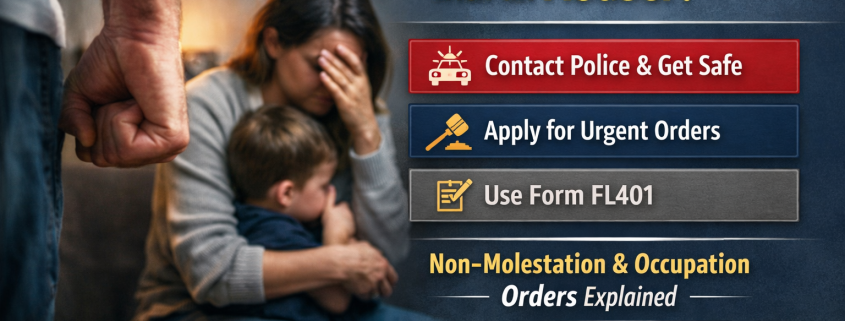
    He Raised His Fist While We’re Still Living Together — What Do I Do Now?

    A real Facebook comment, and the urgent legal steps that follow

    **“HELP!
    Going through divorce / domestic abuse / living under the same roof / completing financial forms for a consent order / have a 6-year-old child.

    This morning my ex raised his fist to me and squared up to me earlier this week.

    School know and have referred to MASH. I’ve been told to log it with the police.

    What do I do?
    Do I move out to protect myself and my child?
    How does this impact the divorce?

    Should he be moving out?
    Do I apply for a non-molestation order and an occupation order?
    How quickly does this happen?”*

    This is not a theoretical question.
    This is a live safeguarding situation.

    If this is you, or someone you support, the priority is simple and non-negotiable:

    Safety comes first — always.

    Everything else (divorce paperwork, finances, consent orders) comes second.


    Step 1: Immediate safety comes first

    If someone has raised their fist, squared up, or made you fear violence:

    • That is domestic abuse
    • You do not have to wait for physical injury
    • You do not have to “see what happens next”

    If there is immediate risk

    • Call the police
    • Get yourself and your child to a safe place if you can
    • Do not worry about “over-reacting” — courts and safeguarding agencies take threats of violence seriously

    The school has already referred to MASH. That means:

    • Professionals are concerned about risk to a child
    • You should keep records of all school communications
    • This strengthens the need for formal protective steps

    Step 2: What protective orders are available (England & Wales)

    The Family Court has emergency powers designed for exactly this situation.

    1. Non-Molestation Order (NMO)

    A non-molestation order is a protective injunction that:

    • Prohibits threats, intimidation, harassment or violence
    • Can protect you and your child
    • Is a criminal offence to breach

    This is the primary legal tool where there are threats or fear of harm.


    2. Occupation Order

    An occupation order deals with the home. It can:

    • Decide who stays and who must leave
    • Exclude the abusive party from the property or part of it
    • Be made even if both names are on the tenancy or mortgage

    This is how the court answers the question:

    “Who should move out — me or him?”

    You do not have to decide that alone.


    3. Domestic Abuse Protection Orders (DAPOs)

    DAPOs exist but are currently:

    • Only available in pilot areas
    • Not yet the main route for most people

    For most litigants in person, non-molestation + occupation orders remain the correct route.


    Step 3: How quickly can this be done?

    Emergency (without-notice) applications

    If there is risk of significant harm, the court can:

    • Make orders without telling him first
    • Act the same day or within days
    • Rely on your sworn written evidence

    The law explicitly allows this where it is “just and convenient” to do so.

    This is not unusual.
    It exists because waiting can be dangerous.


    On-notice hearings

    If the court decides notice is appropriate:

    • A hearing should normally be listed within 21 days
    • Interim protection can still be put in place

    Step 4: What form is used?

    Protective injunctions are applied for using:

    Form FL401

    This form can include:

    • A non-molestation order
    • An occupation order
    • Both together

    It must be supported by a clear witness statement setting out:

    • What has happened
    • Why you fear harm
    • Why urgent protection is needed

    Step 5: Evidence and documentation — do this now

    You do not need perfect evidence.
    You need clear, contemporaneous records.

    Start immediately:

    • Write down dates, times, words used, actions
    • Note who saw or heard what
    • Keep copies of:
      • School emails
      • MASH correspondence
      • Police reference numbers
    • Save messages, voicemails, or threats

    This is not about proving everything beyond doubt.
    It is about showing risk.


    “Do I move out? How does this affect the divorce?”

    This is one of the most common — and most misunderstood — questions.

    The honest answer:

    • Your safety and your child’s safety come first
    • The Family Court has specific powers (occupation orders) to decide housing without you having to flee
    • Whether leaving affects finances depends on the wider facts — and cannot be safely answered in a Facebook comment

    What matters right now is this:

    Do not stay somewhere unsafe out of fear of “damaging your case.”

    The court’s primary concern in protective injunctions is risk, not tactical advantage.


    Costs and enforcement

    • There is no court fee to apply for a non-molestation or occupation order
    • Legal aid may be available depending on eligibility
    • Breaching a non-molestation order is a criminal offence and can result in arrest

    These orders have teeth.


    What you can do today (practical checklist)

    If you are in this position today, do the following:

    1. Contact police if there is immediate risk
    2. Keep yourself and your child safe
    3. Start a written incident log
    4. Preserve school and MASH communications
    5. Prepare an FL401 application
    6. Seek urgent support with drafting if needed — this is not the time for guesswork

    How JSH Law can help immediately

    I support litigants in person who are:

    • Living under the same roof as an abusive ex
    • Navigating divorce alongside safeguarding risk
    • Preparing urgent FL401 applications
    • Unsure whether to seek a non-molestation order, an occupation order, or both

    I can help with:

    • Structuring your witness statement
    • Risk-focused drafting for without-notice applications
    • Explaining what the court is likely to prioritise
    • Helping you act quickly, calmly, and strategically

    You do not need to handle this alone.


      Links

      1. Get an injunction: Overview

        UK Government · GOV.UK · 2025

        2. FJC Best Practice: Protective Injunctions

        Family Justice Council (Judiciary) · Guidance PDF · 2025

        3. Form FL401 page

        HM Courts & Tribunals Service · GOV.UK · 2025

        4. Family Law Act 1996 § 42

        UK Parliament · legislation.gov.uk · 1996 (as amended)

        Regulatory & Editorial Notice

        This article is provided for general information only and does not constitute legal advice.
        Family-law outcomes depend on individual facts and circumstances.
        Nothing in this article creates a solicitor-client relationship.
        If you are in immediate danger, contact the police or emergency services without delay.

        Domestic Abuse Allegations and PD12J:

        What the Court Must Do — and What Litigants in Person Need to Watch For.

        Introduction: Why PD12J Matters More Than Most Litigants Realise

        When allegations of domestic abuse are raised in family court proceedings, the legal framework that governs how the court must respond is not optional. It is mandatory.

        That framework is Practice Direction 12J (PD12J).

        Yet many litigants in person only discover PD12J after key decisions have already been made — sometimes after contact has been suspended, sometimes after findings have been implicitly assumed without a hearing, and sometimes after Cafcass recommendations have hardened into a narrative that is difficult to unwind.

        This article explains, in plain language:

        • what PD12J is and why it exists
        • what the court is required to do when abuse is alleged
        • the most common PD12J failures seen in practice
        • how litigants in person can spot procedural drift early
        • what practical steps can be taken to protect fairness without escalating conflict

        This is not about disputing safeguarding. It is about ensuring that safeguarding decisions are reached lawfully.


        What Is PD12J?

        PD12J is a Practice Direction attached to the Family Procedure Rules. Its purpose is explicit:

        To ensure that where domestic abuse is alleged, the court identifies the issues early, applies the correct legal framework, and does not make child arrangements decisions that expose a child or parent to risk.

        In other words, PD12J exists to prevent short-cuts, assumptions, and welfare decisions being made on an unsafe factual foundation.

        Crucially, PD12J applies whether or not allegations are disputed, and regardless of whether parties are represented.


        The Trigger Point: When PD12J Applies

        PD12J is engaged when:

        • allegations of domestic abuse are raised in a C1A
        • abuse is referred to in statements, position statements, or oral submissions
        • Cafcass identify safeguarding concerns linked to alleged abuse
        • the court itself raises concerns about past behaviour

        It does not require:

        • a criminal conviction
        • police action
        • corroboration at the outset

        Once triggered, the court must follow a structured analytical process.


        What the Court Is Required to Do Under PD12J

        At a minimum, PD12J requires the court to:

        1. Identify the allegations clearly
          Not vaguely, not by implication, but specifically.
        2. Determine whether findings of fact are necessary
          This is not optional. The court must ask: Can safe child arrangements be decided without resolving these allegations?
        3. Consider the impact of alleged abuse on the child and parent
          Including coercive control, emotional harm, and post-separation abuse.
        4. Avoid assuming allegations are true or false
          Interim decisions must not pre-judge the outcome.
        5. Record the analysis
          PD12J compliance must be visible on the face of the decision.

        Failure at any of these stages is not a technicality. It goes to procedural fairness.


        Common PD12J Failures Seen in Practice

        Litigants in person frequently encounter the same problems, often without realising they are legally significant.

        1. “We Don’t Need a Fact-Finding Hearing”

        Courts sometimes decline fact-finding on the basis that allegations are:

        • “historic”
        • “not directly relevant”
        • “too many”
        • “unlikely to change the outcome”

        PD12J is clear: the test is necessity, not convenience.

        If alleged abuse could affect:

        • contact safety
        • parental dynamics
        • a child’s emotional welfare

        the court must explain why findings are not required.


        2. Interim Restrictions Without Analysis

        Contact may be:

        • supervised
        • reduced
        • suspended

        without a PD12J-compliant analysis being articulated.

        Interim caution is lawful. Silent assumption is not.


        3. Cafcass Recommendations Treated as Determinative

        Cafcass play a vital role, but they:

        • do not make findings of fact
        • do not apply PD12J
        • rely on what they are told

        Where Cafcass recommendations are adopted without judicial analysis, PD12J risks being bypassed.


        4. Abuse Being Minimis ed or Over-Relied Upon

        Both errors occur:

        • genuine abuse dismissed as “relationship conflict”
        • untested allegations treated as established risk

        PD12J exists to prevent both extremes.


        Why Litigants in Person Are Particularly Vulnerable

        Represented parties often have PD12J raised for them. Litigants in person usually do not.

        This creates a structural imbalance where:

        • allegations are framed by one party
        • Cafcass narratives crystallise early
        • interim decisions harden into status quo

        Without intervention, procedural shortcuts can quietly become the foundation of final orders.


        What Litigants in Person Can Do — Practically

        This is not about confrontation. It is about calm procedural clarity.

        1. Name PD12J Explicitly (Once, Clearly)

        You are entitled to say:

        “I respectfully ask the court to confirm how PD12J has been applied in this case.”

        That sentence alone reframes the discussion.


        2. Separate Emotion From Structure

        Focus on:

        • process
        • sequence
        • recorded reasoning

        Avoid relitigating relationship history unless invited.


        3. Ask Procedural Questions, Not Substantive Arguments

        For example:

        • “Has the court determined whether findings are necessary?”
        • “Is the court satisfied that safe arrangements can be made without resolving these allegations?”

        These are lawful questions. They are not attacks.


        4. Preserve the Record

        If PD12J is not addressed:

        • ask for it to be noted
        • request clarification
        • keep contemporaneous notes

        This matters later.


        Why Getting PD12J Wrong Early Is So Difficult to Undo

        Once:

        • interim arrangements are in place
        • Cafcass reports are filed
        • children adapt to reduced contact

        courts are understandably cautious about disruption.

        This is why early procedural correctness matters more than later argument.


        The Role of Support for Litigants in Person

        Many litigants do not need a solicitor to understand PD12J — but they do need:

        • someone who knows the framework
        • someone who can keep submissions focused
        • someone who can identify drift early

        Structured McKenzie Friend support often plays a crucial role here, particularly where power imbalance or complexity is present.


        Final Thought: PD12J Is Not a Weapon — It Is a Safeguard

        PD12J protects:

        • children
        • alleged victims
        • accused parents
        • the integrity of the process

        It is not about winning. It is about ensuring decisions are made on a lawful foundation.

        If you are representing yourself and allegations are in play, understanding PD12J is not optional. It is essential.


        Suggested Internal Links


        External Links

        Call Me

        If domestic abuse allegations have been raised in your family court case and you are representing yourself, early procedural clarity can make a significant difference to how the court approaches the issues.

        I provide calm, structured support to litigants in person navigating PD12J-related concerns, including understanding the court’s obligations and identifying when procedural safeguards may not have been properly applied, subject to the court’s discretion.

        You are welcome to get in touch to discuss whether support may be appropriate in your circumstances.

          Regulatory & Editorial Notice

          This article is provided for general information purposes only and does not constitute legal advice. It is not a substitute for advice from a qualified solicitor or barrister. References to legislation, procedural rules, guidance, or third-party organisations are made for informational and public-interest purposes only. While care has been taken to ensure accuracy at the time of publication, the law and its interpretation may change. Readers are responsible for seeking appropriate legal advice specific to their circumstances.