
When a Parent Discloses Strangulation and has a SEN Child: What to Do Next (UK Family Court)
When a Parent Discloses Strangulation and You Have SEN Children: What to Do Next (UK Family Court)
Safety note: If you are in immediate danger, call 999. If it is not an emergency, consider calling 101. If you cannot speak safely, use the Silent Solution (dial 999 and follow the operator’s prompts).
This article is written for litigants in person who find themselves in one of the most frightening situations a parent can face:
- you have children (often with Special Educational Needs (SEN)),
- the other parent is angry, aggressive, and unsafe, and
- you have disclosed that the other parent has strangled you (including where that has been admitted to professionals, such as social services or Cafcass).
If that is you: you do not need to “handle this better”. You need protection, stability, and a clear procedural plan.
Strangulation (non-fatal strangulation/suffocation) is treated in law and safeguarding practice as a serious risk indicator. It is also a criminal offence. (legislation.gov.uk)
This is why the priority in family law is often not “contact arrangements first” — it is safety first.
Key Takeaways (for litigants in person)
- Strangulation is treated as a serious risk indicator in safeguarding and family proceedings.
- A 15-minute consultation is triage and orientation: safety, urgency, next steps.
- Most situations like this require a protection-first approach before child arrangements litigation.
- Legal aid and specialist domestic abuse support should be pursued in parallel.
What you can expect from a 15-minute consultation with JSH Law
A 15-minute consultation is triage and orientation, not full casework.
In this call, JSH Law will help you:
- Check immediate safety (for you and the children).
- Identify the legal category of your problem (protective injunctions vs. children proceedings vs. both).
- Confirm whether there are deadlines, active proceedings, or court orders.
- Map the fastest lawful route to protection and stability.
- Signpost the right next step, including legal aid and specialist domestic abuse support.
What this call is not
It is not:
- drafting your witness statement,
- advising you what to “say to the judge”,
- telling you the outcome,
- or running your whole case.
That work is longer-form, and it must be done safely and properly.
Why strangulation changes everything
If a parent says, “He strangled me,” that is not “relationship conflict”. It is a serious safeguarding disclosure.
In UK law:
- The Domestic Abuse Act 2021 sets a statutory definition of domestic abuse (and recognises patterns of controlling/coercive behaviour). (legislation.gov.uk)
- Non-fatal strangulation/suffocation is recognised as a specific offence (via the Domestic Abuse Act’s amendments). (legaladvicecentre.london)
In family proceedings, the court must approach child arrangements through a safeguarding lens where domestic abuse is raised (see Practice Direction 12J). (justice.gov.uk)
The procedural approach JSH Law takes in this situation
When the disclosure is: SEN children + father unsafe/aggressive + strangulation admitted to professionals, the “best practice” procedural mindset is:
- Protect first (injunctions)
- Stabilise housing if needed
- Only then open or progress child arrangements litigation, unless the children’s arrangements must be stabilised urgently
That is why our priority sequence usually looks like this:
Priority Summary
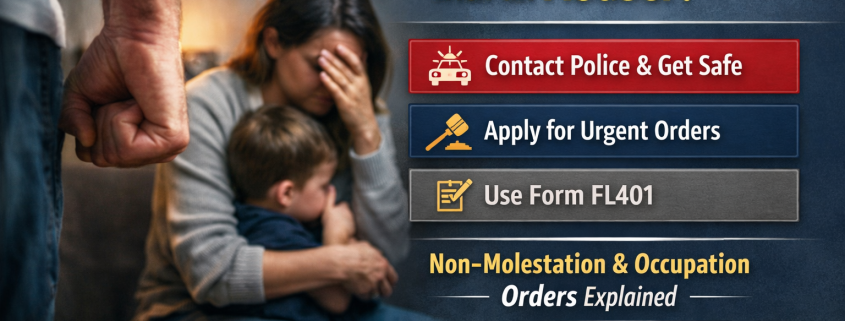
- 1️⃣ FL401 – Non-Molestation Order (immediate) (legislation.gov.uk)
- 2️⃣ Occupation Order (if housing risk exists) (legislation.gov.uk)
- 3️⃣ C100 + C1A (only if children’s arrangements must be stabilised now) (legislation.gov.uk)
- 4️⃣ Legal aid solicitor + specialist DA support (in parallel) (legislation.gov.uk)
| Priority | Action | Why it matters | Key legal reference |
|---|---|---|---|
| 1️⃣ | FL401 – Non-Molestation Order (immediate) | Creates a legal firewall to stop abuse, threats, intimidation and unwanted contact. | Family Law Act 1996 s.42 |
| 2️⃣ | Occupation Order (if housing risk exists) | Regulates occupation of the home; can exclude an unsafe person where justified. | Family Law Act 1996 s.33 |
| 3️⃣ | C100 + C1A (only if children’s arrangements must be stabilised now) | Only used urgently when children’s arrangements require immediate court control. | Children Act 1989 s.8 |
| 4️⃣ | Legal aid solicitor + specialist DA support (in parallel) | Secures specialist representation/support where domestic abuse gateway applies (subject to means). | LASPO 2012 Sch 1 para 12 |
Step 1: FL401 – Non-Molestation Order (IMMEDIATE)
What it is
A Non-Molestation Order is a protective injunction under the Family Law Act 1996. (legislation.gov.uk)
It can prohibit the other person from:
- using or threatening violence,
- harassing, intimidating, pestering,
- contacting you (including via third parties),
- coming to your home, workplace, or the children’s school (if appropriate).
Why it is the first priority in high-risk disclosures
Because it creates a legal firewall. It is designed to stop further abuse and reduce immediate risk.
Breach is a criminal offence
Breach of a non-molestation order is a criminal offence under s.42A Family Law Act 1996. (legislation.gov.uk)
Can it be made “without notice”?
Yes. In urgent cases, the court can consider the application without the respondent being told first (a “without notice” / ex parte application). The criteria are set out in s.45 Family Law Act 1996, and the Family Procedure Rules require your supporting evidence to explain why notice was not given. (legislation.gov.uk)
Practical reality: without-notice orders exist because sometimes warning the other person increases risk, pressure, or intimidation.
What you need procedurally
An application for a non-molestation order is made on Form FL401 and must be supported by a witness statement (your statement of facts). (justice.gov.uk)
What your witness statement should cover (high-level)
- the relationship and living situation (briefly)
- the pattern of behaviour (keep it factual)
- the strangulation disclosure (what happened, when, injuries if any, what was said to professionals)
- the children’s needs and exposure (especially SEN needs and routine stability)
- why you need protection now
- why you seek the order without notice (if applicable)
Step 2: Occupation Order (IF HOUSING RISK EXISTS)
What it is
An Occupation Order is an injunction that regulates who can live in, enter, or be excluded from the family home. It also arises under the Family Law Act 1996 (commonly under s.33 and related provisions depending on your property/occupancy status). (legislation.gov.uk)
When it becomes urgent
Consider it immediately if:
- the other parent still lives in the home,
- is trying to return,
- is turning up, refusing to leave, or making the home unsafe,
- you are being forced to flee with SEN children (disruption can be extremely harmful),
- the home is the only stable base for schooling, EHCP support, therapies, etc.
How the court assesses it
In some scenarios (notably s.33 cases), the court applies the “balance of harm” approach and considers the likely harm if the order is not made versus harm to the respondent if it is made. (This sits within the statutory framework of the Family Law Act’s occupation order provisions.) (legislation.gov.uk)
Practical point: occupation orders can be “harder” than NMOs
Courts treat excluding someone from their home as a major interference with rights — it can be granted, but it must be properly evidenced and proportionate, especially if sought without notice.
Step 3: C100 + C1A (ONLY if children’s arrangements must be stabilised now)
This is where people often make a costly mistake: they rush into a children application too early, and it unintentionally triggers pressure around contact before safety is stabilised.
The legal basis
A Child Arrangements Order is a s.8 Children Act 1989 order. (legislation.gov.uk)
You apply using Form C100 (private law children application). Cafcass will usually be involved in initial safeguarding checks. (cafcass.gov.uk)
What is Form C1A?
Form C1A is supplemental information used to tell the court about allegations of harm and domestic abuse (or to respond to them). (gov.uk)
When you should file C100 + C1A urgently
Usually only if one of these is true:
- the other parent is threatening to remove the children,
- there is an immediate dispute about where the children live / are collected from,
- contact is being demanded in a way that creates immediate risk,
- the school, GP, or professionals need court-backed clarity quickly,
- there is already chaos around handovers that is escalating.
PD12J: why domestic abuse matters in child arrangements
Where domestic abuse is raised, the court must consider safeguarding and risk, and handle contact decisions accordingly under Practice Direction 12J. (justice.gov.uk)
This is especially relevant where:
- there are serious allegations,
- the children may have witnessed incidents,
- or the abusive parent seeks to use proceedings to continue coercive control.
Step 4: Legal aid solicitor + specialist DA support (IN PARALLEL)
If strangulation has been admitted to professionals (social services/Cafcass), you should assume legal aid may be available (subject to means and evidence requirements) and you should pursue it immediately, not after you’ve struggled alone for months.
Legal aid: the legal framework
Legal aid remains available for certain family matters involving domestic abuse under LASPO 2012 Schedule 1, Part 1, paragraph 12, subject to providing evidence of domestic abuse as required by the regulations. (legislation.gov.uk)
Government guidance confirms you may be eligible for legal aid for domestic abuse matters if you have evidence and meet the financial criteria. (gov.uk)
Why specialist DA support matters (even if you are “strong”)
A specialist domestic abuse service (often via an IDVA) can help with:
- safety planning,
- liaison with police and children’s services,
- refuge/housing options,
- documenting risk properly.
For SEN children, that wrap-around support can be the difference between coping and collapse.
A simple decision map (quick reference)
If you are unsafe now: emergency services first.
Otherwise:
- Need immediate protection from abuse/harassment? → FL401 non-molestation (legislation.gov.uk)
- Need the abuser kept out of the home / housing stability? → add occupation order (legislation.gov.uk)
- Need urgent court control over children’s living/contact arrangements? → C100 + C1A (legislation.gov.uk)
- Want representation and safety-informed strategy? → legal aid solicitor + DA support (legislation.gov.uk)
What evidence and documents help (without drowning yourself)
You do not need a 200-page bundle on day one. You need credible, relevant, time-anchored evidence.
Examples:
- a letter/email note from social services/Cafcass referencing the disclosure (if available)
- police incident numbers (if any)
- GP/A&E notes (if any)
- photos of injuries (if any)
- a short chronology of key incidents (dates + 1–2 lines each)
- school/SEN documents only where they show vulnerability/routine impact
What to expect in court (high-level)
- Injunction applications (FL401) require your witness statement and can be dealt with urgently, including without notice where justified. (justice.gov.uk)
- Children applications (C100) will usually trigger initial safeguarding checks and a first hearing process. PD12J is central where domestic abuse is raised. (justice.gov.uk)
Call to Action: Book a 15-Minute Consultation with JSH Law
If you are in this situation — especially with SEN children — you do not need to “power through”. You need a clear procedural plan and the right support around you.
Book a 15-minute consultation here:
👉
- Understand the nature of your issue
- Explain the type of support available
- Confirm next steps, if appropriate
What to include in your booking notes (so we can help faster)
- Are the children safe today?
- Is the other parent in the home / turning up?
- Any deadlines, hearings, or existing orders?
- Any professional involvement (police / social services / Cafcass)?
- One sentence: what is your biggest fear right now?
Regulatory & Editorial Notice (JSH Law)
This article is general information for public education. It is not legal advice and should not be relied on as a substitute for advice on your specific facts. Reading this article does not create a solicitor-client relationship. If you are at immediate risk of harm, contact the police or emergency services. Where third-party sources are referenced, they are provided for convenience and do not necessarily reflect endorsement by JSH Law.
Key legal references (for readers who want sources)
- Family Law Act 1996:
- Non-molestation orders s.42 (legislation.gov.uk)
- Breach offence s.42A (legislation.gov.uk)
- Without notice criteria s.45 (legislation.gov.uk)
- Occupation orders framework (including s.33) (legislation.gov.uk)
- Family Procedure Rules: Part 10 (applications under FLA 1996; witness statement; without notice) (justice.gov.uk)
- Children Act 1989: s.8 orders (Child Arrangements / Prohibited Steps / Specific Issue) (legislation.gov.uk)
- Practice Direction 12J (domestic abuse and harm in child arrangements proceedings) (justice.gov.uk)
- Domestic Abuse Act 2021: statutory definition s.1 and related provisions (legislation.gov.uk)
- Non-fatal strangulation / suffocation offence (commencement and prosecution guidance) (legaladvicecentre.london)
- Legal aid: LASPO 2012 Sch 1 para 12 + evidence requirements reg.33; GOV.UK guidance (legislation.gov.uk)
- Form C1A (allegations of harm/domestic abuse) (gov.uk)
 jsh law ltd