An overview of the different types of hearings in family court proceedings and their procedural purpose at various stages of a case.

Start Here: A Clear, Candid Overview of UK Family Law — Baroness Hale’s “Family Law in the 21st Century”

If you are a litigant in person, one of the hardest parts of Family Court is not your case — it’s understanding the system around it. This “Start Here” resource embeds and breaks down a public lecture by Baroness Hale (former President of the UK Supreme Court) on Family Law in the 21st Century. Although recorded a few years ago, it remains one of the clearest big-picture explanations of what family law actually does: it defines relationships, gives legal status to some relationships, and provides remedies when things go wrong. The lecture also tackles issues litigants regularly encounter in practice — the myth of “common law marriage”, the rationale for no-fault divorce, how children’s welfare is analysed, and why procedure and duplication create hidden barriers for unrepresented parties. This guide pulls out the practical takeaways and shows how to watch the video strategically, so you can move from confusion to structure and present your case in the language the court works in.

Start Here: A Clear, Candid Overview of UK Family Law — Baroness Hale’s “Family Law in the 21st Century”

Resources > Start Here Pillar  |  Video explainer for litigants in person  |  England & Wales focus (with references to UK-wide context where relevant)

Key takeaways for litigants in person

  • Family law is bigger than “family court”: it defines relationships, gives legal status to some relationships, and provides remedies when things go wrong.
  • The modern trend is inclusion: the law has moved away from excluding children or families based on marital status.
  • “Wishes and feelings” matter, but the child’s welfare is paramount and decisions are not a popularity vote.
  • No-fault divorce was designed to reduce conflict — because conduct-based divorce fuels acrimony and makes co-parenting harder.
  • Unmarried cohabitants still have major legal gaps (despite widespread belief in “common law marriage”).
  • Procedure matters: complexity and duplication hurt litigants in person; simplifying how cases start could improve access to justice.

If you are a litigant in person, one of the hardest parts of the Family Court is not “your case” — it’s the wider system. The rules, the language, the assumptions, the different applications, the endless forms, and the emotional load of trying to make sense of it all at the same time.

That is why this video is worth your time.

It’s a public lecture by Baroness Hale of Richmond (former President of the UK Supreme Court) called “Family Law in the 21st Century”. It was produced a few years ago, but it remains a strong “big picture” explainer: what family law is, how it has evolved, and why the system feels difficult when you are unrepresented.

This article does three things:

  • Embeds the video so you can watch it in one place.
  • Explains the main ideas in plain English (without dumbing it down).
  • Pulls out what matters practically for litigants in person going through Family Court.

Watch the video: “Family Law in the 21st Century” (Baroness Hale)

Tip: if you are watching as a litigant in person, keep a notebook beside you. Write down the themes that apply to your situation: relationships, parental responsibility, children arrangements, remedies, and procedure.

What family law actually does (and why that matters in court)

One of the most helpful frameworks in this talk is her starting point: family law is not just “what happens in family court”. It does at least three things:

  1. Defines relationships (who counts as family for legal purposes).
  2. Gives legal status to some relationships (marriage, civil partnership, adoption, parental orders).
  3. Provides remedies when things go wrong (child arrangements, protective orders, divorce, finances).

This matters because litigants in person often enter proceedings believing the court is there to “decide who is right”. That is not the court’s job. The court’s job is to apply the law to the facts and make workable orders that promote welfare and safety.

If you bring the court a case that is essentially “this person is awful”, but you do not translate that into a welfare and safeguarding framework, you will feel unheard. Often, you are not unheard — you are just not speaking the court’s language.

Inclusion: the law moved away from excluding children and families

A significant part of the lecture tracks how family law has shifted from exclusion to inclusion. Historically, legal “family” was shaped by marriage and bloodline — and children born outside marriage could be treated very differently. Modern reforms moved towards recognising children as full family members regardless of their parents’ marital status.

For litigants in person, the practical point is this: the court will not treat a child as “less legitimate” because a relationship was informal. Your child’s welfare and stability come first.

But there is a second, more subtle point: the law distinguishes between:

  • Parentage (who is a legal parent), and
  • Parental responsibility (who has legal authority for key decisions).

That distinction matters in everyday disputes about schooling, medical decisions, travel, communication, and consent. If you don’t know whether someone has parental responsibility, you can waste months arguing the wrong point.

Quick reference: parental responsibility basics are explained by Cafcass here: Cafcass – Parental Responsibility.

Status relationships: marriage, civil partnership, adoption, parental orders

Another major theme is how the law “creates” family relationships through formal status. Marriage and civil partnership change legal status without a court order. Adoption and parental orders change legal relationships by court order.

Why does this matter to litigants in person? Because many of the most painful shocks in family breakdown happen when someone assumes they have rights that they do not.

1) The “common law marriage” myth

Baroness Hale touches on a reality that affects thousands of people: cohabitants often believe they have “marriage-like” financial rights. In England & Wales, that is usually not true. There are property and trust claims in some circumstances, but there is no automatic “divorce-style” financial remedy for cohabitants simply because they lived together.

If you are reading this and you are not married / not in a civil partnership, and your dispute is about housing or assets, this point is critical: the legal framework may be completely different from what people assume.

2) Religious-only marriages (and why remedies can be limited)

She also highlights the problem of religious marriages not recognised in civil law. This can affect financial remedies when relationships end. In plain terms: if you are not legally married under English law, you may not be entitled to the financial remedies people associate with divorce.

For litigants in person, that does not mean “no remedy exists” — it means you need to identify the correct route early. Leaving it until the end can be catastrophic.

Remedies: the Family Court’s main day-to-day work

When most people say “family law”, they mean the remedies: what happens when things go wrong.

Baroness Hale lists the reality plainly: remedies for domestic abuse, remedies for children arrangements, remedies to protect children from harm, and remedies for divorce and finances.

For litigants in person, two practical lessons sit underneath this:

1) The system is designed for risk-management, not moral judgment

Especially in children cases, the court is forward-looking: what arrangements reduce risk and promote stability going forward? That is why the court repeatedly returns to statutory structure, including the welfare checklist under the Children Act 1989. (A useful starting point is s.1 and s.1(3) for the welfare checklist.) Children Act 1989, s.1.

2) Domestic abuse: the issue is implementation as much as law

She notes something many survivors recognise: the legal framework can look “serviceable” on paper, but outcomes depend on implementation. In private children proceedings where domestic abuse is raised, the key procedural guidance is Practice Direction 12J.

If domestic abuse is part of your case, do not rely on “the court will know”. You must structure your case so the court is forced to apply the framework. That means: allegations, evidence, impact on the child, risk factors, and workable safeguarding proposals.

No-fault divorce: reducing conflict so co-parenting is possible

There is an excellent section in the Q&A where Baroness Hale explains why she supports no-fault divorce. Her reasoning is practical: conduct-based divorce encourages lists of accusations that inflame conflict, create bitterness, and make cooperation about children and finances harder.

For litigants in person, the take-home is not “divorce is easy”. It is: the system is slowly trying to remove unnecessary conflict from the process where it can. Family breakdown is hard enough; procedure should not make it harder.

Useful reference point: Divorce, Dissolution and Separation Act 2020 (legislation overview) .

Is the system biased against men (or women)? A more honest answer than you usually hear

One of the audience questions in the transcript asks whether the family court system is biased against men. Baroness Hale’s answer is realistic: men can feel it is stacked against them; women can feel it is stacked against them. The law is intended to be gender-neutral, and the correct analysis is child-centred.

For litigants in person, this is important because “bias” arguments often become a dead end. They drain your energy and rarely change the outcome. What changes outcomes is:

  • Evidence, not outrage.
  • Welfare analysis, not slogans.
  • Practical proposals, not punishment requests.
  • Credible safeguarding structure, not assumption.

If you want the court to make a different order, you need to show: (a) why the current arrangement is not meeting welfare needs or managing risk, and (b) what alternative order is workable and proportionate.

AI and family law: automation for process, not for human judgment

This is especially relevant given the wider debate about AI in legal services. Baroness Hale draws a clear line: some processes (like administrative steps) can be automated, but disputed facts and evaluative welfare judgments should not be.

If you are a litigant in person using AI tools:

  • Use them to organise, summarise, and structure.
  • Do not use them to invent, embellish, or “improve” evidence.
  • Always verify authorities and facts independently.

Your credibility matters more than your eloquence.

The “one-stop shop” idea: why procedure is the hidden barrier for litigants in person

Baroness Hale ends with a procedural reform idea that will resonate with anyone who has tried to run a case unrepresented: a single entry point into the family justice system.

Her point is straightforward: multiple processes, multiple application forms, repeated witness statements, duplicated facts — this creates avoidable friction. And when legal representation is low (as it is for many families), complexity becomes a form of exclusion.

This is exactly why “Start Here” resources matter. Litigants in person need:

  • A clear picture of the system, not fragments.
  • Joined-up information (one thing should link to the next).
  • Practical guidance on what the court actually needs.

If you watch this video and you feel “I finally understand what is happening”, that is the point. Knowledge reduces chaos.

How to use this video strategically (not just passively)

If you are currently in proceedings, here is a practical way to use this talk:

  1. Identify which “bucket” your case sits in: children arrangements, domestic abuse protection, divorce, finances, or multiple.
  2. Write your case theory in one sentence: “The order needed is X because welfare/safety requires Y.”
  3. List your top 5 facts that support that theory (with dates).
  4. Attach evidence to those facts (not to your feelings).
  5. Propose a workable order (contact plan, handovers, supervision, communication boundaries, review points).

This approach moves you from “reaction” to “strategy” — and that is where litigants in person begin to regain control.


Book a 15-minute consultation (phone)

If you are a litigant in person and you want help translating what you are experiencing into a structured court-ready approach, you can book a 15-minute consultation below.

The aim is clarity: what matters, what doesn’t, and what you should do next.


6 useful links (start here)

  • Children Act 1989, section 1 (welfare principle + welfare checklist)
    The statutory backbone of private children proceedings: welfare is paramount and the checklist guides analysis.
    View legislation
  • Practice Direction 12J (domestic abuse in children proceedings)
    The key procedural guidance when domestic abuse is raised — how courts should approach risk and contact.
    Read PD12J
  • Cafcass – Advice for parents and carers
    Practical information on safeguarding, parental responsibility, and what Cafcass does in private law cases.
    Cafcass parents hub
  • HMCTS – Find and download court forms
    Official form access point (C100, C1A, C79 and more). Always use the current version.
    Court and tribunal forms
  • Guidance on MIAMs and mediation
    A realistic starting point for resolving disputes without hearings where appropriate and safe.
    Family mediation guidance
  • Advicenow – Family court guides for litigants in person
    Plain-English guides designed for people running cases themselves (court process, statements, hearings).
    Advicenow guides
Regulatory & Editorial Notice

This article is provided for general information and commentary only. It does not constitute legal advice and must not be relied upon as such. Every case turns on its own facts, evidence, and legal context. JSH Law provides litigation support services to litigants in person, including strategic guidance, document preparation assistance, and hearing support. JSH Law is not a firm of solicitors and does not conduct litigation or provide reserved legal activities.

The embedded video remains the intellectual property of its respective publisher/rights holders. It is embedded here for educational and public-interest discussion purposes. Where links are provided to third-party resources (legislation, guidance, organisations), they are included for convenience and do not imply endorsement.

If you or a child are at immediate risk of harm, call 999 in an emergency. For urgent domestic abuse support, consider contacting specialist services in your area.

Family Court Hearing Types Explained (England & Wales)

Confused about your upcoming Family Court hearing? Learn what each hearing type means and how to prepare effectively.

Family Court Hearing Types Explained (England & Wales)

Category: Hearing Types  |  Audience: Litigants in Person (Private Children Proceedings)

Key takeaways for litigants in person

  • Each hearing has a specific procedural purpose — know what the court is deciding that day.
  • Most private children cases follow the Child Arrangements Programme under Practice Direction 12B.
  • A hearing is rarely about telling your whole story — it is about resolving defined issues.
  • If domestic abuse is raised, safeguarding principles under Practice Direction 12J may shape the structure of hearings.
  • Your preparation should match the type of hearing listed.

Why Hearing Types Matter

The Family Court does not run one continuous trial. It progresses in stages. Each hearing exists for a reason under the Family Procedure Rules 2010.

If you prepare for the wrong objective, you weaken your credibility. Understanding the function of your next hearing is one of the most important things you can do as a litigant in person.

1. First Hearing Dispute Resolution Appointment (FHDRA)

This is usually the first hearing after a C100 application. It forms part of the Child Arrangements Programme under PD12B.

Purpose:

  • Identify safeguarding concerns
  • Explore settlement
  • Decide interim arrangements (if safe)
  • Give directions for next steps

It is not a final hearing.

2. Directions Hearing

A procedural hearing focused purely on case management.

Purpose:

  • Timetables for statements
  • Disclosure orders
  • Police / medical record requests
  • Listing of further hearings

These hearings are governed by active case management principles under the Family Procedure Rules 2010.

3. Fact-Finding Hearing

If serious allegations are disputed, particularly domestic abuse, the court may list a fact-finding hearing. The framework is guided by PD12J.

Purpose:

  • Determine which allegations are proven
  • Apply the civil standard (balance of probabilities)
  • Assess risk and safeguarding impact

Evidence is tested through cross-examination. This is often one of the most significant hearings in private children proceedings.

4. Dispute Resolution Appointment (DRA)

A DRA takes place after evidence has been gathered (for example, after a Section 7 report).

Purpose:

  • Narrow the issues
  • Encourage settlement
  • Identify what remains in dispute
  • Prepare for final hearing if needed

5. Final Hearing

This is where the judge hears all remaining evidence and makes a final decision. The welfare principle under section 1 Children Act 1989 applies.

Purpose:

  • Hear oral evidence
  • Consider reports
  • Apply welfare checklist
  • Make a final order

6. Enforcement Hearing

If a Child Arrangements Order is breached, the court may list an enforcement hearing following a C79 application.

Purpose:

  • Determine whether breach occurred
  • Assess reasonable excuse
  • Consider enforcement powers

7. Urgent / Without Notice Hearing

In urgent safeguarding situations, the court may hear applications without the other party present initially.

These are exceptional and require strong evidence of immediate risk.

How to Prepare for Your Specific Hearing

  • Read the order listing the hearing carefully.
  • Identify what issues the judge must decide that day.
  • Prepare a short, focused position statement.
  • Bring an indexed bundle.
  • Stay child-focused.

Critical mindset

The court is not revisiting everything at every hearing. It is progressing through stages. Match your preparation to the stage you are in.


Book a 15-minute consultation (phone)

If you are unsure what your upcoming hearing is for — or how to prepare strategically — you can book a 15-minute initial consultation below:

Useful links

  1. Family Procedure Rules 2010
    legislation.gov.uk
  2. Practice Direction 12B (Child Arrangements Programme)
    justice.gov.uk
  3. Practice Direction 12J (Domestic Abuse)
    justice.gov.uk
  4. Children Act 1989
    legislation.gov.uk
  5. GOV.UK – Apply for a Child Arrangements Order
    gov.uk
  6. Cafcass – What Happens in Private Law Proceedings
    cafcass.gov.uk

Regulatory & Editorial Notice

This article is provided for general informational purposes only and does not constitute legal advice. Family Court proceedings depend on individual circumstances and judicial discretion. Always verify the current rules and directions before relying on procedural guidance.

Enforcing Child Contact Orders (C79): When Orders Are Ignored

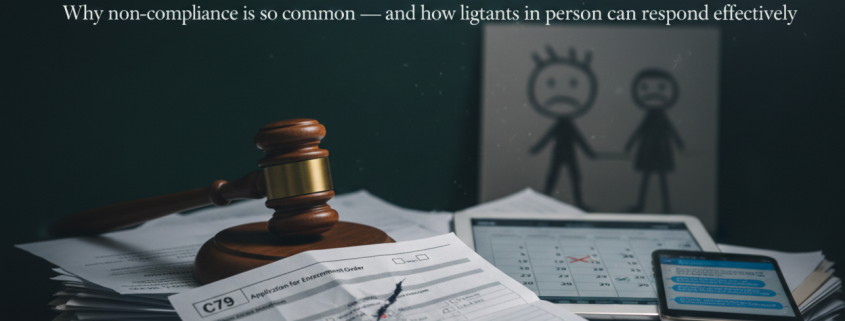
Why non-compliance is so common — and how litigants in person can respond effectively

Introduction: When a court order exists — but nothing changes

For many parents, obtaining a Child Arrangements Order feels like the end of the battle. The court has made a decision. Arrangements are set out clearly. The expectation is that life will now move forward.

Yet for a significant number of parents, the reality is very different.

Contact does not resume. Time is reduced, restricted, or cancelled altogether. Excuses multiply. Weeks turn into months. And despite the existence of a court order, one parent finds themselves effectively shut out of their child’s life.

This is where enforcement becomes necessary — and where many litigants in person feel lost, frustrated, and disillusioned.

This article explains how enforcement works, why it is often misunderstood, where parents go wrong, and how a structured approach can help litigants in person respond without escalating conflict or damaging credibility.


What enforcement of a Child Arrangements Order actually means

Enforcement is the process by which the court is asked to intervene because an existing order is not being complied with.

This is done through a C79 application.

The court is not re-deciding what arrangements should be. It is considering whether:

  • an order has been breached
  • the breach is established
  • there was a reasonable excuse
  • enforcement action is appropriate

Understanding this distinction is critical.

Many parents approach enforcement as an opportunity to re-argue the merits of their case. That is rarely effective.


Why enforcement is so difficult in practice

Enforcement in family court is procedurally demanding and emotionally draining.

Parents often encounter:

  • repeated breaches with minimal consequences
  • shifting justifications for non-compliance
  • informal variation without court approval
  • reluctance by courts to escalate sanctions early
  • delays that compound harm

For litigants in person, these challenges are magnified by uncertainty about what the court expects to see in an enforcement application.


Common mistakes litigants in person make when enforcing contact

1. Treating enforcement as a continuation of the original dispute

The court is not revisiting history. It is assessing compliance.

Lengthy narratives about the relationship breakdown often distract from the central issue: whether the order has been breached.


2. Failing to evidence breaches clearly

Courts require specificity.

Dates, times, what was ordered, what occurred instead — vague assertions are rarely sufficient.

Many litigants assume the court will “know what has been happening.” It will not, unless it is clearly evidenced.


3. Escalating emotionally rather than procedurally

Understandably, parents feel angry and hurt. But enforcement applications framed in emotive language often weaken credibility rather than strengthen it.

The court is assessing behaviour, not distress.


4. Delaying enforcement for too long

Some parents tolerate non-compliance for months before acting, hoping matters will resolve.

By the time enforcement is sought, patterns of non-compliance may already be entrenched — and harder to address.


What the court is actually looking for on a C79

When considering enforcement, the court focuses on:

  • the clarity of the original order
  • the extent and frequency of breaches
  • any alleged reasonable excuse
  • the impact on the child
  • whether enforcement action would be proportionate

Parents who present their case around these factors are far more likely to be taken seriously.


The myth of automatic enforcement

There is a common misconception that once a breach is shown, enforcement automatically follows.

In reality, family courts are cautious. They prioritise welfare and proportionality and often attempt less intrusive measures before imposing sanctions.

This can be deeply frustrating for parents — but understanding this reality allows litigants in person to prepare strategically rather than react emotionally.


The importance of documenting breaches properly

Effective enforcement depends on clear records.

This includes:

  • maintaining a contact log
  • preserving messages and cancellations
  • recording attempts to comply with the order
  • avoiding confrontational communication

Well-organised evidence allows the court to see patterns, not just isolated incidents.


When variation and enforcement overlap

Sometimes non-compliance arises because circumstances have changed — but no variation application has been made.

Courts may be reluctant to enforce rigidly where an order no longer reflects reality.

Litigants in person often struggle to know whether to pursue enforcement, variation, or both.

This is an area where early procedural clarity can prevent wasted applications and further delay.


How enforcement affects children — and why courts tread carefully

While enforcement is about compliance, courts remain focused on children’s welfare.

They are mindful that:

  • sanctions may increase conflict
  • children can be placed under pressure
  • rigid enforcement may not resolve underlying issues

This explains why enforcement can feel slow or ineffective — but it also highlights why clear, measured applications are essential.


When support with enforcement can make a difference

Support can be particularly valuable where:

  • breaches are ongoing and disputed
  • communication has broken down
  • previous enforcement attempts have failed
  • allegations are raised in response to enforcement
  • a parent feels unheard or overwhelmed

Structured support helps parents focus on process, not emotion.


How I support litigants in person with enforcement applications

I support parents seeking to enforce Child Arrangements Orders by helping them:

  • understand whether enforcement is appropriate
  • structure evidence clearly and chronologically
  • approach the C79 application in a focused way
  • prepare for what the court is likely to consider
  • avoid common pitfalls that undermine enforcement

I do not promise outcomes, and I do not escalate conflict.

My role is to help litigants in person engage with enforcement proceedings in a way that protects their credibility and keeps the focus where the court expects it to be.


A message to parents facing repeated non-compliance

If you are dealing with ongoing breaches of a Child Arrangements Order, your frustration is understandable.

But enforcement is not about expressing that frustration. It is about presenting a clear procedural case that the court can act upon.

Clarity, consistency, and preparation matter.


Call Me

If a Child Arrangements Order is not being complied with and you are representing yourself, structured support may help you approach enforcement with clarity and confidence.

I offer procedural support to litigants in person pursuing enforcement applications, subject to the court’s discretion.

You are welcome to get in touch to discuss whether support would be appropriate in your circumstances.

    Regulatory & Editorial Notice
    This article is published for general information purposes only. It does not constitute legal advice and should not be relied upon as such. Every family case turns on its own facts and procedural context. Support services described are non-reserved and subject to the discretion of the court. Where legal advice is required, readers should seek assistance from a suitably qualified legal professional.