
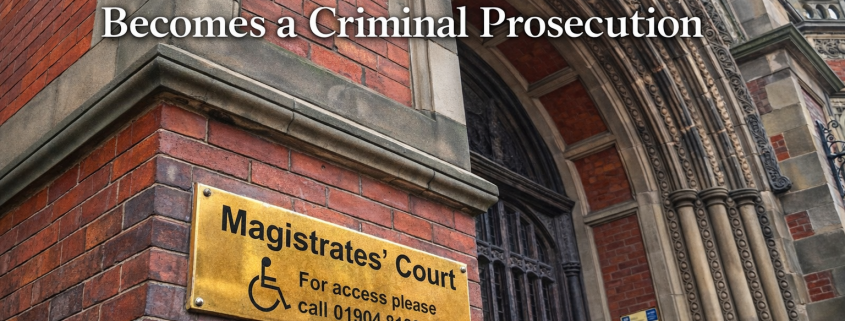
When Home Education Becomes a Criminal Prosecution
What Litigants in Person Need to Know About School Attendance Orders, Social Care Overreach, and Magistrates’ Court Proceedings
Across England and Wales, a growing number of parents are discovering — often too late — that a dispute about elective home education (EHE) can escalate into criminal prosecution.
Not because their child is unsafe.
Not because education is unsuitable.
But because process has gone wrong, power has been misused, or parents have been pressured into compliance without understanding their rights.
This article is written for Litigants in Person navigating the intersection of:
- home education,
- Children’s Social Care involvement,
- School Attendance Orders (SAOs),
- and Magistrates’ Court prosecutions under the Education Act 1996.
It is based on a real case (anonymised), and on patterns I see repeatedly in practice.
If you are facing — or fear you may face — similar action, this guide is for you.
1. The Scenario (Anonymised but Real)
A parent lawfully elects to home educate their child under section 7 of the Education Act 1996.
The child has anxiety. School is harming their wellbeing.
The parent has previously home educated successfully.
Children’s Social Care are already involved — not because of educational neglect, but because of domestic abuse by the other parent.
During a meeting, the parent raises home education as a safeguarding-led decision.
From that moment:
- Professionals express opposition.
- Education officers are involved prematurely.
- The parent is told (incorrectly) that home education is not allowed due to child protection involvement.
- A proposed Bill — not law — is repeatedly relied upon.
- A positive EHE visit is later contradicted by a negative decision with no clear reasons.
- A School Attendance Order is issued.
- Threats of prosecution follow.
- Eventually, a Single Justice Procedure Notice arrives.
The parent is now facing criminal charges.
This is not rare. And it is not inevitable.
2. The Legal Foundation: Your Right to Home Educate
Section 7, Education Act 1996
Parents must ensure their child receives an education that is:
- efficient, and
- suitable,
- to the child’s age, ability, aptitude, and any special educational needs.
Crucially:
Education does not have to be provided at school.
There is no statutory requirement for:
- a curriculum,
- Ofsted-style inspection,
- or adherence to school norms.
Local Authorities do not approve home education. They may only intervene if they have reason to believe education is unsuitable.
3. What a School Attendance Order (SAO) Actually Is
An SAO (sections 437–443 Education Act 1996) is not automatic.
Before issuing one, the Local Authority must:
- Have reasonable grounds to believe education is unsuitable.
- Serve a notice requiring information.
- Consider the parent’s response fairly and lawfully.
- Only then issue an SAO naming a school.
An SAO is a last resort, not a default enforcement tool.
If the LA:
- relies on irrelevant considerations,
- ignores positive evidence,
- fails to give reasons,
- or predetermines the outcome,
the SAO itself may be unlawful.
4. The Common Trap: “Just Fill in the Forms”
When an SAO is not complied with, councils often move straight to prosecution under section 443.
Parents receive a Single Justice Procedure Notice (SJPN) telling them:
- they’ve been charged,
- they have 21 days to plead,
- and they can get a “discount” if they plead guilty.
This is where many parents make a fatal mistake.
A guilty plea:
- can be decided on the papers,
- leads to conviction, fines, and costs,
- and removes the opportunity to challenge the process.
A not guilty plea does not mean you are refusing responsibility.
It means you are requiring the council to prove its case.
5. What the Magistrates’ Court Can — and Cannot — Decide
The Magistrates’ Court does not decide:
- whether social workers behaved appropriately,
- whether policy was fair,
- or whether you are a “good parent”.
It decides:
- whether a lawful SAO existed,
- whether you failed to comply,
- and whether any defence applies.
This is why procedure matters more than emotion.
6. Defences and Challenge Points Litigants in Person Should Look For
Without giving legal advice, there are recurring issues that often undermine SAO prosecutions:
1. Unlawful reliance on non-law
Proposed legislation (such as past Schools Bills) has no legal force.
If decisions are based on policy that does not exist in law, that is challengeable.
2. Predetermination
If:
- opposition to EHE appears before assessment,
- outcomes are decided before evidence is considered,
- or professionals influence one another behind closed doors,
this may breach public law fairness.
3. Failure to give reasons
Parents are entitled to understand:
- why education was deemed unsuitable,
- and how the decision was reached.
Vague references to “home conditions” or “concerns” are insufficient.
4. Improper influence between departments
Children’s Social Care and Education are separate statutory functions.
Cross-contamination — particularly where safeguarding is used to pressure education compliance — must be scrutinised.
5. Welfare harm caused by enforcement
Evidence that:
- the child’s anxiety worsened,
- emotional distress increased,
- or wellbeing declined due to forced school attendance,
is relevant to reasonableness and proportionality.
7. Policy and Guidance Local Authorities Must Follow
Key documents include:
- Elective Home Education Guidance for Local Authorities (DfE)
- Working Together to Safeguard Children
- Public law principles of fairness, proportionality, and rational decision-making
Failure to follow guidance is not automatically unlawful — but it matters when combined with unfair process.
8. Why Social Care Involvement Does Not Remove EHE Rights
There is no law stating that:
- a Child Protection Plan,
- Child in Need plan,
- or PLO process
automatically prevents home education.
Any restriction must be:
- lawful,
- evidence-based,
- and proportionate.
Blanket policies are not lawful substitutes for individual assessment.
9. The Importance of Paper Control
One of the most damaging patterns I see is parents:
- over-explaining,
- sending emotional responses,
- filling in every box,
- and inadvertently making admissions.
In Magistrates’ Court proceedings:
- less is often more,
- timing matters,
- and disclosure should be forced, not volunteered.
10. You Are Not “Difficult” for Challenging This
Parents are frequently told — explicitly or implicitly — that resisting enforcement means they are:
- uncooperative,
- obstructive,
- or failing to put the child first.
In reality, lawful challenge is part of the system.
Courts exist precisely because decisions can be wrong.
11. Practical Advice for Litigants in Person
If you are facing an SAO or prosecution:
- Do not plead guilty without understanding the consequences.
- Do not assume the council’s paperwork is correct.
- Ask for copies of the SAO, evidence of service, and decision records.
- Keep communications factual and restrained.
- Separate safeguarding issues from education law.
- Get support early.
12. Final Thoughts
This area of law is emotionally charged because it sits at the intersection of:
- parenting,
- education,
- safeguarding,
- and criminal enforcement.
But emotion should not be confused with legality.
Many parents comply not because the law requires it, but because the process overwhelms them.
It does not have to be that way.
Litigant in Person Dealing with a SAO?
If you are a Litigant in Person dealing with:
- a School Attendance Order,
- threatened or active prosecution,
- Children’s Social Care involvement affecting education decisions,
- or pressure to comply without clear reasons,
you do not have to navigate this alone.
I provide McKenzie Friend support to help parents:
- understand what is actually happening,
- prepare paperwork properly,
- challenge unfair process,
- and remain focused and grounded in court.
Every case is different.
Your situation deserves to be looked at carefully, calmly, and lawfully.
📩 Get in touch via jshlaw.co.uk to discuss your situation and understand your options.
🔗 Internal Links
- McKenzie Friend & Family Court Support
https://www.jshlaw.co.uk/mckenzie-friend-support/
Use when you explain how parents can get procedural support and help preparing court paperwork. - Litigants in Person – Family Court Guidance
https://www.jshlaw.co.uk/category/litigants-in-person-family-court-guidance/
Link when discussing how unrepresented parents are often overwhelmed by process. - Family Court Accountability
https://www.jshlaw.co.uk/category/family-court-accountability/
Link when addressing institutional overreach, unfair process, and misuse of power.
🌐 External Links
- Education Act 1996 – Section 7 (Legislation)
https://www.legislation.gov.uk/ukpga/1996/56/section/7
Primary statutory basis for the right to home educate. - Education Act 1996 – Sections 437–443 (School Attendance Orders)
https://www.legislation.gov.uk/ukpga/1996/56/part/VI/chapter/II
Statutory framework for SAOs and enforcement. - DfE – Elective Home Education Guidance for Local Authorities
https://www.gov.uk/government/publications/elective-home-education
Key policy guidance councils are expected to follow.
Regulatory & Editorial Notice
This article is for general information only and does not constitute legal advice. Every case turns on its own facts. If you are involved in live proceedings, you should seek appropriate support before taking action.
 JSH Law Ltd