
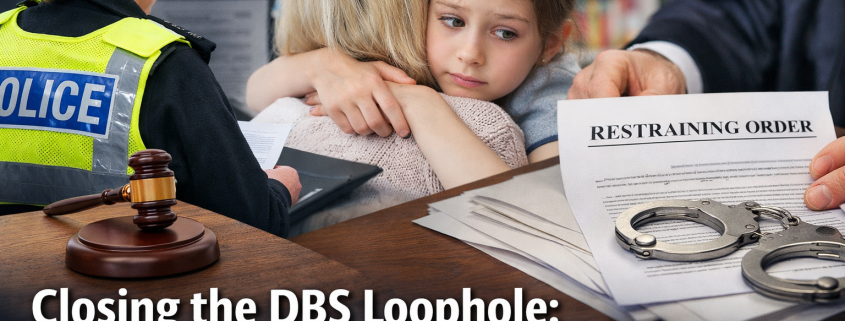
Closing the DBS Loophole: Why Civil Harassment Orders Must Appear on Enhanced DBS Checks
A safeguarding gap hiding in plain sight
A current petition before UK Government and Parliament calls for an urgent and necessary reform:
civil harassment orders, including court-issued undertakings, should be disclosed on Enhanced DBS checks.
At present, a person may be subject to serious civil restrictions imposed by a court—often following repeated harassment, intimidation, or coercive conduct—yet still pass an Enhanced Disclosure and Barring Service (DBS) check and lawfully work with children or vulnerable adults.
That is not a technical oversight.
It is a safeguarding failure.
What is the current problem?
The DBS regime is commonly understood—by employers, volunteers, and the public—as a robust safeguarding mechanism. In reality, it is narrower than many assume.
Enhanced DBS checks primarily disclose:
- criminal convictions and cautions;
- relevant police intelligence (at the discretion of the chief officer);
- barred-list status where applicable.
Civil outcomes, however, sit in a grey area.
This includes:
- civil harassment orders;
- undertakings given to a court in lieu of findings;
- non-criminal protective orders arising from family or civil proceedings.
These measures are often imposed precisely because a court has determined that conduct poses a risk, even if it does not meet the criminal standard of proof or has not resulted in prosecution.
Yet in many cases, they are not automatically disclosed.
Why undertakings matter in safeguarding contexts
In family and civil courts, undertakings are not casual promises. They are legally binding court orders.
They are frequently used where:
- repeated harassment is evidenced;
- power imbalances make findings difficult;
- victims are retraumatised by adversarial fact-finding;
- courts prioritise immediate protection over punitive outcomes.
The absence of findings does not mean the absence of risk.
Courts routinely accept undertakings because:
- the behaviour alleged is serious enough to justify restriction;
- the respondent agrees that restraint is necessary;
- ongoing contact with children or vulnerable people may be relevant.
Failing to reflect this in safeguarding disclosures creates a false sense of safety.
The real-world safeguarding risk
This loophole allows individuals who are under active court-imposed behavioural restrictions to:
- work in schools, nurseries, and colleges;
- volunteer with youth organisations;
- access vulnerable adults in care or support settings.
Employers relying on Enhanced DBS checks are not negligent—they are misled by a system that implies completeness while omitting critical context.
Safeguarding depends on informed risk assessment, not binary criminal labels.
Why police discretion is not enough
It is sometimes argued that police intelligence disclosure fills this gap. In practice, this is unreliable.
Police disclosure depends on:
- local recording practices;
- subjective relevance assessments;
- fragmented information-sharing between civil courts and policing bodies.
Many civil harassment outcomes never reach police databases in a form that triggers discretionary disclosure.
Safeguarding should not depend on chance.
The petition: a proportionate and necessary reform
The petition does not call for:
- criminalisation by the back door;
- automatic barring;
- retrospective punishment.
It calls for transparency.
Disclosure would allow:
- employers to assess risk proportionately;
- safeguarding leads to put controls in place;
- vulnerable people to be protected without stigma or assumption.
Disclosure is not a sanction.
It is information.
Why this matters particularly in family-law contexts
Those familiar with family proceedings know that:
- abuse often presents as coercive, controlling, or cumulative;
- victims may withdraw allegations under pressure;
- findings are not always pursued for child-focused reasons.
A civil court may still conclude that restrictions are essential, even where criminal thresholds are not met.
To ignore those outcomes in safeguarding checks is to misunderstand how harm actually manifests.
A system built for safeguarding must reflect reality
Safeguarding frameworks must align with how risk is identified in practice, not just in criminal law theory.
If a court has deemed it necessary to restrict someone’s behaviour to protect another person, that information is plainly relevant where:
- children are involved;
- vulnerable adults are at risk;
- positions of trust are held.
Anything less undermines public confidence in safeguarding systems.
Final thoughts
This petition highlights a quiet but serious flaw in the safeguarding infrastructure.
Closing the DBS loophole would:
- strengthen child and vulnerable-adult protection;
- support employers in making informed decisions;
- respect due process while prioritising safety;
- reflect the reality of civil-court risk management.
Safeguarding should never rely on incomplete information.
This is not about punishment.
It is about protection.
Sign the Petition
If you work in safeguarding, family law, education, or care—or if you have experienced the limitations of current disclosure systems—you may wish to review and support the petition calling for reform of Enhanced DBS disclosures.
Require civil harassment orders to be disclosed in enhanced DBS checks – Petitions
Informed systems protect people.
Opaque systems protect risk.
Regulatory & Editorial Notice
This article is published for general information and public-interest discussion only. It does not constitute legal advice. References to safeguarding frameworks, civil orders, or DBS processes are illustrative and may not apply to individual circumstances. Allegations are not findings. Readers should seek independent legal or professional advice where appropriate.