
 jsh law ltd
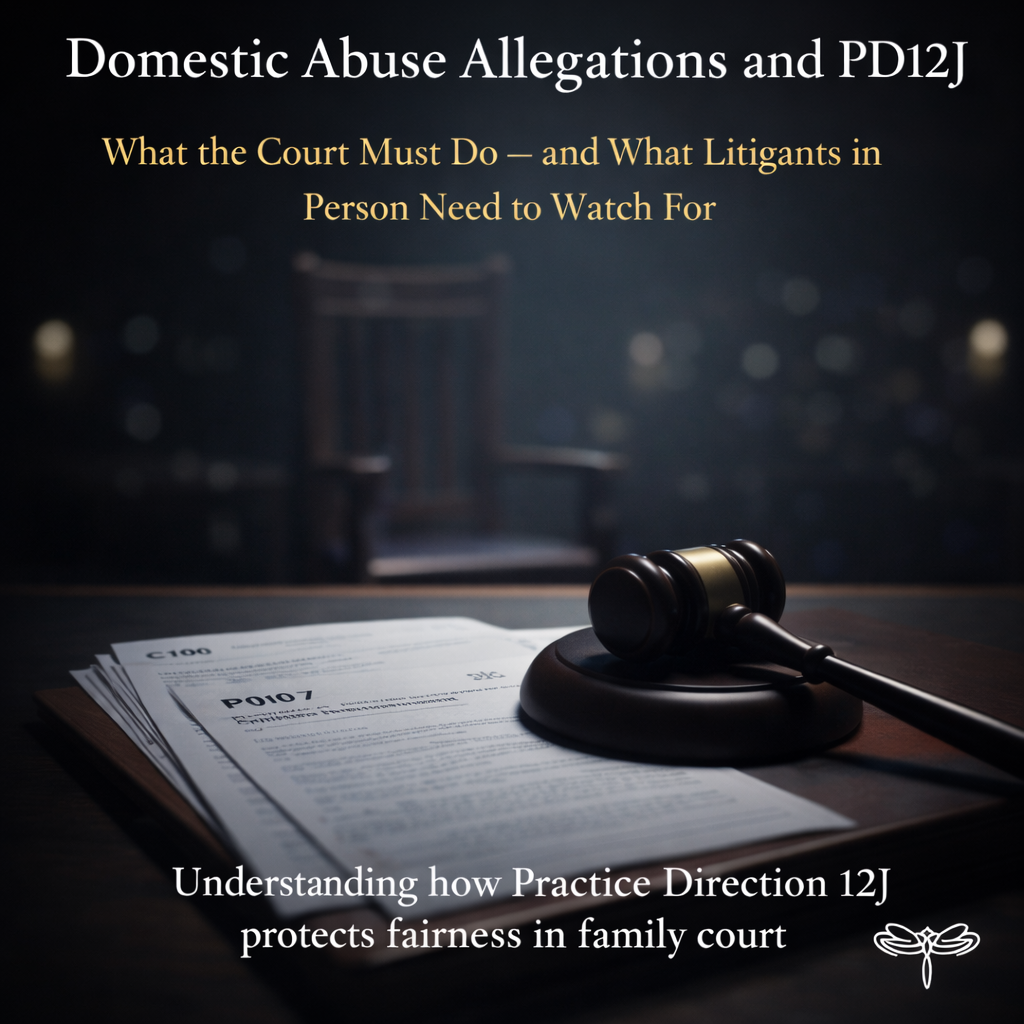
Domestic Abuse Allegations and PD12J:
What the Court Must Do — and What Litigants in Person Need to Watch For.
Introduction: Why PD12J Matters More Than Most Litigants Realise
When allegations of domestic abuse are raised in family court proceedings, the legal framework that governs how the court must respond is not optional. It is mandatory.
That framework is Practice Direction 12J (PD12J).
Yet many litigants in person only discover PD12J after key decisions have already been made — sometimes after contact has been suspended, sometimes after findings have been implicitly assumed without a hearing, and sometimes after Cafcass recommendations have hardened into a narrative that is difficult to unwind.
This article explains, in plain language:
- what PD12J is and why it exists
- what the court is required to do when abuse is alleged
- the most common PD12J failures seen in practice
- how litigants in person can spot procedural drift early
- what practical steps can be taken to protect fairness without escalating conflict
This is not about disputing safeguarding. It is about ensuring that safeguarding decisions are reached lawfully.
What Is PD12J?
PD12J is a Practice Direction attached to the Family Procedure Rules. Its purpose is explicit:
To ensure that where domestic abuse is alleged, the court identifies the issues early, applies the correct legal framework, and does not make child arrangements decisions that expose a child or parent to risk.
In other words, PD12J exists to prevent short-cuts, assumptions, and welfare decisions being made on an unsafe factual foundation.
Crucially, PD12J applies whether or not allegations are disputed, and regardless of whether parties are represented.
The Trigger Point: When PD12J Applies
PD12J is engaged when:
- allegations of domestic abuse are raised in a C1A
- abuse is referred to in statements, position statements, or oral submissions
- Cafcass identify safeguarding concerns linked to alleged abuse
- the court itself raises concerns about past behaviour
It does not require:
- a criminal conviction
- police action
- corroboration at the outset
Once triggered, the court must follow a structured analytical process.
What the Court Is Required to Do Under PD12J
At a minimum, PD12J requires the court to:
- Identify the allegations clearly
Not vaguely, not by implication, but specifically. - Determine whether findings of fact are necessary
This is not optional. The court must ask: Can safe child arrangements be decided without resolving these allegations? - Consider the impact of alleged abuse on the child and parent
Including coercive control, emotional harm, and post-separation abuse. - Avoid assuming allegations are true or false
Interim decisions must not pre-judge the outcome. - Record the analysis
PD12J compliance must be visible on the face of the decision.
Failure at any of these stages is not a technicality. It goes to procedural fairness.
Common PD12J Failures Seen in Practice
Litigants in person frequently encounter the same problems, often without realising they are legally significant.
1. “We Don’t Need a Fact-Finding Hearing”
Courts sometimes decline fact-finding on the basis that allegations are:
- “historic”
- “not directly relevant”
- “too many”
- “unlikely to change the outcome”
PD12J is clear: the test is necessity, not convenience.
If alleged abuse could affect:
- contact safety
- parental dynamics
- a child’s emotional welfare
the court must explain why findings are not required.
2. Interim Restrictions Without Analysis
Contact may be:
- supervised
- reduced
- suspended
without a PD12J-compliant analysis being articulated.
Interim caution is lawful. Silent assumption is not.
3. Cafcass Recommendations Treated as Determinative
Cafcass play a vital role, but they:
- do not make findings of fact
- do not apply PD12J
- rely on what they are told
Where Cafcass recommendations are adopted without judicial analysis, PD12J risks being bypassed.
4. Abuse Being Minimis ed or Over-Relied Upon
Both errors occur:
- genuine abuse dismissed as “relationship conflict”
- untested allegations treated as established risk
PD12J exists to prevent both extremes.
Why Litigants in Person Are Particularly Vulnerable
Represented parties often have PD12J raised for them. Litigants in person usually do not.
This creates a structural imbalance where:
- allegations are framed by one party
- Cafcass narratives crystallise early
- interim decisions harden into status quo
Without intervention, procedural shortcuts can quietly become the foundation of final orders.
What Litigants in Person Can Do — Practically
This is not about confrontation. It is about calm procedural clarity.
1. Name PD12J Explicitly (Once, Clearly)
You are entitled to say:
“I respectfully ask the court to confirm how PD12J has been applied in this case.”
That sentence alone reframes the discussion.
2. Separate Emotion From Structure
Focus on:
- process
- sequence
- recorded reasoning
Avoid relitigating relationship history unless invited.
3. Ask Procedural Questions, Not Substantive Arguments
For example:
- “Has the court determined whether findings are necessary?”
- “Is the court satisfied that safe arrangements can be made without resolving these allegations?”
These are lawful questions. They are not attacks.
4. Preserve the Record
If PD12J is not addressed:
- ask for it to be noted
- request clarification
- keep contemporaneous notes
This matters later.
Why Getting PD12J Wrong Early Is So Difficult to Undo
Once:
- interim arrangements are in place
- Cafcass reports are filed
- children adapt to reduced contact
courts are understandably cautious about disruption.
This is why early procedural correctness matters more than later argument.
The Role of Support for Litigants in Person
Many litigants do not need a solicitor to understand PD12J — but they do need:
- someone who knows the framework
- someone who can keep submissions focused
- someone who can identify drift early
Structured McKenzie Friend support often plays a crucial role here, particularly where power imbalance or complexity is present.
Final Thought: PD12J Is Not a Weapon — It Is a Safeguard
PD12J protects:
- children
- alleged victims
- accused parents
- the integrity of the process
It is not about winning. It is about ensuring decisions are made on a lawful foundation.
If you are representing yourself and allegations are in play, understanding PD12J is not optional. It is essential.
Suggested Internal Links
- Child Arrangements Orders (C100): Getting It Right From the Start
- False Allegations in the Family Court: Protecting Credibility as a Litigant in Person
- Parental Alienation and Contact Breakdown: Responding Without Damaging Your Case
External Links
- Judiciary of England and Wales — Practice Direction 12J
- Cafcass guidance on domestic abuse and safeguarding in private law cases
- Practice Direction 12J explained and also here and here.
Call Me
If domestic abuse allegations have been raised in your family court case and you are representing yourself, early procedural clarity can make a significant difference to how the court approaches the issues.
I provide calm, structured support to litigants in person navigating PD12J-related concerns, including understanding the court’s obligations and identifying when procedural safeguards may not have been properly applied, subject to the court’s discretion.
You are welcome to get in touch to discuss whether support may be appropriate in your circumstances.
Regulatory & Editorial Notice
This article is provided for general information purposes only and does not constitute legal advice. It is not a substitute for advice from a qualified solicitor or barrister. References to legislation, procedural rules, guidance, or third-party organisations are made for informational and public-interest purposes only. While care has been taken to ensure accuracy at the time of publication, the law and its interpretation may change. Readers are responsible for seeking appropriate legal advice specific to their circumstances.

 JSH LAW LTD
 JSH LAW LTD
 jsh law ltd






 jsh law ltd
 jsh law ltd
Leave a Reply
Want to join the discussion?Feel free to contribute!