
 jsh law ltd
He Raised His Fist While We’re Still Living Together — What Do I Do Now?
A real Facebook comment, and the urgent legal steps that follow
**“HELP!
Going through divorce / domestic abuse / living under the same roof / completing financial forms for a consent order / have a 6-year-old child.This morning my ex raised his fist to me and squared up to me earlier this week.
School know and have referred to MASH. I’ve been told to log it with the police.
What do I do?
Do I move out to protect myself and my child?
How does this impact the divorce?Should he be moving out?
Do I apply for a non-molestation order and an occupation order?
How quickly does this happen?”*
This is not a theoretical question.
This is a live safeguarding situation.
If this is you, or someone you support, the priority is simple and non-negotiable:
Safety comes first — always.
Everything else (divorce paperwork, finances, consent orders) comes second.
Step 1: Immediate safety comes first
If someone has raised their fist, squared up, or made you fear violence:
- That is domestic abuse
- You do not have to wait for physical injury
- You do not have to “see what happens next”
If there is immediate risk
- Call the police
- Get yourself and your child to a safe place if you can
- Do not worry about “over-reacting” — courts and safeguarding agencies take threats of violence seriously
The school has already referred to MASH. That means:
- Professionals are concerned about risk to a child
- You should keep records of all school communications
- This strengthens the need for formal protective steps
Step 2: What protective orders are available (England & Wales)
The Family Court has emergency powers designed for exactly this situation.
1. Non-Molestation Order (NMO)
A non-molestation order is a protective injunction that:
- Prohibits threats, intimidation, harassment or violence
- Can protect you and your child
- Is a criminal offence to breach
This is the primary legal tool where there are threats or fear of harm.
2. Occupation Order
An occupation order deals with the home. It can:
- Decide who stays and who must leave
- Exclude the abusive party from the property or part of it
- Be made even if both names are on the tenancy or mortgage
This is how the court answers the question:
“Who should move out — me or him?”
You do not have to decide that alone.
3. Domestic Abuse Protection Orders (DAPOs)
DAPOs exist but are currently:
- Only available in pilot areas
- Not yet the main route for most people
For most litigants in person, non-molestation + occupation orders remain the correct route.
Step 3: How quickly can this be done?
Emergency (without-notice) applications
If there is risk of significant harm, the court can:
- Make orders without telling him first
- Act the same day or within days
- Rely on your sworn written evidence
The law explicitly allows this where it is “just and convenient” to do so.
This is not unusual.
It exists because waiting can be dangerous.
On-notice hearings
If the court decides notice is appropriate:
- A hearing should normally be listed within 21 days
- Interim protection can still be put in place
Step 4: What form is used?
Protective injunctions are applied for using:
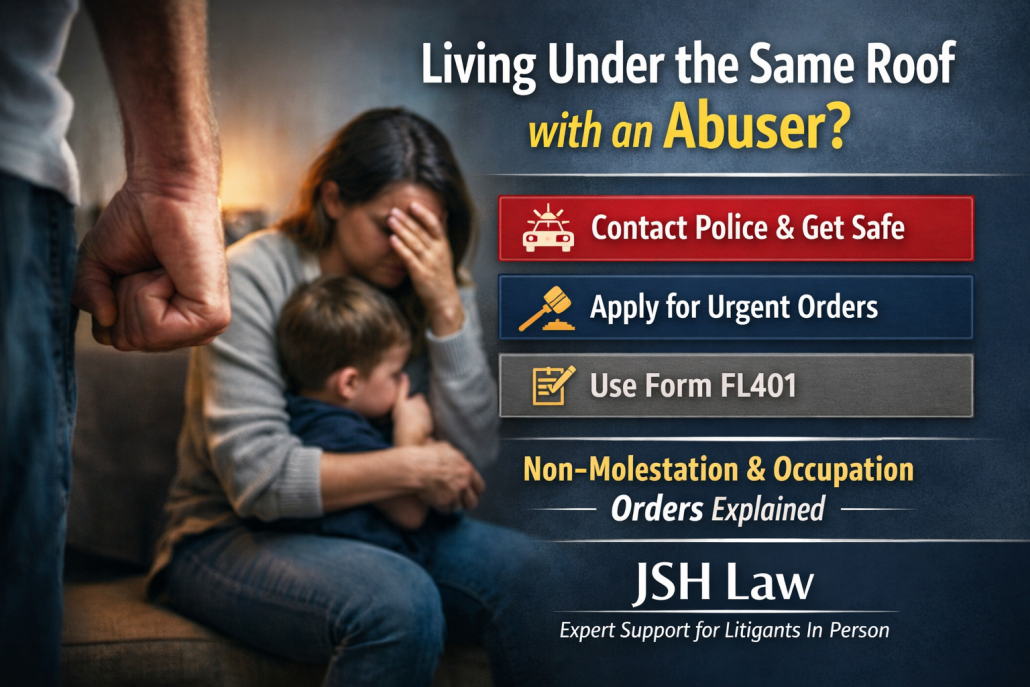
Form FL401
This form can include:
- A non-molestation order
- An occupation order
- Both together
It must be supported by a clear witness statement setting out:
- What has happened
- Why you fear harm
- Why urgent protection is needed
Step 5: Evidence and documentation — do this now
You do not need perfect evidence.
You need clear, contemporaneous records.
Start immediately:
- Write down dates, times, words used, actions
- Note who saw or heard what
- Keep copies of:
- School emails
- MASH correspondence
- Police reference numbers
- Save messages, voicemails, or threats
This is not about proving everything beyond doubt.
It is about showing risk.
“Do I move out? How does this affect the divorce?”
This is one of the most common — and most misunderstood — questions.
The honest answer:
- Your safety and your child’s safety come first
- The Family Court has specific powers (occupation orders) to decide housing without you having to flee
- Whether leaving affects finances depends on the wider facts — and cannot be safely answered in a Facebook comment
What matters right now is this:
Do not stay somewhere unsafe out of fear of “damaging your case.”
The court’s primary concern in protective injunctions is risk, not tactical advantage.
Costs and enforcement
- There is no court fee to apply for a non-molestation or occupation order
- Legal aid may be available depending on eligibility
- Breaching a non-molestation order is a criminal offence and can result in arrest
These orders have teeth.
What you can do today (practical checklist)
If you are in this position today, do the following:
- Contact police if there is immediate risk
- Keep yourself and your child safe
- Start a written incident log
- Preserve school and MASH communications
- Prepare an FL401 application
- Seek urgent support with drafting if needed — this is not the time for guesswork
How JSH Law can help immediately
I support litigants in person who are:
- Living under the same roof as an abusive ex
- Navigating divorce alongside safeguarding risk
- Preparing urgent FL401 applications
- Unsure whether to seek a non-molestation order, an occupation order, or both
I can help with:
- Structuring your witness statement
- Risk-focused drafting for without-notice applications
- Explaining what the court is likely to prioritise
- Helping you act quickly, calmly, and strategically
You do not need to handle this alone.
Links
1. Get an injunction: Overview
UK Government · GOV.UK · 2025
2. FJC Best Practice: Protective Injunctions
Family Justice Council (Judiciary) · Guidance PDF · 2025
HM Courts & Tribunals Service · GOV.UK · 2025
UK Parliament · legislation.gov.uk · 1996 (as amended)
Regulatory & Editorial Notice
This article is provided for general information only and does not constitute legal advice.
Family-law outcomes depend on individual facts and circumstances.
Nothing in this article creates a solicitor-client relationship.
If you are in immediate danger, contact the police or emergency services without delay.











Leave a Reply
Want to join the discussion?Feel free to contribute!