A recent coercive control conviction in Surrey resulted in a sentence of just over two years’ imprisonment
— meaning likely release at the halfway point. While convictions under section 76 of the Serious Crime Act 2015 remain relatively rare, sentencing often fails to reflect the cumulative psychological harm caused by years of domination, isolation and fear. This article explores why short custodial sentences may not equate to reduced risk, and why coercive control remains highly relevant in Family Court proceedings under the Children Act 1989 and Practice Direction 12J. A criminal conviction does not automatically resolve safeguarding concerns in private children cases. Understanding the difference between punishment and ongoing risk is essential for litigants in person navigating contact disputes after domestic abuse.
When Coercive Control Leads to Conviction — Why Sentencing Still Falls Short
Recently, a man in Surrey was sentenced to just over two years’ imprisonment for coercive and controlling behaviour,
strangulation and criminal damage against his former partner.
Under standard sentencing rules, that typically means release at the halfway point.
In practical terms, just over a year in custody.
The case was described as a rare conviction in a county where reportedly only around 7% of recorded coercive control cases result in charge.
That statistic speaks to the evidential and structural difficulty of prosecuting patterns of abuse.
It criminalises a pattern of behaviour which may include:
Isolation from support networks
Monitoring or regulating daily life
Control of finances
Threats and intimidation
Undermining autonomy
Creating psychological dependency
This offence is not about one argument or one assault.
It recognises the architecture of domination.
Strangulation, threats and criminal damage are often symptoms of a deeper system of entitlement and control.
The Sentencing Problem
When custodial sentences are limited to two years (or less), several realities follow:
Automatic release at halfway point
Limited structured behavioural intervention
No guarantee of insight or change
Minimal long-term deterrent effect
Coercive control is cumulative. It rewires perception, fear responses and dependency.
A short custodial sentence does not dismantle the belief system that enabled the abuse.
On paper, the system records:
Convicted. Sentence passed. Case closed.
For many families, it is not closed.
Why This Matters in the Family Court
In private law children proceedings under the
Children Act 1989,
the court’s paramount consideration is welfare.
Where domestic abuse is raised, the court must apply the safeguarding framework in
Practice Direction 12J.
A short custodial sentence can sometimes be interpreted as:
“Punishment served”
“Matter concluded”
“Historic behaviour”
That interpretation risks oversimplification.
Coercive control affects:
A parent’s capacity to support safe contact
A child’s emotional regulation
The survivor’s ability to co-parent
Ongoing litigation dynamics
Even where contact is ordered, history informs structure.
Supervision, indirect contact, parallel parenting models, and clear boundaries may be necessary.
The Reality Survivors Face
After criminal proceedings conclude, some survivors report:
Litigation as continuation of control
Repeated procedural applications
Financial strain
Reputational attacks
Manipulation through child arrangements
The abuse may shift from private to procedural.
Without proper identification and management, Family Court can unintentionally become another arena for coercive dynamics.
What We Do at JSH Law
We support litigants in person navigating private children proceedings where domestic abuse forms part of the history.
Our role is structured and evidence-led. We:
Identify coercive patterns clearly and lawfully
Structure chronologies effectively
Apply the correct statutory framework
Prepare safeguarding-focused position statements
Separate emotional narrative from legal analysis
These cases require precision.
They require clarity about the difference between a past conviction and ongoing risk.
A Forward-Looking Perspective
Awareness of coercive control has improved significantly over the last decade.
The creation of the offence under the Serious Crime Act 2015 marked progress.
But charging rates and sentencing outcomes demonstrate that recognition and resolution are not the same.
True safeguarding requires:
Recognition of cumulative harm
Structured judicial analysis
Evidence-led advocacy
Clear litigation boundaries
If You Are Navigating Something Similar
Do not assume the criminal conviction “speaks for itself”.
Do not assume short custody equals reduced risk.
Do not assume the Family Court understands the pattern without structured explanation.
Arm yourself with knowledge.
Structure your evidence.
Approach proceedings strategically rather than reactively.
It is not simply “over” because an order has been made.
Contact JSH Law
If you are currently navigating Family Court proceedings involving coercive control,
we can review your position, structure your evidence and support you through hearings.
You deserve clarity, not chaos.
You deserve structure, not fear.
https://jshlaw.co.uk/wp-content/uploads/2026/02/ChatGPT-Image-Feb-3-2026-04_07_33-AM.png10241536jessica susan hillhttps://jshlaw.co.uk/wp-content/uploads/2026/01/jsh-law-logo-new-black-300x67.pngjessica susan hill2026-02-18 16:09:292026-02-18 16:09:33When Coercive Control Leads to Conviction — Why Sentencing Still Falls Short
When you are facing the family court alone, especially in a domestic abuse situation, you are not operating at your best. You are exhausted. Emotional. Frightened. Angry. Sometimes all of that at once.
That is precisely when mistakes are made.
And early mistakes in family proceedings compound. They shape police records. They shape Cafcass safeguarding notes. They shape the narrative that follows you for the next 6–12 months.
If you are in that position — about to report domestic abuse, with children involved — this article is for you.
🔑 Key Takeaways (Before You Do Anything)
The first 72 hours matter more than you think.
Police wording, initial statements and medical evidence shape the court narrative.
Never assume “the truth will just come out.” Evidence must be structured.
Emotional reactions are understandable — but court decisions are evidence-led.
Early procedural strategy reduces time in court. Poor framing extends it.
If you are about to take action, pause. Read this first.
Why Early Framing Changes Everything
In family law, especially where domestic abuse is alleged, the court operates under the welfare principle (Children Act 1989, s.1). The child’s welfare is paramount.
But allegations of abuse trigger a parallel framework under Practice Direction 12J of the Family Procedure Rules. The court must consider:
Risk to the child
Risk to the parent
The need for fact-finding
Safe contact arrangements
What many litigants in person do not realise is this:
The court will rely heavily on early documentation — police reports, safeguarding letters, initial C100 and C1A forms.
If those are inconsistent, emotional, exaggerated, or poorly structured, it creates credibility issues later.
This is not about “being calm.” It is about being strategic when everything feels chaotic.
The Most Common Mistakes at the Start of a Case
1. Calling the Police Without Thinking About Documentation
Calling the police may absolutely be necessary. In some cases, it is critical for safety.
But mistakes happen when:
No written chronology is prepared beforehand.
Injuries are not photographed.
Medical attention is not sought.
Messages and threats are not preserved.
There is no clear statement of previous incidents.
Police attend, take a quick account, leave. The record is sparse. Later, Cafcass sees “one incident.” or “no action taken”.
That is how patterns become minimised.
2. Oversharing Emotion, Undersharing Facts
Courts are evidence-driven, not emotion-driven.
Common error:
Long narratives filled with adjectives.
Character attacks.
General statements like “he is dangerous” without examples.
What the court needs:
Dates.
Specific incidents.
What happened.
What the children saw or heard.
What risk arises now.
Precision equals credibility.
🔑 Key Takeaways at This Stage
Prepare a chronology before speaking formally to authorities.
Stick to facts, dates, and observable behaviour.
Photograph, screenshot, preserve everything.
Seek medical evidence where appropriate.
Think: “If this is read in 12 months, will it still stand up?”
Early due diligence prevents later damage control.
3. Waiting Too Long to File Protective Applications
Many victims hesitate. They hope things calm down.
Meanwhile:
The other parent files first.
The narrative is framed against them.
The first court hearing is reactive instead of proactive.
If police are involved, protective applications may include:
Non-molestation orders
Occupation orders
Child Arrangements Orders with protective provisions
Timing matters. Being first to frame the issue often shapes the direction of proceedings.
4. Misunderstanding Cafcass
Cafcass is not your therapist. Nor your advocate.
They conduct safeguarding checks and advise the court.
Common mistakes:
Treating Cafcass calls informally.
Venting instead of presenting structured concerns.
Failing to provide evidence during safeguarding.
Assuming Cafcass “will investigate everything.”
They work on what is provided. If you are vague, their report may be vague.
5. Weaponising the Children (Even Unintentionally)
Under stress, some parents:
Discuss allegations in front of children.
Tell children “Daddy might be arrested.”
Seek statements from children.
Record children discussing events.
This can backfire severely.
The court is alert to emotional harm and influence. Protecting the children means shielding them from the adult process.
🔑 Key Takeaways Before You Leave
File early and strategically, not reactively.
Treat every Cafcass interaction as formal.
Keep children out of adult conflict.
Evidence must be organised — not dumped.
Think long-term: how will this look at a fact-finding hearing?
The Hidden Mistake: Failing to Think 6–12 Months Ahead
Family proceedings are slow. Especially where domestic abuse is alleged.
You may face:
A first hearing (FHDRA)
Directions
A Section 7 report
Possibly a fact-finding hearing
Interim contact arrangements
If the case is poorly framed at the start, you spend months correcting it.
If it is properly structured early:
Fact-finding may be avoided.
Interim safety measures are clearer.
Court time is reduced.
The emotional toll is lighter.
For someone like Luz, who is overwhelmed and about to take decisive action, this is the moment to regain control.
Not emotionally.
Procedurally.
What Taking Control Actually Looks Like
Before calling police:
Write a clear timeline.
List prior incidents chronologically.
Identify evidence (photos, texts, witnesses).
Decide what outcome you seek (no contact? supervised? defined boundaries?).
After police involvement:
Request crime reference numbers.
Preserve body-worn footage references if relevant.
Seek medical documentation.
Prepare for safeguarding contact.
If court proceedings are issued:
Draft C100 carefully.
Use C1A properly for abuse allegations.
Avoid narrative excess.
Attach structured evidence summaries.
This is not about escalation.
It is about positioning.
🔑 Final Key Takeaways
Early framing shapes the entire case trajectory.
Emotion is valid — but evidence wins cases.
Documentation must be strategic.
Children’s welfare is the court’s priority.
The first week often determines the next year.
If you are at the beginning of this process, do not do it blindly.
How JSH Law Supports Litigants in Person
A 15-minute consultation is not therapy.
It is focused, strategic guidance on:
Immediate protective steps.
Police and safeguarding positioning.
Application strategy.
Evidence structuring.
Procedural next steps.
The goal is simple:
Minimal time in court. Maximum protection. Clear narrative.
If you are about to make a report, or proceedings are imminent, this is the moment to act strategically.
📌 Book a 15-Minute Consultation
Use the booking form below to secure an initial strategy session.
In high-risk cases, early procedural control can make all the difference.
You do not need to navigate the first steps alone — but you do need to take them correctly.
15-minute introductory telephone call (free)
New enquiries only · UK & international timezones supported
This short call is for new enquiries only. It allows us to:
Understand the nature of your issue
Explain the type of support available
Confirm next steps, if appropriate
Important: This call does not constitute legal advice and does not create a solicitor-client relationship.
The primary legislation governing child arrangements in England and Wales. Establishes the welfare principle, meaning the child’s welfare is the court’s paramount consideration.
The supplemental form used to set out allegations of domestic abuse or risk of harm within famil
https://jshlaw.co.uk/wp-content/uploads/2026/02/ChatGPT-Image-Feb-3-2026-04_07_33-AM.png10241536jessica susan hillhttps://jshlaw.co.uk/wp-content/uploads/2026/01/jsh-law-logo-new-black-300x67.pngjessica susan hill2026-02-11 16:14:322026-02-12 14:48:38Common Mistakes Litigants in Person Make — And How to Avoid Derailing Your Case at the Start
When a Parent Discloses Strangulation and You Have SEN Children: What to Do Next (UK Family Court)
Safety note: If you are in immediate danger, call 999. If it is not an emergency, consider calling 101. If you cannot speak safely, use the Silent Solution (dial 999 and follow the operator’s prompts).
This article is written for litigants in person who find themselves in one of the most frightening situations a parent can face:
you have children (often with Special Educational Needs (SEN)),
the other parent is angry, aggressive, and unsafe, and
you have disclosed that the other parent has strangled you (including where that has been admitted to professionals, such as social services or Cafcass).
If that is you: you do not need to “handle this better”. You need protection, stability, and a clear procedural plan.
Strangulation (non-fatal strangulation/suffocation) is treated in law and safeguarding practice as a serious risk indicator. It is also a criminal offence. (legislation.gov.uk)
This is why the priority in family law is often not “contact arrangements first” — it is safety first.
Key Takeaways (for litigants in person)
Strangulation is treated as a serious risk indicator in safeguarding and family proceedings.
A 15-minute consultation is triage and orientation: safety, urgency, next steps.
Most situations like this require a protection-first approach before child arrangements litigation.
Legal aid and specialist domestic abuse support should be pursued in parallel.
What you can expect from a 15-minute consultation with JSH Law
A 15-minute consultation is triage and orientation, not full casework.
In this call, JSH Law will help you:
Check immediate safety (for you and the children).
Identify the legal category of your problem (protective injunctions vs. children proceedings vs. both).
Confirm whether there are deadlines, active proceedings, or court orders.
Map the fastest lawful route to protection and stability.
Signpost the right next step, including legal aid and specialist domestic abuse support.
What this call is not
It is not:
drafting your witness statement,
advising you what to “say to the judge”,
telling you the outcome,
or running your whole case.
That work is longer-form, and it must be done safely and properly.
Why strangulation changes everything
If a parent says, “He strangled me,” that is not “relationship conflict”. It is a serious safeguarding disclosure.
In UK law:
The Domestic Abuse Act 2021 sets a statutory definition of domestic abuse (and recognises patterns of controlling/coercive behaviour). (legislation.gov.uk)
Non-fatal strangulation/suffocation is recognised as a specific offence (via the Domestic Abuse Act’s amendments). (legaladvicecentre.london)
In family proceedings, the court must approach child arrangements through a safeguarding lens where domestic abuse is raised (see Practice Direction 12J). (justice.gov.uk)
The procedural approach JSH Law takes in this situation
When the disclosure is: SEN children + father unsafe/aggressive + strangulation admitted to professionals, the “best practice” procedural mindset is:
Protect first (injunctions)
Stabilise housing if needed
Only then open or progress child arrangements litigation, unless the children’s arrangements must be stabilised urgently
That is why our priority sequence usually looks like this:
A Non-Molestation Order is a protective injunction under the Family Law Act 1996. (legislation.gov.uk)
It can prohibit the other person from:
using or threatening violence,
harassing, intimidating, pestering,
contacting you (including via third parties),
coming to your home, workplace, or the children’s school (if appropriate).
Why it is the first priority in high-risk disclosures
Because it creates a legal firewall. It is designed to stop further abuse and reduce immediate risk.
Breach is a criminal offence
Breach of a non-molestation order is a criminal offence under s.42A Family Law Act 1996. (legislation.gov.uk)
Can it be made “without notice”?
Yes. In urgent cases, the court can consider the application without the respondent being told first (a “without notice” / ex parte application). The criteria are set out in s.45 Family Law Act 1996, and the Family Procedure Rules require your supporting evidence to explain why notice was not given. (legislation.gov.uk)
Practical reality: without-notice orders exist because sometimes warning the other person increases risk, pressure, or intimidation.
What you need procedurally
An application for a non-molestation order is made on Form FL401 and must be supported by a witness statement (your statement of facts). (justice.gov.uk)
What your witness statement should cover (high-level)
the relationship and living situation (briefly)
the pattern of behaviour (keep it factual)
the strangulation disclosure (what happened, when, injuries if any, what was said to professionals)
the children’s needs and exposure (especially SEN needs and routine stability)
why you need protection now
why you seek the order without notice (if applicable)
Step 2: Occupation Order (IF HOUSING RISK EXISTS)
What it is
An Occupation Order is an injunction that regulates who can live in, enter, or be excluded from the family home. It also arises under the Family Law Act 1996 (commonly under s.33 and related provisions depending on your property/occupancy status). (legislation.gov.uk)
When it becomes urgent
Consider it immediately if:
the other parent still lives in the home,
is trying to return,
is turning up, refusing to leave, or making the home unsafe,
you are being forced to flee with SEN children (disruption can be extremely harmful),
the home is the only stable base for schooling, EHCP support, therapies, etc.
How the court assesses it
In some scenarios (notably s.33 cases), the court applies the “balance of harm” approach and considers the likely harm if the order is not made versus harm to the respondent if it is made. (This sits within the statutory framework of the Family Law Act’s occupation order provisions.) (legislation.gov.uk)
Practical point: occupation orders can be “harder” than NMOs
Courts treat excluding someone from their home as a major interference with rights — it can be granted, but it must be properly evidenced and proportionate, especially if sought without notice.
Step 3: C100 + C1A (ONLY if children’s arrangements must be stabilised now)
This is where people often make a costly mistake: they rush into a children application too early, and it unintentionally triggers pressure around contact before safety is stabilised.
The legal basis
A Child Arrangements Order is a s.8 Children Act 1989 order. (legislation.gov.uk)
You apply using Form C100 (private law children application). Cafcass will usually be involved in initial safeguarding checks. (cafcass.gov.uk)
What is Form C1A?
Form C1A is supplemental information used to tell the court about allegations of harm and domestic abuse (or to respond to them). (gov.uk)
When you should file C100 + C1A urgently
Usually only if one of these is true:
the other parent is threatening to remove the children,
there is an immediate dispute about where the children live / are collected from,
contact is being demanded in a way that creates immediate risk,
the school, GP, or professionals need court-backed clarity quickly,
there is already chaos around handovers that is escalating.
PD12J: why domestic abuse matters in child arrangements
Where domestic abuse is raised, the court must consider safeguarding and risk, and handle contact decisions accordingly under Practice Direction 12J. (justice.gov.uk)
This is especially relevant where:
there are serious allegations,
the children may have witnessed incidents,
or the abusive parent seeks to use proceedings to continue coercive control.
Step 4: Legal aid solicitor + specialist DA support (IN PARALLEL)
If strangulation has been admitted to professionals (social services/Cafcass), you should assume legal aid may be available (subject to means and evidence requirements) and you should pursue it immediately, not after you’ve struggled alone for months.
Legal aid: the legal framework
Legal aid remains available for certain family matters involving domestic abuse under LASPO 2012 Schedule 1, Part 1, paragraph 12, subject to providing evidence of domestic abuse as required by the regulations. (legislation.gov.uk)
Government guidance confirms you may be eligible for legal aid for domestic abuse matters if you have evidence and meet the financial criteria. (gov.uk)
Why specialist DA support matters (even if you are “strong”)
A specialist domestic abuse service (often via an IDVA) can help with:
safety planning,
liaison with police and children’s services,
refuge/housing options,
documenting risk properly.
For SEN children, that wrap-around support can be the difference between coping and collapse.
A simple decision map (quick reference)
If you are unsafe now: emergency services first.
Otherwise:
Need immediate protection from abuse/harassment? → FL401 non-molestation (legislation.gov.uk)
Need the abuser kept out of the home / housing stability? → add occupation order (legislation.gov.uk)
Need urgent court control over children’s living/contact arrangements? → C100 + C1A (legislation.gov.uk)
Want representation and safety-informed strategy? → legal aid solicitor + DA support (legislation.gov.uk)
What evidence and documents help (without drowning yourself)
You do not need a 200-page bundle on day one. You need credible, relevant, time-anchored evidence.
Examples:
a letter/email note from social services/Cafcass referencing the disclosure (if available)
police incident numbers (if any)
GP/A&E notes (if any)
photos of injuries (if any)
a short chronology of key incidents (dates + 1–2 lines each)
school/SEN documents only where they show vulnerability/routine impact
What to expect in court (high-level)
Injunction applications (FL401) require your witness statement and can be dealt with urgently, including without notice where justified. (justice.gov.uk)
Children applications (C100) will usually trigger initial safeguarding checks and a first hearing process. PD12J is central where domestic abuse is raised. (justice.gov.uk)
Call to Action: Book a 15-Minute Consultation with JSH Law
If you are in this situation — especially with SEN children — you do not need to “power through”. You need a clear procedural plan and the right support around you.
Book a 15-minute consultation here: 👉
15-minute introductory telephone call (free)
New enquiries only · UK & international timezones supported
This short call is for new enquiries only. It allows us to:
Understand the nature of your issue
Explain the type of support available
Confirm next steps, if appropriate
Important: This call does not constitute legal advice and does not create a solicitor-client relationship.
What to include in your booking notes (so we can help faster)
Are the children safe today?
Is the other parent in the home / turning up?
Any deadlines, hearings, or existing orders?
Any professional involvement (police / social services / Cafcass)?
One sentence: what is your biggest fear right now?
Regulatory & Editorial Notice (JSH Law)
This article is general information for public education. It is not legal advice and should not be relied on as a substitute for advice on your specific facts. Reading this article does not create a solicitor-client relationship. If you are at immediate risk of harm, contact the police or emergency services. Where third-party sources are referenced, they are provided for convenience and do not necessarily reflect endorsement by JSH Law.
Key legal references (for readers who want sources)
Form C1A (allegations of harm/domestic abuse) (gov.uk)
https://jshlaw.co.uk/wp-content/uploads/2026/02/ChatGPT-Image-Feb-3-2026-04_07_33-AM.png10241536jessica susan hillhttps://jshlaw.co.uk/wp-content/uploads/2026/01/jsh-law-logo-new-black-300x67.pngjessica susan hill2026-02-10 12:47:092026-02-10 13:29:42When a Parent Discloses Strangulation and has a SEN Child: What to Do Next (UK Family Court)
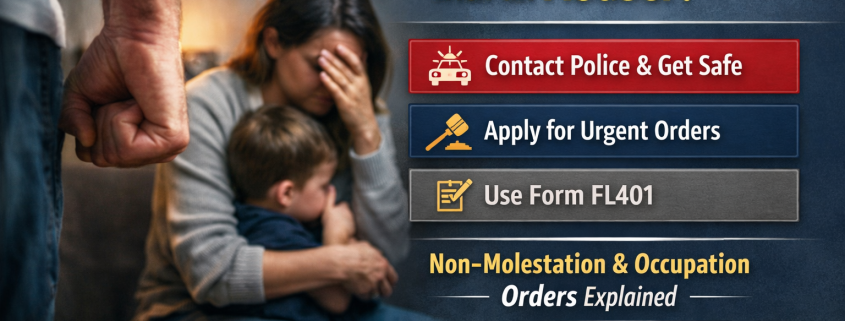
A real Facebook comment, and the urgent legal steps that follow
**“HELP! Going through divorce / domestic abuse / living under the same roof / completing financial forms for a consent order / have a 6-year-old child.
This morning my ex raised his fist to me and squared up to me earlier this week.
School know and have referred to MASH. I’ve been told to log it with the police.
What do I do? Do I move out to protect myself and my child? How does this impact the divorce?
Should he be moving out? Do I apply for a non-molestation order and an occupation order? How quickly does this happen?”*
This is not a theoretical question. This is a live safeguarding situation.
If this is you, or someone you support, the priority is simple and non-negotiable:
Safety comes first — always.
Everything else (divorce paperwork, finances, consent orders) comes second.
Step 1: Immediate safety comes first
If someone has raised their fist, squared up, or made you fear violence:
That is domestic abuse
You do not have to wait for physical injury
You do not have to “see what happens next”
If there is immediate risk
Call the police
Get yourself and your child to a safe place if you can
Do not worry about “over-reacting” — courts and safeguarding agencies take threats of violence seriously
The school has already referred to MASH. That means:
Professionals are concerned about risk to a child
You should keep records of all school communications
This strengthens the need for formal protective steps
Step 2: What protective orders are available (England & Wales)
The Family Court has emergency powers designed for exactly this situation.
1. Non-Molestation Order (NMO)
A non-molestation order is a protective injunction that:
Prohibits threats, intimidation, harassment or violence
Can protect you and your child
Is a criminal offence to breach
This is the primary legal tool where there are threats or fear of harm.
2. Occupation Order
An occupation order deals with the home. It can:
Decide who stays and who must leave
Exclude the abusive party from the property or part of it
Be made even if both names are on the tenancy or mortgage
This is how the court answers the question:
“Who should move out — me or him?”
You do not have to decide that alone.
3. Domestic Abuse Protection Orders (DAPOs)
DAPOs exist but are currently:
Only available in pilot areas
Not yet the main route for most people
For most litigants in person, non-molestation + occupation orders remain the correct route.
Step 3: How quickly can this be done?
Emergency (without-notice) applications
If there is risk of significant harm, the court can:
Make orders without telling him first
Act the same day or within days
Rely on your sworn written evidence
The law explicitly allows this where it is “just and convenient” to do so.
This is not unusual. It exists because waiting can be dangerous.
On-notice hearings
If the court decides notice is appropriate:
A hearing should normally be listed within 21 days
Interim protection can still be put in place
Step 4: What form is used?
Protective injunctions are applied for using:
Form FL401
This form can include:
A non-molestation order
An occupation order
Both together
It must be supported by a clear witness statement setting out:
What has happened
Why you fear harm
Why urgent protection is needed
Step 5: Evidence and documentation — do this now
You do not need perfect evidence. You need clear, contemporaneous records.
Start immediately:
Write down dates, times, words used, actions
Note who saw or heard what
Keep copies of:
School emails
MASH correspondence
Police reference numbers
Save messages, voicemails, or threats
This is not about proving everything beyond doubt. It is about showing risk.
“Do I move out? How does this affect the divorce?”
This is one of the most common — and most misunderstood — questions.
The honest answer:
Your safety and your child’s safety come first
The Family Court has specific powers (occupation orders) to decide housing without you having to flee
Whether leaving affects finances depends on the wider facts — and cannot be safely answered in a Facebook comment
What matters right now is this:
Do not stay somewhere unsafe out of fear of “damaging your case.”
The court’s primary concern in protective injunctions is risk, not tactical advantage.
Costs and enforcement
There is no court fee to apply for a non-molestation or occupation order
Legal aid may be available depending on eligibility
Breaching a non-molestation order is a criminal offence and can result in arrest
These orders have teeth.
What you can do today (practical checklist)
If you are in this position today, do the following:
Contact police if there is immediate risk
Keep yourself and your child safe
Start a written incident log
Preserve school and MASH communications
Prepare an FL401 application
Seek urgent support with drafting if needed — this is not the time for guesswork
How JSH Law can help immediately
I support litigants in person who are:
Living under the same roof as an abusive ex
Navigating divorce alongside safeguarding risk
Preparing urgent FL401 applications
Unsure whether to seek a non-molestation order, an occupation order, or both
I can help with:
Structuring your witness statement
Risk-focused drafting for without-notice applications
Explaining what the court is likely to prioritise
Helping you act quickly, calmly, and strategically
UK Parliament · legislation.gov.uk · 1996 (as amended)
Regulatory & Editorial Notice
This article is provided for general information only and does not constitute legal advice. Family-law outcomes depend on individual facts and circumstances. Nothing in this article creates a solicitor-client relationship. If you are in immediate danger, contact the police or emergency services without delay.
https://jshlaw.co.uk/wp-content/uploads/2026/01/ChatGPT-Image-Jan-28-2026-02_50_51-PM.png10241536jessica susan hillhttps://jshlaw.co.uk/wp-content/uploads/2026/01/jsh-law-logo-new-black-300x67.pngjessica susan hill2026-01-28 14:53:512026-02-03 03:32:52He Raised His Fist While We’re Still Living Together — What Do I Do Now?


 jsh law ltd