
Content addressing safeguarding considerations specific to family court proceedings and their impact on case management and outcomes.

Posts

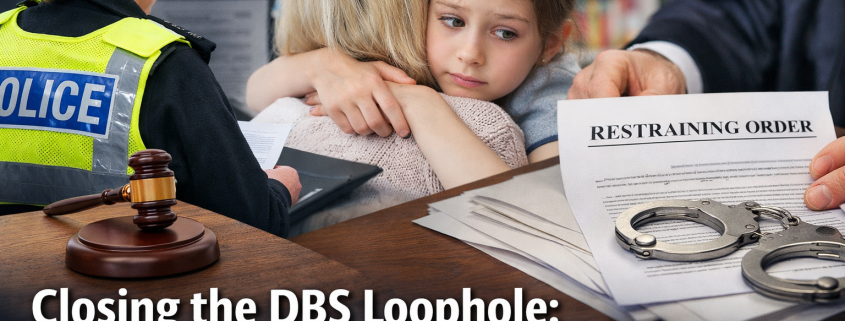
Closing the DBS Loophole: Why Civil Harassment Orders Must Appear on Enhanced DBS Checks

A safeguarding gap hiding in plain sight

A current petition before UK Government and Parliament calls for an urgent and necessary reform:
civil harassment orders, including court-issued undertakings, should be disclosed on Enhanced DBS checks.

At present, a person may be subject to serious civil restrictions imposed by a court—often following repeated harassment, intimidation, or coercive conduct—yet still pass an Enhanced Disclosure and Barring Service (DBS) check and lawfully work with children or vulnerable adults.

That is not a technical oversight.
It is a safeguarding failure.


What is the current problem?

The DBS regime is commonly understood—by employers, volunteers, and the public—as a robust safeguarding mechanism. In reality, it is narrower than many assume.

Enhanced DBS checks primarily disclose:

  • criminal convictions and cautions;
  • relevant police intelligence (at the discretion of the chief officer);
  • barred-list status where applicable.

Civil outcomes, however, sit in a grey area.

This includes:

  • civil harassment orders;
  • undertakings given to a court in lieu of findings;
  • non-criminal protective orders arising from family or civil proceedings.

These measures are often imposed precisely because a court has determined that conduct poses a risk, even if it does not meet the criminal standard of proof or has not resulted in prosecution.

Yet in many cases, they are not automatically disclosed.


Why undertakings matter in safeguarding contexts

In family and civil courts, undertakings are not casual promises. They are legally binding court orders.

They are frequently used where:

  • repeated harassment is evidenced;
  • power imbalances make findings difficult;
  • victims are retraumatised by adversarial fact-finding;
  • courts prioritise immediate protection over punitive outcomes.

The absence of findings does not mean the absence of risk.

Courts routinely accept undertakings because:

  • the behaviour alleged is serious enough to justify restriction;
  • the respondent agrees that restraint is necessary;
  • ongoing contact with children or vulnerable people may be relevant.

Failing to reflect this in safeguarding disclosures creates a false sense of safety.


The real-world safeguarding risk

This loophole allows individuals who are under active court-imposed behavioural restrictions to:

  • work in schools, nurseries, and colleges;
  • volunteer with youth organisations;
  • access vulnerable adults in care or support settings.

Employers relying on Enhanced DBS checks are not negligent—they are misled by a system that implies completeness while omitting critical context.

Safeguarding depends on informed risk assessment, not binary criminal labels.


Why police discretion is not enough

It is sometimes argued that police intelligence disclosure fills this gap. In practice, this is unreliable.

Police disclosure depends on:

  • local recording practices;
  • subjective relevance assessments;
  • fragmented information-sharing between civil courts and policing bodies.

Many civil harassment outcomes never reach police databases in a form that triggers discretionary disclosure.

Safeguarding should not depend on chance.


The petition: a proportionate and necessary reform

The petition does not call for:

  • criminalisation by the back door;
  • automatic barring;
  • retrospective punishment.

It calls for transparency.

Disclosure would allow:

  • employers to assess risk proportionately;
  • safeguarding leads to put controls in place;
  • vulnerable people to be protected without stigma or assumption.

Disclosure is not a sanction.
It is information.


Why this matters particularly in family-law contexts

Those familiar with family proceedings know that:

  • abuse often presents as coercive, controlling, or cumulative;
  • victims may withdraw allegations under pressure;
  • findings are not always pursued for child-focused reasons.

A civil court may still conclude that restrictions are essential, even where criminal thresholds are not met.

To ignore those outcomes in safeguarding checks is to misunderstand how harm actually manifests.


A system built for safeguarding must reflect reality

Safeguarding frameworks must align with how risk is identified in practice, not just in criminal law theory.

If a court has deemed it necessary to restrict someone’s behaviour to protect another person, that information is plainly relevant where:

  • children are involved;
  • vulnerable adults are at risk;
  • positions of trust are held.

Anything less undermines public confidence in safeguarding systems.


Final thoughts

This petition highlights a quiet but serious flaw in the safeguarding infrastructure.

Closing the DBS loophole would:

  • strengthen child and vulnerable-adult protection;
  • support employers in making informed decisions;
  • respect due process while prioritising safety;
  • reflect the reality of civil-court risk management.

Safeguarding should never rely on incomplete information.

This is not about punishment.
It is about protection.


Sign the Petition

If you work in safeguarding, family law, education, or care—or if you have experienced the limitations of current disclosure systems—you may wish to review and support the petition calling for reform of Enhanced DBS disclosures.

Require civil harassment orders to be disclosed in enhanced DBS checks – Petitions

Informed systems protect people.
Opaque systems protect risk.


Regulatory & Editorial Notice
This article is published for general information and public-interest discussion only. It does not constitute legal advice. References to safeguarding frameworks, civil orders, or DBS processes are illustrative and may not apply to individual circumstances. Allegations are not findings. Readers should seek independent legal or professional advice where appropriate.

Safeguarding and Cafcass involvement in family court proceedings for litigants in person

Safeguarding and Local Authority Involvement in Family Court: What It Means and How to Navigate the Process as a Litigant in Person

Safeguarding concerns and local authority involvement can change the direction of family court proceedings very quickly. For many litigants in person, this is the point at which matters begin to feel frightening, opaque, and out of control.

Often, safeguarding issues arise unexpectedly — through a Cafcass letter, a report, a professional referral, or information shared between agencies. What is particularly difficult is that the language used can feel serious and consequential, while the process itself is rarely explained clearly.

This article explains:

  • what safeguarding and local authority involvement in family court usually means,
  • how such concerns commonly arise,
  • where litigants in person often struggle,
  • and how structured procedural support can help you engage with the process calmly and appropriately.

What Is Safeguarding in the Family Court Context?

In family court proceedings, safeguarding refers to concerns about a child’s welfare, safety, or emotional wellbeing. These concerns may relate to a wide range of issues, including parenting capacity, historical events, professional involvement, or risks identified by third parties.

Safeguarding does not automatically mean that findings have been made, nor does it mean that conclusions have already been reached. However, once safeguarding concerns are raised, they can influence:

  • how the court manages the case,
  • whether Cafcass becomes involved,
  • the timing and structure of hearings,
  • and the type of information the court expects to see.

For litigants in person, this shift can be disorientating — particularly if concerns are raised in a way that feels sudden or unclear.


How Local Authority or Cafcass Involvement Usually Arises

Safeguarding involvement may arise in several ways, including:

  • information shared by Cafcass following safeguarding checks,
  • references to previous local authority involvement,
  • professional reports or records,
  • concerns raised by one party during proceedings,
  • or issues identified by the court itself.

In many cases, litigants in person are unclear about:

  • why safeguarding has been raised,
  • what information the court is relying on,
  • what stage the process is at,
  • and what they are expected to do in response.

This lack of clarity often leads to anxiety, over-disclosure, or reactive responses that can complicate matters further.


Common Difficulties for Litigants in Person

When safeguarding or local authority issues arise, litigants in person frequently encounter the same difficulties.

1. Not Understanding What the Court Is Actually Considering

Safeguarding language can feel broad or alarming. Litigants often assume the court is deciding far more than it actually is at that stage.

This can lead to unfocused responses or attempts to address issues that are not currently before the court.

2. Providing Too Much Information

In an effort to “explain everything”, litigants may submit large volumes of material, historic detail, or emotionally driven responses that obscure rather than clarify the key issues.

Courts expect relevance and proportion, particularly where safeguarding is concerned.

3. Reacting Emotionally Rather Than Procedurally

Safeguarding concerns understandably feel personal. However, responding emotionally rather than procedurally can undermine credibility and make it harder for the court to identify what actually matters.

4. Difficulty Organising Evidence and Records

Local authority involvement often comes with reports, assessments, timelines, and professional records. Litigants in person may struggle to organise these coherently or understand how they should be presented.

5. Uncertainty About What Happens Next

Many people are unsure whether safeguarding concerns will lead to further assessments, additional hearings, or changes to arrangements — and no one explains this clearly.


Anonymised Example of How These Issues Develop

In one anonymised case, a litigant in person was involved in private law proceedings when safeguarding concerns emerged relating to historic professional involvement. Reports and records were referenced without clear explanation of their relevance or purpose.

The litigant felt compelled to respond to everything at once, unsure what weight the court was placing on the material or how it would be used. As a result, preparation became reactive and overwhelming, rather than focused and strategic.

What was missing was not effort or engagement, but procedural clarity — an understanding of what the court was addressing, what was background context, and what required a measured response.


How Structured Procedural Support Can Help

My role is not to assess safeguarding concerns or provide legal advice. Instead, I provide calm, structured support to help litigants in person engage with safeguarding and local authority involvement appropriately.

This includes helping you to:

  • understand what stage the safeguarding process is at,
  • identify what the court is actually focusing on,
  • organise documents and reports clearly and proportionately,
  • prepare measured written responses,
  • avoid over-disclosure or unnecessary escalation,
  • and approach hearings with greater confidence and clarity.

Importantly, support is focused on process, not outcomes.


Why Structure and Proportion Matter

Safeguarding issues require care, restraint, and clarity. Courts are concerned not only with the content of information, but with how litigants engage with the process.

Structured preparation helps you:

  • protect your credibility,
  • demonstrate understanding of the process,
  • and ensure your position is presented calmly and coherently.

This is particularly important where professional involvement or historical material is being considered.


What This Support Is — and Is Not

To be clear:

  • I do not provide legal advice.
  • I do not act as your solicitor.
  • I do not make representations on your behalf.

Support is provided in a McKenzie Friend capacity only, subject to the court’s discretion, and focuses on preparation, understanding, and procedural confidence.


Final Thoughts

Safeguarding and local authority involvement can feel overwhelming, particularly when you are representing yourself. Much of the stress arises not from the concerns themselves, but from uncertainty about what they mean and how to respond.

With calm, proportionate preparation and a clearer understanding of process, it is possible to engage with safeguarding issues in a way that supports rather than undermines your position.


Call Me

If safeguarding or local authority involvement has arisen in your family court case and you are representing yourself, structured procedural support may help you approach the situation with clarity and confidence.

You are welcome to get in touch using the form below to discuss whether support may be appropriate in your circumstances.


    Regulatory & Editorial Notice

    This article is provided for general information purposes only and does not constitute legal advice. The content reflects procedural guidance and commentary based on experience supporting litigants in person within the family court system.

    Jessica Susan Hill does not act as a solicitor in these matters and does not provide legal advice or legal representation. Support is offered in a McKenzie Friend capacity only, subject to the court’s discretion.

    Any examples or scenarios referred to in this article are anonymised and are not intended to identify any individual case or person.

    Family law and court procedure are fact-specific and may change over time. Readers are encouraged to seek independent legal advice where appropriate.