

This topic focuses on Practice Direction 12J and its application in private law children cases involving allegations of domestic abuse. It explains how the court is required to approach safeguarding, risk assessment, and decision-making where abuse is alleged.

Articles under this tag support self-represented parents by explaining how PD12J affects case management, fact-finding hearings, interim contact, and the court’s duty to prioritise safety while ensuring procedural fairness.

Posts

The “Vibe Lawyer” Moment: AI, Litigants in Person, and the Coming Shockwave for the Family Courts

Litigants in person are being called “vibe lawyers” for using AI to draft complaints and court documents. But behind the headlines lies a harder truth: people are turning to artificial intelligence because they cannot afford representation in an increasingly complex and overstretched justice system. Judges are right to be concerned about fake citations and procedural errors. Yet dismissing AI use outright misses the deeper issue — access to justice has been under strain for years, and technology is now filling the gap.

The “Vibe Lawyer” Moment: AI, Litigants in Person, and the Coming Shockwave for the Family Courts

By Jessica Susan Hill | JSH Law

Key Takeaways (Read This First)

  • AI is already changing litigation behaviour — the judiciary is explicitly preparing for a surge in AI-generated claims across civil, family and tribunals.
  • The risk isn’t “AI” — it’s unverified AI: fabricated authorities and confidently wrong submissions waste court time and damage credibility.
  • LiPs are not “wreaking havoc” for fun. Many are doing what they must to participate in a system they cannot afford to navigate with representation.
  • The solution is guardrails, not barriers: verification standards, procedural literacy, and responsible workflows that help the court as well as the litigant.
  • Family proceedings are high-stakes. Used properly, AI can improve clarity and evidence organisation; used badly, it can derail safeguarding analysis and case management.

1. Why this matters now

“Vibe lawyers” is a catchy label, but it risks obscuring a far more serious reality: litigants in person are using AI tools to draft complaints, defences, witness statements and skeleton arguments at scale — and the courts are already feeling the impact. The phenomenon is now so visible that Sir Geoffrey Vos (Master of the Rolls, Head of Civil Justice) has explicitly warned that the judiciary must prepare for an “AI revolution” that may vastly increase the number of civil, family and tribunal claims the justice system must manage. His speech is worth reading in full. :contentReference[oaicite:0]{index=0}

Let’s be direct: the justice system in England and Wales is already stretched. Many court users already experience the process as opaque, intimidating and unaffordable. That is not a personal failing of litigants — it is a structural reality. AI is entering a pressure-cooker and magnifying what was already there: information asymmetry, procedural complexity, delay and the gulf between a represented party and an unrepresented one.

So, yes — judges and practitioners are right to be concerned about inaccurate AI-generated material clogging lists and adding burden to judges who are already firefighting. But it is also true that, in the medium term, AI could become one of the most significant access-to-justice tools we have ever seen. Both truths can exist at once.

2. The judiciary is not guessing — it is responding to lived reality

We are past the point of theoretical debate. The judiciary has been issuing speeches and guidance precisely because AI use is now operationally relevant. Beyond speeches, the Judicial Office has published updated guidance addressing risks including confidentiality, bias and “hallucinations” — where AI produces plausible but incorrect information. The October 2025 judicial guidance explicitly flags the danger of fictitious citations and misleading legal content. :contentReference[oaicite:1]{index=1}

Sir Geoffrey Vos has also repeatedly articulated a simple “core rules” approach: understand what the tool is doing, do not upload private/confidential data into public tools, and check the output before using it for any purpose. He set that out again in October 2025. :contentReference[oaicite:2]{index=2}

This is not anti-technology. It is the judiciary doing what it should do: protecting the integrity of the process while acknowledging that new tools are changing behaviour.

3. The real problem: “confidently wrong” submissions

Generative AI tools can draft impressive text quickly. But they do not “know” the law. They predict language. That difference matters profoundly in litigation. A well-written paragraph that contains an invented case, a misquoted statute or an inaccurate procedural route is not merely unhelpful — it can actively undermine a party’s credibility and force the court to spend additional time cleaning up the mess.

The legal profession has already seen what happens when verification fails. In June 2025, the Divisional Court (Dame Victoria Sharp P and Johnson J) dealt with the now widely-reported “fake authorities” problem in Ayinde v London Borough of Haringey and Al-Haroun v Qatar National Bank, where false citations and inaccurate quotations were placed before the court, with suspected or admitted use of AI tools without proper checks. The judgment is publicly available and makes required reading for anyone tempted to treat AI output as “good enough”. :contentReference[oaicite:3]{index=3}

Importantly, that judgment is aimed at lawyers — because professionals are held to professional standards. But the underlying point applies to everyone: accuracy is non-negotiable in court work. You can be passionate, traumatised, exhausted, and still required to file documents that are factually and legally sound.

4. Why litigants in person are using AI (and why the “money pit” narrative is wrong)

Many litigants in person feel they are treated as an administrative inconvenience — or worse, as a “cost centre” rather than a rights-holder. I understand why that perception forms. The system can be brutal: forms, deadlines, practice directions, directions hearings, orders you must interpret and comply with under stress. In private law children proceedings, you may be trying to protect a child, manage safeguarding concerns, and preserve your own mental stability while preparing documents that lawyers train for years to produce.

For a growing number of people, AI has become the first accessible “translator” of legal language. It can explain terminology, propose a structure for a statement, generate headings for a skeleton argument, and help a person who feels overwhelmed take a first step. That is why it feels like a shake-up. It is not because LiPs are trying to harm the system. It is because they are trying to participate in it.

And here is the hard truth: if access to representation continues to shrink in practice — whether by cost, availability, or scope — more people will use AI. That is not something a press headline can reverse. It is a reality the system must incorporate.

5. Family court is the pressure point

Family proceedings are where AI misuse can become most dangerous, because the stakes are often immediate and human: the child’s living arrangements, contact, safeguarding, allegations of domestic abuse, coercive control, substance misuse, mental health, relocation, schooling — the list is endless.

Private law children cases are ultimately governed by the welfare principle in the Children Act 1989, section 1. The court’s job is not to reward the best writer. It is to determine what best meets the child’s welfare needs. But poor drafting can still distort the court’s understanding of what matters. :contentReference[oaicite:4]{index=4}

And family procedure is its own ecosystem. The Family Procedure Rules and associated Practice Directions are not optional reading; they are the architecture of how your case moves through the system. PD12J (domestic abuse and harm) is particularly critical where abuse is alleged, because it shapes fact-finding decisions, safeguarding analysis and protective measures. :contentReference[oaicite:5]{index=5}

Where AI is used badly in family court, I commonly see the same patterns (and judges see them too):

  • Misstating legal tests (e.g., confusing civil and criminal standards, or quoting the wrong threshold framework).
  • Over-inclusion: 30-page narratives where only a small percentage is evidentially relevant.
  • Inflammatory language that escalates conflict rather than centring the child.
  • Procedural fantasy: “applications” and “orders” that do not exist or are not procedurally available.
  • Fake authority: citations that sound real but are not verifiable.

Those problems do not just “waste time”. They can change outcomes. They can harden judicial perceptions. They can reduce a litigant’s credibility. And in safeguarding contexts, credibility matters.

6. But here is the opportunity: structured AI use can help the court

Now for the other side of the ledger, which the “vibe lawyer” framing often ignores.

Used properly, AI can reduce noise and increase clarity. It can help an overwhelmed litigant present their case in a way that judges can actually work with. It can support:

  • Chronology building (dates, events, orders, and key turning points).
  • Document organisation (indexes, exhibit lists, consistent naming).
  • Issue framing (what is the dispute actually about?).
  • Drafting clarity (headings, structure, neutral tone).
  • Summarising communications (WhatsApp/SMS/email) into court-usable bundles.

Those are not cosmetic benefits. They are directly aligned with what the court needs: efficient case management, focused evidence, and parties who can articulate relevant issues.

In other words: the best version of AI in litigation is not “AI replaces lawyers.” It is “AI helps people present usable material so the court can do its job.” That is the access-to-justice promise.

7. The non-negotiable: verification

The line between empowerment and chaos is verification.

Professional regulators have been clear that AI cannot be trusted to judge its own accuracy. The SRA has warned about hallucinations and the risk of plausible but incorrect outputs, including non-existent cases. :contentReference[oaicite:6]{index=6}

For court users, this translates into a simple operating standard:

  • If you cite it, you must be able to prove it exists (case name, neutral citation, and a reliable source).
  • If you quote a statute, check it on legislation.gov.uk (not in an AI chat box).
  • If you refer to rules or practice directions, check the official source (FPR/CPR/PD pages).
  • If it sounds “too perfect”, slow down — AI is very good at confidence, not always good at truth.

After the June 2025 “fake authorities” judgment, the direction of travel is obvious: courts will increasingly treat fabricated or careless citations as serious misconduct where professionals are involved, and as a significant credibility issue where litigants are involved. :contentReference[oaicite:7]{index=7}

8. A real-world cautionary tale: Mata v Avianca

Even outside the UK, courts have reacted strongly when lawyers filed AI-generated fake authorities. The widely-cited US case Mata v Avianca resulted in sanctions after fabricated case citations were submitted. It is not “UK law”, but it is a stark illustration of what happens when verification collapses. :contentReference[oaicite:8]{index=8}

Why mention it here? Because the underlying professional lesson travels: courts do not have time for invented law, and they should not have to spend scarce judicial time correcting avoidable errors.

9. What this means for litigants in person

What This Means for LiPs (Practical Guidance)

1) Use AI to organise, not to “source” law. AI is excellent for structure, headings, summaries, chronologies and drafting tone. It is unreliable as a sole source of legal authority.

2) Keep it child-focused (family cases). Remove insult, speculation and “character assassination”. Judges need facts, evidence, and impact on the child.

3) Treat every AI output as a draft. You are responsible for what you file. Read it. Edit it. Make sure it matches your evidence.

4) Verify every citation. If you cannot open the case or locate it on a reputable database, do not rely on it.

5) Don’t upload confidential material into public AI tools. Safeguarding details and private communications should be handled carefully. Follow the Judicial Office warnings on confidentiality. :contentReference[oaicite:9]{index=9}

6) Aim for shorter, clearer documents. Judges do not reward length. They reward relevance. A focused 6–10 pages often lands better than a sprawling 30.

7) If you’re stuck, get human oversight. A short consultation to sanity-check structure, compliance with directions, and relevance can prevent months of damage.

10. What this means for the justice system: guardrails, not barriers

If the system responds to AI by “closing ranks” and shaming litigants, it will fail. People will still use AI — but they will do so in worse, more chaotic ways. A better approach is to develop common standards that increase quality and reduce burden.

In practice, that means three things.

A) Judicial clarity

Courts and judiciary leadership can help by setting clear expectations about what is acceptable in written submissions — particularly around citation verification and disclosure of AI use where relevant. The Judicial Office guidance is already laying the foundation here. :contentReference[oaicite:10]{index=10}

B) Procedural literacy for court users

Most problems I see are not “bad people”. They are overwhelmed people. The system needs short, accessible, official pathways explaining (for example) what a directions hearing is, how to comply with an order, how to prepare a bundle, and how to draft a witness statement that is relevant rather than reactive.

C) Responsible support models

This is where the best “shake up” lies: hybrid support that uses AI to accelerate organisation and drafting, with human oversight to ensure compliance, accuracy, relevance and tone. That model benefits everyone: the litigant, the other party, and the court.

11. A note on professional standards (and why it still matters to LiPs)

When professionals file inaccurate material, the consequences can be severe, including regulatory referral. That was made explicit in the June 2025 judgment dealing with false citations. :contentReference[oaicite:11]{index=11}

LiPs are not held to the same professional code — but the practical consequences can still be harsh: credibility erosion, judicial impatience, adverse costs risks in some contexts, and (most importantly) a judge simply not trusting what they are reading. In family court, loss of credibility can be profoundly damaging.

This is why “AI literacy” is not an academic luxury. It is a procedural survival skill.

12. Conclusion: the future is responsible AI, not no AI

AI is in the courtroom ecosystem now. The judiciary is preparing for it. Regulators are warning about it. The profession is adapting to it. The question is not whether litigants in person will use AI — they already are.

The question is whether we will build a culture of responsible use.

Used recklessly, AI produces noise: invented authorities, misunderstood legal tests, and sprawling submissions that burden the court. Used properly, it can produce clarity: structured chronologies, coherent statements, and focused issues that help the court get to the real substance of the case.

If we care about access to justice, we cannot treat litigants in person as an administrative irritation. We should treat them as court users with rights and responsibilities — and we should equip them with tools and guardrails that allow them to participate meaningfully.

That is the “AI revolution” that matters: not chaos, but capability.


Useful Official Resources

If you want structured, responsible help using AI to prepare court documents (without risking accuracy or credibility), you can book a short consultation below:


Regulatory & Editorial Notice (JSH Law): This article is published for general information and public-interest commentary only. It does not constitute legal advice and should not be relied upon as such. Where this article refers to third-party sources (including court judgments, guidance, regulator publications, media reporting, or external organisations), those references are provided for context and convenience; JSH Law does not control or endorse third-party content and cannot guarantee its accuracy, completeness, or continued availability. Court users should always consult the original primary sources (including the Family Procedure Rules, Practice Directions, and judgments) and obtain appropriate professional advice for their specific circumstances.

“Is Any Thing Too Hard for the Lord?” — A Come, Follow Me Reflection for Litigants in Person in the Family Court

“Is Any Thing Too Hard for the Lord?” — A Come, Follow Me Reflection for Litigants in Person in the Family Court

By Jessica Susan Hill, Legal Consultant & McKenzie Friend (JSH Law Ltd)

Every Sunday, after I’ve been to church, I want to write something that’s both personal and practical: a long-form reflection that draws on my Come, Follow Me lesson in The Church of Jesus Christ of Latter-day Saints, and turns it into grounded encouragement for litigants in person navigating the family court. If you are in proceedings right now—especially where there is high conflict, safeguarding concern, or domestic abuse dynamics—this is for you.

Today’s lesson is Genesis 18–23, titled “Is Any Thing Too Hard for the Lord?” (official Come, Follow Me lesson page). It’s a sequence of stories about promise, delay, rescue, consequence, testing, and (interestingly, for a legal mind) the first formal land purchase recorded for Abraham’s family.

Key takeaways for Litigants in Person (LiPs)

  • Do not let “delay” trick you into despair. In Genesis, waiting is not absence—it is formation. Court delay can be brutal; build a system to survive it.
  • Be an advocate like Abraham. Calm, structured, principled advocacy wins credibility. Don’t rant. Don’t spiral. Build your case like a professional.
  • Get out—and stay out—of “Sodom” dynamics. If you’re leaving coercive control or chronic conflict, don’t look back emotionally. Protect your nervous system and your evidence.
  • God provides “means” in motion. If you take the next right step, you’ll often find the next tool, the next contact, the next document, the next insight (see 1 Nephi 17:3).
  • Your weakness is not disqualification. It can become the exact channel for strength (Ether 12:27)—including learning court process, building a bundle, and holding boundaries.
  • Anchor to purpose. You’re not doing this for drama. You’re doing this for safety, stability, and your child’s welfare. Keep that mission statement (Moses 1:39).

Why I’m writing this (and why faith belongs in a court-user toolkit)

Let me be plain: family court can feel like wilderness. It can be confusing, exhausting, and sometimes psychologically destabilising—particularly if you are facing a controlling, manipulative, or hostile other party, or if you’re trying to communicate safeguarding concerns clearly without being dismissed as “emotional” or “difficult.”

In the UK, a significant number of parents and parties appear without representation. Some do so by choice; many do so because they cannot access or afford legal advice. The system expects you to comply with process, deadlines, and evidence standards whether or not you have a lawyer. That is the reality.

Faith—properly understood—doesn’t replace competence. It fuels it. It gives meaning to disciplined action. It helps you hold your nerve, keep your integrity, and make decisions that protect your child long-term rather than “winning” the next argument.

The Church lesson this week is not “soft.” Genesis 18–23 contains joy, horror, fear, grief, and law-like transactions. It speaks directly to anyone trying to remain spiritually grounded while navigating a world that can be unjust, corrupt, or unsafe.

Genesis 18–23: a quick narrative map (and why it matters to LiPs)

The Come, Follow Me reading covers:

  1. Genesis 18 — Sarah is promised a child; Abraham intercedes for Sodom.
  2. Genesis 19 — Sodom falls; Lot’s family flees; Lot’s wife looks back.
  3. Genesis 20 — Abraham’s fear-driven misstep; God intervenes to protect the covenant promise.
  4. Genesis 21 — Isaac is born; conflict and separation happen; a treaty is made.
  5. Genesis 22 — Abraham is tested with Isaac (the “Akedah”).
  6. Genesis 23 — Sarah dies; Abraham negotiates and purchases land formally.

If you’re a litigant in person, you can read that and think: “What has this got to do with my case?” Plenty. This is a blueprint for how humans behave under pressure—and what it looks like to keep moving forward without being destroyed by the environment.

For additional Latter-day Saint commentary on this week’s reading, you may find this helpful: Church News: “What have Church leaders said about Genesis 18–23?”.

1) “Is any thing too hard for the Lord?” — when your case feels impossible

In Genesis 18, Sarah laughs at the idea of pregnancy in old age. It’s not a cartoonish laugh; it’s the laughter of someone whose lived experience tells her that the promise is implausible. And then comes the question: “Is any thing too hard for the Lord?”

In the New Testament, the angel says to Mary: “For with God nothing shall be impossible.” (Luke 1:37). In my own faith tradition, the Book of Mormon offers a parallel logic: God provides means to accomplish what He commands (1 Nephi 17:3).

For a litigant in person, “impossible” often means:

  • “I can’t afford representation.”
  • “I can’t do the paperwork.”
  • “I can’t face him/her in court.”
  • “No one will believe me.”
  • “The system is too slow; my child needs safety now.”

Here is the practical reframe: you may not be able to control the other party, the listing delays, or the court’s resourcing. But you can build a credible, organised, evidence-led case file and present it in a way that the court can act on. That is not “wishful thinking.” That is disciplined stewardship.

If you are applying for a child arrangements order (or related orders under section 8 Children Act 1989), the official application route and forms are here: Form C100 (GOV.UK) and the broader GOV.UK overview here: Making child arrangements if you divorce or separate.

What I want you to take from Genesis 18 is not “pretend it’s fine.” It’s this: God’s question challenges the assumption that your present limitation sets the ceiling for your future. It doesn’t.

2) Abraham’s intercession: what principled advocacy looks like

Abraham doesn’t scream at God about Sodom. He reasons. He appeals to justice. He negotiates down—50, 45, 40, 30, 20, 10—with humility but also firmness. He models something litigants in person desperately need: structured advocacy.

In family court, “structured advocacy” means:

  • Clarity: what orders are you seeking and why?
  • Relevance: what facts directly support the order you want?
  • Proportionality: are you asking for the minimum necessary to protect the child?
  • Evidence discipline: can you prove what you’re saying with dated documents, screenshots, logs, reports, or admissions?
  • Tone control: your credibility rises when you remain calm and factual.

This is not about being “nice.” It is about being effective.

One of the most important judicial frameworks in domestic abuse-related private law children proceedings is Practice Direction 12J (PD12J). PD12J sets out what the court must do where domestic abuse is alleged or admitted, including ensuring that any child arrangements order protects the safety and wellbeing of the child and the parent and does not expose them to further risk. For a plain-English explainer, this UK Parliament briefing is also useful: House of Commons Library: Child arrangements and domestic abuse.

Abraham’s “intercession” reminds me of something I tell clients constantly: you don’t win by being louder; you win by being clearer.

3) Sodom, corruption, and the psychology of “looking back”

Genesis 19 is uncomfortable reading. It is meant to be. It depicts a society with collapsed moral boundaries and a predatory, violent culture. Lot’s family is told to leave urgently. Lot’s wife looks back and becomes “a pillar of salt.”

In the context of modern family court cases, I often see a parallel dynamic—not because “the court is Sodom,” but because many litigants in person are trying to exit:

  • coercive control,
  • chronic conflict patterns,
  • high-conflict co-parenting dynamics,
  • or a wider environment of manipulation, intimidation, and narrative warfare.

The “look back” in real life is often psychological. It can look like:

  • re-reading abusive messages for hours and spiralling,
  • seeking closure from a person who thrives on withholding it,
  • breaking no-contact boundaries “just this once,”
  • arguing in circles to force an apology that will never come,
  • or clinging to the idea that “if I explain it differently, they’ll finally understand.”

If you are leaving a toxic environment, the first stage is physical safety; the second is emotional detachment. Court proceedings can accidentally keep you emotionally tethered because you must keep engaging. That is why you need a system.

A practical “don’t look back” protocol for LiPs

  • Communication boundaries: keep everything in writing and keep it child-focused. No essays. No emotional bait.
  • Evidence hygiene: screenshot, date-stamp, store, and then stop re-reading.
  • Nervous system protection: limit exposure windows. You don’t need to re-traumatise yourself to “prepare.”
  • External support: speak to a grounded friend, therapist, advocate, or support service—someone who brings you back to reality.

If you’re in private law proceedings, Cafcass explains the process and what to expect here: Cafcass: what happens in private law proceedings, and their overview of involvement (including safeguarding letters) is here: Cafcass: overview of our involvement.

4) Delay is not denial: Sarah, Abraham, and the long middle

One of the cruelest features of family court is time. Delay can feel like injustice, especially where there are safeguarding concerns, where children are distressed, or where one party uses process as a weapon.

Abraham and Sarah’s story is, in part, about the long middle: the space between promise and fulfilment. If you are a litigant in person, you may be living in a long middle right now:

  • between separation and stability,
  • between disclosure and findings,
  • between the first hearing and a final hearing,
  • between reporting harm and seeing meaningful safeguards.

Here is the hard truth: waiting will not become easier just because you “accept” it. Waiting becomes survivable when you build structure. A faith-based approach is not passive; it is disciplined.

A “wilderness routine” for court users

  • One admin block per week: evidence filing, chronology updates, statement drafting, or document requests.
  • One wellbeing anchor per day: prayer, scripture, exercise, journaling, a walk—something that brings you back to centre.
  • One support touchpoint: someone who reminds you who you are when the other party tries to rewrite you.
  • One “next right step” list: court is overwhelming when you treat it as one giant problem. Break it down.

If you are struggling to manage forms and process, two practical support resources worth knowing: Support Through Court (a charity helping people who face civil and family courts alone), and AdviceNow’s step-by-step guides: AdviceNow: child arrangements.

5) “Weak things become strong” — applying Ether 12:27 to court survival

The Book of Mormon verse that has carried many people through impossible seasons is Ether 12:27: weakness is given so that we may be humble, and if we come unto Christ, weak things can become strong.

In practice, for litigants in person, “weakness” may be:

  • lack of legal knowledge,
  • fear of cross-examination or confrontation,
  • trauma symptoms and overwhelm,
  • financial insecurity,
  • or the feeling of being “outmatched.”

The transformation often comes through very ordinary means:

  • learning the court vocabulary,
  • building a chronology,
  • identifying the key issues,
  • preparing a concise position statement,
  • and showing up consistently with integrity.

That is how weakness becomes strength: not by magic, but by grace meeting effort.

6) “Provide means” — 1 Nephi 17:3 and the logic of practical faith

1 Nephi 17:3 teaches a pattern I have seen repeatedly in real life: when God commands, He also provides “means” to accomplish it—often discovered after you begin.

For a litigant in person, the “means” may look like:

  • a template for a chronology,
  • a support service that helps you complete forms,
  • clarity from reading the official process guidance,
  • finding the right legal framework (e.g., PD12J) to structure safeguarding concerns,
  • or simply learning how to present your evidence in a coherent, restrained way.

Sometimes the “means” is financial too. If the application fee is a barrier, look at Help with Fees: Get help with court and tribunal fees and the EX160 guidance: Apply for help with fees (EX160).

Faith, in a court context, is not “hoping it all works out.” Faith is: taking the next right step even while you are scared.

7) Abraham’s “test” (Genesis 22): surrender, not self-destruction

Genesis 22 is one of the most confronting passages in scripture. It depicts Abraham’s willingness to obey God in relation to Isaac, the promised son. I won’t attempt to flatten this into a simplistic moral.

But there is a relevant principle for litigants in person: there is a difference between surrender and self-destruction.

In family court, people often destroy themselves trying to:

  • control the other party,
  • force vindication from a system that moves slowly,
  • or “win” every minor point.

Surrender is not giving up your child or tolerating harm. Surrender is releasing what you cannot control so that you can focus on what you can: your evidence, your conduct, your child’s needs, your boundaries, and your long-term stability.

This is where Moses 1:39 helps as a mission statement: God’s work and glory is “to bring to pass the immortality and eternal life” of His children. Translated into court-user language: the purpose is not to “defeat” the other party; it is to protect welfare, build stability, and keep your soul intact.

8) Genesis 23 and the power of paperwork: the first “land deal”

Genesis 23 can look like an anticlimax after the drama of earlier chapters. Sarah dies; Abraham grieves; then he negotiates and purchases the cave of Machpelah as a burial place. But notice the detail: this is formal, witnessed, priced, and legally secured.

That matters.

If you are a litigant in person, you are living in a world where: what is documented is what is real. You can have truth in your heart and still fail if you cannot evidence it. The court does not decide cases on vibes. It decides on evidence, credibility, welfare analysis, and statutory/legal frameworks.

What Genesis 23 teaches the LiP (in plain English)

  • Grief and administration can co-exist: you may be in pain and still need to do the forms.
  • Do it properly: accuracy, dates, copies, and receipts matter.
  • Secure what you can: focus on orders and safeguards that are enforceable and measurable.
  • Think long-term: Abraham was anchoring a future, not just reacting to a moment.

For practical process guidance on applications involving children, GOV.UK also provides a booklet-style explainer here: Making an application: children and the family courts.

A Litigant-in-Person “faith + strategy” checklist for the coming week

If you are reading this after a difficult Sunday—tired, anxious, and carrying the weight of a case—here is a practical checklist you can use this week. (Faith is not a substitute for action. Faith fuels action.)

  1. Define your core aim in one sentence: “I am seeking arrangements that protect X and meet Y need.” Keep it welfare-focused.
  2. Update your chronology: 10–20 lines, dates only, facts only. No commentary.
  3. Create an “evidence index”: label documents clearly, keep them in date order, avoid duplication.
  4. Read PD12J if domestic abuse is relevant: know the framework the court is meant to apply.
  5. Prepare for the first hearing: review Cafcass guidance so you know what to expect.
  6. Reduce reactive communication: shorter, calmer messages. Child-focused. No bait-taking.
  7. Anchor daily: one spiritual practice, one physical practice, one administrative step.

If you need form-filling and procedural support, consider: Support Through Court: how they help and AdviceNow’s practical guides (start here): AdviceNow: apply for a child arrangements order without a lawyer.

Work with me: 15-minute consultation

If you want a calm, strategic second pair of eyes on your case—especially around evidence structure, court-ready positioning, safeguarding framing, or preparing for hearings—you can book a 15-minute consultation below.

Alternatively, you can book via the contact page: https://jshlaw.co.uk/contact/

Final reflection: hope that doesn’t ignore reality

I am proud to be a member of The Church of Jesus Christ of Latter-day Saints. I don’t say that as a marketing device; I say it because my faith teaches me to treat people as eternal beings, and to take suffering seriously—not sentimentally.

Genesis 18–23 is not a fairy tale. It is a record of real human complexity: delay, fear, rescue, consequence, testing, grief, and legal reality. And the thread through it all is this: God is able to do what you cannot.

For the litigant in person: you may feel like you are walking through a wilderness you didn’t choose. But you can still become disciplined, credible, and strong. You can still tell the truth with restraint. You can still build a case file that the court can understand. You can still protect your child’s welfare and your own integrity.

“Is any thing too hard for the Lord?” does not mean everything will be easy. It means you are not limited to what you can currently see—and you are not alone in the work.


Documents and courtroom setting illustrating how family courts assess disputed allegations using the balance of probabilities.

Should an Ex-Partner’s Allegations Be Taken at Face Value in Family Court?

What happens when there isn’t “clear and convincing” evidence?

A real Facebook question that comes up every day

“Should my ex’s allegations be taken at face value?
What if there isn’t clear and convincing evidence of abuse?”

This question is asked constantly in private children proceedings, safeguarding disputes, and high-conflict separations.

It usually comes from someone who is:

  • Shocked by allegations they dispute
  • Alarmed by how seriously professionals are treating them
  • Afraid that a lack of early evidence means the court will simply “believe” the other parent

The short answer is this:

No — allegations are not automatically accepted as fact.
But no — they are not ignored just because evidence is not immediately available either.

Understanding that distinction is critical.


The biggest misconception: “clear and convincing evidence”

One of the most common misunderstandings I see is the belief that the family court requires “clear and convincing evidence” before it will act.

That is not the test in England & Wales family proceedings.

That phrase comes from:

  • US family law
  • Criminal law discussions
  • Internet misinformation

It is not the legal standard applied by UK family courts when deciding allegations of abuse.


What standard of proof does the Family Court use?

The balance of probabilities

In England & Wales, the family court determines disputed allegations on the civil standard of proof:

Is it more likely than not that the alleged behaviour occurred?

This is known as the balance of probabilities.

It applies to:

  • Domestic abuse allegations
  • Coercive and controlling behaviour
  • Incident-based allegations
  • Fact-finding hearings

There is no higher evidential threshold simply because an allegation is serious.

That does not mean the court is casual or careless — quite the opposite.


The court’s role: careful evaluation, not blind acceptance

Judges and magistrates are required to:

  • Assess allegations with care
  • Avoid assumptions
  • Consider the totality of the evidence

In many family cases, especially abuse cases, the court is dealing with:

  • “Word against word” accounts
  • Little or no independent corroboration
  • Evidence that only emerges over time

In those situations, the court may:

  • Order fact-finding hearings
  • Require schedules of allegations and responses
  • Seek third-party disclosure (police, schools, GP records, social services)
  • Weigh consistency, plausibility, and surrounding context

Allegations are therefore tested, not simply believed — but they are also not dismissed at the door.


Why allegations can still affect interim decisions

This is the part many people find hardest to accept.

Even where allegations are disputed and unproven, the court may still:

  • Act cautiously
  • Limit or supervise contact
  • Delay making certain orders

Why?

Because at interim stages the court is not deciding guilt — it is assessing risk.

Child welfare comes first

Where allegations raise potential safeguarding concerns:

  • The court must ensure interim arrangements do not expose a child or parent to unmanageable risk
  • The absence of findings does not equal the absence of risk

This is why you may hear:

  • “These matters are yet to be determined”
  • Followed by cautious interim directions

That is not the court “believing everything”.
It is the court holding the ring until evidence is tested.


What this means in practice (for both parents)

If you are accused

  • Allegations are not treated as proven facts
  • You are entitled to challenge them
  • The court must decide them on evidence, not emotion
  • How you respond procedurally matters enormously

Poorly structured responses, emotional statements, or failing to engage with the process often cause more damage than the allegation itself.


If you are raising concerns

  • You do not need “perfect evidence” at the outset
  • The court understands abuse often occurs in private
  • Safeguarding decisions can still be made while facts are determined
  • You must still present allegations clearly and properly

The real risk: misunderstanding the process

Where things go wrong is not usually because of the law — but because people misunderstand it.

Common mistakes include:

  • Assuming allegations are automatically believed
  • Assuming nothing will happen without “proof”
  • Treating interim decisions as final judgments
  • Failing to prepare properly for fact-finding

Family proceedings are procedural.
Those who understand the procedure fare better — regardless of which side they are on.


How JSH Law helps in these situations

I regularly support litigants in person who are dealing with:

  • Disputed abuse allegations
  • Fact-finding hearings
  • Safeguarding-heavy private law cases
  • Interim arrangements shaped by unresolved concerns

Support includes:

  • Structuring allegation schedules and responses
  • Explaining what the court is actually deciding at each stage
  • Preparing for fact-finding properly
  • Helping clients avoid procedural missteps that escalate risk

This is not about “winning”.
It is about navigating the process safely, fairly, and strategically.

If you are dealing with disputed allegations in family court — whether you are responding to them or raising safeguarding concerns — early procedural handling matters. I support litigants in person with allegation schedules, fact-finding preparation, and safeguarding-focused case strategy.

If you need calm, practical support, you can read more about how I work or get in touch.


    Legal Basis & External References

    Issue

    Whether an ex-partner’s allegations should be accepted at face value, and what standard of proof applies in family proceedings.

    Rule

    • Standard of proof:
      The family court determines disputed allegations on the balance of probabilities.
      (Courts and Tribunals Judiciary; Cafcass)
    • Court’s evaluative role:
      Judges and magistrates must assess whether allegations are proved with appropriate care, often relying on third-party evidence where cases are “word against word”.
    • Evidence and fact-finding:
      The court may require schedules, witness statements, and third-party disclosure to determine allegations, including coercive control and incident-based abuse.
    • Interim child arrangements:
      Where domestic abuse allegations are unresolved, the court should not make interim child arrangements orders unless satisfied they are in the child’s best interests and do not expose the child or parent to unmanageable risk.

    Application

    • “Clear and convincing evidence” is not the test applied in UK family proceedings.
    • The court may still take cautious interim steps pending fact-finding, because safeguarding and welfare drive decision-making.

    Conclusion

    Allegations are not accepted at face value, but are assessed on evidence using the balance of probabilities.
    Disputed issues may require fact-finding, and interim safeguarding decisions may be made while facts are determined.


    External Sources

    1. Domestic Abuse and the Family Court
      Courts and Tribunals Judiciary (2019)
      https://www.judiciary.uk/wp-content/uploads/2019/11/PSU-domestic-abuse-FINAL.pdf
    2. Cafcass Domestic Abuse Practice Policy
      Cafcass (current)
      https://www.cafcass.gov.uk/domestic-abuse-practice-policy
    3. Fact-Finding Hearings and Domestic Abuse Guidance
      Courts and Tribunals Judiciary (current)
      https://www.judiciary.uk/guidance-and-resources/fact-finding-hearings-and-domestic-abuse-in-private-law-children-proceedings-guidance-for-judges-and-magistrates/
    4. Family Procedure Rules 2010 & Practice Directions (incl. PD12J)
      Ministry of Justice (current)
      https://www.justice.gov.uk/courts/procedure-rules/family

    Regulatory & Editorial Notice

    This article is for general information only and does not constitute legal advice.
    Family law outcomes depend on individual facts and circumstances.
    Nothing in this article creates a solicitor-client relationship.

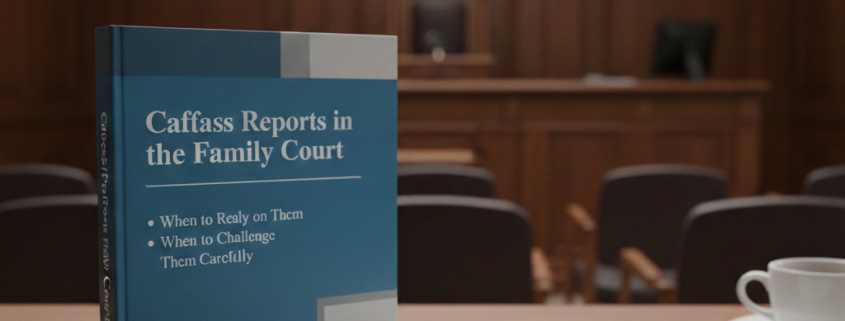
    Cafcass Reports in the Family Court: When to Rely on Them — and When to Challenge Them Carefully

    Introduction: Why Cafcass Reports Carry So Much Weight

    For many litigants in person, a Cafcass report can feel like the moment the case is decided.

    Recommendations are often treated as authoritative. Language used in early safeguarding letters or section 7 reports can shape judicial thinking long before a final hearing. And once a narrative has settled, it can be extremely difficult to shift.

    Yet Cafcass reports are not judgments, not findings of fact, and not immune from scrutiny.

    This article explains:

    • what Cafcass reports are (and are not)
    • how courts are meant to use them
    • common problems that arise in practice
    • when reliance is appropriate
    • when careful challenge may be necessary — and how to do so without damaging credibility

    The aim is not to undermine safeguarding, but to ensure that procedural fairness and accuracy are maintained, particularly for litigants in person.


    What Is Cafcass — and What Is Their Role?

    Cafcass (Children and Family Court Advisory and Support Service) exists to:

    • safeguard and promote the welfare of children
    • advise the court in private law proceedings
    • speak to parents and, where appropriate, children
    • provide analysis and recommendations

    Cafcass officers do not decide cases. They advise the court, which must then apply the law and exercise judicial discretion.

    Understanding this distinction is critical.


    Types of Cafcass Involvement You May Encounter

    Litigants in person commonly encounter Cafcass at several stages:

    1. Initial Safeguarding Letter

    Prepared after police and local authority checks and brief parental interviews.

    2. Early Recommendations

    Often included before the court has determined disputed facts.

    3. Section 7 Welfare Report

    A fuller report assessing welfare factors under the Children Act 1989.

    Each carries different weight — and different risks if misunderstood.


    Why Cafcass Reports Can Become Problematic

    Cafcass officers work under time pressure, with limited information, and often in high-conflict cases. Problems do not arise because of bad faith, but because of structural limitations.

    Common issues include:

    1. Reliance on Unresolved Allegations

    Cafcass may refer to allegations as background context without findings having been made.

    2. One-Sided Narratives

    Where one party is more articulate, organised, or emotionally persuasive.

    3. Incomplete Testing of Evidence

    Cafcass do not cross-examine or conduct fact-finding.

    4. Early Recommendations Becoming “Sticky”

    Interim views can harden into assumed truths.

    None of these invalidate a report — but all require careful handling.


    How the Court Is Meant to Treat Cafcass Reports

    Judges are required to:

    • consider Cafcass advice carefully
    • assess it alongside all evidence
    • apply the legal framework (including PD12J where relevant)
    • make independent decisions

    A Cafcass recommendation should inform, not replace, judicial reasoning.


    When It Is Appropriate to Rely on a Cafcass Report

    Cafcass reports are particularly helpful where:

    • both parties broadly agree on the facts
    • the dispute is about arrangements, not allegations
    • safeguarding issues are low-level or historic
    • the child’s wishes and feelings are clearly expressed

    In such cases, reliance is often proportionate and sensible.


    When a Cafcass Report May Need to Be Challenged Carefully

    Challenge may be appropriate where:

    • allegations are treated as established without findings
    • PD12J has not been applied
    • significant factual errors appear
    • key evidence has been overlooked
    • recommendations contradict earlier safeguarding positions

    The emphasis here is on careful challenge.


    How Litigants in Person Can Raise Concerns Without Backfiring

    This is where many cases go wrong.

    What Not to Do

    • accuse Cafcass of bias
    • re-argue relationship history
    • submit emotional rebuttals
    • personalise criticism

    What To Do Instead

    • identify specific inaccuracies
    • refer to procedural steps
    • ask clarifying questions
    • ground submissions in the welfare checklist

    For example:

    “I respectfully ask the court to consider whether the recommendation assumes facts that have not yet been determined.”

    This keeps the focus on process, not personalities.


    Why Timing Matters More Than Tone

    Concerns raised:

    • early
    • calmly
    • proportionately

    are far more likely to be heard than late, reactive challenges.

    Once a report has been relied upon repeatedly, the court’s tolerance for revisiting it narrows.


    The Role of Support for Litigants in Person

    Many litigants do not need to oppose Cafcass — they need help understanding:

    • what weight a report carries
    • how to frame responses
    • when silence is strategic
    • when clarification is essential

    Structured procedural support can prevent unnecessary escalation while preserving fairness.


    Final Thought: Cafcass Reports Are Influential — Not Infallible

    Cafcass plays an essential role in the family justice system. But their reports are one piece of a wider legal puzzle.

    For litigants in person, the goal is not to fight Cafcass, but to ensure that recommendations rest on a sound procedural footing.

    Clarity, restraint, and timing matter more than volume or force.

    Internal Links (place at end of blog)

    1. Domestic Abuse Allegations and PD12J: What the Court Must Do
    2. False Allegations in the Family Court: Protecting Credibility as a Litigant in Person
    3. Child Arrangements Orders (C100): Getting It Right From the Start

    External Links (authoritative)

    1. Cafcass — About Our Role in Private Law Cases
    2. Judiciary of England and Wales — Children Act 1989 Welfare Checklist

    Contact Me If You Need Me

    If a Cafcass report has been filed in your case and you are representing yourself, understanding how the court is likely to rely on it — and when clarification may be appropriate — can help you navigate proceedings with greater confidence.

    I provide calm, structured support to litigants in person dealing with Cafcass involvement, including understanding reports, identifying procedural issues, and preparing proportionate responses, subject to the court’s discretion.

    You are welcome to get in touch to discuss whether support may be appropriate in your circumstances.

      Domestic Abuse Allegations and PD12J:

      What the Court Must Do — and What Litigants in Person Need to Watch For.

      Introduction: Why PD12J Matters More Than Most Litigants Realise

      When allegations of domestic abuse are raised in family court proceedings, the legal framework that governs how the court must respond is not optional. It is mandatory.

      That framework is Practice Direction 12J (PD12J).

      Yet many litigants in person only discover PD12J after key decisions have already been made — sometimes after contact has been suspended, sometimes after findings have been implicitly assumed without a hearing, and sometimes after Cafcass recommendations have hardened into a narrative that is difficult to unwind.

      This article explains, in plain language:

      • what PD12J is and why it exists
      • what the court is required to do when abuse is alleged
      • the most common PD12J failures seen in practice
      • how litigants in person can spot procedural drift early
      • what practical steps can be taken to protect fairness without escalating conflict

      This is not about disputing safeguarding. It is about ensuring that safeguarding decisions are reached lawfully.


      What Is PD12J?

      PD12J is a Practice Direction attached to the Family Procedure Rules. Its purpose is explicit:

      To ensure that where domestic abuse is alleged, the court identifies the issues early, applies the correct legal framework, and does not make child arrangements decisions that expose a child or parent to risk.

      In other words, PD12J exists to prevent short-cuts, assumptions, and welfare decisions being made on an unsafe factual foundation.

      Crucially, PD12J applies whether or not allegations are disputed, and regardless of whether parties are represented.


      The Trigger Point: When PD12J Applies

      PD12J is engaged when:

      • allegations of domestic abuse are raised in a C1A
      • abuse is referred to in statements, position statements, or oral submissions
      • Cafcass identify safeguarding concerns linked to alleged abuse
      • the court itself raises concerns about past behaviour

      It does not require:

      • a criminal conviction
      • police action
      • corroboration at the outset

      Once triggered, the court must follow a structured analytical process.


      What the Court Is Required to Do Under PD12J

      At a minimum, PD12J requires the court to:

      1. Identify the allegations clearly
        Not vaguely, not by implication, but specifically.
      2. Determine whether findings of fact are necessary
        This is not optional. The court must ask: Can safe child arrangements be decided without resolving these allegations?
      3. Consider the impact of alleged abuse on the child and parent
        Including coercive control, emotional harm, and post-separation abuse.
      4. Avoid assuming allegations are true or false
        Interim decisions must not pre-judge the outcome.
      5. Record the analysis
        PD12J compliance must be visible on the face of the decision.

      Failure at any of these stages is not a technicality. It goes to procedural fairness.


      Common PD12J Failures Seen in Practice

      Litigants in person frequently encounter the same problems, often without realising they are legally significant.

      1. “We Don’t Need a Fact-Finding Hearing”

      Courts sometimes decline fact-finding on the basis that allegations are:

      • “historic”
      • “not directly relevant”
      • “too many”
      • “unlikely to change the outcome”

      PD12J is clear: the test is necessity, not convenience.

      If alleged abuse could affect:

      • contact safety
      • parental dynamics
      • a child’s emotional welfare

      the court must explain why findings are not required.


      2. Interim Restrictions Without Analysis

      Contact may be:

      • supervised
      • reduced
      • suspended

      without a PD12J-compliant analysis being articulated.

      Interim caution is lawful. Silent assumption is not.


      3. Cafcass Recommendations Treated as Determinative

      Cafcass play a vital role, but they:

      • do not make findings of fact
      • do not apply PD12J
      • rely on what they are told

      Where Cafcass recommendations are adopted without judicial analysis, PD12J risks being bypassed.


      4. Abuse Being Minimis ed or Over-Relied Upon

      Both errors occur:

      • genuine abuse dismissed as “relationship conflict”
      • untested allegations treated as established risk

      PD12J exists to prevent both extremes.


      Why Litigants in Person Are Particularly Vulnerable

      Represented parties often have PD12J raised for them. Litigants in person usually do not.

      This creates a structural imbalance where:

      • allegations are framed by one party
      • Cafcass narratives crystallise early
      • interim decisions harden into status quo

      Without intervention, procedural shortcuts can quietly become the foundation of final orders.


      What Litigants in Person Can Do — Practically

      This is not about confrontation. It is about calm procedural clarity.

      1. Name PD12J Explicitly (Once, Clearly)

      You are entitled to say:

      “I respectfully ask the court to confirm how PD12J has been applied in this case.”

      That sentence alone reframes the discussion.


      2. Separate Emotion From Structure

      Focus on:

      • process
      • sequence
      • recorded reasoning

      Avoid relitigating relationship history unless invited.


      3. Ask Procedural Questions, Not Substantive Arguments

      For example:

      • “Has the court determined whether findings are necessary?”
      • “Is the court satisfied that safe arrangements can be made without resolving these allegations?”

      These are lawful questions. They are not attacks.


      4. Preserve the Record

      If PD12J is not addressed:

      • ask for it to be noted
      • request clarification
      • keep contemporaneous notes

      This matters later.


      Why Getting PD12J Wrong Early Is So Difficult to Undo

      Once:

      • interim arrangements are in place
      • Cafcass reports are filed
      • children adapt to reduced contact

      courts are understandably cautious about disruption.

      This is why early procedural correctness matters more than later argument.


      The Role of Support for Litigants in Person

      Many litigants do not need a solicitor to understand PD12J — but they do need:

      • someone who knows the framework
      • someone who can keep submissions focused
      • someone who can identify drift early

      Structured McKenzie Friend support often plays a crucial role here, particularly where power imbalance or complexity is present.


      Final Thought: PD12J Is Not a Weapon — It Is a Safeguard

      PD12J protects:

      • children
      • alleged victims
      • accused parents
      • the integrity of the process

      It is not about winning. It is about ensuring decisions are made on a lawful foundation.

      If you are representing yourself and allegations are in play, understanding PD12J is not optional. It is essential.


      Suggested Internal Links


      External Links

      Call Me

      If domestic abuse allegations have been raised in your family court case and you are representing yourself, early procedural clarity can make a significant difference to how the court approaches the issues.

      I provide calm, structured support to litigants in person navigating PD12J-related concerns, including understanding the court’s obligations and identifying when procedural safeguards may not have been properly applied, subject to the court’s discretion.

      You are welcome to get in touch to discuss whether support may be appropriate in your circumstances.

        Regulatory & Editorial Notice

        This article is provided for general information purposes only and does not constitute legal advice. It is not a substitute for advice from a qualified solicitor or barrister. References to legislation, procedural rules, guidance, or third-party organisations are made for informational and public-interest purposes only. While care has been taken to ensure accuracy at the time of publication, the law and its interpretation may change. Readers are responsible for seeking appropriate legal advice specific to their circumstances.

        False Allegations in the Family Court

        How litigants in person can respond calmly, protect credibility, and avoid common traps

        When allegations redefine the case overnight

        Few moments in family proceedings are as destabilising as the sudden appearance of serious allegations. A case that began as a dispute about arrangements for a child can quickly transform into something far more complex—emotionally and procedurally.

        For litigants in person, the shock is often compounded by confusion about what to do next. Parents may feel compelled to respond immediately, to correct the record, or to defend themselves in detail. Unfortunately, instinctive reactions at this stage can cause lasting harm.

        This article explains how courts approach allegations, why the word “false” must be used with care, where litigants in person most often go wrong, and how a measured, procedural response can protect credibility while the court determines what must happen next.


        Why allegations carry such weight in family proceedings

        Family courts are concerned first and foremost with risk. When allegations of abuse, violence, coercive control, or serious misconduct are raised, the court’s immediate task is not to decide whether they are true, but whether they require investigation before decisions about children can safely be made.

        This means that allegations can:

        • halt or restrict contact on an interim basis
        • trigger safeguarding checks and reports
        • change the procedural route of the case
        • delay substantive decisions

        Understanding this context is essential. Allegations do not have to be proven to influence procedure in the short term.


        The problem with the word “false”

        Parents often describe allegations as “false” when they believe them to be untrue, exaggerated, or misleading. While that belief may be genuine, courts are cautious about the language used.

        From a judicial perspective:

        • an allegation is either admitted, denied, or to be determined
        • the court avoids premature findings
        • credibility is assessed over time, not on assertion

        Using the term “false allegations” too forcefully or too early can be counterproductive. Courts prefer evidence-led denials, not declarations of motive.


        Common mistakes litigants in person make when responding

        1. Responding emotionally rather than procedurally

        Shock and indignation are understandable. But long, emotional rebuttals often obscure the issues the court needs to resolve and can undermine credibility.


        2. Attempting to prove everything at once

        Parents may feel they must disprove every point immediately. In reality, the court will often direct a structured process—sometimes a fact-finding hearing—rather than decide matters summarily.


        3. Alleging bad faith without evidence

        Asserting that allegations are malicious, tactical, or vindictive without evidential support can escalate conflict and invite scrutiny of both parties’ conduct.


        4. Failing to understand the procedural next step

        Whether allegations lead to interim measures, directions for evidence, or a fact-finding hearing depends on how they are framed and responded to.


        What the court is actually deciding at this stage

        When allegations are raised, the court is usually deciding:

        • whether the allegations are relevant to decisions about the child
        • whether they require investigation
        • what interim arrangements are safe
        • what directions are needed to resolve disputed facts

        The court is not deciding who is “right” in the moral sense. It is deciding how to proceed safely and fairly.


        The role of Practice Direction 12J (in brief)

        Where allegations of domestic abuse are raised, the court must consider Practice Direction 12J. This framework governs how allegations are handled and when findings may be required before child arrangements are determined.

        For litigants in person, PD12J is often cited without being understood. What matters in practice is that:

        • allegations may change the procedural route
        • findings are not automatic
        • the court must consider necessity and proportionality

        A calm, structured response helps the court apply the framework correctly.


        Evidence: quality over quantity

        One of the most common errors made by litigants in person is overloading the court with material.

        Effective responses focus on:

        • relevance to the allegations
        • contemporaneous evidence where available
        • consistency over time
        • clarity and proportion

        More documents do not equal a stronger case. Better-organised, relevant material does.


        Interim arrangements and the risk of drift

        When allegations arise, interim arrangements may be altered “pending investigation.” For parents, this can feel like punishment without proof.

        The risk is that temporary arrangements become the new normal.

        This is why measured but timely procedural engagement matters. The aim is not confrontation, but ensuring the case progresses rather than stalls.


        When a fact-finding hearing may be directed

        Not all allegations lead to fact-finding hearings. Courts consider:

        • seriousness and specificity of allegations
        • relevance to child welfare decisions
        • availability of other evidence
        • proportionality

        Litigants in person often misunderstand this stage, either assuming a hearing is inevitable or failing to prepare properly if one is ordered.

        Support at this stage can make a material difference to how evidence is presented and understood.


        How credibility is built—or lost—over time

        Credibility is not established by protestations of innocence. It is assessed through:

        • consistency of accounts
        • compliance with court directions
        • tone and proportionality
        • willingness to engage with process

        Parents who remain calm, focused, and procedural are often viewed more favourably than those who appear reactive or accusatory.


        When support can help

        Support can be particularly valuable where:

        • allegations are serious or wide-ranging
        • safeguarding agencies are involved
        • interim contact has been restricted
        • a parent feels overwhelmed or unheard
        • procedural complexity is increasing

        Support focuses on how to respond, not what outcome to demand.


        How I support litigants in person facing allegations

        I support parents responding to allegations by helping them:

        • understand the procedural implications
        • structure clear, proportionate responses
        • organise relevant evidence
        • prepare for hearings and directions
        • avoid common pitfalls that damage credibility

        I do not promise outcomes. I do not encourage escalation. I do not replace legal representation.

        My role is to help litigants in person engage with the process in a way that protects fairness and procedural integrity.


        A message to parents facing allegations

        Being accused does not mean you will be disbelieved. But how you respond matters.

        Calm, structured engagement gives the court what it needs to assess matters fairly. Emotional or reactive responses often make an already difficult situation harder.

        Support at this stage is not about winning an argument. It is about ensuring the process unfolds properly.


        Call Me

        If you are facing allegations in the family court and representing yourself, structured procedural support may help you respond calmly and protect your position.

        I offer measured, non-adversarial support to litigants in person navigating allegations, subject to the court’s discretion.

        You are welcome to get in touch to discuss whether support would be appropriate in your circumstances.

          Further Reading & Guidance

          Related articles from JSH Law

          1. Parental Alienation and Contact Breakdown
          2. Enforcing Child Contact Orders (C79): When Orders Are Ignored
          3. Support for Litigants in Person in the Family Court

          External guidance

          Regulatory & Editorial Notice

          Regulatory & Editorial Notice
          This article is published for general information purposes only. It does not constitute legal advice and should not be relied upon as such. Every family case turns on its own facts and procedural context. Support services described are non-reserved and subject to the discretion of the court. Where legal advice is required, readers should seek assistance from a suitably qualified legal professional.