
Explanatory guidance on private law family proceedings, including scope, procedural framework, and typical case progression.

Posts

Family Court Etiquette: How to Conduct Yourself as a Litigant in Person

Nervous about a Family Court hearing? Learn how to behave, address the judge properly, and present yourself confidently as a litigant in person.

Family Court Etiquette: How to Conduct Yourself as a Litigant in Person

Category: Court Etiquette (Family Court Procedure UK)  |  Audience: Litigants in Person (England & Wales)

Key takeaways for litigants in person

  • Be calm, structured and respectful — credibility matters more than volume.
  • Address the judge correctly: usually “Sir” or “Madam” in the Family Court.
  • Speak to the judge, not the other parent.
  • Never interrupt. Make notes and wait your turn.
  • Focus on the child’s welfare — that is the court’s legal priority under the Children Act 1989, s.1.
  • Your behaviour in court becomes part of the evidence.

Why Court Etiquette Matters in Family Proceedings

The Family Court is less formal than the Crown Court — but it is still a court of law. Proceedings are governed by the Family Procedure Rules 2010, and hearings are recorded. Judges are assessing not only the evidence but also each party’s ability to prioritise the child’s welfare.

In private children cases, the court’s paramount consideration is the child’s welfare under section 1 of the Children Act 1989. Your conduct in court can directly affect how your credibility, insight, and emotional regulation are perceived.

Put simply: if you appear hostile, chaotic, or unable to focus on the child, that impression can undermine your position.

Before You Enter the Courtroom

  • Arrive early. Aim to be there at least 30 minutes before your hearing.
  • Dress smartly and conservatively. You do not need a suit, but avoid casual or provocative clothing.
  • Turn your phone off. Not silent — off.
  • Bring an indexed bundle and spare copies.
  • Prepare a short position statement. Clear, structured, and child-focused.

How to Address the Judge

In most Family Court hearings before a District Judge or Circuit Judge, you should say:

  • “Sir” (for a male judge)
  • “Madam” (for a female judge)

If unsure, court staff can advise you before the hearing begins. Do not say “Your Honour” unless you are certain of the judge’s title.

Practical tip

If you make a mistake in how you address the judge, correct yourself calmly and move on. Confidence and composure matter more than perfection.

Speaking in Court: The Core Rules

1. Stand when speaking (unless told otherwise)

In most hearings, you stand when addressing the judge. If you are told to remain seated, follow that direction.

2. Do not interrupt

Even if something inaccurate is being said. Make a note. You will be given a chance to respond.

3. Speak to the judge — not to the other parent

You are not there to argue with the other party. All submissions go through the court.

4. Be concise

Judges prefer structure. Use this format:

  • The issue
  • The relevant fact
  • The evidence reference
  • The order you seek

What NOT to Do

  • Roll your eyes, sigh loudly, or react visibly to evidence.
  • Interrupt professionals (Cafcass, social workers, legal representatives).
  • Raise your voice.
  • Use insulting language.
  • Speak over the judge.
  • Film or record the hearing.

Recording or publishing details from Family Court proceedings can amount to contempt of court due to the privacy rules in children cases. The Family Court is generally private, and restrictions apply to what can be shared publicly.

If You Feel Overwhelmed

Family Court hearings are emotionally intense. You may hear allegations you strongly dispute. The judge is watching how you handle pressure.

  • Pause before responding.
  • Ask for a short break if genuinely overwhelmed.
  • Return to the child’s welfare as your anchor.

Key mindset shift

The hearing is not about “winning.” It is about persuading the court that your proposal best serves the child’s welfare.

After the Hearing

  • Listen carefully to the judge’s summary.
  • Make notes of directions and deadlines.
  • Clarify politely if you do not understand something.
  • Comply strictly with filing dates.

Failure to comply with directions can weaken your position significantly.


Book a 15-minute consultation (phone)

If you want help preparing for an upcoming hearing — including drafting a clear position statement, structuring your submissions, or understanding what the judge is likely to focus on — you can book a 15-minute initial consultation below:

Useful links

  1. Children Act 1989 – Section 1 (Welfare Principle)
    The legal foundation for how decisions are made in children cases. Read on legislation.gov.uk.
  2. Family Procedure Rules 2010
    The procedural framework governing Family Court hearings. Read on legislation.gov.uk.
  3. Practice Direction 12B (Child Arrangements Programme)
    Explains the structured pathway of private children cases. Read on justice.gov.uk.
  4. Practice Direction 12J (Domestic Abuse in Child Arrangements Cases)
    Safeguarding framework where abuse is alleged. Read on justice.gov.uk.
  5. GOV.UK – Child Arrangements Orders
    Overview of section 8 applications. Read on GOV.UK.
  6. Cafcass – Private Law Proceedings Guide
    What parents can expect during the process. Read on Cafcass.
Regulatory & Editorial Notice

This article is provided for general informational purposes only. It does not constitute legal advice. Family Court outcomes depend on individual facts, evidence, and judicial discretion. Court rules and procedures may change. If you require advice tailored to your circumstances, seek professional guidance.

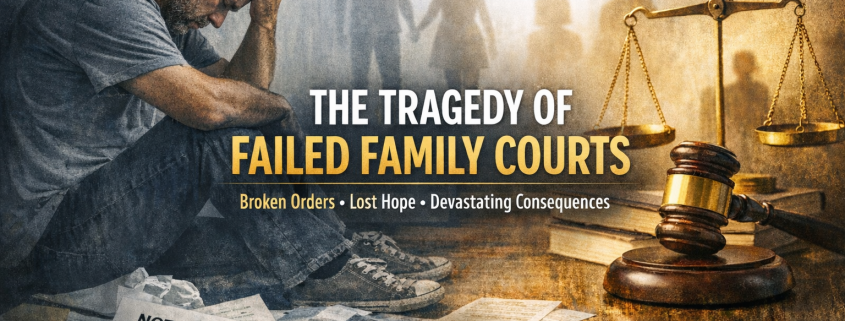
When the System Wears a Parent Down: A Preventable Tragedy in the Family Courts

A recent post shared by PAPA – People Against Parental Alienation recounts the death of a parent following nearly a decade of litigation in the family courts.

It is a devastating read.
And it should stop every professional in this system in their tracks.

This was not a parent who disengaged.
This was not a parent who posed a safeguarding risk.
This was not a parent who refused to comply.

This was a parent who did everything the system asked of him—and was still ground down until there was nothing left.

A Familiar Pattern

The facts described will be painfully recognisable to many parents navigating private law proceedings:

  • Years of allegations, many serious, repeatedly investigated and dismissed
  • Ongoing disruption of contact despite findings of no safeguarding concerns
  • Court orders made, but not enforced
  • Repeated breaches met with little more than verbal criticism
  • Escalating legal costs, depleted savings, mounting debt
  • A parent forced back to court again and again, simply to maintain a relationship with their children

This father lost his home, his financial stability, and ultimately his hope—not because the court found him unfit, but because the system failed to act decisively when its own orders were ignored.

The Enforcement Gap No One Wants to Own

Family courts in England and Wales routinely acknowledge that a relationship with both parents is important for a child, absent safeguarding concerns. Orders are made to reflect that principle.

But making an order is not the same as enforcing it.

What this case exposes—once again—is a persistent enforcement vacuum:

  • Breaches are minimised
  • Delay becomes normalised
  • Responsibility is diffused between agencies
  • Parents are told to “return to court” as if that is a neutral act

Each return to court carries real cost:

  • Financial
  • Emotional
  • Psychological

For some parents, those costs eventually become unbearable.

“It’s a Family Matter”

Perhaps the most chilling part of the account is this: after years of documented obstruction, the parent sought police assistance for harassment and persistent interference—only to be told it was “a family matter” and advised to stop pursuing it.

This response reflects a wider institutional problem. When court orders exist but are not enforced, parents are left in a legal no-man’s-land:

  • The court points to enforcement applications
  • The police defer to family proceedings
  • Local authorities step back once safeguarding thresholds are deemed unmet

And the parent is left carrying the entire burden alone.

This Was Preventable

Let us be clear:
This was not inevitable.

A parent who complied with every instruction, adapted their life to remain available to their children, and continued to engage respectfully with the process should not be left without protection.

Children should not lose a loving parent because court orders were treated as optional.

When systems repeatedly confirm there is no safeguarding risk, yet allow ongoing obstruction to continue unchecked, the harm becomes institutional.

Why This Matters

This is not about one case.
It is about a pattern.

Until parental alienation and persistent obstruction are properly recognised, until court orders are meaningfully enforced, and until agencies stop passing responsibility sideways, tragedies like this will continue.

And they will continue quietly—until another name is added to a memorial.

A Final Word

This father’s children have lost a parent not because he failed them, but because the systems designed to protect family relationships failed to intervene when it mattered most.

That loss will echo far beyond this moment.

We owe it to those children—and to every parent still fighting—to do better.

If you are navigating prolonged family court proceedings and feel worn down by delay, non-enforcement, or repeated obstruction, you are not weak for feeling the strain. These processes are inherently draining, and support matters.

At JSH Law, we believe sunlight, accountability, and enforceability are essential if family justice is to mean anything at all.

We will continue to speak openly about these failures—because silence is part of how they persist.


Regulatory & Editorial Notice

This article constitutes independent legal commentary on matters of public interest arising from content published by a third party, namely PAPA – People Against Parental Alienation.

JSH Law is not associated with, does not act for, and does not endorse any organisation, campaign, demonstration, or fundraising activity referenced or linked in the original third-party material. No donations are requested, facilitated, or processed by JSH Law.

The content of this article is provided for informational and commentary purposes only. It does not constitute legal advice, does not create a solicitor-client relationship, and should not be relied upon as a substitute for independent legal advice tailored to individual circumstances.

Any factual assertions relating to individual cases are drawn solely from publicly available material and are addressed in a generalised and anonymised manner. No findings of fact, liability, or wrongdoing are asserted against any individual, authority, or agency.

JSH Law reserves the right to amend or withdraw this commentary where necessary to ensure ongoing regulatory compliance and professional standards.