
Why Family Court Transparency Matters: What the 30 January 2023 Reporting Pilot Meant for Parents and Litigants in Person
For decades, the family courts have operated in a space that is both necessary and uncomfortable: decisions of the highest consequence, made largely out of public view. On 30 January 2023, that began to shift. As reported by BBC News, a new transparency pilot allowed journalists to report on family court proceedings in a way that had not previously been possible. It was presented as a step towards accountability. But for parents and litigants in person, the real significance runs deeper—because scrutiny is not just about visibility, it is about whether the system can be properly trusted.
Why Family Court Transparency Matters: What the 30 January 2023 Reporting Pilot Meant for Parents and Litigants in Person
For years, one of the deepest frustrations for families caught up in the family justice system has been this: life-changing decisions are made behind closed doors, yet the people most affected often come away feeling unheard, disoriented, and unable to explain what has happened to them. That is why the 30 January 2023 transparency pilot in the family courts mattered so much. It was not simply a procedural reform for journalists. It was a recognition that secrecy, however well-intentioned, can also shield poor process, weak accountability, and profound injustice. For parents and litigants in person, that moment marked something important: the beginning of a more serious public conversation about what really happens in family court.
Key takeaways for litigants in person
1. Greater transparency in family court is not about sensationalism. It is about accountability, scrutiny and public confidence.
2. The family court deals with some of the most serious and intimate decisions the state can make about children and families.
3. For too long, many parents have felt unable to challenge what happened because the system has been too closed for meaningful scrutiny.
4. Journalists being allowed to report from family court was an important step, but it was never a complete answer on its own.
5. Litigants in person still need to be organised, informed and strategically prepared. Transparency helps, but it does not remove the need to present your case properly.
If you need strategic support with your family court case, chronology, statement, position statement, bundle preparation or hearing preparation, you can book a short initial call below.
What changed on 30 January 2023?
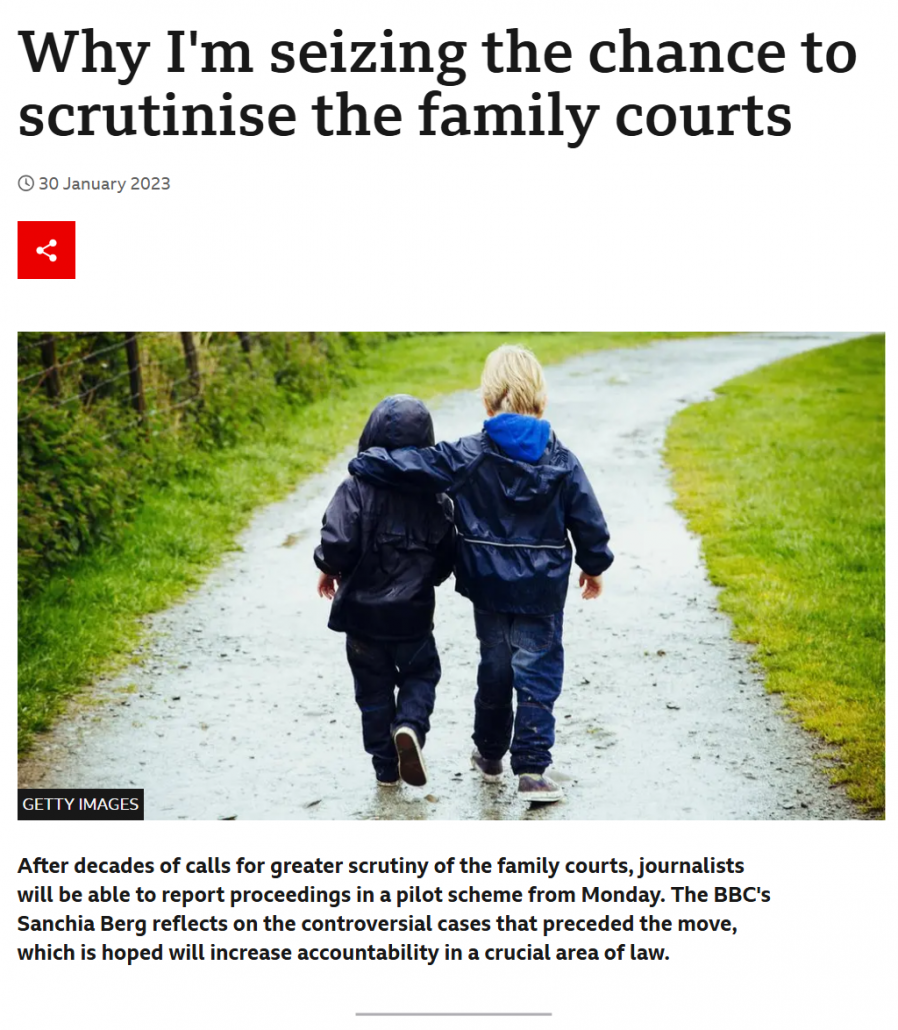
On 30 January 2023, a reporting pilot began in family courts in Leeds, Carlisle and Cardiff. Accredited journalists were to be allowed to report on proceedings in a way that had not previously been possible in any meaningful sense. The intention was to enable closer scrutiny of the family courts, the conduct of local authorities, and the broader decision-making machinery operating in cases involving children.
That may sound modest. In reality, it was significant.
The family courts decide some of the most sensitive issues the law can ever touch: whether a child should be removed from their family, whether parents should be restricted in seeing their children, whether allegations of neglect, abuse, coercion or risk are made out, and whether the state should intervene permanently in family life. These are not minor procedural questions. They are fundamental decisions with lifelong consequences.
Yet despite the seriousness of those decisions, family proceedings have long existed in a space where privacy and secrecy have become difficult to disentangle. Privacy for children is essential. That is not in dispute. But privacy for children is not the same thing as insulation of institutions from scrutiny.
Why this mattered so much
The strongest part of the reporting around the pilot was not simply that a rule was changing. It was the explanation of why scrutiny mattered in the first place.
One of the families referenced in the coverage was that of Liz Anstey, who described the family court process as surreal, traumatic and deeply confusing. She spoke of not knowing who was who, of hearings being adjourned, and of struggling to understand what was going on. That description will resonate with far too many parents.
It should not be normal for people to come out of proceedings affecting their children feeling as though they have fallen into a procedural rabbit hole. Yet many do.
For litigants in person especially, family court can feel like a system with its own language, its own hidden rules, and its own hierarchy of professionals speaking over the lives of ordinary people. Even where the legal process is attempting to do justice, the lived experience can still be one of disempowerment.
That is why scrutiny matters. Not because every complaint made by every parent will be justified. Not because every judicial decision is wrong. But because a justice system that cannot be properly observed will always struggle to command confidence.
The long road to transparency
The 2023 pilot did not appear out of nowhere. It followed decades of pressure, criticism and frustration.
There have been repeated calls over many years for family courts to be opened up to greater scrutiny. Those calls grew louder after cases in which serious errors or alleged miscarriages of justice became publicly known. The concern was never simply that family proceedings were private. The concern was that a private system can become a system in which accountability is too weak, patterns are too difficult to identify, and public understanding is distorted by the absence of real information.
As the article explains, there were previous attempts to increase transparency. In 2009, journalists were allowed into family court hearings, but the practical effect was limited. The rules were too unclear. Reporting remained heavily constrained. Journalists could attend, but not in a way that made meaningful public reporting realistic in most cases.
That distinction is important.
There is a world of difference between being nominally allowed into a courtroom and being able to report in a way that actually informs the public. If a journalist cannot identify the local authority, cannot speak to the family, cannot explain the core facts, and cannot describe the decision in a coherent way, then what exists is not real open justice. It is a carefully managed appearance of it.
Why “private” should never mean “beyond scrutiny”
Family cases are heard in private for good reason. Children must be protected. Their identities, welfare and futures must not be exposed to public harm. That principle is sound and necessary.
But there has always been a dangerous slippage in public debate: the assumption that because proceedings are private, detailed scrutiny is somehow inappropriate or impossible.
That is wrong.
The justice system should be capable of doing two things at once: protecting children’s anonymity while also allowing the conduct of professionals and institutions to be examined. Those aims are not contradictory. In fact, they should sit together. If anything, a system making decisions about vulnerable children should attract more careful scrutiny, not less.
The transparency debate has never really been about whether children should be named. They should not. It has been about whether the operation of the system itself should remain largely shielded from view.
That is where the reporting pilot mattered. It accepted, at least in principle, that anonymity for the child can coexist with proper public-interest reporting.
Why this issue matters to litigants in person
For litigants in person, the transparency issue is not abstract. It affects confidence, fairness and the perceived legitimacy of the whole process.
Parents representing themselves often feel that professionals enter the room with authority already attached to them. Cafcass officers, local authority social workers, experts, guardians, counsel and judges all operate within a system they understand. The parent may be the only person in the room trying to navigate it in real time.
When that process is then almost entirely shielded from outside scrutiny, the parent’s sense of powerlessness can intensify. Even where there are legal remedies, appeals or complaint routes, those mechanisms can be difficult, expensive, slow and procedurally complex. Many families do not have the resources to pursue them.
Transparency does not solve that problem entirely. But it changes the climate. It creates at least the possibility that poor practice, inconsistency, or systemic patterns may be seen and discussed.
And that matters, because courts and agencies behave differently when they know their conduct may be observed and reported.
The limits of transparency
It is also important to be realistic. Transparency is not a cure-all.
Allowing journalists to report on cases does not automatically prevent bad decisions. It does not guarantee that all families will be treated fairly. It does not eliminate the structural disadvantages faced by litigants in person. And it does not remove the emotional and procedural pressure of family proceedings.
In some respects, transparency may even expose a further uncomfortable truth: that the problem was never only secrecy. It was also resources, culture, delay, evidential inconsistency, and the enormous discretionary power exercised within a stressed and overburdened system.
But transparency still matters because without it, those deeper problems are easier to ignore.
A closed system can always reassure itself that it is functioning well. A scrutinised system has to show its workings.
The human cost of family court decisions
One of the most powerful features of the earlier article was its reminder that family court reporting is not simply about legal principle. It is about human consequence.
There is a tendency in legal systems to become desensitised to process. Adjournments become routine. bundles become routine. directions become routine. expert reports become routine. But for the family living through the case, none of it is routine.
When a child is removed, when contact is suspended, when allegations are made, when a case drags on, when a hearing ends in tears outside court, those events are not procedural footnotes. They are pivotal moments in people’s lives.
That is one of the reasons meaningful reporting matters. It restores some human visibility to a system that can otherwise become dominated by anonymised process and professional shorthand.
It forces a wider public to confront what family justice actually does.
The issue of confidence in the system
Sir Andrew McFarlane’s observation at the time that there was “an absence of confidence” in the family courts due to a “vacuum of information” was, in my view, a strikingly honest one.
Confidence in family justice cannot be manufactured by insisting that the public should simply trust it. Trust has to be earned. And in any justice system, trust depends in part on visibility.
Where information is too scarce, rumour fills the gap. Where reporting is too constrained, suspicion hardens. Where people are told that everything is being done properly but cannot see how, confidence erodes.
That does not mean every criticism is well-founded. It means opacity is a poor foundation for legitimacy.
What parents should take from this
If you are a parent or grandparent involved in family proceedings, this issue should matter to you even if no journalist ever attends your hearing.
It matters because it signals a broader recognition that the family justice system cannot remain culturally closed if it wants public trust.
It matters because it validates something many families have been saying for years: that the system can feel inaccessible, confusing and unaccountable.
And it matters because it underlines the importance of presenting your case in a way that is clear, disciplined and evidence-led. In a more transparent system, the quality of process becomes more visible. That means your own preparation matters too.
If you are self-representing, ask yourself:
Can I explain my case clearly?
Do I have a proper chronology?
Have I distinguished fact from allegation?
Have I focused on the child’s welfare rather than only my own grievances?
Do I understand what order I am asking the court to make and why?
Transparency may shine more light on the system, but you still need to be ready to stand in that light with a properly prepared case.
My own view
I have long taken the view that privacy for children must be preserved, but that this should never be used as a reason to avoid examination of how the family courts actually operate.
The stakes are simply too high.
When the state intervenes in family life, when children are removed, when contact is curtailed, when professional opinions shape outcomes, and when judicial discretion carries lifelong consequences, accountability is not optional. It is essential.
The 30 January 2023 pilot was important because it represented a serious move away from the idea that family justice can rely on closed-room legitimacy. It accepted that if the public is to have confidence in the system, the system must be prepared to be seen.
That does not weaken justice. It strengthens it.
Final thoughts
The family courts deal with some of the most painful and consequential decisions in the legal system. They will never be easy places. Nor should they become spectacles.
But neither should they remain so closed that only fragments of truth emerge, and only after years of campaigning, appeals, or extraordinary effort.
The 2023 transparency pilot mattered because it recognised that accountability and child protection can coexist. It recognised that secrecy is not the same as safety. And it offered, at least in part, a route towards a family justice system that could be better understood, better scrutinised and, perhaps in time, better trusted.
For litigants in person, that was and remains a development worth paying close attention to.
Need help preparing for family court?
If you are facing private children proceedings and need clear, strategic support, book a 15-minute initial consultation to discuss your case, your next steps, and how to approach proceedings with greater confidence.
Practical litigation support. Clear strategy. Confidence before your next hearing.
Useful links
- BBC News: Why I’m seizing the chance to scrutinise the family courts
- Judiciary guidance on reporting in the family courts
- The Transparency Project
- Family Procedure Rules and Practice Directions
- Cafcass
- Judiciary of England and Wales
Regulatory & Editorial Notice: This article is published by JSH Law Ltd for general information, commentary and public legal education only. JSH Law Ltd is not a firm of solicitors and does not provide reserved legal activities or regulated legal services. Nothing in this article constitutes legal advice, representation, or the formation of a solicitor-client relationship. Family court cases turn on their own facts, evidence, judicial evaluation and procedural history. Readers should obtain advice tailored to their own circumstances before taking or refraining from any step in litigation. Commentary on public reporting, court reform, institutions or third-party materials is editorial in nature and is presented in good faith on the basis of sources believed to be reliable at the time of publication.