

My Octopus Teacher: What This Extraordinary Documentary Teaches Us
Recently I watched My Octopus Teacher on Netflix, and it is one of those rare documentaries that quietly changes the way you think. On the surface, it is a film about a diver and an octopus. In reality, it is a powerful reflection on trust, observation, vulnerability and the importance of seeing behaviour in context. What makes it so compelling is not spectacle, but patience — and the reminder that real understanding often emerges slowly, through attention rather than assumption.
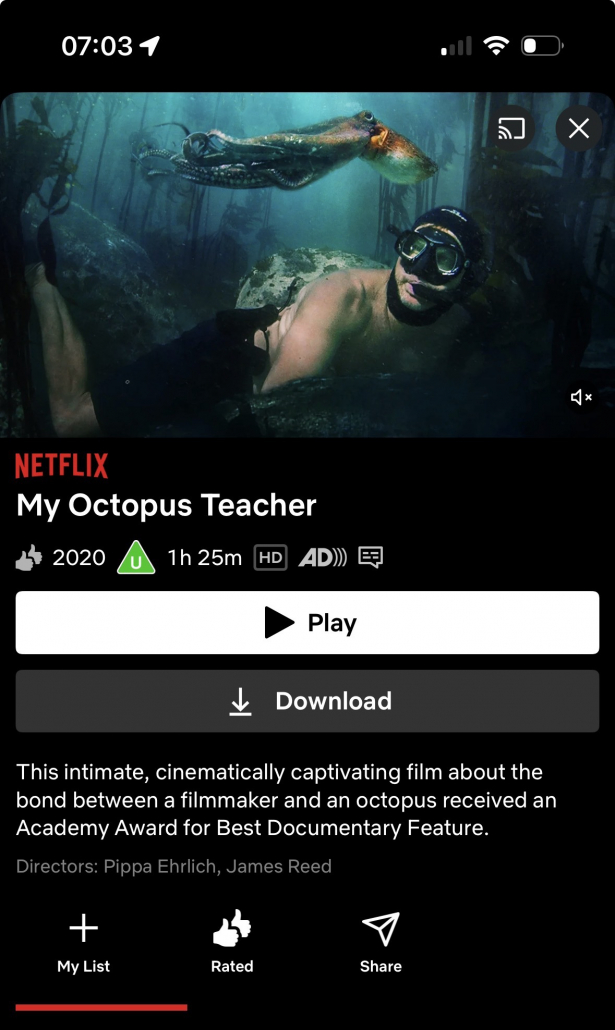
A reflective analysis of My Octopus Teacher exploring trust, vulnerability, observation and the quiet power of understanding behaviour over time.
My Octopus Teacher: What This Extraordinary Documentary Teaches Us About Trust, Presence and Seeing What Others Miss
Film Reflection | Observation, Vulnerability, Trust and the Quiet Power of Paying Attention
Recently I watched My Octopus Teacher on Netflix, and it is one of those rare documentaries that stays with you long after it ends. On the surface, it appears to be a film about a man diving in the ocean and forming an unusual connection with an octopus. That description, while technically accurate, does not come close to capturing its depth. This is not simply a wildlife documentary. It is a meditation on observation, patience, vulnerability, trust and the importance of truly paying attention to another living being over time.
What makes the documentary so powerful is its refusal to hurry. It does not force drama. It does not rely on noise or spectacle. Instead, it invites the viewer into a slower and more attentive way of seeing. Through that slowness, the film reveals something profound: that truth, trust and understanding are rarely immediate. They emerge gradually, through consistency, patience and repeated presence.
Although this is not a legal documentary, many of its themes resonate far beyond the natural world. For anyone involved in conflict, family court proceedings, or the difficult work of understanding behaviour over time, My Octopus Teacher offers a striking reminder that quick judgments are often shallow ones. Real insight usually comes more slowly.
The Premise of the Documentary
The documentary follows filmmaker Craig Foster, who returns to the cold underwater kelp forests of South Africa during a period of emotional exhaustion and personal disconnection. Rather than seeking distraction, he begins a daily practice of free diving in the same natural environment, without heavy equipment and without trying to impose himself on what he encounters.
During this routine, he discovers an octopus and becomes fascinated by its behaviour. At first, the connection is distant. The octopus hides, disguises itself, keeps its distance and appears wary of human presence. But Foster continues to return, day after day, with a kind of respectful consistency that gradually changes the terms of that encounter.
What follows is extraordinary not because it is sensational, but because it is subtle. The film documents a relationship built not through force, but through patience. It is a story of mutual observation before it becomes one of trust. And that, perhaps, is what makes it feel so rare.
The Discipline of Observation
One of the documentary’s most compelling lessons is the discipline of observation. Foster does not demand interaction. He does not chase or corner. He does not insist that the octopus respond to him on human terms. He simply returns, consistently, allowing the creature to become familiar with his presence.
That is an approach many people struggle with in ordinary life. We are used to speed. We want answers quickly. We often interpret behaviour immediately, assigning motive or meaning before we have enough context to do so fairly. In a culture that rewards reaction, patience can seem passive. This documentary shows that patience is not passive at all. It is an active discipline.
Through repeated observation, patterns begin to emerge. The octopus’s movements, decisions, strategies and responses stop looking random. Instead, they begin to make sense within the context of its environment. Fear, concealment, curiosity, exploration and recovery all become understandable once the viewer has spent enough time watching carefully.
This is one of the strongest themes in the film: if you slow down enough, complexity becomes visible.
Trust Is Built, Not Assumed
The bond between the diver and the octopus is not immediate. It develops in stages. The octopus watches. It withdraws. It tests. It returns. There is caution before there is closeness. That is significant, because it reflects something true of trust more generally: trust is not declared into existence. It is earned through repeated, consistent behaviour.
That may sound obvious, but in practice many people overlook it. They expect trust to be present simply because they want connection or because they believe their intentions are good. But trust is not built from private intention alone. It is built from observable conduct over time.
My Octopus Teacher captures that process beautifully. Trust here is not sentimental. It is responsive. It develops because the octopus begins to learn, through repeated exposure, that this particular presence is not immediately harmful. That trust remains fragile, but it becomes real.
There is something deeply moving in that. The film reminds us that trust often begins not with grand gestures, but with predictability, restraint and the absence of threat.
Intelligence in Unexpected Forms
Another remarkable aspect of the documentary is the octopus’s intelligence. The film shows an extraordinary capacity for adaptation, camouflage, problem-solving and survival. The octopus is not passive within its environment. It is constantly assessing, responding and recalibrating.
What is striking is how much of that intelligence might be missed by anyone not looking carefully. If viewed only briefly, its behaviour might seem instinctive, erratic or purely reactive. But the longer one watches, the clearer it becomes that this is an animal making sophisticated decisions under pressure.
That matters because we often have narrow assumptions about what intelligence looks like. We tend to recognise it most readily when it resembles forms we already respect: language, status, certainty, speed or conventional achievement. But intelligence frequently appears in quieter forms — adaptability, strategic retreat, environmental awareness, survival behaviour and sensitivity to changing conditions.
The octopus in this film embodies that kind of intelligence. It is a reminder that wisdom can be hidden in forms many people overlook.
Behaviour Cannot Be Understood Without Context
One of the deepest lessons in the documentary is that behaviour only becomes meaningful when placed in context. The octopus behaves differently depending on whether it is threatened, hidden, injured, curious, hunting or recovering. A single action tells us very little by itself. A pattern of action over time, viewed within its environment, tells us far more.
This has obvious relevance beyond the ocean. Human behaviour, too, is often misunderstood when stripped of context. Fear can look like defensiveness. Hypervigilance can look like overreaction. Withdrawal can look like indifference. Survival strategies can be mistaken for character flaws if the wider picture is ignored.
The documentary does not preach this point explicitly, but it demonstrates it powerfully. Understanding requires more than observation alone. It requires patient observation in context. That is what allows behaviour to become legible.
In difficult disputes, that lesson matters enormously. Isolated moments can mislead. Patterns, chronology and surrounding circumstances often tell the truer story.
Vulnerability and Risk
As the relationship deepens, the octopus becomes more vulnerable. It allows proximity. It engages. It appears to relax in ways it did not at the beginning. But the natural world remains dangerous. Predators exist. Injury happens. Survival is never guaranteed.
This is one of the reasons the film feels honest rather than sentimental. It does not suggest that trust removes danger. It simply shows that connection and risk often exist together. To be open is to be exposed. To trust is to accept uncertainty. To allow closeness is to become vulnerable to loss.
That tension is central to the emotional force of the documentary. The relationship matters precisely because it is fragile. It is meaningful because it is not protected from the realities of the world around it.
There is a wider truth in that. People often want relationships, processes and systems that offer all the benefits of trust with none of the vulnerability. Life does not work like that. Connection always carries risk. The film does not treat that as a flaw. It treats it as part of what makes connection real.
The Quiet Power of Daily Presence
One of the most affecting things about the documentary is the idea of daily return. Foster does not have one dramatic encounter and draw sweeping conclusions from it. He returns, repeatedly, making himself a regular and recognisable presence in the octopus’s world.
That kind of consistency has transformative power. In many areas of life, change does not come through intensity but through repetition. Relationships are often built in small moments rather than major declarations. Understanding grows through accumulated observation rather than sudden certainty. Recovery, too, often depends on routine rather than revelation.
The film demonstrates this with great restraint. The emotional weight comes not from spectacle, but from the gradual accumulation of contact, familiarity and recognition. This is part of why the documentary feels almost meditative. It values constancy over drama.
What the Documentary Reveals About Seeing Clearly
There is a difference between looking and seeing. Many people look without really seeing at all. They register surface information and move on. This documentary is, in many ways, an invitation to see differently.
To see clearly, one must pause long enough for complexity to appear. One must resist the urge to interpret too quickly. One must allow a subject — whether a person, a conflict or a creature — to reveal itself over time rather than demanding instant clarity.
That kind of seeing requires humility. It requires acceptance that the first explanation may not be the right one, that there may be more going on beneath the surface, and that reality is often subtler than our immediate impressions suggest.
My Octopus Teacher communicates this brilliantly. Its emotional effect depends not on telling the viewer what to think, but on allowing the viewer to notice, gradually, how attention changes understanding.
Why This Documentary Resonates So Strongly
Part of the reason this film resonates with so many people is that it speaks to exhaustion and reconnection. Foster begins the documentary at a point of depletion. He is not simply curious about marine life. He is searching, in some sense, for a way back into aliveness, presence and relationship with the world around him.
That gives the documentary an emotional dimension beyond natural history. It is also a story about restoration through attention. In returning to the water, and in allowing himself to be shaped by a quieter rhythm of observation, he begins to recover a sense of wonder and meaning.
That recovery does not come through conquest or control. It comes through humility, discipline and repeated presence. In a world obsessed with productivity and speed, that feels almost radical.
Key Takeaways for Litigants in Person
Although My Octopus Teacher is not a legal documentary, it offers important lessons for anyone trying to understand behaviour, build a clear case or navigate emotionally difficult proceedings:
- Do not rush to conclusions. Initial impressions are often incomplete. A fuller picture usually emerges over time.
- Look for patterns, not isolated incidents. Repeated behaviour often reveals far more than one-off moments.
- Context matters. Behaviour can only be understood properly when viewed against the surrounding circumstances.
- Consistency builds credibility. Steady, predictable conduct is often more persuasive than dramatic claims.
- Patience reveals what urgency can miss. The more emotionally charged a situation is, the more important careful observation becomes.
In short: understanding rarely comes from reacting quickly. It comes from paying close attention, noticing patterns and allowing the wider picture to emerge.
Final Reflections
My Octopus Teacher is an extraordinary documentary not because it tries to impress, but because it invites stillness. It asks the viewer to slow down, to notice, and to appreciate that some of the most important truths reveal themselves quietly.
It is a film about trust, but also about the conditions that make trust possible. It is a film about intelligence, but also about how often intelligence goes unseen. It is a film about vulnerability, but also about the courage required to remain open in a world that contains risk.
Most of all, it is a film about attention. In a noisy world, that may be one of the most valuable lessons of all. To observe with care. To resist premature judgment. To understand that behaviour makes more sense when seen in context. And to recognise that real connection is built not through control, but through presence.
That is what gives the documentary its emotional power. It reminds us that there is wisdom in patience, that there is meaning in quiet consistency, and that sometimes the deepest forms of understanding come not from speaking more loudly, but from watching more carefully.
Need Support Navigating Family Court?
If you are involved in family court proceedings and feel overwhelmed by the process, you are not alone. Many people find themselves trying to understand complex behaviour, organise evidence and present their case clearly while under significant emotional strain.
I help litigants in person structure their material, understand the process and present their position more clearly and confidently.
You can book a free 15-minute consultation below to discuss your situation.
Regulatory & Editorial Notice: This article is provided for general educational and commentary purposes only. It does not constitute legal advice, reserved legal activity, or a solicitor-client retainer. References to films, documentaries, public figures, animal behaviour or wider reflective themes are included as editorial commentary only. Anyone requiring legal advice on a specific matter should seek advice from a suitably qualified legal professional on the facts of their individual case.















Leave a Reply
Want to join the discussion?Feel free to contribute!