

This section provides practical tools to support preparation and organisation in family court proceedings. It includes templates, checklists, starter packs, and tracking resources designed for litigants in person.

Content in this category is intended to help users structure their case materials, meet procedural requirements, and reduce errors by using clear, repeatable tools aligned with family court expectations.

Organising Evidence for Judicial Review with AI – What the Court Expects — and What It Will Not Tolerate

Judicial Review & AI – Part 4


Introduction: evidence is where Judicial Review succeeds or collapses

By the time a Judicial Review claim reaches the court, the law is usually not the problem.

Most claims fail because:

  • evidence is disorganised,
  • assertions are not supported,
  • documents are missing, duplicated, or mislabelled,
  • or the court cannot see — quickly — what matters.

For litigants in person, this stage is often overwhelming. Evidence arrives in dozens (sometimes hundreds) of emails, PDFs, screenshots, portal messages, and letters.

AI can help — dramatically — but only if used with discipline.

This article explains:

  • what evidence the Administrative Court actually expects,
  • how evidence is assessed at the permission stage,
  • how to organise evidence using AI without breaching trust,
  • and the common mistakes that cause otherwise viable claims to fail.

The legal role of evidence in Judicial Review

Judicial Review is decided primarily on:

  • documents, not testimony,
  • procedure, not credibility contests,
  • records, not recollections.

This is reflected in CPR Part 54 and the Practice Directions governing Administrative Court proceedings.

Unlike many other proceedings:

  • witness statements are limited,
  • cross-examination is rare,
  • the court expects evidence to be self-explanatory.

Your evidence bundle must allow the judge to understand the case without detective work.


The permission stage: why evidence clarity matters so much

Most Judicial Review claims fail at the permission stage.

At this point, the judge typically has:

  • limited time,
  • a short bundle,
  • no oral argument.

They are asking:

  1. Is there an arguable public-law case?
  2. Is it properly evidenced?
  3. Is it procedurally clean?

If the evidence is confusing, incomplete, or bloated, permission is often refused — even where issues exist.

AI’s value lies in reducing friction at this stage.


What counts as evidence in Judicial Review

Evidence in Judicial Review usually includes:

  • court orders,
  • appeal notices,
  • acknowledgements,
  • correspondence with the court,
  • procedural emails,
  • automated responses,
  • screenshots of portals,
  • letters before action (if already sent),
  • relevant policy documents (where applicable).

What it does not usually include:

  • opinion,
  • speculation,
  • emotional narrative,
  • extensive witness evidence (unless strictly necessary).

AI must be used to organise, not embellish.


The court’s evidence mindset

The Administrative Court expects evidence to be:

  • Relevant
    Does it prove or disprove a fact that matters?
  • Chronological
    Does it align cleanly with the timeline?
  • Traceable
    Can each assertion be located in a document?
  • Proportionate
    Is unnecessary material excluded?

Courts are particularly alert to over-inclusion, which often signals lack of focus.


Common evidence failures in JR claims (and why they are fatal)

Before looking at AI workflows, it is worth being blunt about recurring problems.

Judicial Review claims often fail because:

  • screenshots are not dated,
  • emails are partial or cropped,
  • documents are duplicated,
  • key letters are missing,
  • evidence is embedded inside narrative statements,
  • bundles are unpaginated or misindexed.

The court will not “piece it together”.

This is not hostility — it is volume and practicality.


Where AI fits into evidence organisation

AI is exceptionally good at:

  • sorting,
  • grouping,
  • deduplicating,
  • indexing,
  • cross-referencing.

It must never:

  • decide relevance for you,
  • remove context without review,
  • alter original documents.

Think of AI as a junior clerk, not a decision-maker.


Step-by-step: organising JR evidence using AI (safely)

Step 1: Evidence ingestion — create a single source of truth

All evidence must be:

  • gathered into one workspace,
  • clearly labelled,
  • preserved in original form.

AI can help detect:

  • duplicates,
  • near-duplicates,
  • inconsistent filenames.

But originals must remain untouched.


Step 2: Categorise evidence by function, not emotion

Evidence should be grouped by role, for example:

  • filing evidence,
  • acknowledgements,
  • responses,
  • non-responses,
  • procedural decisions.

AI can assist by:

  • clustering documents by content,
  • identifying recurring phrases (“acknowledged”, “will be listed”).

This supports clarity — not argument.


Step 3: Anchor every document to the timeline

Each document should be linked to:

  • a specific date,
  • a specific event in the chronology.

AI can cross-check:

  • whether any timeline entry lacks a document,
  • whether any document is unused.

Unused evidence should usually be removed.


Step 4: Identify what the evidence proves

This is subtle but crucial.

Evidence does not exist to tell a story — it exists to prove facts such as:

  • an appeal was lodged,
  • correspondence was sent,
  • no response was received,
  • time elapsed.

AI can help summarise what each document demonstrates — but the summary must be verified.


Step 5: Create an evidence index the court can scan in minutes

A proper JR evidence index includes:

  • exhibit number,
  • date,
  • short neutral description,
  • page reference.

AI excels here:

  • generating draft indices,
  • checking numbering,
  • ensuring consistency.

The final index, however, must be human-approved.


Step 6: Reduce — then reduce again

This is where discipline matters.

Courts prefer:

  • fewer documents,
  • clearly relevant,
  • cleanly indexed.

AI can help flag:

  • repetitive correspondence,
  • documents that add nothing new.

Removing material is often the hardest — and most important — step.


Evidence of silence: how to prove “nothing happened”

Silence is central to many JR claims — and difficult to evidence.

Courts expect:

  • proof of what did happen,
  • followed by demonstrable gaps.

AI helps by:

  • calculating time between events,
  • showing unanswered chasers,
  • mapping inactivity periods.

What you must not do:

  • assert silence without showing the surrounding activity.

Absence must be structurally visible.


Targeting the correct public body through evidence

Evidence should make clear whether:

  • the issue lies with a judge,
  • court administration,
  • listing processes,
  • or systems operated under HMCTS.

This matters because:

  • Judicial Review must be directed at the correct defendant,
  • misidentification leads to refusal.

AI can help trace patterns of response and responsibility.


What judges look for in JR evidence bundles

Judges assessing permission typically ask:

  • Can I see what happened quickly?
  • Are the documents reliable?
  • Is the bundle proportionate?
  • Does the evidence support the alleged failure?

A clean bundle signals seriousness and credibility.

A chaotic one signals risk.


What AI must not be used to do with evidence

AI must not:

  • alter documents,
  • “clean up” screenshots,
  • infer missing content,
  • summarise without verification,
  • replace originals with generated text.

Any hint of document manipulation can destroy trust instantly.


Key Takeaways (for litigants in person)

  • Judicial Review is document-driven.
  • Evidence must be relevant, chronological, and proportionate.
  • Silence is proved through structure, not assertion.
  • AI is best used for:
    • sorting,
    • indexing,
    • consistency checking,
    • gap detection.
  • Every document must earn its place in the bundle.
  • Courts will not fix evidence problems for you.

A strong evidence bundle often determines permission before law is considered.


Preparing for the next stage

Once evidence is organised, you are ready for:

  • formal engagement with the public body,
  • the Pre-Action Protocol stage.

This is where many Judicial Review cases resolve — without issuing proceedings.


Call to Action

If you are:

  • overwhelmed by court correspondence,
  • unsure what evidence matters,
  • or concerned about preparing a JR-ready bundle,

You may wish to seek structured support before taking further steps.


Regulatory & Editorial Notice (JSH Law)

This article is provided for general information only and does not constitute legal advice.

Judicial Review proceedings are governed by strict procedural rules.
Improperly organised evidence may result in refusal of permission or adverse costs consequences.

Readers should seek independent legal advice where appropriate.
Building a Judicial Review Timeline Using AI – Without losing accuracy, credibility, or the court’s trust

Judicial Review & AI – Part 3


Introduction: why timelines decide Judicial Review cases

In Judicial Review, chronology is not background material.

It is the case.

Before the court considers:

  • grounds,
  • unlawfulness,
  • remedies,

it asks a far more basic question:

What actually happened — and when?

For litigants in person, this is often the hardest part. Court processes generate:

  • fragmented emails,
  • automated notices,
  • partial acknowledgements,
  • long silences,
  • overlapping procedures.

AI can help enormously — but only if used with discipline.

This article explains:

  • why timelines are decisive in Judicial Review,
  • what a JR-ready chronology looks like,
  • how to use AI to build one without introducing error,
  • and how courts assess credibility through structure.

Why Judicial Review timelines are different from ordinary case histories

In most litigation, timelines support argument.

In Judicial Review, timelines establish unlawfulness.

They are used to show:

  • a failure to act,
  • an unreasonable delay,
  • a procedural breach,
  • or a decision taken (or avoided) at a specific moment.

The Administrative Court does not tolerate:

  • vagueness,
  • reconstructed guesswork,
  • emotional narrative.

It expects forensic precision.

That expectation applies equally to litigants in person.


The legal role of chronology in Judicial Review

Under CPR Part 54, claimants must file:

  • a Statement of Facts and Grounds, and
  • evidence supporting those facts.

Facts come first.
Law comes second.

Courts repeatedly emphasise that:

  • arguments cannot float free of dates,
  • unlawfulness must be anchored in time,
  • delay must be measurable, not rhetorical.

A Judicial Review without a clear timeline is usually refused at the permission stage.


Common chronology errors that sink JR claims

Before we look at AI, it is important to understand what not to do.

Courts routinely reject claims where:

  • dates are inconsistent,
  • events are out of sequence,
  • filings are assumed rather than proven,
  • silence is alleged without evidence,
  • timelines mix facts with argument.

A chronology is not:

  • a witness statement,
  • a complaint letter,
  • a narrative of injustice.

It is a neutral factual map.


What a JR-ready timeline actually looks like

A proper Judicial Review timeline has five characteristics:

1. Strict chronology

Events are ordered by date, not importance.

2. Documentary anchoring

Every entry can be traced to evidence.

3. Procedural clarity

Each step is linked to a rule, duty, or process.

4. Neutral language

No argument, no emotion, no speculation.

5. Gap visibility

Silence and delay are shown by absence, not assertion.

AI is excellent at supporting these — if controlled correctly.


Where AI adds real value (and where it doesn’t)

AI is most effective before drafting begins.

At this stage, AI is a:

  • sorting engine,
  • pattern detector,
  • consistency checker.

It is not a fact-creator.


Step-by-step: building a Judicial Review timeline using AI

Step 1: Gather everything (before analysis)

Before using AI at all, you must gather:

  • appeal notices,
  • acknowledgements,
  • emails,
  • court orders,
  • automated responses,
  • postal records,
  • screenshots of portals,
  • chasing correspondence.

If it isn’t documented, it doesn’t exist for JR purposes.

AI cannot rescue missing evidence.


Step 2: Convert documents into machine-readable text

AI works best when documents are:

  • OCR-converted,
  • clearly labelled,
  • date-stamped.

At this stage, AI can assist with:

  • extracting dates,
  • identifying senders,
  • detecting references to procedures.

However, you must manually verify every extracted date.

OCR errors are common — and fatal if unchecked.


Step 3: Create a neutral event list (no interpretation)

This is the most important discipline.

Each timeline entry should follow a simple structure:

  • Date
  • Actor (e.g. appellant, court, listing office)
  • Action
  • Document reference

Example (neutral):

12 March 2025 – Appeal lodged by claimant via online portal. Acknowledgement email received same day.

Not:

The court ignored my appeal.

AI can help strip out loaded language and enforce neutrality.


Step 4: Separate facts from legal significance

At this stage, do not label anything as unlawful.

AI can help you create two parallel views:

  • a pure factual chronology, and
  • a working analysis layer (for your eyes only).

Courts must see only the first.

This separation is critical.


Step 5: Identify silence and delay structurally

Silence is not a single event.

It is a gap between events.

AI can help calculate:

  • elapsed time between steps,
  • number of chasers sent,
  • periods of complete inactivity.

This is where patterns emerge — and where many litigants realise:

  • delay is shorter than they thought, or
  • longer — and more serious.

Both outcomes are valuable.


Step 6: Link events to procedural expectations

Once the factual timeline exists, AI can assist you in mapping:

  • procedural rules,
  • expected next steps,
  • legal duties.

For example:

  • Was acknowledgment required?
  • Was listing discretionary?
  • Was a decision required within a reasonable time?

This is analysis — not evidence — and should remain separate.


Step 7: Identify the moment of failure

Judicial Review usually crystallises around a specific point:

  • a refusal,
  • a deadline missed,
  • a failure to respond after repeated engagement.

AI can help test different candidates:

  • Is the claim premature?
  • Has the duty actually arisen yet?
  • Has time started to run?

This prevents issuing JR too early or too late.


Who is the timeline for?

Your JR timeline serves three audiences:

  1. You
    To understand whether you actually have a public-law issue.
  2. The court
    To assess permission quickly and confidently.
  3. The defendant public body
    Particularly during the Pre-Action Protocol stage.

AI helps align all three.


Targeting the correct public authority

A frequent JR failure is naming the wrong defendant.

Your timeline should make clear whether the issue lies with:

  • a judge’s decision,
  • court administration,
  • listing systems,
  • or processes operated under HMCTS.

AI can help detect where actions (or inaction) originate — but you must decide the legal target.


The court’s perspective: what judges look for

When judges review JR chronologies, they ask:

  • Are dates consistent?
  • Are events evidenced?
  • Is delay objectively shown?
  • Is the claim focused or sprawling?

A clean timeline:

  • builds trust,
  • shortens hearings,
  • increases permission prospects.

A messy one undermines credibility immediately.


What AI must not be used to do at this stage

AI must not:

  • infer facts not in evidence,
  • assume reasons for silence,
  • compress time inaccurately,
  • replace human verification.

The fastest way to lose the court’s confidence is to present a timeline that collapses under basic scrutiny.


Key Takeaways (for litigants in person)

  • In Judicial Review, chronology is the case.
  • Timelines must be neutral, evidenced, and precise.
  • Silence is shown through gaps, not complaints.
  • AI is best used as:
    • a sorting tool,
    • a gap detector,
    • a consistency checker.
  • Every date must be manually verified.
  • A strong timeline often reveals whether JR is viable before you issue.

If your timeline does not clearly show what duty arose, when, and how it was breached, Judicial Review will fail.


How this prepares you for the next step

Once a Judicial Review-ready timeline exists, you can:

  • organise evidence properly,
  • prepare a Pre-Action Protocol letter,
  • apply pressure without issuing proceedings.

That is where AI’s organisational strengths really come into play.


Call to Action

If you are struggling to:

  • organise complex court correspondence,
  • identify whether delay is legally significant,
  • or build a clean Judicial Review chronology,

You may wish to seek structured assistance before taking further steps.


Regulatory & Editorial Notice (JSH Law)

This article is provided for general information only and does not constitute legal advice.

Judicial Review is subject to strict procedural rules and time limits.
Chronology errors can be fatal to claims.

Readers should seek independent legal advice where appropriate before issuing proceedings.

Appeals Ignored by Judges – Identifying a True Public-Law Failure (and not a bad decision)

Judicial Review & AI – Part 2

Silence feels like injustice — but the law is stricter

For litigants in person, one of the most distressing experiences in the court system is silence.

You file an appeal correctly.
You receive confirmation.
Weeks pass.
Months pass.
Nothing happens.

No listing.
No refusal.
No reasons.
No response.

At that point, many people quite reasonably ask:

“If the court won’t deal with my appeal, isn’t that unlawful?”

Sometimes, the answer is yes.
Very often, however, the legal position is more complicated — and this is where Judicial Review cases are won or lost.

This article explains how to tell the difference between:

  • a true public-law failure, and
  • a situation that feels unfair but does not meet the legal threshold.

It also explains how AI can help litigants in person identify the difference early, before time limits expire or energy is wasted.


Why “ignored” does not always mean “unlawful”

The High Court does not intervene simply because a process is slow, confusing, or poorly explained.

Judicial Review is concerned with lawfulness, not service standards.

Courts recognise that:

  • judges have discretion,
  • listings depend on resources,
  • delays occur.

The key question is not:

“Has this taken too long?”

It is:

“Has the court failed to perform a legal duty it was required to perform?”

That distinction matters.


The legal anatomy of a “failure to act”

In public law, a challenge may arise from:

  • a decision, or
  • a failure to make a decision.

A failure to act can be unlawful where:

  • there is a legal duty to act, and
  • the failure is more than mere administrative delay.

This principle has long been recognised, including in Padfield v Minister of Agriculture [1968] AC 997, where the House of Lords confirmed that discretion must be exercised lawfully and not to frustrate statutory purpose.

However, not every delay or silence amounts to unlawfulness.


The critical question: is there a duty to decide?

Judicial Review only engages where there is:

  1. a public body,
  2. exercising a public function,
  3. under a legal duty (express or implied),
  4. which it has failed to discharge lawfully.

In the context of appeals, this means asking:

  • Does the court have a duty to determine the appeal?
  • Or only a power to do so, subject to discretion?
  • Is the appeal procedurally valid?
  • Has the appeal been stayed, struck out, or filtered in a way permitted by law?

Without a duty, there is no unlawful failure.


Categories of “ignored appeals” — and what they mean legally

Not all silence is the same. For Judicial Review purposes, it is essential to categorise what is happening.

1. Administrative delay (usually not JR-worthy)

Examples:

  • backlog in listings,
  • staff shortages,
  • routine delays without refusal.

Courts have repeatedly held that delay alone, without more, is rarely enough.

Unless delay becomes so excessive that it defeats the purpose of the process, it is unlikely to ground Judicial Review.

This is frustrating — but it is the reality.


2. Procedural limbo (potentially JR-relevant)

Examples:

  • appeal lodged correctly but never progressed,
  • repeated chasing with no substantive response,
  • documents acknowledged but no procedural step taken.

Here, the question becomes:

  • has the system effectively stalled the appeal without decision?

This is where patterns matter — and where AI becomes useful.


3. Refusal without reasons (often JR-relevant)

Courts are not always required to give reasons.

However, where:

  • a decision finally disposes of a right of appeal, or
  • fairness requires explanation,

a failure to give reasons can amount to procedural unfairness.

This principle is discussed in cases such as R v Secretary of State for the Home Department, ex parte Doody [1994] 1 AC 531.

If an appeal is refused — explicitly or effectively — without reasons where reasons are required, Judicial Review may be engaged.


4. Constructive refusal (high-value JR category)

Sometimes, there is no express refusal — just silence that functions as one.

This is known as constructive refusal.

Examples:

  • repeated correspondence ignored,
  • no listing after prolonged periods,
  • no explanation, no escalation route, no decision.

In such cases, the court may treat inaction as a decision in itself.

However, this requires evidence, not assumption.


Why courts are cautious about intervening in other courts’ processes

Judicial Review of courts is exceptional.

The High Court is acutely aware of:

  • judicial independence,
  • separation of functions,
  • the dangers of satellite litigation.

This caution was emphasised in R (Cart) v Upper Tribunal [2011] UKSC 28, where the Supreme Court limited the circumstances in which higher courts will intervene in decisions of specialist tribunals.

As a result, JR claims alleging court failure must be:

  • tightly framed,
  • procedurally clean,
  • clearly about lawfulness, not disagreement.

This is why vague claims that an appeal has been “ignored” almost always fail.


The difference between “not listed yet” and “refused to be heard”

This distinction is subtle but crucial.

SituationLegal Character
Appeal awaiting listingUsually administrative
Appeal stayed lawfullyNot JR
Appeal filtered under rulesNot JR (unless unlawful)
Appeal refused without reasonsPotential JR
Appeal never determined at allPossible JR
Systemic obstructionPossible JR

Judicial Review turns on what has actually happened, not how it feels.


How AI helps identify a true public-law failure

At this stage, AI should be used as a diagnostic tool, not a drafting engine.

AI can help litigants in person to:

1. Build an accurate chronology

AI can assist in ordering:

  • filing dates,
  • acknowledgements,
  • chasers,
  • responses (or lack of them).

This matters because patterns of silence are more persuasive than isolated delays.


2. Distinguish decision from non-decision

AI can help flag:

  • whether any document actually constitutes a decision,
  • whether procedural rules have been engaged,
  • whether a lawful stay or filter applies.

Many people discover here that a decision has been made — just not understood.


3. Test whether delay defeats purpose

AI can help compare:

  • elapsed time,
  • statutory or procedural expectations,
  • impact on rights.

This supports — or undermines — any argument that delay is unlawful.


4. Identify who the correct target is

Sometimes the issue is not the judge at all, but:

  • court administration,
  • listing officers,
  • procedural systems operating under HMCTS.

Judicial Review must be directed at the correct public authority.


What AI cannot do here

AI cannot:

  • decide whether a duty exists,
  • override procedural rules,
  • convert frustration into unlawfulness.

Crucially, AI cannot change the fact that courts are allowed to prioritise cases.

AI helps you see clearly, not win automatically.


Evidence that matters in JR claims about ignored appeals

Courts look for:

  • proof of proper filing,
  • evidence of acknowledgment,
  • repeated attempts to engage,
  • absence of lawful explanation,
  • length and impact of delay.

They do not respond well to:

  • emotional language,
  • assumptions,
  • speculation.

AI is useful because it forces structure and neutrality.


Key Takeaways (for litigants in person)

  • Silence alone is not automatically unlawful.
  • Judicial Review requires a failure of legal duty, not poor service.
  • Distinguish:
    • delay,
    • refusal,
    • constructive refusal.
  • Evidence patterns, not impressions.
  • AI is most valuable before issuing proceedings.

If you cannot articulate what legal duty has been breached, Judicial Review will fail — however unfair the situation feels.


How this sets up the next step

If — and only if — you have identified:

  • a procedural failure,
  • linked to a legal duty,
  • supported by evidence,

the next step is to build a Judicial Review-ready chronology.

That is where AI becomes genuinely powerful.


Call to Action

If you are experiencing prolonged silence or procedural obstruction and want to understand:

  • whether this is merely delay,
  • or a genuine public-law failure,

You may wish to seek structured support in analysing your case before any Judicial Review steps are taken. Contact Us.


Regulatory & Editorial Notice (JSH Law)

This article is provided for general information only and does not constitute legal advice.

Judicial Review is fact-specific, discretionary, and subject to strict time limits and procedural rules.
Readers should obtain independent legal advice where appropriate.
References to statutes, case law, court procedures, and public bodies are accurate at the time of publication but may change.

Judicial Review: When It Is — and Isn’t — the Right Route

A foundational guide for litigants in person (and how AI fits safely)

Introduction: why this distinction matters

Judicial Review is often misunderstood.

For litigants in person, it can feel like the last remaining door when appeals are ignored, delayed indefinitely, or dismissed without explanation. That emotional reality is entirely understandable — but Judicial Review is not a general remedy for unfairness.

It is a narrow, technical public-law mechanism designed to correct unlawful decision-making, not to re-argue the merits of a case.

This article exists for one reason:
to help you decide correctly whether Judicial Review is even available to you before time, money, and emotional energy are spent.

It also explains — at a high level — how AI can assist responsibly, without misleading the court or yourself.


What Judicial Review actually is (in law)

Judicial Review is a supervisory jurisdiction of the High Court.

Its statutory foundation lies in section 31 of the Senior Courts Act 1981, with procedure governed by CPR Part 54.

At its core, Judicial Review asks a single question:

Did a public body act lawfully?

That is all.

It does not ask:

  • whether the decision was fair in a general sense,
  • whether the judge was right or wrong on the facts,
  • whether the outcome feels unjust.

The High Court does not substitute its own decision.
It supervises the legality of the process.

This distinction is not technical nit-picking — it is everything.


The three classic grounds of Judicial Review

The orthodox formulation comes from Council of Civil Service Unions v Minister for the Civil Service [1985] AC 374 (“the GCHQ case”).

Judicial Review may lie where a decision is:

  1. Illegal
    The decision-maker:
    • misunderstood the law,
    • acted outside their powers,
    • failed to exercise a duty they were legally required to exercise.
  2. Procedurally unfair
    The process was unfair, for example:
    • failure to give reasons where reasons are required,
    • failure to hear a party,
    • failure to follow mandatory procedure.
  3. Irrational
    The decision is so unreasonable that no reasonable decision-maker could have reached it
    (the Wednesbury threshold: Associated Provincial Picture Houses v Wednesbury Corporation [1948] 1 KB 223).

This is a very high bar.

Later developments have added concepts such as:

  • legitimate expectation,
  • proportionality (in limited contexts),
    but the core discipline remains the same.

Judicial Review is about lawfulness, not correctness

This principle was reinforced repeatedly, including in:

  • O’Reilly v Mackman [1983] 2 AC 237
    (public law challenges must be brought by Judicial Review, not disguised private actions)
  • Anisminic Ltd v Foreign Compensation Commission [1969] 2 AC 147
    (errors of law can render a decision unlawful)

But crucially, courts have also emphasised restraint.

Judicial Review is not an appeal in disguise.

If you are asking:

  • “the judge misunderstood the evidence”
  • “the judge preferred the other side’s account”
  • “the judge was wrong”

…you are almost certainly outside JR territory.


Appeals vs Judicial Review: the non-negotiable hierarchy

Courts are clear:
where an appeal route exists, Judicial Review will usually be refused.

This principle was strongly restated in R (Cart) v Upper Tribunal [2011] UKSC 28, where the Supreme Court emphasised that Judicial Review is exceptional, not a parallel route.

Judicial Review may only become available where:

  • the appeal route does not exist, or
  • the appeal route exists in theory but is not functioning in reality.

That distinction matters enormously for litigants in person.


When Judicial Review may be appropriate if appeals are ignored

Judicial Review may be viable where the problem is not how the judge decided — but that no lawful decision is being made at all.

Examples include:

  • an appeal lodged correctly but never listed,
  • months (or years) of silence from the court,
  • refusal to consider an appeal without reasons,
  • administrative obstruction that prevents access to a lawful determination,
  • systemic failure by court administration.

In such cases, the target of Judicial Review is often inaction, delay, or procedural refusal — not the underlying merits.

This can engage duties of fairness and legality owed by public bodies, including courts and court administration operating under HMCTS.


When Judicial Review is not appropriate (and often fails)

Judicial Review is not appropriate where:

  • you simply disagree with the judge’s reasoning,
  • you believe the judge misunderstood the law but an appeal route exists,
  • you missed an appeal deadline,
  • the case is fact-heavy rather than process-focused,
  • the application is late and delay cannot be justified.

The High Court is ruthless on this point.

Delay alone can defeat a claim, even if the underlying issue has merit.
Judicial Review must be brought:

  • promptly, and
  • in any event within three months of the decision or failure complained of.

Why litigants in person often misidentify JR issues

This is not a failing — it is structural.

Litigants in person experience:

  • silence as injustice,
  • delay as obstruction,
  • confusion as hostility.

But the court sees:

  • jurisdictional boundaries,
  • procedural gateways,
  • alternative remedies.

Judicial Review succeeds only where the legal framing is correct.

This is where careful use of AI can help — and where careless use can be fatal.


How AI fits properly at this stage

At this early stage, AI is not about drafting claims.

It is about clarity and triage.

Used responsibly, AI can help litigants in person to:

  • turn scattered events into a clean chronology,
  • distinguish decisions from disagreements,
  • identify whether the problem is:
    • delay,
    • refusal,
    • silence,
    • or merits dissatisfaction,
  • map facts against public-law grounds,
  • identify whether an alternative remedy still exists.

AI is especially useful at helping you answer the hardest question:

Is this actually a Judicial Review issue — or am I trying to use JR to fix something it cannot fix?


What AI must not be used for

It is critical to be clear.

AI must never be used to:

  • invent facts,
  • invent case law,
  • generate unverified legal authority,
  • file documents without human review,
  • present speculation as evidence.

Courts are increasingly alert to misuse of AI.
Judicial Review — a jurisdiction grounded in trust and precision — is unforgiving of errors.

AI is a support tool, not a substitute for legal responsibility.


Key Takeaways (for litigants in person)

Judicial Review is about process, not outcomes.

  • If an appeal route exists and functions, JR will almost always fail.
  • JR may be viable where appeals are ignored, blocked, or never determined.
  • Delay is often fatal — time limits matter.
  • The court will not rescue poorly framed claims.
  • AI can help you see the legal shape of your problem, but it cannot change the law.

If this first boundary is misunderstood, everything that follows collapses.


Where this fits in the wider series

This article is the foundation.

Every subsequent post in this series assumes:

  • you understand what JR is for,
  • you understand what it is not for,
  • you are prepared to abandon JR if it is the wrong route.

The next article builds directly on this.


Call to Action

If you are a litigant in person facing ignored appeals, unexplained delay, or procedural obstruction, the most important step is early, accurate framing.

If you would like structured support in:

  • assessing whether Judicial Review is viable,
  • organising your chronology and evidence,
  • understanding where AI can safely assist (and where it cannot),

You may wish to make an enquiry for support >


Regulatory & Editorial Notice (JSH Law)

This article is provided for general information only.
It does not constitute legal advice and does not create a solicitor-client relationship.

Judicial Review is highly fact-sensitive, time-critical, and procedurally complex.
Readers should seek independent legal advice where appropriate before taking action.

Any references to statutes, case law, public bodies, or procedures are accurate at the time of publication but may change.

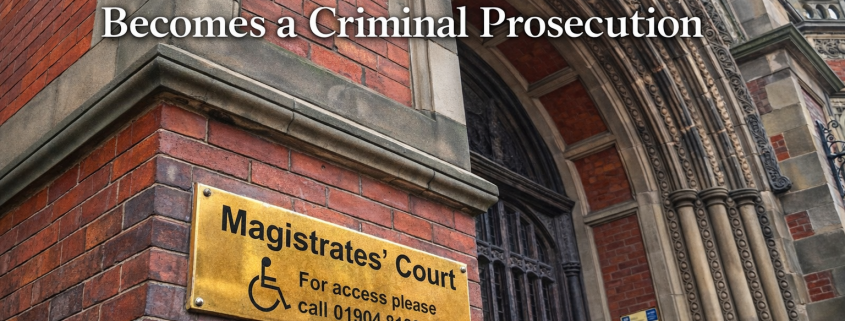
Exterior of York Magistrates’ Court used to illustrate a blog on school attendance orders and home education prosecution.

When Home Education Becomes a Criminal Prosecution

What Litigants in Person Need to Know About School Attendance Orders, Social Care Overreach, and Magistrates’ Court Proceedings

Across England and Wales, a growing number of parents are discovering — often too late — that a dispute about elective home education (EHE) can escalate into criminal prosecution.

Not because their child is unsafe.
Not because education is unsuitable.
But because process has gone wrong, power has been misused, or parents have been pressured into compliance without understanding their rights.

This article is written for Litigants in Person navigating the intersection of:

  • home education,
  • Children’s Social Care involvement,
  • School Attendance Orders (SAOs),
  • and Magistrates’ Court prosecutions under the Education Act 1996.

It is based on a real case (anonymised), and on patterns I see repeatedly in practice.

If you are facing — or fear you may face — similar action, this guide is for you.


1. The Scenario (Anonymised but Real)

A parent lawfully elects to home educate their child under section 7 of the Education Act 1996.

The child has anxiety. School is harming their wellbeing.
The parent has previously home educated successfully.

Children’s Social Care are already involved — not because of educational neglect, but because of domestic abuse by the other parent.

During a meeting, the parent raises home education as a safeguarding-led decision.

From that moment:

  • Professionals express opposition.
  • Education officers are involved prematurely.
  • The parent is told (incorrectly) that home education is not allowed due to child protection involvement.
  • A proposed Bill — not law — is repeatedly relied upon.
  • A positive EHE visit is later contradicted by a negative decision with no clear reasons.
  • A School Attendance Order is issued.
  • Threats of prosecution follow.
  • Eventually, a Single Justice Procedure Notice arrives.

The parent is now facing criminal charges.

This is not rare. And it is not inevitable.


2. The Legal Foundation: Your Right to Home Educate

Section 7, Education Act 1996

Parents must ensure their child receives an education that is:

  • efficient, and
  • suitable,
  • to the child’s age, ability, aptitude, and any special educational needs.

Crucially:

Education does not have to be provided at school.

There is no statutory requirement for:

  • a curriculum,
  • Ofsted-style inspection,
  • or adherence to school norms.

Local Authorities do not approve home education. They may only intervene if they have reason to believe education is unsuitable.


3. What a School Attendance Order (SAO) Actually Is

An SAO (sections 437–443 Education Act 1996) is not automatic.

Before issuing one, the Local Authority must:

  1. Have reasonable grounds to believe education is unsuitable.
  2. Serve a notice requiring information.
  3. Consider the parent’s response fairly and lawfully.
  4. Only then issue an SAO naming a school.

An SAO is a last resort, not a default enforcement tool.

If the LA:

  • relies on irrelevant considerations,
  • ignores positive evidence,
  • fails to give reasons,
  • or predetermines the outcome,

the SAO itself may be unlawful.


4. The Common Trap: “Just Fill in the Forms”

When an SAO is not complied with, councils often move straight to prosecution under section 443.

Parents receive a Single Justice Procedure Notice (SJPN) telling them:

  • they’ve been charged,
  • they have 21 days to plead,
  • and they can get a “discount” if they plead guilty.

This is where many parents make a fatal mistake.

A guilty plea:

  • can be decided on the papers,
  • leads to conviction, fines, and costs,
  • and removes the opportunity to challenge the process.

A not guilty plea does not mean you are refusing responsibility.
It means you are requiring the council to prove its case.


5. What the Magistrates’ Court Can — and Cannot — Decide

The Magistrates’ Court does not decide:

  • whether social workers behaved appropriately,
  • whether policy was fair,
  • or whether you are a “good parent”.

It decides:

  • whether a lawful SAO existed,
  • whether you failed to comply,
  • and whether any defence applies.

This is why procedure matters more than emotion.


6. Defences and Challenge Points Litigants in Person Should Look For

Without giving legal advice, there are recurring issues that often undermine SAO prosecutions:

1. Unlawful reliance on non-law

Proposed legislation (such as past Schools Bills) has no legal force.

If decisions are based on policy that does not exist in law, that is challengeable.


2. Predetermination

If:

  • opposition to EHE appears before assessment,
  • outcomes are decided before evidence is considered,
  • or professionals influence one another behind closed doors,

this may breach public law fairness.


3. Failure to give reasons

Parents are entitled to understand:

  • why education was deemed unsuitable,
  • and how the decision was reached.

Vague references to “home conditions” or “concerns” are insufficient.


4. Improper influence between departments

Children’s Social Care and Education are separate statutory functions.

Cross-contamination — particularly where safeguarding is used to pressure education compliance — must be scrutinised.


5. Welfare harm caused by enforcement

Evidence that:

  • the child’s anxiety worsened,
  • emotional distress increased,
  • or wellbeing declined due to forced school attendance,

is relevant to reasonableness and proportionality.


7. Policy and Guidance Local Authorities Must Follow

Key documents include:

  • Elective Home Education Guidance for Local Authorities (DfE)
  • Working Together to Safeguard Children
  • Public law principles of fairness, proportionality, and rational decision-making

Failure to follow guidance is not automatically unlawful — but it matters when combined with unfair process.


8. Why Social Care Involvement Does Not Remove EHE Rights

There is no law stating that:

  • a Child Protection Plan,
  • Child in Need plan,
  • or PLO process

automatically prevents home education.

Any restriction must be:

  • lawful,
  • evidence-based,
  • and proportionate.

Blanket policies are not lawful substitutes for individual assessment.


9. The Importance of Paper Control

One of the most damaging patterns I see is parents:

  • over-explaining,
  • sending emotional responses,
  • filling in every box,
  • and inadvertently making admissions.

In Magistrates’ Court proceedings:

  • less is often more,
  • timing matters,
  • and disclosure should be forced, not volunteered.

10. You Are Not “Difficult” for Challenging This

Parents are frequently told — explicitly or implicitly — that resisting enforcement means they are:

  • uncooperative,
  • obstructive,
  • or failing to put the child first.

In reality, lawful challenge is part of the system.

Courts exist precisely because decisions can be wrong.


11. Practical Advice for Litigants in Person

If you are facing an SAO or prosecution:

  • Do not plead guilty without understanding the consequences.
  • Do not assume the council’s paperwork is correct.
  • Ask for copies of the SAO, evidence of service, and decision records.
  • Keep communications factual and restrained.
  • Separate safeguarding issues from education law.
  • Get support early.

12. Final Thoughts

This area of law is emotionally charged because it sits at the intersection of:

  • parenting,
  • education,
  • safeguarding,
  • and criminal enforcement.

But emotion should not be confused with legality.

Many parents comply not because the law requires it, but because the process overwhelms them.

It does not have to be that way.


Litigant in Person Dealing with a SAO?

If you are a Litigant in Person dealing with:

  • a School Attendance Order,
  • threatened or active prosecution,
  • Children’s Social Care involvement affecting education decisions,
  • or pressure to comply without clear reasons,

you do not have to navigate this alone.

I provide McKenzie Friend support to help parents:

  • understand what is actually happening,
  • prepare paperwork properly,
  • challenge unfair process,
  • and remain focused and grounded in court.

Every case is different.
Your situation deserves to be looked at carefully, calmly, and lawfully.

📩 Get in touch via jshlaw.co.uk to discuss your situation and understand your options.

    🔗 Internal Links

    1. McKenzie Friend & Family Court Support
      https://www.jshlaw.co.uk/mckenzie-friend-support/
      Use when you explain how parents can get procedural support and help preparing court paperwork.
    2. Litigants in Person – Family Court Guidance
      https://www.jshlaw.co.uk/category/litigants-in-person-family-court-guidance/
      Link when discussing how unrepresented parents are often overwhelmed by process.
    3. Family Court Accountability
      https://www.jshlaw.co.uk/category/family-court-accountability/
      Link when addressing institutional overreach, unfair process, and misuse of power.

    🌐 External Links

    1. Education Act 1996 – Section 7 (Legislation)
      https://www.legislation.gov.uk/ukpga/1996/56/section/7
      Primary statutory basis for the right to home educate.
    2. Education Act 1996 – Sections 437–443 (School Attendance Orders)
      https://www.legislation.gov.uk/ukpga/1996/56/part/VI/chapter/II
      Statutory framework for SAOs and enforcement.
    3. DfE – Elective Home Education Guidance for Local Authorities
      https://www.gov.uk/government/publications/elective-home-education
      Key policy guidance councils are expected to follow.

    Regulatory & Editorial Notice

    This article is for general information only and does not constitute legal advice. Every case turns on its own facts. If you are involved in live proceedings, you should seek appropriate support before taking action.

    Closing the DBS Loophole: Why Civil Harassment Orders Must Appear on Enhanced DBS Checks

    A safeguarding gap hiding in plain sight

    A current petition before UK Government and Parliament calls for an urgent and necessary reform:
    civil harassment orders, including court-issued undertakings, should be disclosed on Enhanced DBS checks.

    At present, a person may be subject to serious civil restrictions imposed by a court—often following repeated harassment, intimidation, or coercive conduct—yet still pass an Enhanced Disclosure and Barring Service (DBS) check and lawfully work with children or vulnerable adults.

    That is not a technical oversight.
    It is a safeguarding failure.


    What is the current problem?

    The DBS regime is commonly understood—by employers, volunteers, and the public—as a robust safeguarding mechanism. In reality, it is narrower than many assume.

    Enhanced DBS checks primarily disclose:

    • criminal convictions and cautions;
    • relevant police intelligence (at the discretion of the chief officer);
    • barred-list status where applicable.

    Civil outcomes, however, sit in a grey area.

    This includes:

    • civil harassment orders;
    • undertakings given to a court in lieu of findings;
    • non-criminal protective orders arising from family or civil proceedings.

    These measures are often imposed precisely because a court has determined that conduct poses a risk, even if it does not meet the criminal standard of proof or has not resulted in prosecution.

    Yet in many cases, they are not automatically disclosed.


    Why undertakings matter in safeguarding contexts

    In family and civil courts, undertakings are not casual promises. They are legally binding court orders.

    They are frequently used where:

    • repeated harassment is evidenced;
    • power imbalances make findings difficult;
    • victims are retraumatised by adversarial fact-finding;
    • courts prioritise immediate protection over punitive outcomes.

    The absence of findings does not mean the absence of risk.

    Courts routinely accept undertakings because:

    • the behaviour alleged is serious enough to justify restriction;
    • the respondent agrees that restraint is necessary;
    • ongoing contact with children or vulnerable people may be relevant.

    Failing to reflect this in safeguarding disclosures creates a false sense of safety.


    The real-world safeguarding risk

    This loophole allows individuals who are under active court-imposed behavioural restrictions to:

    • work in schools, nurseries, and colleges;
    • volunteer with youth organisations;
    • access vulnerable adults in care or support settings.

    Employers relying on Enhanced DBS checks are not negligent—they are misled by a system that implies completeness while omitting critical context.

    Safeguarding depends on informed risk assessment, not binary criminal labels.


    Why police discretion is not enough

    It is sometimes argued that police intelligence disclosure fills this gap. In practice, this is unreliable.

    Police disclosure depends on:

    • local recording practices;
    • subjective relevance assessments;
    • fragmented information-sharing between civil courts and policing bodies.

    Many civil harassment outcomes never reach police databases in a form that triggers discretionary disclosure.

    Safeguarding should not depend on chance.


    The petition: a proportionate and necessary reform

    The petition does not call for:

    • criminalisation by the back door;
    • automatic barring;
    • retrospective punishment.

    It calls for transparency.

    Disclosure would allow:

    • employers to assess risk proportionately;
    • safeguarding leads to put controls in place;
    • vulnerable people to be protected without stigma or assumption.

    Disclosure is not a sanction.
    It is information.


    Why this matters particularly in family-law contexts

    Those familiar with family proceedings know that:

    • abuse often presents as coercive, controlling, or cumulative;
    • victims may withdraw allegations under pressure;
    • findings are not always pursued for child-focused reasons.

    A civil court may still conclude that restrictions are essential, even where criminal thresholds are not met.

    To ignore those outcomes in safeguarding checks is to misunderstand how harm actually manifests.


    A system built for safeguarding must reflect reality

    Safeguarding frameworks must align with how risk is identified in practice, not just in criminal law theory.

    If a court has deemed it necessary to restrict someone’s behaviour to protect another person, that information is plainly relevant where:

    • children are involved;
    • vulnerable adults are at risk;
    • positions of trust are held.

    Anything less undermines public confidence in safeguarding systems.


    Final thoughts

    This petition highlights a quiet but serious flaw in the safeguarding infrastructure.

    Closing the DBS loophole would:

    • strengthen child and vulnerable-adult protection;
    • support employers in making informed decisions;
    • respect due process while prioritising safety;
    • reflect the reality of civil-court risk management.

    Safeguarding should never rely on incomplete information.

    This is not about punishment.
    It is about protection.


    Sign the Petition

    If you work in safeguarding, family law, education, or care—or if you have experienced the limitations of current disclosure systems—you may wish to review and support the petition calling for reform of Enhanced DBS disclosures.

    Require civil harassment orders to be disclosed in enhanced DBS checks – Petitions

    Informed systems protect people.
    Opaque systems protect risk.


    Regulatory & Editorial Notice
    This article is published for general information and public-interest discussion only. It does not constitute legal advice. References to safeguarding frameworks, civil orders, or DBS processes are illustrative and may not apply to individual circumstances. Allegations are not findings. Readers should seek independent legal or professional advice where appropriate.

    Legal tech investment didn’t slow in Q4 2025 — it reset. This article explains what that shift means for litigants in person navigating family court without a solicitor.

    Legal Tech Investment in Q4 2025: What It Really Means for Litigants in Person

    If you are representing yourself in family court, the phrase “legal tech investment” might sound distant, irrelevant, or aimed squarely at law firms — not people like you.

    But Q4 2025 marked an important shift that does affect litigants in person. Quietly, and over time, it will change how courts expect cases to be prepared, how information is managed, and what “reasonable” looks like when presenting your case.

    This was not a slowdown in legal technology.
    It was a reset — and the signal finally became clear.

    This Wasn’t a Collapse. It Was Consolidation.

    In Q4 2025, investors did not stop funding legal technology. Instead, they became more selective.

    Money moved into fewer companies, later in their development, with clearer evidence that their tools actually work in real legal environments.

    Why this matters to you as a litigant in person is simple:
    the systems shaping legal work are becoming more structured, more standardised, and more expectation-driven.

    That affects everyone who steps into court — not just solicitors.

    The End of “Tools for Show”

    Earlier waves of legal technology focused on features: drafting tools, clever AI tricks, or one-off applications that looked impressive but sat outside real legal workflows.

    In Q4 2025, that changed.

    Investors backed tools that:

    • fit into everyday legal processes
    • organise work clearly
    • track decisions and actions
    • reduce noise and duplication

    This matters because courts increasingly expect:

    • clarity
    • proportionality
    • focused documentation
    • and procedural discipline

    These expectations apply whether or not you have a lawyer.

    Workflow Matters More Than Cleverness

    One of the strongest signals from Q4 was this:
    workflow now matters more than individual features.

    In practice, that means:

    • how documents are organised
    • how evidence is presented
    • how timelines are structured
    • how issues are narrowed

    For litigants in person, this is often where cases unravel — not because the underlying concerns lack merit, but because the presentation becomes overwhelming, unfocused, or procedurally unsafe.

    Technology is increasingly being used to enforce structure.
    Litigants in person are expected to do the same — even without the tech.

    Proof Replaced Promise — and That’s Important

    Investors stopped backing tools that merely claimed to save time or improve outcomes. They demanded proof:

    • consistent use
    • measurable impact
    • real adoption

    Courts are doing something similar.

    Assertions alone are not enough.
    Volume is not persuasion.
    Emotion is not evidence.

    Litigants in person often harm their own case by:

    • filing too much material
    • repeating points across documents
    • responding reactively rather than strategically
    • misunderstanding what the court is deciding at each stage

    The direction of travel is clear: measured, structured engagement matters more than ever.

    What This Means in Plain Terms

    This shift in legal tech investment tells us something important about where the system is heading:

    • Courts expect clearer thinking, not longer documents
    • Process matters as much as substance
    • Organisation and focus are increasingly decisive
    • Technology is shaping expectations — even when you are not using it yourself

    Litigants in person are not being left behind deliberately — but they can be left behind accidentally if no one explains the rules of engagement.

    Where Support Fits In

    I do not provide legal advice and I do not act as a solicitor.

    What I do provide is procedural, strategic support to help litigants in person:

    • understand what stage they are at
    • identify what the court is actually focusing on
    • prepare documents that are proportionate and relevant
    • avoid common mistakes that weaken credibility
    • approach hearings with clarity rather than panic

    In a system increasingly shaped by structure and workflow, having someone help you make sense of the process is no longer a luxury — it is a safeguard.

    The Bigger Picture

    Q4 2025 marked the end of legal tech’s experimental phase.

    The tools being funded now are not about replacing lawyers. They are about how legal work is organised, measured, and presented.

    For litigants in person, the lesson is not “you need AI.”
    The lesson is: clarity, structure, and proportionality are now non-negotiable.

    If you are unsure whether you are presenting your case safely, or whether your approach aligns with what the court expects, it is better to sense-check early than to repair damage later.

    Further Reading & References

    Internal Links


    External Links


    Regulatory & Editorial Notice

    This article is provided for general information and psychoeducational purposes only. It does not constitute legal advice and should not be relied upon as such. Any references to legal processes, technology, or court expectations are illustrative and non-exhaustive. Litigants in person remain responsible for their own cases and compliance with court directions. Support described is offered in a non-legal, procedural capacity only and is subject to the court’s discretion.

      When the System Wears a Parent Down: A Preventable Tragedy in the Family Courts

      A recent post shared by PAPA – People Against Parental Alienation recounts the death of a parent following nearly a decade of litigation in the family courts.

      It is a devastating read.
      And it should stop every professional in this system in their tracks.

      This was not a parent who disengaged.
      This was not a parent who posed a safeguarding risk.
      This was not a parent who refused to comply.

      This was a parent who did everything the system asked of him—and was still ground down until there was nothing left.

      A Familiar Pattern

      The facts described will be painfully recognisable to many parents navigating private law proceedings:

      • Years of allegations, many serious, repeatedly investigated and dismissed
      • Ongoing disruption of contact despite findings of no safeguarding concerns
      • Court orders made, but not enforced
      • Repeated breaches met with little more than verbal criticism
      • Escalating legal costs, depleted savings, mounting debt
      • A parent forced back to court again and again, simply to maintain a relationship with their children

      This father lost his home, his financial stability, and ultimately his hope—not because the court found him unfit, but because the system failed to act decisively when its own orders were ignored.

      The Enforcement Gap No One Wants to Own

      Family courts in England and Wales routinely acknowledge that a relationship with both parents is important for a child, absent safeguarding concerns. Orders are made to reflect that principle.

      But making an order is not the same as enforcing it.

      What this case exposes—once again—is a persistent enforcement vacuum:

      • Breaches are minimised
      • Delay becomes normalised
      • Responsibility is diffused between agencies
      • Parents are told to “return to court” as if that is a neutral act

      Each return to court carries real cost:

      • Financial
      • Emotional
      • Psychological

      For some parents, those costs eventually become unbearable.

      “It’s a Family Matter”

      Perhaps the most chilling part of the account is this: after years of documented obstruction, the parent sought police assistance for harassment and persistent interference—only to be told it was “a family matter” and advised to stop pursuing it.

      This response reflects a wider institutional problem. When court orders exist but are not enforced, parents are left in a legal no-man’s-land:

      • The court points to enforcement applications
      • The police defer to family proceedings
      • Local authorities step back once safeguarding thresholds are deemed unmet

      And the parent is left carrying the entire burden alone.

      This Was Preventable

      Let us be clear:
      This was not inevitable.

      A parent who complied with every instruction, adapted their life to remain available to their children, and continued to engage respectfully with the process should not be left without protection.

      Children should not lose a loving parent because court orders were treated as optional.

      When systems repeatedly confirm there is no safeguarding risk, yet allow ongoing obstruction to continue unchecked, the harm becomes institutional.

      Why This Matters

      This is not about one case.
      It is about a pattern.

      Until parental alienation and persistent obstruction are properly recognised, until court orders are meaningfully enforced, and until agencies stop passing responsibility sideways, tragedies like this will continue.

      And they will continue quietly—until another name is added to a memorial.

      A Final Word

      This father’s children have lost a parent not because he failed them, but because the systems designed to protect family relationships failed to intervene when it mattered most.

      That loss will echo far beyond this moment.

      We owe it to those children—and to every parent still fighting—to do better.

      If you are navigating prolonged family court proceedings and feel worn down by delay, non-enforcement, or repeated obstruction, you are not weak for feeling the strain. These processes are inherently draining, and support matters.

      At JSH Law, we believe sunlight, accountability, and enforceability are essential if family justice is to mean anything at all.

      We will continue to speak openly about these failures—because silence is part of how they persist.


      Regulatory & Editorial Notice

      This article constitutes independent legal commentary on matters of public interest arising from content published by a third party, namely PAPA – People Against Parental Alienation.

      JSH Law is not associated with, does not act for, and does not endorse any organisation, campaign, demonstration, or fundraising activity referenced or linked in the original third-party material. No donations are requested, facilitated, or processed by JSH Law.

      The content of this article is provided for informational and commentary purposes only. It does not constitute legal advice, does not create a solicitor-client relationship, and should not be relied upon as a substitute for independent legal advice tailored to individual circumstances.

      Any factual assertions relating to individual cases are drawn solely from publicly available material and are addressed in a generalised and anonymised manner. No findings of fact, liability, or wrongdoing are asserted against any individual, authority, or agency.

      JSH Law reserves the right to amend or withdraw this commentary where necessary to ensure ongoing regulatory compliance and professional standards.