

The Rise of McKenzie Friends: Support, Risk, and the Reality in UK Courts | JSH Law
As more people navigate family court proceedings without legal representation, McKenzie Friends are becoming an increasingly visible part of the system. For many litigants in person, they offer practical support at a time when it is most needed. But while the right support can make a real difference, the wrong support can create serious and often irreversible consequences. Understanding that distinction—and where the risks lie—is now essential for anyone managing their own case.
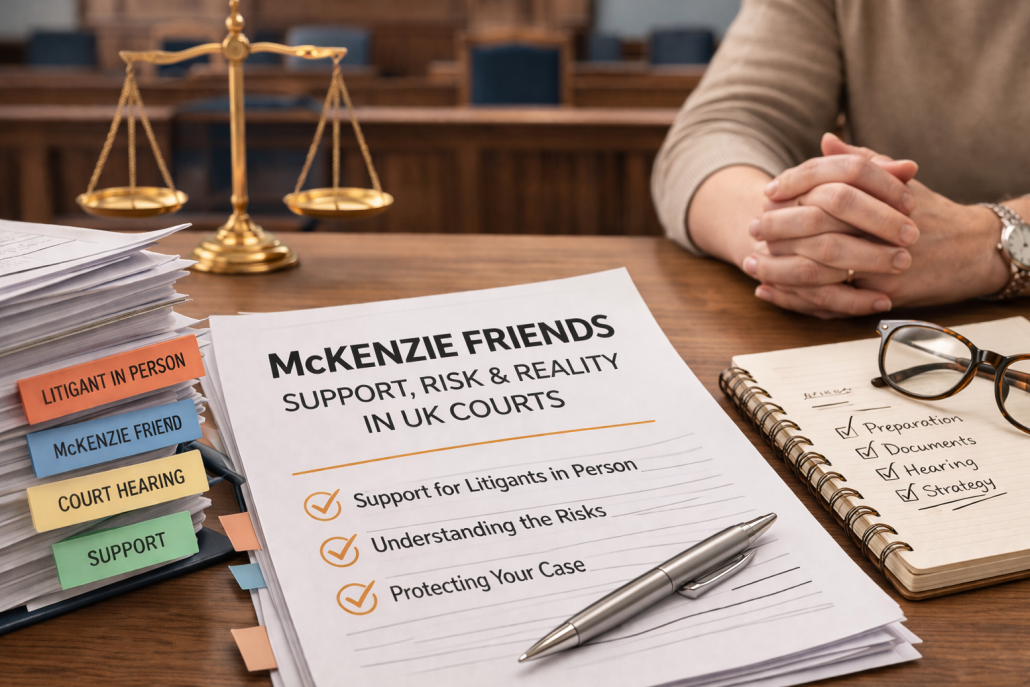
- McKenzie Friends can provide valuable support, but they are not legal representatives.
- They operate outside formal regulation and oversight.
- There is a wide variation in quality and experience.
- Understanding their role — and its limits — is essential.
- Used properly, they can strengthen a case. Used incorrectly, they can create risk.
The Rise of McKenzie Friends: Support, Risk, and the Reality in UK Courts
Over the past decade, the landscape of the family courts has changed significantly.
Increasing numbers of people are now navigating proceedings without legal representation. The reasons are well understood — rising legal costs, reduced access to legal aid, and the practical reality that many simply cannot afford traditional representation.
In response, a growing number of litigants in person have turned to McKenzie Friends for support.
For many, that support can be the difference between managing a case and becoming overwhelmed by it.
But as their presence in the courts has increased, so too has the need to properly understand what they are — and what they are not.
—What Is a McKenzie Friend?
The concept of a McKenzie Friend originates from case law and is now an established part of court practice in England and Wales.
At its simplest, a McKenzie Friend is someone who provides support to a litigant in person during legal proceedings.
That support can include:
- Taking notes in court
- Helping organise documents
- Assisting with preparation
- Providing quiet guidance during hearings
They may sit beside you in court and help you stay focused and organised.
But their role is limited.
They are not your representative.
They do not automatically have the right to address the court, they cannot sign documents on your behalf, and they do not conduct litigation.
This distinction is fundamental.
—Why Their Use Has Increased
The increase in the use of McKenzie Friends is not accidental.
It reflects a wider shift in access to justice.
Legal representation is, in many cases, expensive. For some, it is simply out of reach.
At the same time, the complexity of family proceedings has not reduced.
The result is a growing number of individuals who are expected to manage legally complex situations without formal support.
In that context, it is entirely understandable that people seek assistance where they can find it.
McKenzie Friends have emerged as part of that response.
—The Benefit — and Why It Matters
When used properly, a McKenzie Friend can provide genuine value.
They can:
- Help you stay organised
- Improve how your case is prepared
- Support you during stressful hearings
- Provide clarity where the process feels overwhelming
For many litigants in person, particularly in emotionally demanding cases, that support is not just helpful — it is essential.
It can increase confidence, improve presentation, and make the process more manageable.
—The Other Side of the Picture
However, the growth of this sector has also highlighted a more difficult reality.
There is no single standard for who can act as a McKenzie Friend.
Unlike solicitors or barristers, they are not subject to:
- Formal qualification requirements
- Regulatory oversight
- Mandatory professional insurance
This creates a wide variation in the quality of support available.
Some individuals operate with care, structure, and a clear understanding of their role.
Others may not.
—Where Risk Can Arise
The risk is not simply about competence.
It is about structure.
Problems tend to arise where the boundary between support and control becomes unclear.
For example:
- Where decisions are effectively made for the litigant
- Where communication is handled on their behalf
- Where the case begins to feel as though it is being “run” by someone else
This is rarely intentional.
It often develops gradually.
But when it happens, it can affect both the integrity and the perception of the case.
There is also a very real, practical cost where support is poorly structured. What may initially appear to be a cheaper or more accessible option can, in some cases, lead to significant financial and personal loss. This can arise where a McKenzie Friend has little or no legal experience, offers services without clear boundaries, or operates without any form of professional accountability. Warning signs can include a lack of onboarding or written agreement, no clear explanation of their role, no insurance, and a tendency to take control rather than support. In those circumstances, mistakes are not just procedural—they can affect outcomes. Poorly drafted documents, missed deadlines, or misguided strategic decisions can result in prolonged proceedings, increased costs, and in some cases, irreversible damage to a person’s position. The reality is that in litigation, the consequences of getting it wrong are not theoretical—they are measured in time, money, and outcomes that cannot always be undone.
—The Variation in Experience
Another factor to consider is the variation in experience across the sector.
Some McKenzie Friends bring years of practical exposure to court processes.
Others may have very limited experience.
Without formal standards, it can be difficult for a litigant to distinguish between the two.
This places an additional responsibility on those seeking support to ask the right questions and make informed decisions.
—Practical Safeguards
If you are considering using a McKenzie Friend, there are some simple steps that can help protect your position:
- Ask about their experience and background
- Understand clearly what they will and will not do
- Ensure you remain in control of your case at all times
- Keep all arrangements clear and documented
- Be cautious of anyone presenting themselves as a substitute for a solicitor
These steps are not about limiting support.
They are about ensuring that support is used properly.
—The Balance That Needs to Be Struck
There is a clear tension within this space.
On one hand, access to justice requires that people are able to obtain support.
On the other, there is a need to ensure that support does not become something it is not intended to be.
Finding that balance is essential.
Support should strengthen your position, not compromise it.
—Final Thoughts
The rise of McKenzie Friends reflects a system under pressure.
It also reflects the adaptability of those navigating it.
For litigants in person, the key is not whether to seek support.
It is how that support is structured.
Used correctly, it can be a significant advantage.
Used without clarity, it can introduce unnecessary risk.
Understanding that distinction is one of the most important steps you can take in protecting your case.
—Need Structured Support With Your Case?
If you are navigating proceedings as a litigant in person and want clear, structured support that strengthens your case while keeping you in control, you can book an initial consultation below.
—Regulatory & Editorial Notice: JSH Law Ltd is not a firm of solicitors and does not provide regulated legal services. This article is for general information and commentary only and does not constitute legal advice.