
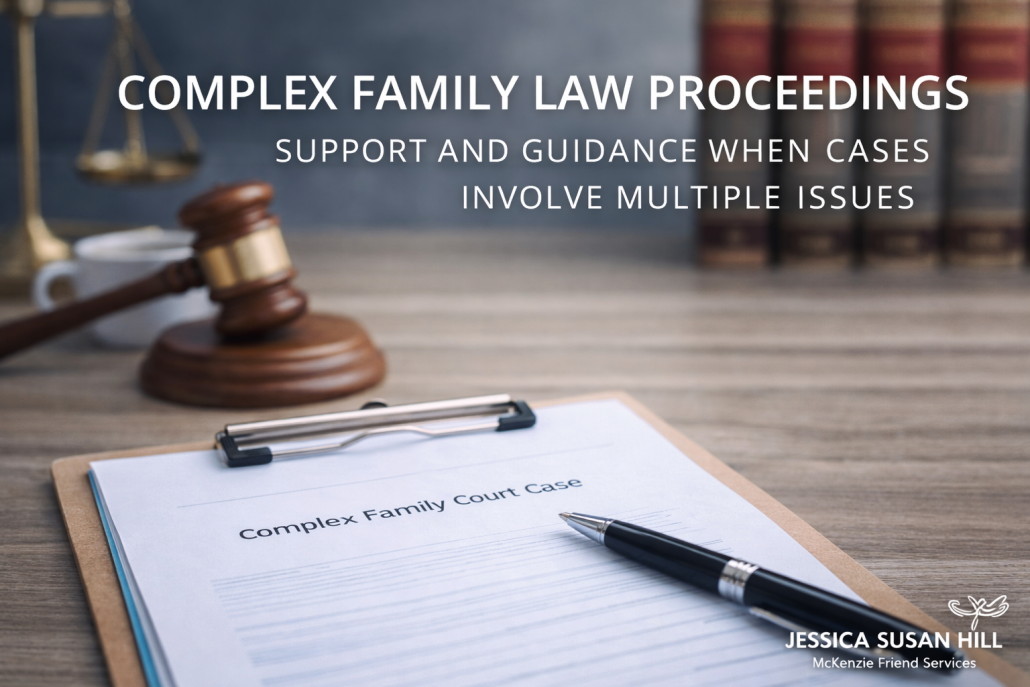
Complex Family Law Proceedings: What They Are and How to Navigate Them as a Litigant in Person
Family court proceedings are rarely straightforward. However, some cases go beyond the ordinary and become complex family law proceedings, involving overlapping legal, procedural, and safeguarding issues that can be difficult to manage without structured support.
For litigants in person, complexity does not arise because someone has done something “wrong”. It arises because multiple systems, concerns, or stages of proceedings intersect at the same time.
This article explains:
- what makes a family law case “complex”,
- what such proceedings typically involve,
- how complexity often develops in practice, and
- how structured McKenzie Friend support can help you navigate the process calmly and effectively.
What Are Complex Family Law Proceedings?
A family law case may be considered complex when it involves more than a single issue or a single procedural track.
Common indicators of complexity include:
- multiple hearings across different stages of proceedings,
- safeguarding or welfare concerns alongside private law disputes,
- disputed factual histories,
- involvement of third parties or professionals,
- procedural irregularities or appeals,
- or significant imbalance between the parties’ understanding of process.
Complexity does not necessarily mean the case is high-conflict or dramatic. In many instances, complexity develops gradually as issues are not resolved early and procedural decisions compound over time.
What Complex Family Law Proceedings Often Involve
While every case is different, complex proceedings commonly include a combination of the following elements.
1. Multiple Procedural Stages
Rather than progressing smoothly from application to final hearing, complex cases often involve:
- interim hearings,
- adjournments,
- directions hearings,
- reviews,
- or appellate steps.
Understanding why each hearing is taking place — and what the court expects at each stage — becomes critical.
2. Safeguarding and Welfare Issues
Where safeguarding concerns are raised, proceedings may involve:
- Cafcass reports or recommendations,
- safeguarding letters,
- professional involvement from social services or other agencies,
- or disputes about how concerns have been assessed or recorded.
These issues can significantly affect the direction and pace of proceedings.
3. Disputed Narratives or Allegations
Some cases involve sharply contested accounts of past events, communication breakdown, or allegations that affect decision-making.
Even where findings are not being sought, how disputed material is handled procedurally can have lasting consequences.
4. Appeals or Procedural Challenges
Complexity may increase where:
- a decision is challenged,
- time limits have passed,
- transcripts are required,
- or procedural errors are alleged.
Appeals introduce a different legal framework, stricter focus, and higher expectations of clarity.
5. Litigants in Person Facing Represented Opponents
When one party is legally represented and the other is not, complexity can arise from:
- imbalance of knowledge,
- unfamiliarity with procedural rules,
- or difficulty understanding what is relevant versus what is emotionally significant.
How Complexity Develops in Practice (Anonymised Example)
In one anonymised case, a litigant in person entered family court proceedings expecting a limited dispute focused on child arrangements. Over time, the case became significantly more complex.
Key features included:
- repeated hearings addressing different procedural questions,
- safeguarding concerns raised at various stages,
- confusion about what issues had been determined and what remained live,
- difficulties understanding why certain decisions were made,
- and later, the need to challenge aspects of the process itself.
The litigant was not struggling because of a lack of commitment or care — they were struggling because no one had helped them step back and understand the procedural landscape as a whole.
Documents had been prepared in isolation rather than strategically. Emotional energy had been spent on issues the court was not addressing, while critical procedural points were being missed.
This is a common pattern in complex family law cases involving litigants in person.
Why Complexity Is Particularly Difficult for Litigants in Person
Complex cases place additional strain on litigants in person because:
- court documents assume procedural knowledge,
- expectations are rarely explained in plain language,
- hearings move quickly and are highly focused,
- and misunderstandings can have cumulative effects.
Many litigants attempt to manage by reacting to each new development in isolation. Unfortunately, this often increases stress and reduces clarity.
What is usually missing is structure.
How Structured McKenzie Friend Support Can Help
My role is not to act as your solicitor or provide legal advice. Instead, I provide procedural, practical, and organisational support designed to help you navigate complexity with confidence and control.
1. Clarifying What the Court Is Actually Dealing With
In complex proceedings, clarity is often lost.
I help you identify:
- what the court is deciding now,
- what has already been determined,
- and what is not currently before the court.
This prevents unnecessary argument and misplaced focus.
2. Structuring Documents and Evidence
Complex cases generate large volumes of material.
I support you to:
- organise documents chronologically and logically,
- prepare clear statements or summaries,
- ensure relevance and proportionality,
- and avoid common procedural pitfalls.
3. Preparing for Hearings Calmly and Strategically
Rather than approaching hearings with anxiety or uncertainty, I help you prepare by:
- understanding the purpose of the hearing,
- identifying key points that matter procedurally,
- and ensuring you are ready to engage appropriately.
4. Supporting You Through Procedural Complexity
Where cases involve appeals, reviews, or unusual procedural routes, I help you:
- understand the process step-by-step,
- prepare materials in line with expectations,
- and maintain focus on clarity rather than emotion.
5. Helping You Regain a Sense of Control
Perhaps most importantly, structured support helps you move from reacting to events to actively managing your case.
You remain in control at all times.
What This Support Is — and Is Not
It is important to be clear about boundaries.
- I do not provide legal advice.
- I do not act as your representative.
- I do not promise outcomes.
What I do provide is calm, proportionate support focused on preparation, understanding, and procedural confidence — particularly in cases that have become complex or difficult to manage alone.
Final Thoughts
Complex family law proceedings are challenging, but complexity does not mean chaos.
With the right structure, clarity, and preparation, it is possible to navigate even difficult cases without becoming overwhelmed or losing sight of what matters to the court.
If you are representing yourself in a family law case that feels increasingly complex, support may help you regain perspective and move forward more confidently.
Contact Me
If you are involved in complex family court proceedings and are representing yourself, you do not have to navigate the process alone.
I offer calm, structured McKenzie Friend support to help litigants in person prepare clearly, understand procedure, and approach hearings with confidence.
You are welcome to get in touch using the form below to discuss whether support may be appropriate in your circumstances.
Jessica Susan Hill provides procedural McKenzie Friend support to litigants in person involved in family court proceedings across England and Wales.
Overwhelmed by complex family court proceedings?
JSH Law can help you separate the live issues from historical material, prepare an accurate chronology and identify the documents and deadlines relevant to the next hearing. Where regulated advice or representation is required, specialist referral may be appropriate.
Regulatory & Editorial Notice
This article is provided for general information purposes only and does not constitute legal advice. The content reflects procedural guidance and commentary based on experience supporting litigants in person within the family court system.
Jessica Susan Hill does not act as a solicitor in these matters and does not provide legal advice or legal representation. Support is offered in a McKenzie Friend capacity only, subject to the court’s discretion.
Any examples or scenarios referred to in this article are anonymised and are not intended to identify any individual case or person.
Family law and court procedure are fact-specific and may change over time. Readers are encouraged to seek independent legal advice where appropriate.
 © 2026 JSH Law Ltd. All rights reserved.
 © 2026 JSH Law Ltd
 jsh law ltd
Leave a Reply
Want to join the discussion?Feel free to contribute!