
 © 2026 JSH Law Ltd. All rights reserved.
Child-Focused Courts: What the New Family Court Model Really Means for Parents and Litigants in Person
There are moments when the family justice system pauses and admits—quietly but clearly—that something isn’t working as it should. The recent announcement, widely reported by BBC News, that Child Focused Courts will be rolled out across England and Wales is one of those moments. It is being described as the most significant change in a generation. But for parents navigating proceedings right now, the real question is not what the reform promises—it is what it actually changes in practice, and whether it will make any meaningful difference to the outcome of your case.
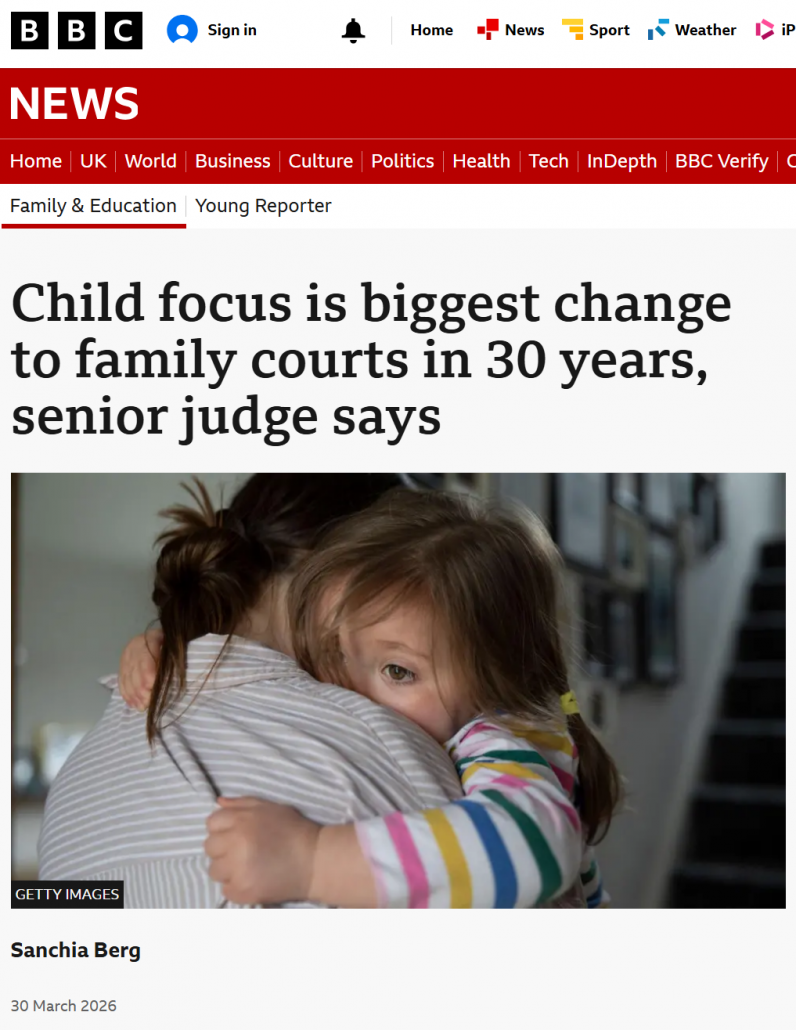
Child-Focused Courts: What the New Family Court Model Really Means for Parents and Litigants in Person
For years, many parents have walked into the family court believing the system would carefully examine what was happening to their child, weigh the evidence properly, and then make decisions that were truly centred on welfare.
Too often, that has not been the lived experience.
Delay has been normalised. Parents have been drawn into adversarial litigation. Serious allegations have sometimes taken too long to assess properly. Children have been left waiting while adults, professionals and institutions move at a pace that bears little resemblance to a child’s sense of time.
That is why the latest announcement reported by the BBC matters.
The government has now confirmed that the newly named Child Focused Courts model, previously known as the Pathfinder approach, will be rolled out across England and Wales. Senior family judge Sir Andrew McFarlane has described the shift as the biggest change in this area of family justice in 30 years. It is being presented as a major structural reset: less adversarial, more front-loaded, more alert to domestic abuse, and more focused on what the child is actually experiencing.
Key takeaways for litigants in person
1. The family court process is changing. In many areas, the court will be expected to focus much earlier on the child’s actual lived experience, not just the parents’ competing positions.
2. Early information is becoming more important. If your case is poorly prepared at the beginning, you may lose ground quickly.
3. Allegations of harm, especially domestic abuse, are supposed to be identified and explored sooner.
4. A child-focused system does not mean parents can relax. It means you need to be more disciplined, more evidence-led, and more careful about how you present your case.
5. The label sounds positive, but litigants in person should still approach the system with clear eyes. A new model is only as good as its day-to-day implementation.
Why this change is happening
The official explanation is straightforward: the existing family court process has too often been too slow, too conflict-driven, and too damaging for children. The Ministry of Justice says the pilot areas showed cases being resolved up to seven and a half months faster, with backlogs reduced and agencies working together earlier where domestic abuse or other forms of harm were alleged.
That matters. In private children proceedings, delay is not administrative inconvenience. It is lived instability. For a child, months of uncertainty about where they will live, who they will see, and whether adults will stop fighting can feel enormous.
The judiciary has also been unusually clear in its support for the reform. Sir Andrew McFarlane has said the key change is the production of a Child Impact Report by Cafcass, Cafcass Cymru or the local authority at a much earlier stage. In simple terms, the idea is to stop leaving meaningful welfare analysis until later in the process and instead bring it forward, so the first hearing is better informed and more child-centred from the outset.
That is a significant cultural shift. The President of the Family Division has even said that the model “turns the old approach on its head”.
What is a Child Focused Court?
In practical terms, Child Focused Courts are intended to move the family court away from a parent-versus-parent battle model and towards a problem-solving model centred on child welfare and safety.
That sounds obvious. Family courts should already be child-focused. The welfare of the child is already the court’s paramount consideration under section 1 of the Children Act 1989. But anyone with real experience of the system knows that what the law says on paper and what proceedings feel like in practice are not always the same thing.
The significance of this reform is that it tries to change the process, not just repeat the principle.
Under the model being rolled out, there is supposed to be earlier gathering of information, earlier risk identification, earlier attention to domestic abuse, earlier engagement with the child’s situation, and fewer unnecessary hearings. The first hearing is not meant to be a vague holding exercise. It is meant to be a better-informed decision point.
That is the theory. And the theory is sensible.
The Child Impact Report: why this matters so much
The Child Impact Report is one of the most important features of the new model.
Traditionally, many parents have experienced the family court process as something in which the adults speak first, argue first, accuse first, file statements first, and only later does a proper welfare-focused assessment begin to shape the case. By then, narratives may already have hardened. Interim positions may already have influenced the direction of proceedings. The emotional temperature may already be high.
The Child Impact Report is intended to change that.
According to the judiciary, this report is designed to give the court an early understanding of the impact the dispute is having on the child. The first hearing can then focus on the real question: what needs to happen to make things better for this child?
For litigants in person, that should be a wake-up call.
If the case is going to be framed earlier around impact, welfare and safety, then your preparation cannot just be a list of what the other parent has done wrong. You need to be able to explain, clearly and calmly:
What is happening for the child?
What is the child currently experiencing?
What are the risks, if any?
What arrangements are working or not working?
What practical outcome are you asking the court to put in place, and why is it better for the child?
That is a more disciplined question than many parents are used to answering.
Will this help victims of domestic abuse?
This is one of the most important questions, and also one of the most sensitive.
The government and judiciary have both emphasised that the new model is intended to improve the family court’s handling of domestic abuse. Official statements say that risks should be identified sooner, support should come in earlier, and the process should be less retraumatising. The President of the Family Division has also noted the regular involvement of domestic abuse professionals in the model.
That is positive. It is also long overdue.
For years, one of the deepest criticisms of private children proceedings has been that abuse allegations were too often forced into adversarial structures that did not feel safe, coherent or humane. Some parents have felt disbelieved. Others have felt that serious issues were minimised in the rush to restore or preserve parental involvement. Still others have experienced proceedings as a form of continuing control.
If the Child Focused Courts model genuinely improves early identification of harm, early risk assessment, and the quality of the court’s understanding of abuse dynamics, that is a meaningful step forward.
But parents should also be realistic. Structural reform is not the same thing as guaranteed safety. A new model does not automatically produce good professional judgment. It does not eliminate poor evidence, minimisation, or misunderstanding. And it certainly does not remove the need for careful preparation.
In other words: this reform may help, but it does not remove the burden on parties to present their case properly.
What litigants in person need to understand right now
If you are representing yourself in private children proceedings, the biggest mistake you can make is to hear the phrase “child-focused” and assume the court will now do all the work for you.
It will not.
The system may become better structured. It may become better front-loaded. It may become quicker in some areas. But the pressure on litigants in person to be organised, relevant and evidence-led is not going away. If anything, it may increase.
Why? Because when information is gathered earlier, first impressions become even more important. The shape of the case may settle faster. The issues may crystallise sooner. Weak pleading, muddled allegations, emotional overstatement and disorganised evidence can do real damage at the beginning of a case.
That means you should be thinking in the following way from day one:
1. Build a proper chronology
If you cannot explain the sequence of events clearly, the court may never properly understand your case. Dates matter. Incidents matter. Changes in arrangements matter. Police involvement, school issues, safeguarding concerns, messages, missed contact, medical issues and prior agreements all need to be set out in an organised way.
2. Distinguish fact from feeling
Your emotional experience matters. But family courts still make decisions by reference to evidence, welfare and risk. Try to separate what you can prove from what you believe. The clearer you are about that distinction, the more credible you become.
3. Focus on impact on the child
Do not simply repeat what the other parent has done to you. Explain what effect it has had on the child. Has the child become anxious? Withdrawn? Distressed at transitions? Exposed to conflict? Confused about routines? Losing educational stability? Struggling emotionally after contact? Those are the types of questions that fit a genuinely child-focused analysis.
4. Be solution-led
The court is not only interested in the problem. It wants to know what order, structure or safeguard you say should be put in place. That could mean a phased reintroduction plan, indirect contact moving to supported contact, a handover arrangement, a no-discussion-of-adult-issues condition, an information-sharing provision, a defined holiday schedule, or a section 7 report if more assessment is needed.
5. Do not assume “child-focused” means “I automatically win”
That is especially important. Some parents will hear the rhetoric around child welfare and assume the system will naturally validate their position. That is dangerous thinking. The court still decides cases on evidence, proportionality and welfare evaluation. You still need to prove what you say. You still need to engage with the weaknesses in your own case. And you still need to be careful not to present adult grievances as though they are automatically child harm.
The promise of this reform — and the reality check
There is a lot to welcome here.
Earlier welfare-focused information is better than later welfare-focused information.
Earlier identification of domestic abuse risk is better than allowing those issues to drift.
Fewer hearings can be better, provided the case is being understood properly.
Listening to children earlier is better than treating their voices as an afterthought.
Trying to reduce conflict rather than inflame it is plainly sensible.
But there is also a reality check that needs to be said out loud.
Family justice reforms often sound excellent in principle. The real question is always implementation.
Will Child Impact Reports be consistently high quality?
Will Cafcass and local authorities have the time, training and resources to do this well?
Will judges across all areas apply the model with consistency?
Will litigants in person understand what is expected of them?
Will the system really become safer for those raising domestic abuse, coercive control and child harm concerns?
Those are not cynical questions. They are necessary questions.
It is entirely possible for a reform to be both promising and imperfect. That is probably the most realistic position to take.
What this may mean for McKenzie Friend support and litigation support
For those supporting litigants in person, this change also matters.
A more front-loaded process means early case analysis becomes even more valuable. Parents will need help identifying the real issues, preparing chronologies, organising exhibits, structuring safeguarding concerns properly, and avoiding the common trap of filing long emotional material that lacks legal or evidential focus.
That is where good litigation support can make a real difference.
A litigant in person who is left to navigate a supposedly more sophisticated process without proper help may still be badly disadvantaged. A system can be child-focused on paper and still feel overwhelming to the parent trying to present their case coherently.
So while this reform may improve the architecture of proceedings, it does not remove the need for practical support, strategic preparation and clarity of presentation.
A word of caution for parents reading headlines
Media headlines can make legal change sound more immediate, more dramatic, or more complete than it really is.
Parents should therefore be careful about two things.
First, not every court area will change in exactly the same way overnight. The rollout is national, but it is being implemented over time.
Second, a change in model does not mean every individual decision will suddenly feel fair. The day-to-day experience of family proceedings still depends on the quality of the evidence, the quality of the professionals involved, the judge hearing the case, and the extent to which the issues are properly identified and managed.
So yes, this is a major development. But no, it is not a magic fix.
What a genuinely child-focused approach should look like
In truth, a genuinely child-focused court should do more than use child-centred language.
It should:
Identify harm early.
Recognise abuse properly.
Reduce delay.
Hear children appropriately.
Avoid unnecessary adversarial escalation.
Make proportionate orders grounded in evidence.
Support arrangements that are safe, workable and emotionally realistic for the child.
It should also resist lazy assumptions. It should not confuse adult assertion with proof. It should not reduce complex children’s cases to slogans. And it should not force a child to carry the emotional burden of a process designed by adults but badly experienced by children.
That is the standard by which this reform will need to be judged.
Final thoughts
The BBC report is right to treat this as a major moment in family justice. It is a serious development, and one that could improve outcomes for many children and families if it is implemented well.
But litigants in person should approach it with both hope and discipline.
Hope, because a court process that listens earlier, assesses sooner, and focuses more clearly on the child is plainly preferable to one that does not.
Discipline, because no reform removes the need to prepare your case properly.
If you are in private children proceedings now, the message is simple: do not wait for the system to become perfect before you become organised.
Build the chronology. Clarify the issues. Focus on the child. Gather the evidence. Make a realistic proposal. Say what the court needs to know, not just what you most want to say.
That has always mattered.
Under a Child Focused Court model, it may matter earlier than ever.
Useful links
- BBC News: Child focus is biggest change to family courts in 30 years, senior judge says
- GOV.UK: Children to get swifter justice as new family court approach expands nationally
- Judiciary: Judges welcome roll-out of Child Focused Courts
- Judiciary: A View from the President of the Family Division’s Chambers (April 2026)
- Cafcass: Cafcass welcomes Child Focused Courts
- Cafcass: Child Impact Assessment Framework (CIAF)
- Family Procedure Rules and Practice Directions
Regulatory & Editorial Notice: This article is published by JSH Law Ltd for general information, commentary and public legal education only. JSH Law Ltd is not a firm of solicitors and does not provide reserved legal activities or regulated legal services. Nothing in this article constitutes legal advice, representation, or the formation of a solicitor-client relationship. Family court cases turn on their own facts, evidence, judicial evaluation and procedural history. Readers should obtain advice tailored to their own circumstances before taking or refraining from any step in litigation. Commentary on public reporting, court reform, institutions or third-party materials is editorial in nature and is presented in good faith on the basis of sources believed to be reliable at the time of publication.
Need help preparing for family court?
If you are facing private children proceedings and need clear, strategic support, book a 15-minute initial consultation to discuss your case, your next steps, and how to approach proceedings with greater confidence.
Practical litigation support. Clear strategy. Confidence before your next hearing.
 © 2026 JSH Law Ltd
 © 2026 JSH Law Ltd. All rights reserved.
 © 2026 JSH Law Ltd. All rights reserved.
Leave a Reply
Want to join the discussion?Feel free to contribute!