
 © 2026 JSH Law Ltd
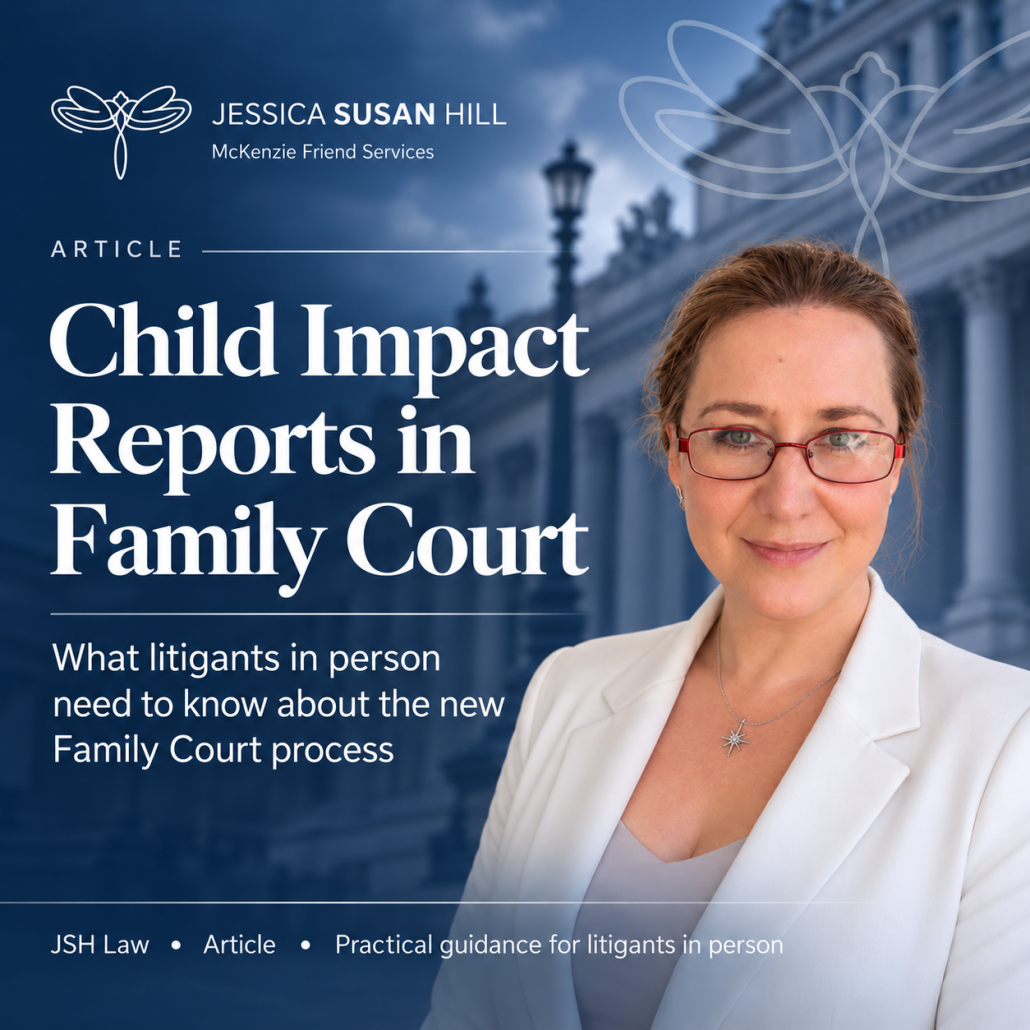
Child Impact Reports in Family Court: What Parents Need to Know About the New Child Focused Courts
Child Focused Courts are changing private children proceedings across England and Wales. This practical guide explains the Child Impact Report, its relationship with Section 7, safeguarding checks, Cafcass assessments, fact-finding and how litigants in person should prepare.
If your Family Court paperwork suddenly refers to a “Child Impact Report”, a “Child Focused Court” or a “Decision Hearing”, you have not misunderstood your case. Private children proceedings are moving towards a different way of working — one designed to understand the child, safeguarding concerns and the real issues in dispute much earlier.
The model previously known as Pathfinder is now being rolled out nationally as the Child Focused Model.
For litigants in person, one part of that change matters particularly: the Child Impact Report.
A Child Impact Report is not simply an informal Cafcass note.
Under the Child Focused Court procedure it is a report under
section 7 of the Children Act 1989.
Child Impact Reports: five things to know first
1. It is a Section 7 report.
The current procedure expressly treats the Child Impact Report as a report under section 7 Children Act 1989.
2. It is designed to happen early.
The model front-loads information about the child, safeguarding, domestic abuse, disputed facts and welfare issues.
3. It can be highly influential — but it is not the judgment.
Cafcass, Cafcass Cymru or another Social Work Agency may make recommendations. The court still makes the decision.
4. Factual errors and evidential gaps can be challenged.
The strongest response identifies the exact problem, the source evidence, why it matters and what you want the court to do about it.
5. Early preparation matters.
A process designed to reach the real issues earlier leaves less room for assuming that important evidential problems can simply be repaired several hearings later.
What are Child Focused Courts?
Child Focused Courts are the national development of the private-law reform model previously known as Pathfinder.
The model was developed as an alternative to the more traditional sequence of private-law children proceedings, where important safeguarding information and detailed welfare assessment could emerge only after several stages of litigation.
In March 2026, the Government announced national expansion of the Child Focused Court model across England and Wales. The rollout is phased, so not every English Family Court is necessarily operating the model in exactly the same way at the same time.
If you are unsure whether the Child Focused Model applies to your own case, start with your latest sealed court order.
Look for terminology such as:
- Child Focused Model;
- Child Impact Report;
- Information Gathering and Assessment;
- Safeguarding Gatekeeping Appointment;
- Decision Hearing;
- PD36Z; or
- PD12B (Pilot).
What is different about the Child Focused Model?
The central difference is earlier investigation and assessment.
Under the traditional process, a parent might file a C100 application, Cafcass would undertake initial safeguarding checks, the parties would attend a first hearing, and only later might the court order further statements, disclosure, a fact-finding hearing or a Section 7 welfare report.
The Child Focused Model deliberately tries to gather the important information earlier.
That may include consideration of:
- the child’s circumstances;
- the child’s wishes and feelings where appropriate;
- each parent’s perspective;
- domestic abuse and safeguarding concerns;
- police and local-authority information;
- previous proceedings and orders;
- whether factual findings are necessary;
- whether further evidence or disclosure is required;
- appropriate support or intervention; and
- what the court actually needs to decide.
The aim is not simply to process the parents’ dispute faster. It is to identify the impact of the dispute — and any risk of harm — on the child earlier.
What is a Child Impact Report?
The Child Impact Report is the central assessment document within the Child Focused Model.
Practice Direction 36Z provides that Stage 1 begins with gathering information for the report. Depending upon the case, this can involve:
- safeguarding checks;
- engagement with each parent or party;
- direct or indirect engagement with the child where appropriate;
- a DASH or equivalent domestic-abuse risk assessment where domestic abuse is a feature;
- consideration of other relevant proceedings;
- previous orders;
- information from relevant external agencies;
- focused welfare assessment where necessary; and
- recommendations about the next steps in the proceedings.
Those recommendations can potentially include whether:
- support or intervention should take place;
- a fact-finding hearing is required;
- additional evidence is necessary;
- particular arrangements appear to be in the child’s welfare interests; or
- the case should proceed to a Decision Hearing.
Child Impact Report or Section 7 report?
This is one of the most important points to understand.
A Child Impact Report is itself a report under section 7 of the Children Act 1989.
The Practice Direction therefore says that there should not ordinarily be a need to order a separate generic Section 7 report as well.
| Question | Child Impact Report |
|---|---|
| Is it a Section 7 report? | Yes. PD36Z expressly treats it as a report under section 7 Children Act 1989. |
| Is a separate Section 7 usually required? | Ordinarily no, although the court controls what further evidence is required. |
| Can it include the child’s wishes and feelings? | Yes, where appropriate to the child’s age, understanding and welfare needs. |
| Can it contain safeguarding information? | Yes. |
| Can it make recommendations? | Yes, including recommendations about welfare and next procedural steps. |
| Does Cafcass make the final decision? | No. The court does. |
| Can errors be challenged? | Yes. The response should identify the issue, source evidence, significance and what is sought. |
The more useful question is therefore not:
“Am I getting a Section 7 report?”
It is:
“What has the court directed the Child Impact Report to investigate — and does that cover the issues which actually need to be resolved?”
Who prepares the Child Impact Report?
In England, the report will commonly involve Cafcass. In Wales, Cafcass Cymru performs the equivalent family-court role.
In an appropriate case, a relevant local authority may instead lead or contribute to the assessment, particularly where children’s services already have significant involvement with the child.
The important questions for a parent are:
- Who is preparing the report?
- What have they actually been asked to investigate?
- What information have they obtained?
- What relevant information appears to be missing?
- Who has been spoken to?
- What recommendations are being made?
- What is the evidential basis for those recommendations?
Will my child be spoken to?
Earlier involvement of children is a central feature of the Child Focused Model.
The Practice Direction provides for direct or indirect engagement with the child where appropriate, taking account of age, understanding and welfare needs.
That does not mean the child makes the decision.
Nor does it mean that a child expressing a particular wish automatically determines the final order.
There is an important difference between:
hearing what a child says
and
understanding why they may be saying it, what they have experienced, what pressures may exist around them and what arrangements are safe and consistent with their welfare.
That distinction is particularly important in cases involving:
- domestic abuse;
- coercive control;
- post-separation abuse;
- contact refusal;
- allegations of alienating behaviour;
- trauma;
- SEND or neurodivergence; or
- high parental conflict.
What safeguarding checks happen?
Safeguarding is built into the information-gathering stage.
The current Practice Direction provides for safeguarding enquiries which can include police and local-authority information. Where domestic abuse is a feature of the case, a DASH or equivalent risk assessment may form part of the process.
The court can also consider whether further input is required from an IDVA or Domestic Abuse Support Worker.
Why this matters
An investigative process only improves safeguarding if the information gathered is accurate, properly contextualised and understood through an appropriate domestic-abuse and child-welfare lens.
What if the Child Impact Report is wrong or incomplete?
This is likely to be the most important part of this guide for many parents.
A Child Impact Report can be influential.
It is not the judgment.
If you believe part of the report is inaccurate, unsupported or incomplete, resist the temptation to respond only with:
“Cafcass has lied about everything.”
Even where you feel profoundly misrepresented, a broad attack can obscure the issue that actually needs correcting.
Instead, analyse the report in parts.
- What exactly does the report say?
- Where did that information come from?
- Is it allegation, observation, opinion, recommendation or established finding?
- What evidence supports or contradicts it?
- What relevant material appears to have been omitted?
- Why does the error or omission matter to the child or the recommendation?
- What do you want clarified, corrected or considered by the court?
How to challenge the report without attacking the professional
Suppose the report says:
“The mother has repeatedly prevented the child from spending time with the father.”
Less useful response:
“The FCA is biased and has believed everything the father said.”
More useful:
Report: Paragraph 34 states that I repeatedly prevented contact.
Evidence: Contact-centre records show sessions took place on 3, 10 and 17 May. The session on 24 May was cancelled by the centre. The email dated 28 May records my proposal for a replacement session.
Why it matters: Paragraph 51 relies upon an alleged pattern of obstruction when recommending a change in arrangements.
What I ask: That the factual basis of paragraph 34 is clarified and the recommendation at paragraph 51 is reconsidered against the contact records.
Received a Child Impact Report and something important is wrong or missing?
JSH Law can help you compare the report against the underlying evidence, identify factual inaccuracies and evidential gaps, build a chronology and prepare a focused response or position statement for the next hearing.
What if important evidence has been left out?
Missing evidence can matter more in a front-loaded process because the report may shape the direction of the case at an early stage.
Potentially relevant material might include:
- police records;
- local-authority material;
- school safeguarding information;
- GP or medical records;
- previous Family Court findings;
- earlier court orders;
- contact-centre records;
- domestic-abuse risk assessments;
- relevant messages or emails;
- records concerning the child’s additional needs; or
- evidence establishing the chronology of contact or safeguarding events.
The answer is not automatically to send hundreds of pages to Cafcass or the court.
More evidence is not necessarily better evidence.
Ask:
What evidence is actually missing, who holds it, why does it matter and what is the correct route for obtaining or dealing with it?
For more on structuring complex evidence, see the JSH Law Six-Question Check and our Evidence & Chronology support.
Do I still need a chronology?
In many cases, yes.
A chronology can be particularly useful in a front-loaded process because professionals need to understand the relevant history quickly.
But a good chronology is not a diary of the relationship.
It normally concentrates on events relevant to:
- the child’s welfare;
- contact arrangements;
- alleged harm;
- domestic abuse;
- safeguarding intervention;
- professional involvement;
- previous proceedings;
- implementation or breach of orders; and
- the issues now requiring determination.
Where coercive control is alleged, context is important. Concision should not mean artificially breaking an alleged pattern into disconnected incidents.
Will there still be a fact-finding hearing?
Yes, where factual findings are necessary.
The Child Focused Model does not abolish fact-finding.
Once the Child Impact Report and other information are available, the court considers whether findings of fact are required and identifies the specific factual issues that need determination.
Where domestic abuse is in issue, Practice Direction 12J remains important.
The court can consider whether fact-finding should take place:
- at a separate fact-finding hearing; or
- in an appropriate case, at the same time as the Decision Hearing.
The important point is:
Allegations should not quietly become findings merely because they have been repeated in professional material.
Equally, not every disputed allegation automatically requires a separate fact-finding hearing. The court must decide what factual determinations are necessary to resolve the welfare issues safely.
What is a Decision Hearing?
The Child Focused Model uses the term Decision Hearing for the stage at which the court investigates unresolved issues and makes the decisions required to conclude the application.
The Practice Direction provides that at a Decision Hearing the court will investigate the issues that remain unresolved, focus the parties on the child’s best interests and decide what order, if any, should be made.
The broader philosophy is:
better information earlier → fewer unnecessary hearings → substantive decisions sooner where it is safe to do so.
Do not assume you will have several later hearings to repair something important that was unclear at the beginning.
Can the Child Impact Report be withheld from a party?
Ordinarily, the Social Work Agency filing the Child Impact Report must also serve it on the other parties.
There is, however, a safeguarding exception.
If the agency considers that disclosure may be inappropriate, it can ask the court to determine whether the whole report, or only part of it, should be disclosed.
The court must consider safeguarding and risk of harm. It may determine that only part of the report should be disclosed where necessary.
So if you receive a redacted report, or are told that part of the material is not being disclosed, do not automatically assume somebody is improperly concealing evidence.
There may be a safeguarding decision behind it.
At the same time, if undisclosed material may materially affect the determination of your case, procedural fairness remains an important consideration for the court.
What happens to existing or returning cases?
The move towards Child Focused Courts does not mean every existing private-law case is automatically restarted under a completely new procedure.
The applicable Practice Direction contains detailed provisions about qualifying proceedings, locations and timing.
Returning cases can also be treated differently. Depending upon the circumstances, the court may consider:
- a new Child Impact Report;
- an updated Child Impact Report; or
- that no new report is required.
Your own sealed order remains the starting point.
Before your Child Impact assessment: 8 things to do
1. Read the latest court order
Identify what has been directed, who must do it and the deadline.
2. Identify the real issues
Separate matters which are agreed from the issues which genuinely require determination.
3. Build a focused chronology
Use dates, events and sources. Avoid turning every entry into argument.
4. Preserve original evidence
Keep original messages, emails, photographs, recordings and documents. Do not rely only on cropped screenshots where the underlying material still exists.
5. Separate allegation from finding
Keep clear distinctions between:
- what you allege;
- what the other party alleges;
- what is agreed;
- what a professional has recorded;
- what a professional recommends;
- what the court has actually found; and
- what remains disputed.
6. Identify safeguarding evidence
If you say there is a risk of harm, identify the evidence relevant to that risk and explain the connection to the child.
7. Prepare for Cafcass contact
Be ready to explain clearly:
- your child’s current circumstances;
- the arrangements now;
- your main welfare concerns;
- relevant safeguarding history;
- what you say the child needs;
- what order you are asking the court to make; and
- why that outcome is safe and workable.
8. Audit the report when it arrives
Read it once for the overall conclusion. Then read it again against the evidence.
Mark factual inaccuracies, unsupported assumptions, missing evidence, recommendations you agree with, recommendations you dispute and any point genuinely requiring clarification.
Use the JSH Law Six-Question Check
If the report feels overwhelming, work through:
Where did this information come from?
Is it allegation, evidence, opinion or finding?
What sits around it?
Who has and has not been heard?
Why does it matter to the child?
Who can actually address the issue?
Read the full JSH Law Six-Question Check.
Where can AI help?
Used carefully, AI and digital tools can help reduce the administrative burden of a large family-court file.
They may assist with:
- sorting documents by date;
- building a draft chronology;
- locating repeated factual propositions;
- comparing a Child Impact Report against source documents;
- locating references to particular incidents;
- organising issues into a structured table; or
- reducing duplication in draft documents.
But three cautions matter.
First, AI output is not evidence. Every important factual proposition must be checked against the underlying source.
Second, AI can misunderstand context. That is particularly important in cases involving trauma, coercive control, domestic abuse, neurodivergence and children’s behaviour.
Third, Family Court material is highly confidential. Do not assume it is appropriate to upload court documents, Cafcass reports or children’s records to an external AI service.
For more detailed guidance, see: AI Evidence in the Family Court: Deepfakes, Screenshots & Digital Evidence .
Use technology to organise the evidence.
Do not let technology quietly rewrite it.
The bigger change: the beginning of the case matters more
There is a risk that “faster Family Court” is heard as meaning parents need to do less preparation.
The opposite may be closer to the truth.
If the system gathers evidence earlier, hears from children earlier and aims to identify the necessary decisions sooner, then the quality of the information available at the beginning becomes more important.
A litigant in person may simultaneously be trying to:
- parent a distressed child;
- manage separation;
- respond to allegations;
- deal with domestic abuse or post-separation control;
- understand unfamiliar orders;
- communicate with Cafcass;
- obtain agency records;
- prepare evidence;
- meet deadlines; and
- work out what the court actually needs.
That is precisely why structure matters.
What happened? What evidence supports it? What does it mean for this child? What remains disputed? What does the court need to do next?
You do not need to turn your entire life into a court bundle.
Need help preparing for a Child Impact Report or Child Focused Court?
JSH Law provides practical, evidence-led support for litigants in person in private family proceedings.
Support can include:
- organising evidence before Cafcass assessment;
- reviewing a Child Impact Report against the underlying records;
- preparing focused Cafcass responses;
- chronologies and timelines;
- position statements and witness statements;
- schedules of allegations or disputed issues;
- organising police, local-authority, school and medical material;
- urgent court documents;
- appeal or reopening paperwork where appropriate;
- hearing preparation; and
- McKenzie Friend and hearing support where available.
The aim is not to put everything before the court. It is to identify what matters, what supports it and how it connects to the child’s welfare and the decision the court actually has to make.
 © 2026 JSH Law Ltd. All rights reserved.
 JSH LAW LTD











 © 2026 JSH Law Ltd. All rights reserved.
Leave a Reply
Want to join the discussion?Feel free to contribute!