
 © 2026 JSH Law Ltd
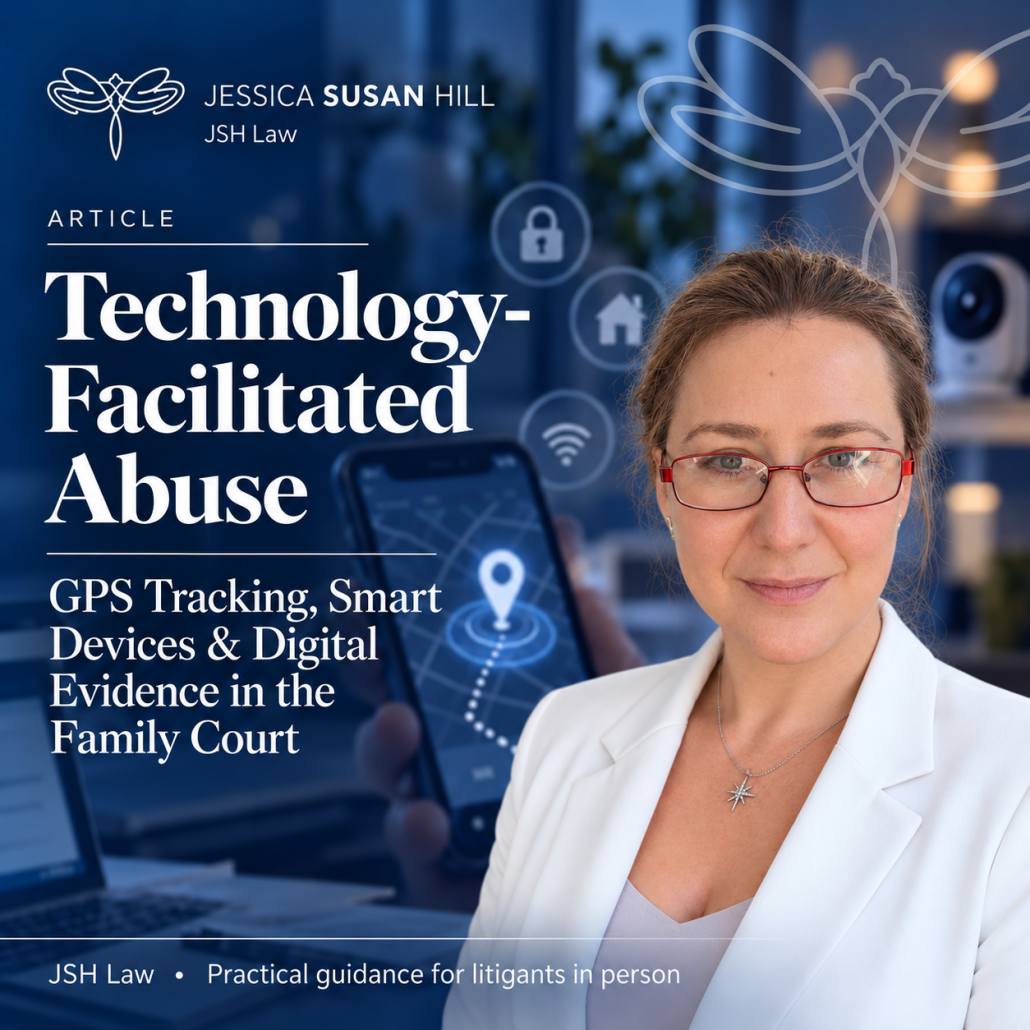
Technology-Facilitated Abuse in the Family Court: GPS Tracking, Smart Devices & Digital Evidence
Technology-facilitated domestic abuse can involve GPS tracking, smart devices, compromised accounts and digital surveillance. This practical JSH Law guide explains how litigants in person can preserve, organise and present digital evidence without losing the wider pattern of coercive control.
Your ex-partner seems to know where you are. The smart doorbell keeps being accessed. A location alert appears on your phone. Passwords change. Your child’s device seems to reveal where you are. None of it looks dramatic in isolation.
That is precisely why technology-facilitated abuse can be difficult to explain in the Family Court.
A GPS tracker, shared Apple or Google account, smart-home login, location-sharing setting, connected car, camera doorbell or repeated account-access alert may look like a technical problem.
But technology can also be used as part of a wider pattern of monitoring, intimidation, stalking or coercive control.
The legal question is not simply whether technology was involved.
It is:
What happened, what digital material proves it, what is the context, what effect did it have, how does it affect the child or protective parent, and what does the Family Court actually need to decide?
This guide explains how litigants in person can identify, preserve and organise evidence of technology-facilitated domestic abuse without turning the case into an unmanageable digital evidence dump.
The important 2026 point
Technology-facilitated abuse is not a separate category which sits outside ordinary domestic-abuse analysis.
Domestic abuse can include controlling or coercive behaviour, psychological or emotional abuse and other abusive behaviour. Government statutory guidance expressly recognises abuse carried out through technology, including GPS locators, wearable technology, smart-home devices, hidden cameras and compromised accounts.
And since 5 January 2026, the amended Practice Direction 12J reinforces the need for the Family Court to assess domestic-abuse allegations holistically, including any pattern of coercive and controlling behaviour.
Technology-facilitated abuse: five things to know first
1. Digital behaviour can be domestic abuse.
Monitoring location, controlling accounts, using spyware, accessing smart devices or repeatedly surveilling someone can form part of abusive behaviour.
2. The pattern matters.
One notification or login may have an innocent explanation. A repeated sequence of surveillance, intimidation and control may look very different when placed in context.
3. Preserve before you edit.
Keep original messages, alerts, emails, files and device information wherever safely possible. A cropped screenshot may lose the date, sender, URL, device identifier or surrounding context which later becomes important.
4. Do not turn the child into an investigator.
Do not ask a child to monitor the other parent, search devices, obtain passwords or secretly collect evidence.
5. More screenshots do not necessarily mean stronger evidence.
The court needs relevant, understandable evidence connected to the issues it must determine.
What is technology-facilitated domestic abuse?
Technology-facilitated abuse describes the use or misuse of technology to abuse, monitor, intimidate, harass or control another person.
It can happen during a relationship.
It can also continue after separation.
The Government’s Domestic Abuse Act statutory guidance gives examples including:
- monitoring or controlling email accounts;
- monitoring social-media accounts or telephone activity;
- using spyware;
- using GPS locators on phones, computers, wearable technology, vehicles or even pets;
- using internet-connected devices to obtain someone’s location;
- using smart watches or smart-home devices to monitor, control or frighten;
- using hidden cameras;
- creating false accounts;
- online harassment; and
- image-based abuse.
The National Cyber Security Centre also recognises the use of connected technology in domestic abuse, stalking and harassment, including smart cameras and speakers used to monitor victims.
The device is not the abuse.
The important question is how the technology is being used and whether that behaviour forms part of intimidation, surveillance, harassment, coercion or control.
What can technology-facilitated abuse look like after separation?
Post-separation abuse can be particularly difficult to recognise because some technology remains legitimately shared after a relationship ends.
Parents may still have:
- shared calendars;
- family cloud accounts;
- children’s device accounts;
- shared streaming services;
- smart-home systems;
- doorbell-camera access;
- connected vehicles;
- school or nursery applications; or
- location-sharing arrangements connected with children.
That means the existence of digital access does not itself establish abuse.
Context matters.
| Digital event | What needs to be examined? |
|---|---|
| Location sharing remains switched on | Was it consensual? Was consent withdrawn? How was the information subsequently used? |
| Repeated login alerts | Which account, when, from what device or location, and is there evidence identifying the person responsible? |
| Smart doorbell monitoring | Who has authorised access? Is it being used for a legitimate shared purpose or to monitor movements? |
| Tracker discovered | Where was it found? Who owns it? What identifying information exists? Has police advice been sought? |
| Child’s device reveals location | Is location sharing required for the child’s safety, or is it being used to monitor the other household? |
| Messages show knowledge of private movements | What was said, what information could legitimately have been known, and does it connect to other digital evidence? |
The evidential task is therefore not to label every unexplained technical event as surveillance.
It is to identify what can actually be proved.
Why does technology-facilitated abuse matter in the Family Court?
In private children proceedings, the court is concerned with the child’s welfare and, where domestic abuse is raised, the implications of that abuse for the child and the adults caring for them.
Practice Direction 12J applies where domestic abuse is alleged, admitted or there is otherwise reason to believe that a child or party has experienced domestic abuse, or is at risk of doing so.
Domestic abuse is not limited to physical violence.
It can include controlling or coercive behaviour and psychological, emotional or economic abuse.
Children can also be harmed by living within domestic abuse even where the abusive behaviour is principally directed at a parent.
The 2026 amendments are particularly important because they reinforce a holistic assessment.
That matters in technology-abuse cases because the evidence can otherwise become fragmented:
- one password reset;
- one tracker alert;
- one strange login;
- one message demonstrating unexpected knowledge;
- one camera-access event;
- one new social-media account.
Seen separately, each may appear inconclusive.
Seen chronologically and alongside the surrounding behaviour, a different evidential picture may emerge.
But pattern does not remove the need for proof
A holistic assessment does not mean that every unexplained technical problem should be attributed to the other parent. The evidence still needs to be tested carefully. Where attribution is uncertain, say so.
How do you prove a pattern rather than produce 500 screenshots?
This is where many litigants in person run into difficulty.
They have a huge amount of material.
But volume is not the same as evidential clarity.
Imagine a parent has:
- 42 security-alert emails;
- 86 screenshots;
- three recordings;
- two police incident numbers;
- an AirTag alert;
- messages from the other parent;
- doorbell-camera logs; and
- several years of WhatsApp history.
Sending all of it to the court without analysis may make the underlying pattern harder rather than easier to see.
A better structure is:
Event → Digital source → What it proves → Context → Child/safety impact → Issue for the court
Example
Less useful:
“He constantly tracks me and hacks everything.”
More useful:
12 September: security email records a login to the account from an unrecognised device.
13 September: password changed and two-factor authentication enabled.
14 September: message received from the other parent referring to a location not previously disclosed to them.
16 September: further security alert recorded.
Issue: whether these events, together with the wider evidence, support the alleged pattern of post-separation monitoring. Attribution remains disputed.
The second version does not exaggerate what the evidence proves.
That makes it stronger.
How should digital evidence be preserved?
Preservation should usually happen before presentation.
If it is safe to do so:
- Keep the original. Preserve the original email, message thread, photograph, video or file rather than keeping only a screenshot.
- Record the date and time. Note when you received or discovered it.
- Preserve identifying information. Account names, email addresses, telephone numbers, device names and URLs may later matter.
- Keep context. Preserve the surrounding messages rather than only the sentence which appears most helpful.
- Do not alter the original. Avoid editing, annotating or overwriting the source file.
- Create a working copy. Use copies for highlighting or preparing court documents.
- Record what you did. If you changed a password, removed a tracker or altered a setting, make a contemporaneous note.
Do not manufacture a cleaner version and then lose the underlying source.
Are screenshots enough for the Family Court?
Sometimes a screenshot may be perfectly useful.
But screenshots have limitations.
They can omit:
- the preceding conversation;
- the following conversation;
- the full date;
- the sender;
- the account identifier;
- the URL;
- metadata;
- information showing how the screenshot was obtained.
There is also an important procedural point.
Under Family Procedure Rule 22.1, the court controls the evidence, including the issues upon which it requires evidence, the nature of that evidence and the way it is placed before the court.
And where a document has been disclosed, FPR 22.16 provides a specific mechanism concerning authenticity: a party to whom a document is disclosed is deemed to admit its authenticity unless a notice requiring it to be proved is served within the applicable period.
That does not mean every screenshot automatically proves the truth of everything depicted in it.
Authenticity, relevance, meaning and weight are different questions.
Have you got hundreds of digital records but no clear evidence structure?
That is an evidence-organisation problem — and it is often solvable.
JSH Law can provide defined-scope support to litigants in person with:
- digital evidence audits;
- evidence chronologies;
- source registers;
- schedules of allegations and responses;
- witness-statement preparation support;
- C1A and safeguarding-document support;
- Cafcass response documents;
- position statements;
- bundle preparation support; and
- hearing preparation.
What about evidence from a child’s phone, watch or tablet?
This requires particular care.
A child’s device may contain information relevant to safeguarding.
But a child should not be turned into an evidence-gatherer in adult litigation.
Do not ask a child to:
- search the other parent’s phone;
- obtain passwords;
- secretly record conversations;
- photograph the other household;
- monitor adults;
- forward private messages on demand; or
- keep a surveillance diary for court.
There is an important distinction between a child spontaneously showing a parent something concerning and an adult recruiting that child into evidence collection.
If a child discloses something worrying, record what happened calmly and accurately, avoid repeated questioning and consider the appropriate safeguarding route.
A child’s voice matters. The child should not become the family’s digital investigator.
What about AirTags, smart doorbells, connected cars and smart-home devices?
Everyday technology can produce useful evidence.
Government guidance on controlling or coercive behaviour specifically identifies evidence including:
- digital and social-media evidence;
- CCTV and home-video footage, including smart doorbells;
- GPS tracking devices on phones, tablets and vehicles;
- emails;
- bank records;
- photographs; and
- records from services.
But the existence of data is only the beginning.
Ask:
- Who controls the account?
- Who had authorised access?
- What does the log actually show?
- Can the user or device be identified?
- Is the date/time reliable?
- Could there be another explanation?
- What happened immediately before and afterwards?
- Is the evidence relevant to an issue the court needs to determine?
If you discover a physical tracking device and believe stalking or domestic abuse may be occurring, safety and police advice may be more important than immediately dismantling it for litigation purposes.
Use the JSH Law Six-Question Check on digital evidence
Where did the digital material come from? Original email, app, device, screenshot, download, police disclosure?
What does it actually establish? Fact, allegation, inference, location data, account activity?
What happened before and after it? Is anything missing?
Can the other party understand and respond to the allegation and evidence?
Why does it matter to safety, parenting, the child or the order sought?
What decision or direction are you actually asking the court to make?
Read the full JSH Law Six-Question Check.
Can AI help organise technology-abuse evidence?
Potentially, yes.
AI can be useful for working with a large evidence set.
For example, it may help:
- sort a list of incidents by date;
- identify repeated account names or telephone numbers;
- compare two chronologies;
- create an initial evidence index;
- identify duplicated screenshots;
- group events by issue; or
- check whether document references match a chronology.
But AI introduces a serious risk in precisely this kind of case.
An AI system may infer connections which the evidence does not establish.
It may describe an ordinary login alert as “hacking”.
It may say a location record proves surveillance when it does not establish who accessed the information.
It may turn correlation into causation.
Use AI to organise the evidence.
Do not let AI decide what the evidence proves.
There is also a confidentiality problem.
Digital-abuse cases can contain children’s information, addresses, private photographs, medical information, passwords, account identifiers, security data and confidential Family Court documents.
Do not upload that material indiscriminately into an external AI service.
What if changing the technology could increase the danger?
This is one of the most important practical points in this guide.
If you believe an abusive person is monitoring you, suddenly changing passwords, removing a tracker or disconnecting an account may alert them.
That may sometimes be exactly what you need to do.
But in a high-risk case, it may also change the perpetrator’s behaviour or escalate risk.
Safety comes before building a perfect evidence file.
Consider obtaining specialist domestic-abuse, cyber-safety or police support from a safe device where necessary.
Do not confront someone simply to obtain an admission.
Do not deliberately provoke further abusive messages for evidence.
And do not remain exposed to surveillance merely because you think the Family Court will want more proof.
I think technology is being used to monitor or control me. What should I do?
1. Think about immediate safety
If you or a child may be at immediate risk, evidence organisation is not the first priority.
2. Use a safe device if necessary
Do not assume a device or account is private if you believe it may be compromised.
3. Preserve what already exists
Keep original alerts, emails, messages, files and photographs where safely possible.
4. Start an incident chronology
Record the date, event, source, context and impact.
5. Separate fact from inference
“An unknown login occurred” is a fact if the alert proves it. “My former partner logged in” may still be an inference unless there is evidence of attribution.
6. Keep the child out of evidence-gathering
Do not use the child’s devices or contact arrangements as a surveillance operation.
7. Record police or professional involvement
Keep incident numbers, dates and relevant correspondence.
8. Identify the Family Court issue
Is the evidence relevant to domestic abuse, safeguarding, contact arrangements, handovers, disclosure, participation or another issue?
9. Do not send the court everything
Check the court’s directions and organise the evidence before deciding what needs to be filed or included in a hearing bundle.
10. Ask what you want the court to do
Evidence should ultimately connect to an issue requiring a decision, direction or protective measure.
Digital evidence is strongest when the court can see the human pattern
Technology-facilitated abuse creates a peculiar evidential problem.
The technology can make enormous amounts of information available while simultaneously making the real story harder to see.
A litigant may arrive with thousands of screenshots and still struggle to explain the pattern.
The solution is not to reduce serious abuse to a handful of disconnected incidents.
Nor is it to call every technical anomaly abuse.
The task is more disciplined:
Preserve the source. Establish the chronology. Separate fact from inference. Show the pattern. Explain the impact. Connect it to the child and the decision the court must make.
That is how digital material becomes usable evidence rather than digital noise.
Need help turning digital evidence into a clear Family Court case file?
JSH Law provides defined-scope support for litigants in person in private children proceedings.
Depending on the agreed scope, support can include:
- digital evidence organisation;
- chronologies and timelines;
- evidence-source registers;
- schedules of allegations and responses;
- C1A preparation support;
- witness-statement preparation support;
- Cafcass responses;
- position statements;
- court-bundle preparation support; and
- hearing preparation and McKenzie Friend support where appropriate.
Related JSH Law guides
Primary and official sources
- Home Office — Domestic Abuse Statutory Guidance
- Home Office — Controlling or Coercive Behaviour Statutory Guidance
- Practice Direction 12J — Child Arrangements and Domestic Abuse and Harm
- Family Procedure Rules Part 22 — Evidence
- National Cyber Security Centre — Technology-Facilitated Domestic Abuse Guidance
 © 2026 JSH Law Ltd. All rights reserved.
 © 2026 Jessica Susan Hill / JSH Law. All rights reserved.














 © 2026 JSH Law Ltd
 © 2026 JSH Law Ltd
Leave a Reply
Want to join the discussion?Feel free to contribute!