You are here:Home1/Blog2/2. Family Court Procedure
This category covers the key considerations and practical steps to take before making an application to the family court. It addresses pre-application requirements, early decision-making, and alternatives to court where appropriate.
Articles here are designed to help litigants in person understand when court proceedings may be necessary, what preparation is required, and how early choices can affect safeguarding, case management, and outcomes later in the process.
Nervous about a Family Court hearing? Learn how to behave, address the judge properly, and present yourself confidently as a litigant in person.
Family Court Etiquette: How to Conduct Yourself as a Litigant in Person
Category: Court Etiquette (Family Court Procedure UK) | Audience: Litigants in Person (England & Wales)
Key takeaways for litigants in person
Be calm, structured and respectful — credibility matters more than volume.
Address the judge correctly: usually “Sir” or “Madam” in the Family Court.
Speak to the judge, not the other parent.
Never interrupt. Make notes and wait your turn.
Focus on the child’s welfare — that is the court’s legal priority under the Children Act 1989, s.1.
Your behaviour in court becomes part of the evidence.
Why Court Etiquette Matters in Family Proceedings
The Family Court is less formal than the Crown Court — but it is still a court of law.
Proceedings are governed by the Family Procedure Rules 2010,
and hearings are recorded. Judges are assessing not only the evidence but also each party’s ability to prioritise the child’s welfare.
In private children cases, the court’s paramount consideration is the child’s welfare under
section 1 of the Children Act 1989.
Your conduct in court can directly affect how your credibility, insight, and emotional regulation are perceived.
Put simply: if you appear hostile, chaotic, or unable to focus on the child, that impression can undermine your position.
Before You Enter the Courtroom
Arrive early. Aim to be there at least 30 minutes before your hearing.
Dress smartly and conservatively. You do not need a suit, but avoid casual or provocative clothing.
Turn your phone off. Not silent — off.
Bring an indexed bundle and spare copies.
Prepare a short position statement. Clear, structured, and child-focused.
How to Address the Judge
In most Family Court hearings before a District Judge or Circuit Judge, you should say:
“Sir” (for a male judge)
“Madam” (for a female judge)
If unsure, court staff can advise you before the hearing begins. Do not say “Your Honour” unless you are certain of the judge’s title.
Practical tip
If you make a mistake in how you address the judge, correct yourself calmly and move on.
Confidence and composure matter more than perfection.
Speaking in Court: The Core Rules
1. Stand when speaking (unless told otherwise)
In most hearings, you stand when addressing the judge. If you are told to remain seated, follow that direction.
2. Do not interrupt
Even if something inaccurate is being said. Make a note. You will be given a chance to respond.
3. Speak to the judge — not to the other parent
You are not there to argue with the other party. All submissions go through the court.
4. Be concise
Judges prefer structure. Use this format:
The issue
The relevant fact
The evidence reference
The order you seek
What NOT to Do
Roll your eyes, sigh loudly, or react visibly to evidence.
Interrupt professionals (Cafcass, social workers, legal representatives).
Raise your voice.
Use insulting language.
Speak over the judge.
Film or record the hearing.
Recording or publishing details from Family Court proceedings can amount to contempt of court due to the privacy rules in children cases.
The Family Court is generally private, and restrictions apply to what can be shared publicly.
If You Feel Overwhelmed
Family Court hearings are emotionally intense. You may hear allegations you strongly dispute.
The judge is watching how you handle pressure.
Pause before responding.
Ask for a short break if genuinely overwhelmed.
Return to the child’s welfare as your anchor.
Key mindset shift
The hearing is not about “winning.” It is about persuading the court that your proposal best serves the child’s welfare.
After the Hearing
Listen carefully to the judge’s summary.
Make notes of directions and deadlines.
Clarify politely if you do not understand something.
Comply strictly with filing dates.
Failure to comply with directions can weaken your position significantly.
Book a 15-minute consultation (phone)
If you want help preparing for an upcoming hearing — including drafting a clear position statement,
structuring your submissions, or understanding what the judge is likely to focus on —
you can book a 15-minute initial consultation below:
Useful links
Children Act 1989 – Section 1 (Welfare Principle)
The legal foundation for how decisions are made in children cases.
Read on legislation.gov.uk.
Family Procedure Rules 2010
The procedural framework governing Family Court hearings.
Read on legislation.gov.uk.
Practice Direction 12B (Child Arrangements Programme)
Explains the structured pathway of private children cases.
Read on justice.gov.uk.
Practice Direction 12J (Domestic Abuse in Child Arrangements Cases)
Safeguarding framework where abuse is alleged.
Read on justice.gov.uk.
GOV.UK – Child Arrangements Orders
Overview of section 8 applications.
Read on GOV.UK.
Cafcass – Private Law Proceedings Guide
What parents can expect during the process.
Read on Cafcass.
https://jshlaw.co.uk/wp-content/uploads/2026/02/ChatGPT-Image-Feb-3-2026-04_07_33-AM.png10241536Jessica Susan Hillhttps://jshlaw.co.uk/wp-content/uploads/2026/01/jsh-law-logo-new-black-300x67.pngJessica Susan Hill2026-02-12 15:07:272026-02-12 15:12:15Family Court Etiquette: How to Conduct Yourself as a Litigant in Person
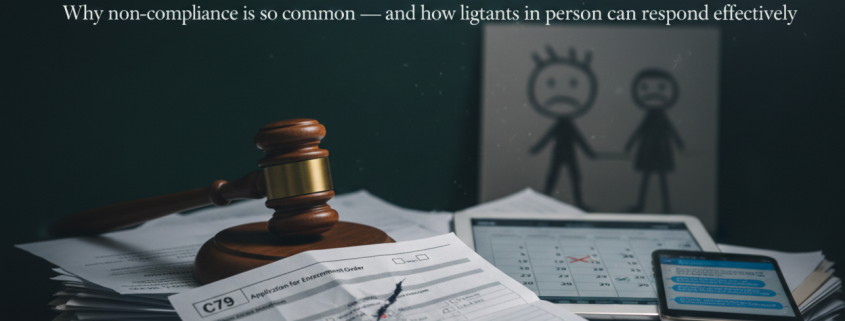
Why non-compliance is so common — and how litigants in person can respond effectively
Introduction: When a court order exists — but nothing changes
For many parents, obtaining a Child Arrangements Order feels like the end of the battle. The court has made a decision. Arrangements are set out clearly. The expectation is that life will now move forward.
Yet for a significant number of parents, the reality is very different.
Contact does not resume. Time is reduced, restricted, or cancelled altogether. Excuses multiply. Weeks turn into months. And despite the existence of a court order, one parent finds themselves effectively shut out of their child’s life.
This is where enforcement becomes necessary — and where many litigants in person feel lost, frustrated, and disillusioned.
This article explains how enforcement works, why it is often misunderstood, where parents go wrong, and how a structured approach can help litigants in person respond without escalating conflict or damaging credibility.
What enforcement of a Child Arrangements Order actually means
Enforcement is the process by which the court is asked to intervene because an existing order is not being complied with.
This is done through a C79 application.
The court is not re-deciding what arrangements should be. It is considering whether:
an order has been breached
the breach is established
there was a reasonable excuse
enforcement action is appropriate
Understanding this distinction is critical.
Many parents approach enforcement as an opportunity to re-argue the merits of their case. That is rarely effective.
Why enforcement is so difficult in practice
Enforcement in family court is procedurally demanding and emotionally draining.
Parents often encounter:
repeated breaches with minimal consequences
shifting justifications for non-compliance
informal variation without court approval
reluctance by courts to escalate sanctions early
delays that compound harm
For litigants in person, these challenges are magnified by uncertainty about what the court expects to see in an enforcement application.
Common mistakes litigants in person make when enforcing contact
1. Treating enforcement as a continuation of the original dispute
The court is not revisiting history. It is assessing compliance.
Lengthy narratives about the relationship breakdown often distract from the central issue: whether the order has been breached.
2. Failing to evidence breaches clearly
Courts require specificity.
Dates, times, what was ordered, what occurred instead — vague assertions are rarely sufficient.
Many litigants assume the court will “know what has been happening.” It will not, unless it is clearly evidenced.
3. Escalating emotionally rather than procedurally
Understandably, parents feel angry and hurt. But enforcement applications framed in emotive language often weaken credibility rather than strengthen it.
The court is assessing behaviour, not distress.
4. Delaying enforcement for too long
Some parents tolerate non-compliance for months before acting, hoping matters will resolve.
By the time enforcement is sought, patterns of non-compliance may already be entrenched — and harder to address.
What the court is actually looking for on a C79
When considering enforcement, the court focuses on:
the clarity of the original order
the extent and frequency of breaches
any alleged reasonable excuse
the impact on the child
whether enforcement action would be proportionate
Parents who present their case around these factors are far more likely to be taken seriously.
The myth of automatic enforcement
There is a common misconception that once a breach is shown, enforcement automatically follows.
In reality, family courts are cautious. They prioritise welfare and proportionality and often attempt less intrusive measures before imposing sanctions.
This can be deeply frustrating for parents — but understanding this reality allows litigants in person to prepare strategically rather than react emotionally.
The importance of documenting breaches properly
Effective enforcement depends on clear records.
This includes:
maintaining a contact log
preserving messages and cancellations
recording attempts to comply with the order
avoiding confrontational communication
Well-organised evidence allows the court to see patterns, not just isolated incidents.
When variation and enforcement overlap
Sometimes non-compliance arises because circumstances have changed — but no variation application has been made.
Courts may be reluctant to enforce rigidly where an order no longer reflects reality.
Litigants in person often struggle to know whether to pursue enforcement, variation, or both.
This is an area where early procedural clarity can prevent wasted applications and further delay.
How enforcement affects children — and why courts tread carefully
While enforcement is about compliance, courts remain focused on children’s welfare.
They are mindful that:
sanctions may increase conflict
children can be placed under pressure
rigid enforcement may not resolve underlying issues
This explains why enforcement can feel slow or ineffective — but it also highlights why clear, measured applications are essential.
When support with enforcement can make a difference
Support can be particularly valuable where:
breaches are ongoing and disputed
communication has broken down
previous enforcement attempts have failed
allegations are raised in response to enforcement
a parent feels unheard or overwhelmed
Structured support helps parents focus on process, not emotion.
How I support litigants in person with enforcement applications
I support parents seeking to enforce Child Arrangements Orders by helping them:
understand whether enforcement is appropriate
structure evidence clearly and chronologically
approach the C79 application in a focused way
prepare for what the court is likely to consider
avoid common pitfalls that undermine enforcement
I do not promise outcomes, and I do not escalate conflict.
My role is to help litigants in person engage with enforcement proceedings in a way that protects their credibility and keeps the focus where the court expects it to be.
A message to parents facing repeated non-compliance
If you are dealing with ongoing breaches of a Child Arrangements Order, your frustration is understandable.
But enforcement is not about expressing that frustration. It is about presenting a clear procedural case that the court can act upon.
Clarity, consistency, and preparation matter.
Call Me
If a Child Arrangements Order is not being complied with and you are representing yourself, structured support may help you approach enforcement with clarity and confidence.
I offer procedural support to litigants in person pursuing enforcement applications, subject to the court’s discretion.
You are welcome to get in touch to discuss whether support would be appropriate in your circumstances.
Regulatory & Editorial Notice This article is published for general information purposes only. It does not constitute legal advice and should not be relied upon as such. Every family case turns on its own facts and procedural context. Support services described are non-reserved and subject to the discretion of the court. Where legal advice is required, readers should seek assistance from a suitably qualified legal professional.
https://jshlaw.co.uk/wp-content/uploads/2026/01/Gemini_Generated_Image_emej5aemej5aemej.png8321248Jessica Susan Hillhttps://jshlaw.co.uk/wp-content/uploads/2026/01/jsh-law-logo-new-black-300x67.pngJessica Susan Hill2026-01-14 18:10:042026-02-03 03:40:06Enforcing Child Contact Orders (C79): When Orders Are Ignored
Why early mistakes can shape your entire caA C100 is not simply a form you complete to get into Family Court. It defines what the dispute is, which children are affected, what orders you are asking for, whether there are safeguarding concerns and what the court needs to deal with next. This JSH Law guide explains the current 2026 C100 process in practical terms for litigants in person.se — and how litigants in person can avoid them
JSH LAW | C100 | CHILD ARRANGEMENTS | PRIVATE CHILDREN LAW
C100 Application Help: Getting Your Family Court Case Clear From the Start
A C100 is not simply a form you complete to “get into court”.
It tells the Family Court what the dispute is, which children are affected, what orders you want, whether there are safeguarding concerns, whether the case is urgent and what the court is being asked to resolve.
For many parents and family members, the C100 is the first substantial document they prepare for private children proceedings.
That makes it deceptively important.
The court, Cafcass or Cafcass Cymru and the other party may all encounter your case initially through the information contained in this application.
Yet the C100 is not supposed to contain every argument, every screenshot or the complete history of the relationship.
The current form expressly asks for brief details of:
previous agreements or parenting arrangements and how they broke down;
why the application is being made;
what you want the court to do; and
the reasons the respondent has given for their position, where known.
It specifically warns applicants not to provide a full witness statement at that stage.
The skill is not putting everything into the C100. The skill is identifying what the court actually needs to understand at the beginning.
JSH LAW C100 FRAMEWORK
Child → Current Arrangement → Problem → Safeguarding → Welfare Impact → Order Sought
If a stranger reading the application cannot work out what is happening, why court intervention is needed and what you are asking the judge to do, the application needs more structure.
What is Form C100 used for?
Form C100 is used to start an application under section 8 of the Children Act 1989 for:
a Child Arrangements Order;
a Prohibited Steps Order;
a Specific Issue Order;
variation of an existing section 8 order;
discharge of an existing section 8 order; and
where appropriate, permission to make a section 8 application.
If Children Act proceedings are already underway and you want another order within those existing proceedings, the appropriate form may instead be C2. Enforcement of an existing Child Arrangements Order normally uses C79.
CURRENT 2026 POSITION
Make sure you are using the current C100
HMCTS updated Form C100 in June 2026.
The current paper form is marked:
C100 (06.26)
It includes updated provisions concerning confidential information and requires detailed information about MIAM attendance or exemption, safeguarding, urgency, existing proceedings, permission requirements and the people involved in the child’s life.
Do not rely on an old downloaded copy simply because it looks similar.
PREPARING A C100?
Get the application clear before the proceedings become complicated
JSH Law can provide defined-scope support to litigants in person preparing a C100 application.
Depending on the agreed scope, support may include:
reviewing what order you are trying to obtain;
organising the factual background;
reviewing C100 wording;
helping identify relevant safeguarding issues;
C1A preparation support;
urgent and without-notice application preparation;
The C100 can ask for three different types of section 8 order
One of the first mistakes applicants make is treating “a C100” and “a Child Arrangements Order” as though they mean exactly the same thing.
They do not.
C100 is the form.
It can be used for three types of order under section 8 of the Children Act 1989.
Child Arrangements Order
Decides with whom a child lives, spends time or otherwise has contact, and when those arrangements take place.
Specific Issue Order
Decides a particular question concerning the exercise of parental responsibility.
Prohibited Steps Order
Prevents a person from taking a specified step concerning a child without the court’s permission.
What is a Child Arrangements Order?
A Child Arrangements Order can regulate:
with whom the child lives;
when the child lives with each person;
with whom the child spends time;
when that time takes place; and
other forms of contact.
The modern statutory language replaced the older labels of “residence” and “contact”.
The wording matters because a child-arrangements case should not begin as an argument about one parent “winning custody”.
The legal question is what arrangements best promote the child’s welfare.
What is a Specific Issue Order?
A Specific Issue Order asks the Family Court to decide a particular question relating to a child’s upbringing.
Examples can include disputes concerning:
education or school choice;
medical treatment;
religious upbringing;
a proposed change of surname;
particular travel or relocation questions; or
another defined parental-responsibility dispute.
The order sought should be expressed as the actual decision the court is being asked to make.
“We disagree about school” identifies a dispute.
“I seek a Specific Issue Order that X attends Y School from September 2027” tells the court what decision is sought.
What is a Prohibited Steps Order?
A Prohibited Steps Order prevents a specified step that would otherwise be capable of being taken in the exercise of parental responsibility without the court’s permission.
Depending on the facts, applications may concern proposals such as:
removing a child from a school;
changing educational arrangements;
taking a child abroad;
relocating with a child;
changing a child’s surname;
taking a particular medical step; or
another specified action affecting the child.
If the risk is immediate, the application may also require urgent consideration.
The C100 is about the child — because the child’s welfare is paramount
Section 1 of the Children Act 1989 governs the court’s approach.
When deciding questions concerning a child’s upbringing, the child’s welfare is the court’s paramount consideration.
The court also works from two important principles:
delay is likely to prejudice a child’s welfare; and
the court should not make an order unless making the order would be better for the child than making no order at all.
That second principle is often called the no-order principle.
In contested section 8 proceedings the court may need to consider the statutory welfare checklist, including matters such as:
the child’s ascertainable wishes and feelings, considered in light of age and understanding;
physical, emotional and educational needs;
the likely effect of a change in circumstances;
age, sex, background and other relevant characteristics;
harm suffered or risk of harm;
the capability of relevant adults to meet the child’s needs; and
the range of powers available to the court.
The C100 should therefore be child-focused rather than adult-scorekeeping.
The fact that one parent behaved badly towards the other is legally important where it affects welfare, risk, parenting, safety or the arrangements sought — not simply because the court is being asked to decide who was the better former partner.
Parental involvement does not mean an automatic 50/50 division of time
The Children Act contains a rebuttable presumption concerning parental involvement where the statutory conditions are met.
But “involvement” means involvement of some kind — direct or indirect.
It does not mean that the law starts from an automatic presumption of:
equal time;
50/50 care;
alternate weeks;
shared residence in equal proportions; or
any other predetermined division of the child’s time.
The particular arrangements still depend upon welfare and the evidence.
Where there is evidence that involvement would place the child at risk of harm, the statutory framework requires careful consideration of that risk.
Before applying: court is not supposed to be the automatic first step
The Child Arrangements Programme contains a pre-application protocol.
Where it is safe and appropriate, families are expected to consider whether the dispute can be resolved without proceedings.
This can include:
direct agreement;
a parenting plan;
mediation;
solicitor negotiation;
another appropriate form of non-court dispute resolution; or
other child-focused support.
Domestic abuse, urgency and safeguarding can fundamentally change that analysis.
No one should be pressured into unsafe mediation merely so that they can say they “tried everything”.
Do you have to attend a MIAM before filing a C100?
In most relevant applications, the prospective applicant must attend a Mediation Information and Assessment Meeting — a MIAM before issuing the application, unless:
the MIAM requirement does not apply to that application; or
a valid exemption is claimed.
A MIAM is not the same thing as being required to mediate.
It is a meeting with an authorised family mediator to consider mediation and other forms of non-court dispute resolution.
The current C100 asks detailed questions about:
whether the applicant attended a MIAM;
whether the parties attempted mediation or another process;
why it did not proceed or resolve the dispute; and
whether an exemption is relied upon.
The court can examine whether an exemption has been validly claimed.
What are the main MIAM exemptions?
The current rules contain several categories of exemption.
These include circumstances involving:
domestic abuse;
child protection concerns;
urgency;
recent previous MIAM or other qualifying NCDR involvement; and
specified practical or other circumstances recognised by the rules.
Some exemptions require supporting evidence.
In particular, the current C100 identifies a range of recognised evidence for a domestic-abuse MIAM exemption, including certain:
criminal justice evidence;
protective orders;
findings of fact;
health-professional evidence;
IDVA or ISVA evidence;
local-authority or housing evidence;
domestic-abuse-service evidence; and
evidence relating to financial abuse.
Do not tick a MIAM exemption simply because mediation is unwanted.
Identify the actual exemption relied upon and provide the evidence required where the rules require evidence.
Who can make a C100 application?
Some applicants have a statutory right to make a section 8 application without first asking the court for permission.
Others require the court’s permission — often called leave.
People who may have an entitlement to apply without separate permission include, depending on the order and circumstances:
a parent;
a guardian;
certain people with parental responsibility;
certain step-parents;
a person already named in a Child Arrangements Order;
certain people with whom a child has lived for the required statutory period;
people with relevant consents; and
others within the statutory categories.
Whether permission is required can be technical.
Do grandparents automatically have the right to apply for a Child Arrangements Order?
Not simply because they are grandparents.
A grandparent may fall within another statutory category which allows an application without leave — for example because of the child’s living arrangements or relevant consent.
But where no such category applies, a grandparent will usually need the court’s permission before the substantive section 8 application can proceed.
That does not mean grandparents are unimportant.
It means the procedural route must be identified correctly.
The current C100 can also ask for permission to apply
The June 2026 C100 asks directly whether permission is:
already granted;
not required; or
being sought with the application.
If permission is needed, the application should explain the basis upon which it is sought.
Do not leave this issue until the hearing if the form itself requires it to be addressed.
What if there is already a section 91(14) order?
A section 91(14) Children Act order can require a person to obtain permission before making a further application.
The current C100 expressly asks about:
section 91(14) orders;
limited civil restraint orders;
extended civil restraint orders; and
general civil restraint orders.
If such an order applies, provide the requested information and a copy of the relevant order.
A permission application should engage with the terms and purpose of that order rather than pretending it does not exist.
The most important drafting box: “Why are you making this application?”
Section 5.4 of the current paper C100 asks for brief details about:
previous formal or informal agreements;
how those arrangements broke down;
why court proceedings are now being brought;
what you want the court to do; and
the respondent’s stated reasons for their actions, where known.
It then gives an important instruction:
Do not turn this section into your full witness statement.
A useful structure is:
1. Current position
Where is the child living and what arrangements currently exist?
2. What changed?
What agreement or arrangement has broken down?
3. The issue
What is now disputed?
4. Child impact
Why does the issue matter to the child’s welfare?
5. Order sought
What precisely are you asking the court to do?
“I want fair contact” is not a clear order
One of the strongest points from the original JSH Law C100 guide remains true:
Applicants should understand what they are actually asking the court to order.
Compare:
“I want fair and equal access to my child.”
with:
“I seek a Child Arrangements Order providing for alternate weekends from Friday after school until Sunday at 6pm, half of school holidays and one video call each Wednesday.”
The second tells the court what practical arrangement is proposed.
That does not mean the court will necessarily make it.
It means the court can understand the proposal.
When must Form C1A be filed with the C100?
The current C100 asks whether the child has experienced, or is at risk of experiencing, harm involving:
domestic abuse;
child abduction;
child abuse;
drug, alcohol or substance misuse; or
other safety or welfare concerns.
If the answer is yes to one or more of those categories, the current form directs the applicant to complete Form C1A and file it with the C100.
C1A is used to provide supplemental information about harm or risk of harm.
The rules recognise urgent circumstances including situations where delay caused by attending a MIAM would create matters such as:
a risk of harm to a child;
a risk to life, liberty or physical safety;
a risk of unlawful removal of a child from the United Kingdom;
a risk of unlawful retention abroad;
a significant risk of miscarriage of justice;
significant financial hardship;
irretrievable difficulty in resolving the dispute; or
certain competing international proceedings.
Section 6 of the C100 deals specifically with requests for urgent and without-notice hearings.
Urgent and without notice are not the same thing
An urgent application can still be made on notice to the other party.
A without-notice application asks the court to consider the request before the respondent has received the usual advance notice.
Under the Child Arrangements Programme, without-notice orders are exceptional.
Relevant circumstances include situations where:
giving notice would allow steps to be taken which defeat the purpose of the application;
there is exceptional urgency and genuinely no time to give notice; or
giving notice would be likely to expose the applicant or child to unnecessary risk of physical or emotional harm.
Without notice does not mean “the other parent must never find out”.
Procedural fairness ordinarily requires the respondent to have an opportunity to be heard subsequently.
Abduction, relocation and travel disputes need careful framing
C100 proceedings may involve concerns that a child will:
be removed from England and Wales;
not be returned following travel;
be moved to another part of the country;
be removed from school;
have travel documents obtained or used; or
be relocated contrary to an existing order or parental-responsibility framework.
Depending on the facts, the application may involve:
a Prohibited Steps Order;
a Specific Issue Order;
a Child Arrangements Order;
urgent directions;
passport-related provisions; or
a different international or High Court remedy.
International child cases can involve jurisdiction, international conventions and urgent protective mechanisms.
Do not assume an ordinary C100 application is always the complete remedy in an abduction situation.
Need to keep your address or contact details confidential? Think about Form C8 before filing
The June 2026 C100 repeatedly directs applicants to use Form C8 where contact details should not be disclosed to another party.
This may be particularly important where:
there is domestic abuse;
a person has moved to a confidential address;
a child is living at a protected location;
there is stalking or harassment;
the applicant is in refuge accommodation; or
disclosure would create another safeguarding risk.
If using C8, check every other document being filed.
A confidential address can still be exposed accidentally through:
a bank statement;
a school letter;
a medical record;
a screenshot;
an exhibit cover sheet; or
another document attached to the application.
Tell the court about previous and current proceedings
The C100 asks about previous or ongoing cases involving the child.
This is not an administrative nuisance.
It may tell the court about:
existing Child Arrangements Orders;
previous findings of fact;
non-molestation or occupation orders;
care or supervision proceedings;
emergency protection proceedings;
other section 8 proceedings;
previous relocation litigation;
section 91(14) restrictions;
related domestic-abuse proceedings; or
important judicial history.
If an order is relevant and the form asks for it, provide the order.
Do not make the new judge reconstruct years of litigation from fragments.
International elements should be identified immediately
The current C100 asks specifically about:
Scotland or Northern Ireland connections;
international elements;
issues affecting jurisdiction; and
other matters potentially affecting the proceedings.
Tell the court if relevant issues include:
a child living abroad;
recent international relocation;
foreign proceedings;
a proposed permanent relocation;
another country arguably having jurisdiction;
retention following an overseas trip; or
another significant international connection.
Jurisdiction should not be treated as an afterthought.
What happens with Cafcass after a C100 is issued?
The current C100 itself explains that it will be shared with Cafcass or Cafcass Cymru so that initial safeguarding work can take place.
Under the standard Child Arrangements Programme, Cafcass or Cafcass Cymru undertakes safeguarding work before the First Hearing Dispute Resolution Appointment in relevant cases.
This can include:
police checks;
local-authority safeguarding enquiries;
contact with the parties concerning safety issues; and
a safeguarding letter or report to the court.
Under the standard CAP timetable, the safeguarding letter/report is ordinarily provided within the procedural timetable before the FHDRA.
The C100 and any C1A therefore matter because they are part of the information available at the beginning of safeguarding work.
Write as though the person reading the form knows nothing about your family.
Your case may not follow the traditional FHDRA route: Child Focused Courts and Pathfinder
Private children procedure is currently changing.
The model originally known as Pathfinder is increasingly referred to as the Child Focused Model or Child Focused Courts.
The Government announced national expansion in March 2026, but the formal pilot provisions under Practice Direction 36Z continue to apply in specified areas while implementation progresses.
This means two litigants filing C100 applications in different court areas may experience different procedural routes.
In a Child Focused Model case, the process can involve an earlier Information Gathering and Assessment stage and a Child Impact Report.
That report may bring together:
information from the parties;
information from the child where appropriate;
safeguarding information;
police and local-authority checks;
external information;
domestic-abuse risk information;
participation issues;
previous orders; and
recommendations about next steps.
In the pilot model, the Child Impact Report is itself treated as a section 7 report, so a separate traditional section 7 report should not automatically be expected.
Practical point:
Read the first court notice and directions carefully. Do not assume your case will follow the same sequence as a friend’s case in another part of England or Wales.
What happens at the FHDRA under the standard Child Arrangements Programme?
Where the standard Child Arrangements Programme applies, the first substantive hearing is normally the First Hearing Dispute Resolution Appointment — FHDRA.
The FHDRA is primarily a safeguarding, issue-identification and case-management hearing.
Will the court automatically order a Section 7 report?
No.
Under the standard CAP, the court can direct Cafcass, Cafcass Cymru or in appropriate cases a local authority to prepare a welfare report under section 7 of the Children Act 1989.
The court should identify the specific welfare matters the report needs to address.
Section 7 reports are commonly relevant where there are disputed questions about:
where a child should live;
spending time or contact;
wishes and feelings;
safeguarding;
parenting capacity;
risk;
reintroduction of contact; or
another defined welfare issue.
In a Child Focused Model case, the Child Impact Report may perform this section 7 function.
Does filing a C1A mean there will automatically be a fact-finding hearing?
No.
The court must decide whether disputed allegations need factual determination in order to resolve welfare and risk issues.
The court may consider:
what is admitted;
what is genuinely disputed;
what evidence already exists;
whether the alleged facts would affect the welfare decision if proved;
whether findings are required for risk assessment;
proportionality; and
whether the case can safely be determined without a separate fact-finding hearing.
If fact-finding is directed, the court may later require:
As at September 2026, the HMCTS fee for a section 8 Children Act application is:
£270
Current court application fee
People on a low income or certain benefits may qualify for Help with Fees.
Court fees are separate from any fee for professional or litigation-support assistance.
Common C100 mistakes
1. Writing a 10-page witness statement in Section 5.4
The form asks for a summary. Full evidence can be directed later if required.
2. Not saying what order is actually sought
“Fair contact” and “shared custody” do not tell the court what practical arrangements you want.
3. Treating the C100 as a complaint about the former relationship
Explain adult behaviour where it is relevant to welfare, safeguarding, risk or the orders sought.
4. Minimising domestic abuse because you fear being called difficult
Relevant safeguarding concerns need to be identified accurately so they can be assessed properly.
5. Describing ordinary disagreement as serious abuse without explaining the behaviour
Use facts, dates, patterns and impact rather than unsupported labels.
6. Failing to file C1A when the C100 requires it
If relevant harm or safety concerns are identified, follow the current form’s direction concerning C1A.
7. Claiming urgency without explaining the actual urgency
Explain what may happen if the application waits for the ordinary timetable.
8. Confusing urgent with without notice
A case can require an urgent hearing while still giving the respondent notice.
9. Forgetting a previous order or case
Previous findings, restrictions, Children Act orders and protective orders can be central to case management.
10. Uploading an evidence dump with the application
Preserve your evidence but distinguish the application stage from later evidence and bundle directions.
11. Assuming parental involvement means automatic equal time
The statutory presumption concerns involvement, not a predetermined division of the child’s time.
12. Using the child as evidence
Do not repeatedly question, coach or recruit the child into proving the adult case.
C100 pre-filing checklist
Before submitting, ask yourself:
Am I using the current form or online service?
Have I identified the correct section 8 order?
Have I clearly described what I want the court to do?
Have I dealt with the MIAM requirement?
If I rely on an exemption, is evidence required?
Have I identified all children correctly?
Have I identified everyone with parental responsibility?
Have I identified where the children currently live?
Have I identified relevant other carers?
Have I disclosed current or previous proceedings?
Do I need permission to apply?
Is there a section 91(14) or civil restraint order?
Have I accurately identified any safeguarding concerns?
Do I need C1A?
Is the application genuinely urgent?
If I seek without-notice consideration, have I explained why?
Is there an international element?
Do any contact details need protecting through C8?
Have I kept the reasons section concise?
Have I avoided unnecessary attachments?
Have I checked the current fee or Help with Fees position?
Have I kept a complete copy of everything filed?
PRACTICAL SUPPORT FOR LITIGANTS IN PERSON
How JSH Law can help with a C100 application
JSH Law provides privately funded, defined-scope litigation and document-preparation support for litigants in person.
Depending on the agreed task, C100 support may include:
reviewing the dispute and identifying the procedural issue;
identifying the section 8 order being sought;
reviewing draft C100 wording;
helping structure Section 5.4;
organising current arrangements and proposals;
C1A preparation support;
domestic-abuse chronology preparation;
safeguarding evidence organisation;
urgent / without-notice preparation;
reviewing previous orders;
permission-application preparation;
section 91(14) document organisation;
relocation or prohibited-steps document preparation;
Cafcass preparation;
first-hearing preparation;
position statements;
witness statements where later directed;
schedules of allegations;
court bundle preparation; and
deadline and order tracking.
Depending on the case, a JSH Law C100 working file might include
C100 Application Review
Orders Sought Summary
Child Arrangements Proposal
Master Case Chronology
Safeguarding Issues Summary
C1A Evidence Map
Urgency / Without-Notice Issues Note
Existing Orders Register
Cafcass Preparation Note
First Hearing Preparation Note
Filing & Hearing Deadline Tracker
Not every case needs every document. The preparation should reflect the actual application and the court’s directions.
Asking JSH Law for C100 help? Send these first
You do not need to send your entire evidence archive at the outset.
Start with:
A short explanation of the current arrangements for the child.
What has changed or broken down.
What order you believe you need.
Any existing Child Arrangements Order.
Any other relevant Family Court orders.
Any C100 already drafted.
Any C1A already drafted.
Any section 91(14) order.
Details of previous or ongoing proceedings.
Any immediate safeguarding concern.
A small selection of particularly important evidence if relevant.
Any known deadline or urgent date.
If you have 3,000 messages, do not begin by sending 3,000 messages.
First identify the issues. The evidence can then be organised around those issues.
Check whether legal aid may be available
Legal aid may be available for some private children cases, particularly where the applicable domestic-abuse or child-protection gateway is met and the means and merits requirements are satisfied.
If funded legal representation may be available, investigate that option before assuming you must conduct complex proceedings alone.
JSH Law support is privately funded and provided on a defined-scope basis.
Frequently asked questions about C100 applications
What is Form C100?
C100 is the HMCTS form used to apply for a Child Arrangements Order, Prohibited Steps Order or Specific Issue Order under section 8 of the Children Act 1989, and to vary or discharge a section 8 order or seek permission to apply where appropriate.
What is the current version of the C100?
As at September 2026, the current HMCTS paper form is the June 2026 version, marked C100 (06.26).
Can I apply online?
HMCTS provides an online application service for eligible child-arrangements applications. A paper C100 remains available where the online route is not used.
How much does it cost?
The current HMCTS fee for a section 8 Children Act application is £270. Help with Fees may be available to eligible applicants.
Do I need a MIAM?
Usually, unless the requirement does not apply or a valid exemption is available. The current form requires the MIAM position to be addressed.
Does a MIAM mean I have to mediate?
No. A MIAM provides information and assesses whether mediation or another form of non-court dispute resolution may be appropriate. It is not an automatic requirement to enter mediation.
Can domestic abuse exempt me from a MIAM?
Domestic abuse is one of the recognised MIAM exemption categories, but the current rules specify evidence requirements. The exemption should be completed accurately.
When do I need Form C1A?
The current C100 directs an applicant to complete C1A where relevant concerns about domestic abuse, child abduction, child abuse, substance misuse or other safety or welfare concerns are identified.
Should I put all the domestic abuse history in the C100?
The C100 should identify the relevant issues and the C1A should provide the supplemental safeguarding information requested. A fuller witness statement or schedule may be directed later. Avoid turning the C100 into an undirected full witness statement.
Should I attach WhatsApp messages?
Do not automatically attach large volumes of messages. Preserve them and identify relevant evidence, but follow the form, rules and any court directions concerning evidence.
Can I ask for an urgent hearing?
Yes, where the circumstances genuinely require urgent court intervention. Section 6 of the current C100 deals with urgent and without-notice requests.
Is an urgent hearing automatically without notice?
No. Urgency and proceeding without notice are different questions. Without-notice orders are exceptional and require additional justification.
Can I keep my address confidential?
Form C8 can be used where contact details should be withheld from another party. You should also ensure those details do not appear elsewhere in documents you file.
Do grandparents use C100?
A grandparent seeking a section 8 order may use C100, but being a grandparent alone does not necessarily give an automatic right to make the substantive application. Permission may be required unless another statutory entitlement applies.
What if there is a section 91(14) order?
You may require the court’s permission before making the application. The current C100 specifically asks about section 91(14) and civil restraint orders.
Can I use C100 to change an existing Child Arrangements Order?
Yes. C100 can be used to seek variation or discharge of an existing section 8 order.
What form do I use if the order is being breached?
An application specifically seeking enforcement of a Child Arrangements Order is ordinarily made using Form C79.
What if proceedings are already open?
An application for an order within existing Children Act proceedings will often use Form C2 rather than starting a new C100 application. Check the procedural position and any existing directions.
Does filing a C100 automatically mean Cafcass will write a Section 7 report?
No. Initial safeguarding work is different from a full welfare report. Under the standard CAP the court may later direct a focused Section 7 report. In Child Focused Model cases, a Child Impact Report may perform the section 7 function.
Will my case definitely have an FHDRA?
Not necessarily. The standard Child Arrangements Programme uses the FHDRA model, but Child Focused Model / Pathfinder procedures apply in participating areas and use a different information-gathering and case-management structure.
Does parental involvement mean the child must spend half their time with each parent?
No. The statutory concept of involvement does not prescribe any particular division of the child’s time. The arrangements remain a welfare decision.
Will the child have to choose which parent to live with?
No. The child’s ascertainable wishes and feelings may be relevant according to age and understanding, but responsibility for making the decision remains with the adults or, where necessary, the court.
Can JSH Law help with a C100?
JSH Law may provide privately funded, defined-scope assistance with C100 preparation, C1A material, chronologies, evidence organisation, urgent applications, Cafcass preparation, hearing documents and practical litigation support for litigants in person.
Legal and procedural information last checked: 16 September 2026.
Important service information
JSH Law provides defined-scope litigation support, document-preparation assistance and practical support for litigants in person.
Assistance with a C100 application can include helping to organise the client’s factual instructions, identify procedural issues, structure court documents and organise evidence within the agreed scope.
JSH Law does not decide what outcome the Family Court should reach, determine disputed allegations or guarantee that a particular order will be made.
The litigant in person remains responsible for checking and approving factual information, signing statements of truth where required, complying with court orders, filing and service where applicable and meeting deadlines.
Where formal regulated legal advice, conduct of litigation, reserved advocacy or representation is required, assistance should be obtained from an appropriately authorised legal professional.
This page provides general procedural and educational information about private children proceedings in England and Wales. It is not case-specific legal advice. The correct application, procedure and outcome depend upon the facts, evidence, safeguarding issues, existing orders, jurisdiction and the child’s individual welfare needs.
JSH LAW | C100 APPLICATION SUPPORT
Start the case by making the court’s job easier
What is happening now? What has broken down? Is there a safeguarding issue? What does the child need? What precise order are you asking the court to make?
Those questions should be clear before the application becomes buried under months of litigation.
https://jshlaw.co.uk/wp-content/uploads/2026/01/Gemini_Generated_Image_nq4qb9nq4qb9nq4q.png8321248Jessica Susan Hillhttps://jshlaw.co.uk/wp-content/uploads/2026/01/jsh-law-logo-new-black-300x67.pngJessica Susan Hill2026-01-14 17:45:092026-09-16 22:42:27C100 Application Help | C1A, Cafcass & Child Arrangements | JSH Law

 JSH LAW LTD
 JSH LAW LTD