

Mazur Explained: The Case That Changes Who Can Run Your Court Case | JSH Law
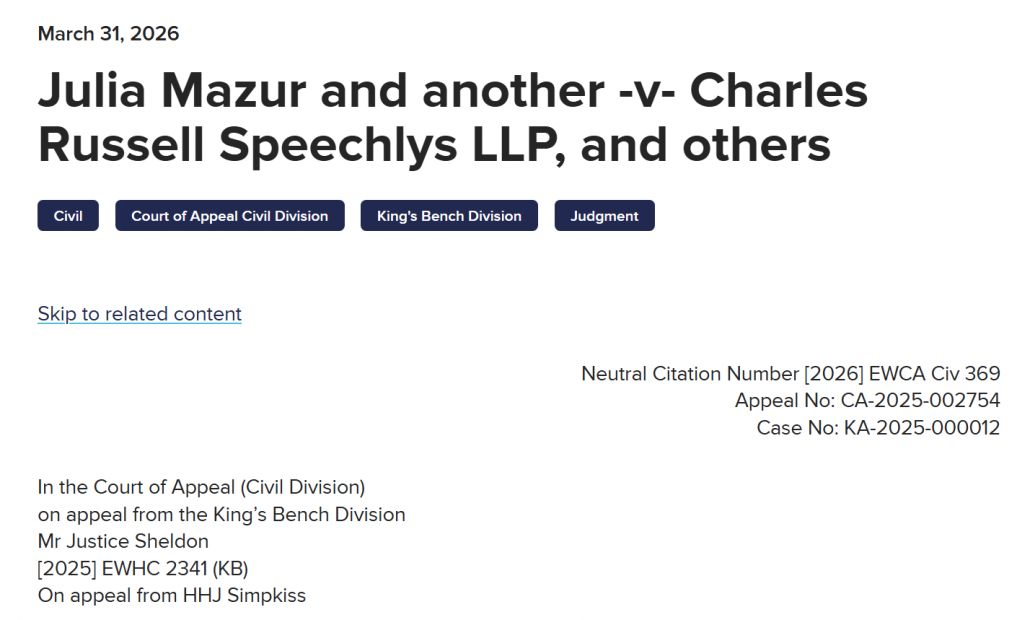
The High Court has just drawn a firm line around who is actually allowed to run a court case—and it’s a line many people have been crossing without realising. In Mazur v Charles Russell Speechlys LLP [2025] EWHC 2341 (KB), the court made it clear that only authorised or exempt individuals can conduct litigation, and that supervision is not enough. For litigants in person, this is not just a technical legal point—it goes directly to how your case is handled, how it is perceived by the court, and whether your position is open to challenge.

- Only authorised or exempt individuals can legally conduct litigation.
- Even well-meaning support can cross the line if someone starts running your case.
- You must remain in control of your case at all times.
- Getting this wrong can expose your case to challenge or criticism.
- Structured, compliant support can strengthen your position significantly.
Mazur Explained: The Case That Changes Who Can Run Your Court Case
There has been a significant shift in how the courts are approaching who is actually allowed to run a case.
The High Court decision in Mazur v Charles Russell Speechlys LLP [2025] EWHC 2341 (KB) has clarified something that, until now, many people in the legal world had quietly blurred:
Only certain people are legally allowed to conduct litigation — and supervision is not enough.
For litigants in person, this matters more than you might realise.
—What Happened in Mazur?
The case arose from a situation where work on a legal matter had been carried out by someone who was not an authorised solicitor or exempt person, but who was working within a legal environment.
The argument was that because this individual was supervised, their actions were acceptable.
The High Court disagreed.
The judgment made it clear that:
- “Conduct of litigation” is a reserved legal activity under the Legal Services Act 2007
- Only authorised or exempt individuals can carry it out
- Supervision by a solicitor does not make an unauthorised person compliant
This was not a new rule — but it is now being applied much more strictly.
—What Does “Conduct of Litigation” Actually Mean?
This is the critical question.
It does not just mean standing up in court. It includes:
- Making decisions about how the case is run
- Sending correspondence on behalf of a party
- Filing documents
- Taking responsibility for procedural steps
In simple terms:
If someone else is effectively running your case — they may be conducting litigation.
—Why This Matters for Litigants in Person
Many litigants in person rely on support. That support can be incredibly valuable — and in many cases, essential.
But there is now a much sharper line between:
- Support (which is allowed), and
- Conduct (which is restricted)
If that line is crossed, it can lead to:
- Challenges from the other side
- Increased scrutiny from the court
- Questions about how the case has been handled
This is not about creating fear — it is about understanding how to stay on solid ground.
—The Difference Between Support and Running the Case
A properly structured support model looks like this:
- You make the decisions
- You send the emails
- You sign and file the documents
- You speak for yourself in court
Support can include:
- Drafting documents for you
- Helping you prepare your case
- Advising you on strategy
- Assisting you in court as a McKenzie Friend
The key distinction is control.
You must remain in control of your case at all times.
—What This Means in Practice
If you are receiving support, you should always be able to say:
- “I reviewed and approved this document”
- “I chose to send this”
- “These are my instructions”
That clarity protects you.
It also strengthens your credibility in court.
—A Shift in the Legal Landscape
This decision reflects a wider shift.
The courts are becoming more alert to:
- Who is actually running a case
- Whether the proper boundaries are being respected
- How unregulated support is being used
At the same time, the reality remains:
Access to justice increasingly depends on litigants in person having the right support.
The answer is not less support.
It is better-structured support.
—Final Thoughts
Mazur does not remove your ability to get help.
What it does is make one thing very clear:
There is a right way to do this — and a wrong way.
If your case is structured properly, support can be a powerful advantage.
If it is not, it can become a vulnerability.
Understanding that distinction is now essential.
—Need Support With Your Case?
If you are navigating proceedings as a litigant in person and want structured, strategic support that keeps your case clear, compliant and strong, you can book an initial consultation below.
—Regulatory & Editorial Notice: JSH Law Ltd is not a firm of solicitors and does not provide regulated legal services. This article is for general information and commentary only and does not constitute legal advice. Any references to legal cases or third-party practices are provided for public interest analysis and educational purposes.
 JSH LAW LTD