If you are facing court without a solicitor or barrister, the phrase “McKenzie Friend” can sound reassuring but also dangerously vague. Too many litigants in person are told conflicting things about what a McKenzie Friend can do, what a judge can refuse, and where the legal line is drawn. The 2010 Practice Guidance remains one of the key judicial documents on the subject, and if you strip away the legal density, its message is clear: you are usually entitled to reasonable assistance, but that assistance has strict limits.
Key takeaways for litigants in person
- You generally have the right to reasonable assistance from a McKenzie Friend.
- A McKenzie Friend may support you, take notes, help with papers, and quietly advise you.
- A McKenzie Friend does not automatically have the right to speak for you, question witnesses, sign documents, or run your case.
- If a court wants to refuse or limit your McKenzie Friend, there should be proper reasons.
- Rights of audience and rights to conduct litigation are separate and only granted case by case.
- Paid McKenzie Friend support is not automatically unlawful, but there are strict legal boundaries around what can and cannot be charged for.
If you are representing yourself in court, the official 2010 Practice Guidance: McKenzie Friends (Civil and Family Courts) is still one of the most important documents you can read. It is short, but it is dense. For litigants in person, the difficulty is not usually finding the guidance. The difficulty is understanding what it actually means in practice.
This article keeps the substance of the original guidance intact, but breaks it down into plain English so that litigants in person can understand what the court says a McKenzie Friend is, what a McKenzie Friend can do, what a McKenzie Friend cannot do, when a court can refuse one, and why the line between “support” and “conduct of litigation” matters so much.
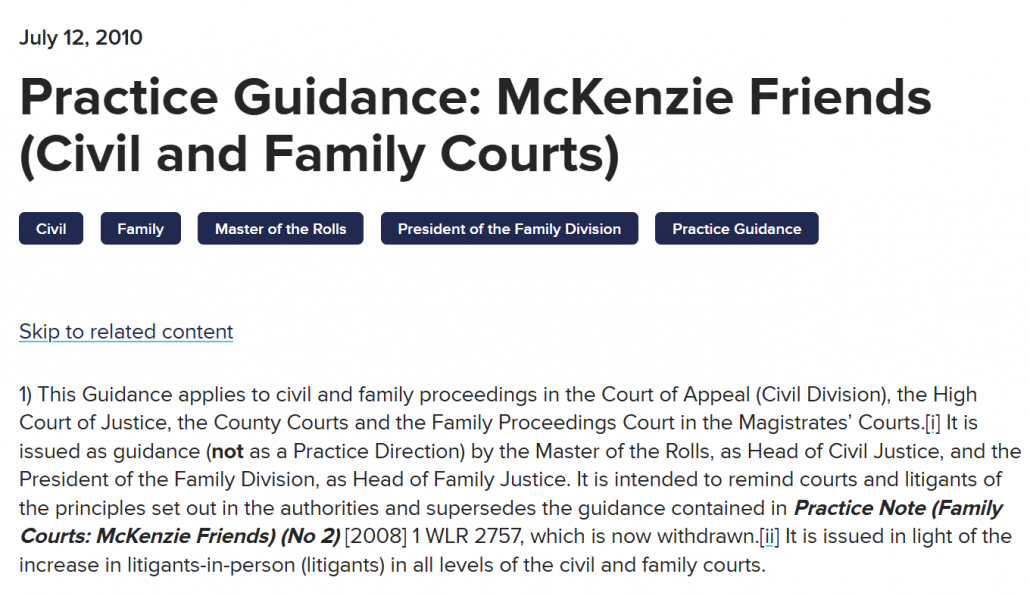
The guidance was issued on 12 July 2010 by the Master of the Rolls, Lord Neuberger of Abbotsbury, and the President of the Family Division, Sir Nicholas Wall. It applies to civil and family proceedings in the Court of Appeal (Civil Division), the High Court, the County Court, and the Family Proceedings Court in the Magistrates’ Courts. It was issued because of the growing number of litigants in person in civil and family cases, and it replaced earlier family guidance that was then withdrawn.
1. What this guidance is — and what it is not
The first thing to understand is that this is guidance. It is not a Practice Direction. That matters, because it does not create a new statutory code. What it does do is draw together the principles already established by the authorities and remind courts and litigants how those principles are supposed to work.
In other words, the judiciary recognised that more and more people were coming to court without solicitors or barristers, and that courts needed a clear framework for dealing with lay supporters, commonly known as McKenzie Friends.
2. The core principle: the right to reasonable assistance
The guidance states plainly that litigants have the right to have reasonable assistance from a layperson, sometimes called a McKenzie Friend. That is the starting point. It is not a favour. It is not something a judge should treat as a personal indulgence. It is a recognised right to reasonable assistance.
But there is an equally important second point: even where a litigant is assisted by a McKenzie Friend, the litigant remains a litigant in person. The McKenzie Friend does not become the advocate, does not become the representative of record, and does not acquire any independent right to act simply because they are sitting beside the litigant.
The guidance is very clear on this. A McKenzie Friend has no independent right to provide assistance beyond what the court permits, and no automatic right to conduct litigation or act as an advocate.
3. What a McKenzie Friend may do
The guidance identifies four things a McKenzie Friend may do:
- provide moral support for litigants;
- take notes;
- help with case papers;
- quietly give advice on any aspect of the conduct of the case.
That list is important because it reflects the real purpose of a McKenzie Friend. A litigant in person may be under extreme emotional pressure. They may struggle to keep up with the papers. They may need someone to help them organise documents, note what happened in court, and quietly point out what needs dealing with next. All of that falls within the proper scope of the role.
For many litigants in person, that kind of support is not a luxury. It is the difference between coping and falling apart. That is exactly why the guidance recognises the right.
4. What a McKenzie Friend may not do
The guidance is equally clear about the limits. A McKenzie Friend may not:
- act as the litigant’s agent in relation to the proceedings;
- manage the litigant’s case outside court, for example by signing court documents;
- address the court, make oral submissions, or examine witnesses.
This is the line many litigants, and frankly many McKenzie Friends, fail to understand properly. Quiet assistance is one thing. Acting as though you are the litigant’s legal representative is another. The first is generally permitted. The second is not, unless the court makes a specific case-by-case grant.
That is why the distinction matters so much. A McKenzie Friend can sit beside you, help with your file, and advise you quietly. They cannot simply stand up and run the hearing because that would cross into rights of audience or conduct of litigation.
5. Can the court refuse a McKenzie Friend?
Yes — but not casually.
The guidance says that although litigants ordinarily have a right to reasonable assistance from a McKenzie Friend, the court retains the power to refuse to permit that assistance. The test is whether, in the particular case, the interests of justice and fairness do not require the litigant to receive such assistance.
That means the court does have control, but the existence of that control does not reverse the starting point. The starting point is that the litigant ordinarily has the right to reasonable assistance. If the right is going to be restricted or refused, there should be a proper reason.
6. What should a litigant do if they want to bring a McKenzie Friend?
The guidance says the litigant should inform the judge as soon as possible, identify who the proposed McKenzie Friend will be, and the proposed McKenzie Friend should produce a short curriculum vitae or other statement. That statement should set out relevant experience, confirm that the proposed McKenzie Friend has no interest in the case, and confirm that they understand the role and the duty of confidentiality.
This is practical and sensible. If you are a litigant in person, do not leave this to chance. Tell the court promptly. Identify your McKenzie Friend. Put in writing who they are, what relevant experience they have, that they understand the limits of the role, that they have no personal interest in the case, and that they will respect confidentiality.
7. Who has to justify excluding the McKenzie Friend?
The guidance deals with this directly. If the court considers there may be grounds for limiting the right to assistance, or if another party objects to the McKenzie Friend’s presence or assistance, it is not for the litigant to justify the exercise of the right. It is for the court or the objecting party to provide sufficient reasons why the litigant should not receive that assistance.
That is a significant point. Too often litigants in person are put on the back foot and made to feel as though they must somehow “earn” the right to support. The guidance says otherwise. The right exists as the starting position. The burden falls on the person seeking to interfere with it to explain why.
8. What if the court is considering refusing or limiting the McKenzie Friend?
The guidance says the matter must be considered carefully because the litigant’s right to a fair trial is engaged. The litigant should be given a reasonable opportunity to argue the point. The proposed McKenzie Friend should not be excluded from that argument and should normally be allowed to help the litigant during that hearing.
That is common sense. If the issue is whether the litigant should be deprived of support, it would be fundamentally unfair to force the litigant to argue that point without the very support they are trying to retain.
9. What about private hearings, in chambers, or cases involving children?
The guidance recognises that where proceedings are in closed court — for example, in chambers, in private, or in proceedings relating to a child — the litigant is required to justify the McKenzie Friend’s presence in court. However, the guidance immediately adds that the presumption in favour of permitting the McKenzie Friend to attend such hearings is a strong one.
So yes, private proceedings raise confidentiality concerns. But no, confidentiality alone is not enough to displace the ordinary presumption in favour of allowing the litigant to have assistance.
That matters greatly in family proceedings. The fact that a case concerns children, sensitive allegations, or private family matters does not, by itself, justify excluding a McKenzie Friend.
10. Can the court remove the McKenzie Friend once the hearing has started?
Yes. The guidance says the court may refuse the exercise of the right at the start of a hearing, and it can also limit or remove it during the course of the hearing. This may happen where the court forms the view that the McKenzie Friend may give, has given, or is giving assistance which impedes the efficient administration of justice.
But the guidance does not encourage immediate exclusion as the default response. It says the court should also consider whether a firm and unequivocal warning to the litigant and/or the McKenzie Friend might suffice in the first instance.
That is important. The proper response to a problem is not always instant exclusion. A warning may be enough. Only where the conduct genuinely undermines justice or case management should the court move further.
11. What if the court first allows the McKenzie Friend and then changes its mind?
The guidance says that where the court decides not to curtail assistance from a McKenzie Friend, that decision should be treated as final unless there is subsequent misconduct by the McKenzie Friend or the court later concludes that the McKenzie Friend’s continuing presence will impede the efficient administration of justice.
If the court later curtails the right, it should give a short judgment explaining why. The litigant may appeal that decision. The McKenzie Friend has no standing to appeal in their own right.
Again, the guidance is structured to protect the litigant, not to turn the issue into repeated satellite arguments every time the other side becomes irritated by the litigant having support.
12. What are not good reasons to refuse a McKenzie Friend?
The guidance is unusually direct here. It says the following factors should not be taken to justify refusing a litigant the assistance of a McKenzie Friend:
- the case or application is simple or straightforward, or is only, for example, a directions or case management hearing;
- the litigant appears capable of conducting the case without assistance;
- the litigant is unrepresented through choice;
- the other party is not represented;
- the proposed McKenzie Friend belongs to an organisation that promotes a particular cause;
- the proceedings are confidential and the court papers contain sensitive family information.
This section is one of the most useful parts of the guidance for litigants in person because it deals with the excuses that are often raised in practice.
A simple hearing is not a reason. A capable litigant is not a reason. Being self-represented by choice is not a reason. The fact that the other side also has no lawyer is not a reason. Organisational affiliation is not a reason. Confidentiality on its own is not a reason.
Put bluntly: courts and opponents are not supposed to sideline a McKenzie Friend on flimsy grounds.
13. When can a litigant be denied assistance?
The guidance does identify circumstances in which assistance may properly be denied because it might undermine, or already has undermined, the efficient administration of justice. The examples given are:
- the assistance is being provided for an improper purpose;
- the assistance is unreasonable in nature or degree;
- the McKenzie Friend is subject to a civil proceedings order or civil restraint order;
- the McKenzie Friend is using the litigant as a puppet;
- the McKenzie Friend is directly or indirectly conducting the litigation;
- the court is not satisfied that the McKenzie Friend fully understands the duty of confidentiality.
These are serious matters. This part of the guidance is aimed at abuse of the role. It is not aimed at genuine, fair, sensible support for a litigant in person. The moment a McKenzie Friend starts using the litigant as a mouthpiece, starts really running the case from behind the scenes, or behaves in a way that undermines the court process, the risk of exclusion becomes real.
14. McKenzie Friends in care proceedings and advocates’ meetings
The guidance makes a specific point about care proceedings. It says that where a litigant is receiving assistance from a McKenzie Friend in care proceedings, the court should consider the McKenzie Friend’s attendance at any advocates’ meetings directed by the court, and in cases commenced after 1 April 2008 should consider directions in accordance with paragraph 13.2 of the Practice Direction Guide to Case Management in Public Law Proceedings.
This makes clear that the issue is not confined to what happens physically inside the courtroom. In appropriate public law cases, the court should also think about whether the McKenzie Friend should be permitted to attend procedural meetings that directly affect the litigant’s ability to participate effectively.
15. Can a litigant share documents and evidence with a McKenzie Friend?
Yes. The guidance expressly says that litigants are permitted to communicate any information relating to the proceedings, including filed evidence, to McKenzie Friends for the purpose of obtaining advice or assistance in relation to the proceedings.
This is an important practical point. Litigants in person often worry that they cannot show documents to their McKenzie Friend. The guidance says they can, for the purpose of seeking advice or assistance. That is one reason why the duty of confidentiality matters so much.
16. What are lawyers expected to do where the other side has a McKenzie Friend?
The guidance states that legal representatives should ensure that documents are served on litigants in good time so that they can seek assistance from their McKenzie Friend regarding the contents before any hearing or advocates’ meeting.
That is not a throwaway line. It recognises a basic fairness point: if the litigant is entitled to assistance, the papers must reach them in time for that assistance to be meaningful.
17. Can the High Court make orders against problematic McKenzie Friends?
Yes. The guidance states that the High Court can, under its inherent jurisdiction, impose a civil restraint order on McKenzie Friends who repeatedly act in ways that undermine the efficient administration of justice.
That underlines the seriousness of repeated misconduct. A McKenzie Friend is not beyond control simply because they are not formally on the record as a lawyer.
18. Rights of audience and rights to conduct litigation: the part most people get wrong
The guidance then turns to the issue that causes the most confusion: rights of audience and rights to conduct litigation.
It says clearly that McKenzie Friends do not have a right of audience or a right to conduct litigation. It also states that it is a criminal offence to exercise rights of audience or to conduct litigation unless a person is properly qualified and authorised by the relevant regulatory body or, if they are a lay person, the court grants those rights on a case-by-case basis.
This is where many people come unstuck. There is a world of difference between helping a litigant and becoming their courtroom mouthpiece or litigation manager. Unless the court specifically grants the right, a lay person cannot simply take it upon themselves to act in that way.
19. Why courts are told to be slow to grant those rights
The guidance says courts should be slow to grant applications by litigants for rights of audience or rights to conduct litigation to any lay person, including a McKenzie Friend.
The reason given is straightforward. People exercising those rights should ordinarily be properly trained, professionally regulated, insured against negligence, and subject to an overriding duty to the court. Those protections matter for all parties and for the proper administration of justice.
That is the policy logic behind the restriction. It is not simply professional gatekeeping. It is about training, accountability, insurance, and duties owed to the court.
20. When might a court grant a right of audience or a right to conduct litigation?
The guidance says any such application must be considered very carefully, and the court should only be prepared to grant those rights where there is good reason to do so, taking into account all the circumstances of the case. They should not be granted automatically, without due consideration, or for mere convenience.
Examples of special circumstances that have been held to justify a right of audience for a lay person include:
- the lay person is a close relative of the litigant;
- health problems prevent the litigant from addressing the court or conducting litigation, and the litigant cannot afford a qualified legal representative;
- the litigant is relatively inarticulate and prompting by the lay person may otherwise unnecessarily prolong the proceedings.
Even then, the burden is on the litigant to persuade the court that the interests of justice justify the grant.
21. What about “professional” McKenzie Friends?
The guidance is particularly cautious here. It says that grants of rights of audience or rights to conduct litigation to lay persons who hold themselves out as professional advocates or professional McKenzie Friends, or who seek to exercise those rights regularly, whether for reward or not, will only be granted in exceptional circumstances.
The reason given is stark: to do otherwise would tend to subvert the will of Parliament.
That sentence matters. It tells you exactly how the senior judiciary viewed the risk. Quiet assistance is one thing. A parallel, informal, unregulated advocacy market routinely exercising reserved legal activities is another. The guidance makes clear that the courts are not to normalise that.
22. When must applications for these extra rights be made?
If a litigant wants a lay person to be granted a right of audience, the application must be made at the start of the hearing. If a right to conduct litigation is sought, the application must be made at the earliest possible time and in any event before the lay person does anything amounting to the conduct of litigation.
That timing matters. You do not get to act first and ask permission later.
The guidance also makes clear that rights of audience and rights to conduct litigation are separate rights. The grant of one does not automatically mean the grant of the other. If both are sought, both must be applied for individually and justified separately.
And even if granted, the court can later remove either right. A grant in one case does not create a precedent entitling the lay person to those rights in future proceedings.
23. Can a McKenzie Friend charge fees?
Yes, but only within lawful limits.
The guidance says litigants can lawfully agree to pay fees to McKenzie Friends for reasonable assistance in court or out of court, including clerical or mechanical work such as photocopying, preparing bundles, delivering documents, or providing legal advice in connection with court proceedings. But such fees cannot lawfully be recovered from the opposing party.
The guidance then draws a further distinction. Fees said to be incurred by McKenzie Friends for carrying out the conduct of litigation, where the court has not granted such a right, cannot lawfully be recovered from either the litigant or the opposing party.
If the court has granted a right to conduct litigation, then in principle those fees may be recoverable from the litigant for whom the work is done, but still not from the opposing party.
If the court has granted a right of audience, fees for exercising that right are in principle recoverable from the litigant and may also, in principle, be recoverable from the opposing party as a recoverable disbursement under CPR 48.6(2) and 48.6(3)(ii).
The practical lesson is simple. A McKenzie Friend may be paid for lawful assistance. But they cannot lawfully charge for reserved legal activities unless the court has actually granted the relevant right, and even then recovery rules remain limited.
24. Other sources of support: PSU and Citizens Advice
The guidance finishes by reminding litigants that they should also be aware of help from Personal Support Units and Citizens’ Advice Bureaux. At the time, it referred specifically to services at the Royal Courts of Justice in London.
The wider point remains useful. A McKenzie Friend is not the only source of help. Litigants in person should also explore court support organisations, advice services, and practical assistance bodies where available.
25. Why this guidance still matters
This guidance matters because it does two things at once. First, it protects litigants in person from being left isolated and overwhelmed. Second, it draws a firm legal boundary around what unqualified lay supporters can and cannot do.
That balance is the whole point. Courts are meant to recognise the reality that self-represented people often need real support. But the justice system is also entitled to protect the boundary around reserved legal activities, rights of audience, and the conduct of litigation.
So if you are a litigant in person, the correct position is not “a McKenzie Friend can do anything.” Nor is it “a McKenzie Friend is just a silent companion who can barely exist in the room.” The true position sits between those two extremes.
You are ordinarily entitled to reasonable assistance. That assistance is valuable and important. But it is assistance, not automatic representation.
26. A practical summary for litigants in person
In practical terms, the 2010 guidance means this:
- You can usually bring a McKenzie Friend.
- You should tell the court in advance who they are.
- Your McKenzie Friend should be ready to confirm their role, experience, neutrality, and confidentiality.
- The court should not exclude them without a proper reason.
- Confidentiality, simplicity of the hearing, or the fact you appear capable are not enough on their own.
- If the McKenzie Friend oversteps the mark, the court can warn, limit, or exclude them.
- A McKenzie Friend cannot automatically speak for you, question witnesses, sign your documents, or run your litigation.
- Those extra rights require a specific application and are granted only sparingly.
That is the real message of the guidance, and every litigant in person should understand it before walking into court.
27. Source and legal references
The original judicial guidance can be read here: Practice Guidance: McKenzie Friends (Civil and Family Courts).
The guidance refers to a number of authorities, including:
- R v Leicester City Justices, ex parte Barrow [1991] 260
- Chauhan v Chauhan [1997] FCR 206
- R v Bow County Court, ex parte Pelling [1999] 1 WLR 1807
- Attorney-General v Purvis [2003] EWHC 3190 (Admin)
- Clarkson v Gilbert [2000] CP Rep 58
- United Building and Plumbing Contractors v Kajla [2002] EWCA Civ 628
- Re O (Children) (Hearing in Private: Assistance) [2005] 3 WLR 1191
- Westland Helicopters Ltd v Sheikh Salah Al-Hejailan (No 2) [2004] 2 Lloyd’s Rep 535
- Agassi v Robinson (Inspector of Taxes) (No 2) [2006] 1 WLR 2126
- Re N (A Child) (McKenzie Friend: Rights of Audience) Practice Note [2008] 1 WLR 2743
The guidance also refers to the Legal Services Act 2007, sections 12 to 19 and Schedule 3, in relation to reserved legal activities.
Regulatory & Editorial Notice
This article is provided for general information and commentary only. It is not legal advice and does not create a client relationship. JSH Law Ltd is not a firm of solicitors and does not provide reserved legal activities unless expressly stated otherwise. Commentary on case law, court procedure, or third-party materials is intended to support public legal understanding and should always be checked against the latest official sources, rules, practice directions, and case-specific orders.

 © 2026 JSH Law Ltd. All rights reserved.