Posts

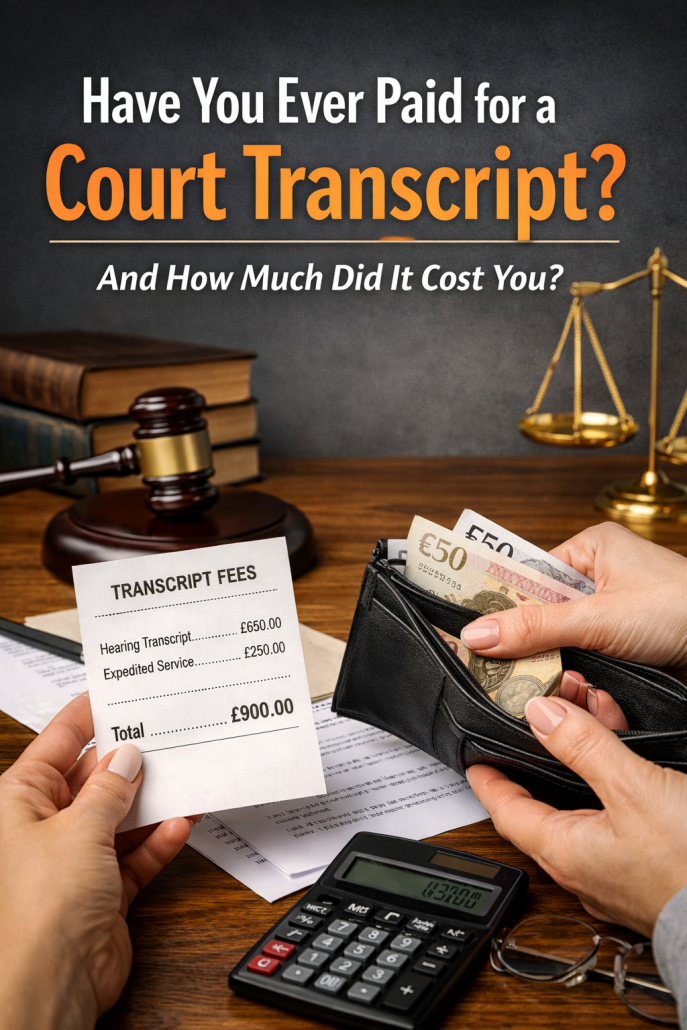
Have You Ever Paid for a Court Transcript — and How Much Did It Cost You?

Have you ever tried to get a transcript of your own court hearing — and been told it could cost hundreds, sometimes thousands of pounds? Most litigants in person don’t even realise transcripts aren’t automatically provided, let alone that access to the full record of what was said in their case sits behind a paywall. Yet that record can be the difference between a successful appeal and a dead end. With Parliament now debating whether court transcripts should be free, it raises a simple but uncomfortable question: should access to justice depend on your ability to pay for it?
Key Takeaways for Litigants in Person
  • You are entitled to a written court order or judgment — but this is NOT the same as a full transcript.
  • Transcripts can cost hundreds or thousands of pounds — creating a real barrier to appeals.
  • You can request transcripts using Form EX107 (and EX107H for sentencing remarks).
  • Part of the judge’s reasoning may appear in the order — but often crucial detail is missing.
  • If the other side drafts the order, it may not fully reflect what happened in court.

Have You Ever Paid for a Court Transcript — and How Much Did It Cost You?

This is not a theoretical question. It is a real, pressing issue for thousands of litigants in person across England and Wales.

A recent UK Parliament petition — “Make all court and tribunal transcripts available free of charge” — has brought the issue sharply into focus.

With over 200,000 signatures, it has now been debated in Parliament. The message from the public is clear:

Justice should not come with a price tag.


Why This Matters (Especially for Litigants in Person)

If you are representing yourself, your case does not end when you walk out of court.

What matters — often critically — is:

  • What the judge actually said
  • How findings were made
  • What reasoning underpins the decision

And here is the problem:

You usually don’t have access to that — unless you pay.

Transcripts are not automatically provided. In many cases, they must be:

  • Requested
  • Approved
  • Prepared by a transcription service
  • Paid for in advance

Costs can run into the hundreds or even thousands of pounds.


“But I Got a Court Order — Isn’t That Enough?”

No — and this is where many litigants in person are caught out.

The court order:

  • Summarises the outcome
  • May include limited reasoning
  • Is often drafted by one party’s legal representative

It does not capture:

  • The full judicial reasoning
  • Oral findings made during the hearing
  • Judicial comments on credibility or evidence

In practice, this means:

Key parts of your case may exist only in the courtroom — and nowhere else.

That becomes a serious problem if you need to:

  • Appeal
  • Challenge findings
  • Correct inaccuracies in an order

The Reality: A Paywall on Justice

The petition describes it plainly — and accurately:

A “paywall” for justice.

If you cannot afford a transcript, you are effectively locked out of:

  • Proper appellate review
  • Accountability of judicial reasoning
  • A complete record of your own case

For represented parties, this cost may be absorbed into legal fees.

For litigants in person, it is often prohibitive.


The Government’s Response (March 2026)

The Government has acknowledged the issue — but stopped short of committing to free transcripts.

Government Response (3 March 2026):

The Government is committed to strengthening transparency across the justice system and is already taking significant steps across all jurisdictions.

In the Crown Court, sentencing remarks are now published online in cases of significant public interest, and judges can also permit broadcasters to film Crown Court sentencing remarks, ensuring greater public visibility of judicial decisions. Victims of rape and serious sexual offences and bereaved families of victims of homicide, manslaughter and fatal road accidents are already entitled to free transcripts of Crown Court sentencing remarks.

These can be requested here: Apply for a transcript of a judge’s sentencing remarks: Form EX107H .

From Spring 2027, the Government is expanding free access to Crown Court sentencing remarks to all victims, ensuring these remarks are provided in time to support any application to the Unduly Lenient Sentencing Scheme.

In the family court, the Government is supporting increased publication of anonymised judgments and implementing Transparency Orders (effective 29 September 2025 for children’s cases).

In civil proceedings, parties already receive the written order or judgment without charge.

In tribunal proceedings, decisions and reasons are generally provided free of charge, with fuller reasons available on request in many cases.

However, the Government states that making all transcripts free would create significant financial and operational pressure. Producing transcripts is resource-intensive and requires careful quality assurance and compliance with reporting restrictions.

The Ministry of Justice is exploring the use of AI to produce transcripts more quickly and cost-effectively while maintaining accuracy and safeguarding standards.

Ministry of Justice


What This Means in Practice

The Government’s position is clear:

  • Transparency is increasing — but incrementally
  • Full free access to transcripts is not currently viable

That leaves litigants in person in a difficult position:

You are expected to navigate appeals and complex proceedings without access to the full record — unless you can afford it.


How to Request a Transcript (What You Need to Know)

If you decide you need a transcript:

  • You must complete Form EX107
  • Submit it to the court
  • Wait for judicial approval
  • Obtain a quote from an approved transcription provider

For sentencing remarks specifically, you can use:

Form EX107H — Apply for a transcript of a judge’s sentencing remarks

Before you apply, ask yourself:

  • Do I need the full hearing transcript — or just part?
  • Is there enough reasoning already in the order?
  • Can I narrow the request to reduce cost?

A Critical Point Most Litigants Miss

Part of the judgment is often embedded within the court order.

But here is the risk:

If the order is drafted by the other side’s barrister, it may:

  • Frame findings in their favour
  • Omit nuance
  • Exclude important oral reasoning

That is why:

You must always check the draft order against what actually happened in court.

If necessary, you can:

  • Challenge the wording
  • Submit your own draft
  • Request clarification from the judge

Where This Is Going: AI and the Future of Transcripts

The Government has signalled a clear direction:

AI-assisted transcription.

If implemented properly, this could:

  • Reduce costs dramatically
  • Increase accessibility
  • Improve consistency across courts

But until that becomes operational, the current system remains:

Expensive, slow, and unequal.


Final Thought — and a Question for You

If you have applied for a court transcript, your experience matters.

How much did it cost you?

Was it worth it?

And more importantly:

Should access to your own case depend on your ability to pay?


If you need support reviewing your court order, preparing for appeal, or deciding whether a transcript is necessary, you can book a consultation below.


Regulatory & Editorial Notice: JSH Law Ltd is not a firm of solicitors and does not provide regulated legal services. This article is for general information and strategic guidance only. It reflects publicly available materials and commentary on matters of public interest. Links to third-party content are provided for reference and do not imply endorsement.



Useful Links for Litigants in Person

Remote Hearings in Family Court (UK): What to Expect and How to Prepare

Remote hearings have become a permanent feature of the Family Court in England and Wales, not merely a temporary fix from the pandemic. Cases are now routinely listed by telephone or video link using secure platforms such as the Cloud Video Platform (CVP) or newer services introduced by HMCTS, and decisions about the mode of hearing are made by the judge based on fairness and access to justice. Remote hearings follow many of the same rules as in-person hearings, but require additional preparation, technology readiness and courtroom etiquette. Understanding how they work and how to prepare is essential for litigants in person.

Remote Hearings in Family Court (UK): What to Expect and How to Prepare

Key Takeaways for Litigants in Person

  • Remote hearings are now a permanent feature of Family Court in England and Wales.
  • They follow the same legal rules as in-person hearings — but require additional technical preparation.
  • You must treat a remote hearing with the same formality and respect as attending court physically.
  • Preparation includes technology checks, privacy safeguards, document readiness and clear communication structure.
  • Poor technical preparation can undermine credibility — evidence readiness still matters.
  • Structure, calm presentation and procedural awareness remain critical in a remote setting.

Introduction: Remote Hearings Are Here to Stay

Remote hearings were accelerated by the COVID-19 pandemic — but they are no longer a temporary measure. The Family Court now routinely lists hearings by telephone or video link where appropriate. Judges determine the mode of hearing based on fairness, practicality and the interests of justice.

For litigants in person, remote hearings can feel both convenient and disorientating. You may be attending from your home, yet participating in a formal judicial process. The setting may feel informal — but the legal consequences are not.

This guide explains how remote hearings work in Family Court, what technology is used, what is expected of you, and how to prepare strategically and professionally.


Official Overview: What Remote Hearings Look Like

The following official-style video provides a helpful overview of how remote court hearings operate in practice:

This video gives visual context for how remote hearings function and what to expect when joining by video.


What Platform Is Used?

Most Family Court remote hearings use:

  • Cloud Video Platform (CVP)
  • Microsoft Teams (in some courts)
  • Telephone conferencing systems

The joining link is usually sent by email in advance. It is your responsibility to check it works.

Guidance from HMCTS is available here:

What to Expect When Joining a Telephone or Video Hearing (GOV.UK)


Are Remote Hearings Legally Different?

No.

The same legal framework applies:

  • Family Procedure Rules 2010
  • Practice Directions (including PD12J and PD27A where relevant)
  • The Children Act 1989 welfare principle (in children cases)

The judge’s powers and expectations remain unchanged.

The only difference is the format of attendance.


When Are Remote Hearings Typically Used?

  • Case Management Hearings
  • Directions Hearings
  • FHDRA hearings
  • Short interim applications
  • Procedural reviews

Fact-finding hearings and final hearings may sometimes still take place remotely, but judges consider complexity, evidence type, and fairness.


Advantages of Remote Hearings

  • No travel costs
  • Reduced time off work
  • Increased listing flexibility
  • Potentially less intimidating environment

Risks of Remote Hearings

  • Technical failures
  • Connectivity interruptions
  • Reduced ability to read courtroom dynamics
  • Distractions in home environments
  • Risk of informal tone creeping in

Preparation neutralises these risks.


Technical Preparation Checklist

Before the Hearing:

  • Test your internet connection.
  • Use a laptop where possible (not just a phone).
  • Charge devices fully.
  • Have a backup device ready.
  • Ensure camera and microphone function.
  • Download required apps in advance.
  • Join the hearing 10–15 minutes early.

Environment Preparation:

  • Quiet room.
  • Neutral background.
  • No interruptions.
  • Phones on silent.
  • Children supervised elsewhere.

Remote Hearing Etiquette

Even though you are at home, you are in court.

  • Dress professionally.
  • Address the judge appropriately (Sir/Madam/Your Honour as applicable).
  • Mute when not speaking.
  • Do not interrupt.
  • Do not record the hearing without permission.

Recording without permission may amount to contempt.


Document Readiness in a Remote Setting

Remote hearings require heightened document awareness.

  • Have the bundle open on screen or printed.
  • Know page numbers in advance.
  • Use bookmarks in PDFs where possible.
  • Prepare a short position statement.
  • Prepare a list of key page references.

In remote hearings, clarity replaces physical presence.


Communication Strategy

When speaking remotely:

  • Speak slowly.
  • Pause before responding.
  • Use page references clearly (“Bundle page 124, paragraph 6”).
  • Avoid talking over others.
  • Keep submissions structured.

Remote platforms amplify confusion. Structure prevents it.


Safeguarding and Privacy

Remote hearings remain confidential.

  • No one else should be in the room unless permitted.
  • No recording or streaming.
  • Ensure no background conversations.

Family proceedings are private.


If Technology Fails

  • Rejoin immediately.
  • Email the court promptly.
  • Have a backup phone number ready.

Judges understand occasional technical issues — but preparation reduces disruption.


Remote Hearings and Credibility

Judges assess credibility even remotely.

  • Eye contact with the camera.
  • Composed tone.
  • Professional setting.
  • Structured responses.

Remote does not mean relaxed standards.


Working With a McKenzie Friend in a Remote Hearing

If supported:

  • Clarify how you will communicate privately (e.g., WhatsApp messages during hearing).
  • Agree speaking boundaries.
  • Ensure the court knows they are present.

Remote coordination requires planning.


After the Hearing

  • Write down key points immediately.
  • Review the order carefully once received.
  • Calendar deadlines.
  • Prepare next steps promptly.

Common Mistakes to Avoid

  • Joining late.
  • Unstable internet.
  • Interrupting.
  • Appearing casual.
  • Being unprepared with documents.
  • Emotional over-speaking.

Remote hearings reward disciplined preparation.


Is a Remote Hearing Fair?

The court must ensure fairness. If you believe remote format prejudices your ability to present your case (e.g., complex evidence or vulnerability concerns), you may raise this with the court in advance.

The judge decides.


Why Remote Hearing Competence Matters

Remote hearings compress time. Judges expect focused submissions.

Disorganisation becomes more visible in digital format.

Technical fluency is now part of courtroom competence.


How JSH Law Supports Remote Hearing Preparation

  • Pre-hearing checklist review.
  • Technology readiness planning.
  • Structured speaking notes.
  • Bundle navigation strategy.
  • Safeguarding awareness integration.

Preparation reduces anxiety.


Book a 15-Minute Consultation


Useful Links


Regulatory & Editorial Notice

This article is provided for general information only and does not constitute legal advice. Each case depends on its own facts and procedural context.

JSH Law provides litigation support services to litigants in person. JSH Law is not a firm of solicitors and does not undertake reserved legal activities.