
 © 2026 JSH Law Ltd. All rights reserved.
Neurodivergent Children and the Family Court | JSH Law
A child can look calm in a Cafcass interview, survive a handover without crying and say they are “fine”—then spend the next two days unable to sleep, attend school or regulate at all. Too often, that reality is missed. Their distress is labelled defiance, inconsistency, manipulation or a parent’s influence before anyone properly asks what it is like for that particular child to move between homes, cope with uncertainty, process adult questions or recover from overload. A neurodivergent child is not a standard child with a difficult behaviour problem. And the Family Court cannot make a genuinely child-centred decision unless it understands the child in front of it, rather than the one it expects to see.
Family Court Reality | Neurodivergence
A Neurodivergent Child Is Not a Standard Child With a Difficult Behaviour Problem
A recent episode of Family Law in the UK asks what happens when a system built around standard assumptions about routine, communication and resilience makes decisions for a child whose brain does not work in a standard way.
It is an important conversation. In the Family Court, misunderstanding neurodivergence can distort the evidence, silence the child and produce arrangements that look equal on paper but are unworkable in real life.
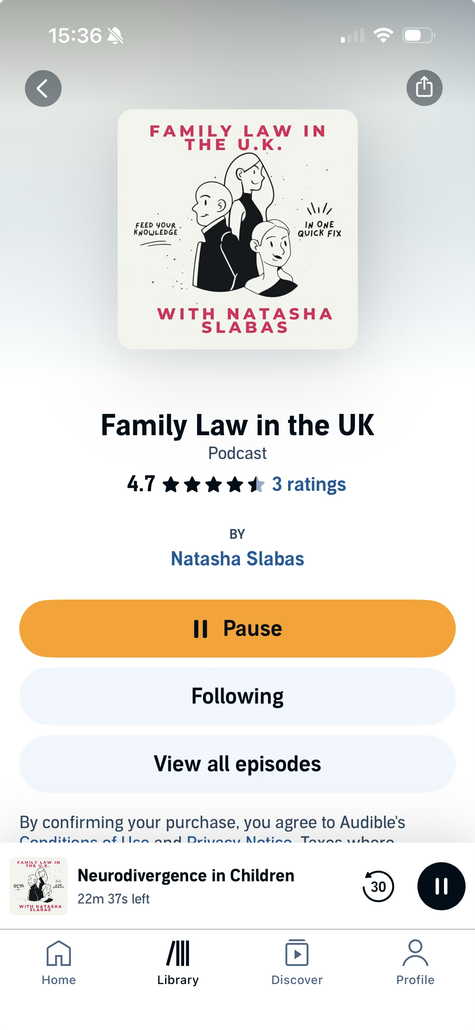
I listened to the episode Neurodivergence in Children from the podcast Family Law in the UK, hosted by family solicitor Natasha Slabas, and immediately thought that more parents going through separation need to hear this discussion.
Natasha is joined by Rosemary Budden, a barrister at Queen Elizabeth Building who also sits as a private FDR judge, and Samantha Jago, a senior family lawyer and head of DMH Stallard’s Guildford family team. Samantha also speaks from personal experience as the parent of a teenager with severe ADHD. That combination matters. The episode is not an abstract discussion about labels. It is about what neurodivergence looks like in daily family life and what can go wrong when a court process does not understand it.
The central message I took from the episode is simple:
“The law cannot properly determine a neurodivergent child’s welfare unless the evidence explains how that particular child experiences the world.”
That sounds obvious. Yet family proceedings repeatedly convert complex lives into short statements, fixed handover times, alternating weekends and competing parental narratives. The danger is that a child’s distress is then interpreted through the conflict between the adults instead of through the child’s neurological, sensory, developmental and communication needs.
Neurodivergence is not one thing
“Neurodivergence” is an umbrella term rather than a single medical diagnosis. It may include autism, ADHD, dyspraxia, dyslexia, learning disabilities, Tourette syndrome and differences in sensory processing. Children may have more than one condition. Some will have a formal diagnosis; others will be awaiting assessment or have needs that are visible long before a diagnostic pathway is completed.
Nor will two children with the same diagnosis necessarily have the same needs. One autistic child may find transitions exceptionally difficult. Another may cope with change if it is predictable and visually explained. One child with ADHD may struggle primarily with time, impulse control and emotional regulation. Another may mask throughout school and collapse only when they reach the safety of home.
This is why a diagnosis should never become a substitute for evidence. “The child has autism” is not a welfare analysis. The court needs to know what that means for this child: their communication, sleep, food, schooling, sensory environment, attachments, regulation, medication, routines, travel, transitions and recovery after stress.
A crucial point
A child does not need to perform distress in a way that adults recognise before the distress is real.
A shutdown may be mistaken for calmness. Avoidance may be called defiance. Repetition may be treated as coaching. A delayed reaction after contact may be dismissed because the child appeared “fine” at handover. Masking may mean that the adults who see the child briefly observe something entirely different from the parent who supports the child afterwards.
The legal test is welfare—but welfare must be individual
In private children proceedings in England and Wales, the child’s welfare is the court’s paramount consideration under section 1 of the Children Act 1989. The welfare checklist requires the court to consider, among other matters:
- the child’s ascertainable wishes and feelings, considered in the light of their age and understanding;
- their physical, emotional and educational needs;
- the likely effect of any change in their circumstances;
- their age, background and any characteristics the court considers relevant;
- any harm they have suffered or are at risk of suffering; and
- how capable each parent is of meeting their needs.
For a neurodivergent child, those factors are inseparable from the child’s functioning. A change that appears minor to an adult—different bedding, an unfamiliar smell, a changed journey, a disrupted bedtime or uncertainty about who will collect them—may have a significant cumulative effect. The legal question is not whether another child of the same age ought to cope. It is how this child is likely to be affected.
Equal time is not automatically equal welfare
One of the episode’s most useful themes is the effect of moving between households. Family courts understandably seek to preserve a child’s meaningful relationship with both parents where it is safe. But that aim cannot be reduced to arithmetic.
A schedule may look balanced because the nights are evenly divided. It may nevertheless impose repeated transitions, forgotten equipment, changes of sensory environment, competing routines and exhausting journeys. For a child who depends on predictability, the true cost may appear in school refusal, sleep disruption, meltdowns, shutdowns, anxiety, toileting problems or days needed to regulate afterwards.
The answer is not necessarily less time with a parent. It may be fewer handovers, longer blocks, consistent belongings in both homes, identical visual calendars, protected recovery time, agreed language, calmer transfer arrangements or a gradual plan. In some families, creative solutions such as “nesting”—the child remaining in one home while the parents rotate—may be considered. Nesting will not be practical or affordable for everyone, and it can generate its own boundaries and conflict. The point is that the court’s toolbox should be wider than a standard alternate-weekend template.
Listening to the child requires more than asking a question
The statutory reference to “ascertainable” wishes and feelings is important. It recognises that the task is to discover the child’s actual perspective, not merely to record the answer obtained through one conversation conducted in an adult-designed format.
A neurodivergent child may:
- interpret questions literally;
- need additional processing time;
- agree in order to end an uncomfortable interaction;
- struggle with open-ended or hypothetical questions;
- communicate more reliably through writing, drawing, visual tools or familiar augmentative communication;
- mask distress in front of an unfamiliar professional;
- find eye contact or a formal interview environment overwhelming;
- give different accounts in different settings because their sense of safety and regulation differs; or
- be unable to explain the cause of a powerful bodily response.
None of those features proves that a child’s account is accurate or inaccurate. They do mean that communication method, context and professional skill matter. A child’s voice is not properly heard merely because an adult asked, “Where do you want to live?” and wrote down the answer.
The court must also avoid two opposite errors. It should not dismiss genuine wishes because the child communicates differently. Equally, it should not place on the child the burden of choosing between parents. Wishes and feelings are part of welfare, not a referendum and not a shortcut around careful analysis.
Behaviour is evidence—but it needs interpretation
Family cases are full of disputed explanations. One parent may say a child is dysregulated after contact. The other may say the reporting parent is anxious, hostile or influencing the child. The court may hear that the child behaves well in one home and struggles in the other.
The correct response is not to leap to whichever narrative sounds simplest. It is to ask better questions:
- What happened before, during and after the behaviour?
- Is there a repeated pattern linked to transitions, sensory load, sleep, school or uncertainty?
- Does the child mask outside a safe environment?
- What do school, health and other independent records show?
- Are both homes implementing the same strategies?
- Has the child’s communication profile been understood?
- Could trauma, domestic abuse, attachment, developmental difference and neurodivergence be interacting?
- What alternative explanations have actually been tested?
This is particularly important where allegations of manipulation or “parental alienation” enter a case. Neurodivergent distress must not be casually converted into evidence against a parent. Nor should a diagnostic label be used to avoid examining abuse, harmful parenting or other causes of reluctance, resistance or refusal. The court must undertake a disciplined causal analysis. Diagnosis, trauma and family dynamics can coexist.
What evidence helps?
The podcast makes a practical distinction. Where parents agree about the nature and effect of the child’s needs, an agreed written summary at an early stage may narrow the dispute and help the court focus on workable arrangements. Where the parents materially disagree, independent evidence may be necessary.
Useful material can include:
- diagnostic or assessment reports;
- Education, Health and Care Plan documents and SEN support plans;
- occupational therapy, speech and language therapy or paediatric evidence;
- school attendance, exclusion, behaviour and pastoral records;
- existing professional recommendations about routine, communication or sensory regulation;
- a short, neutral schedule of the child’s daily needs;
- a focused chronology of changes and observable responses;
- handover or regulation records that are factual rather than argumentative; and
- proposals explaining how each parent will meet the same identified needs.
Parents should resist the temptation to file every message, photograph and diary entry without structure. Volume is not the same as proof. A court is more likely to understand the issue if the evidence identifies the proposition, the source and the practical consequence for the proposed order.
Expert evidence in children proceedings is controlled by the court and must be necessary to assist it to resolve the proceedings justly. A parent should not privately commission an expert report for use in the case without first understanding the procedural rules. Sometimes the best evidence already exists in the child’s treating or educational records. In other cases, a jointly instructed and appropriately qualified expert may be required. The question should be focused: not simply “Does this child have autism?”, but what arrangements, communication methods or transition plan are required in light of the child’s presentation?
Make the evidence do a job
For each document, ask: what fact does this prove, where does it come from, and what practical difference should it make to the order? A smaller, well-organised body of evidence will often be more useful than hundreds of pages without explanation.
The housing issue exposes a gap in the law
One of the hardest parts of the episode concerns housing after separation. Samantha describes a financial remedy case involving a severely autistic, almost non-verbal child whose dependence on a familiar home and routine was not, in her view, given sufficient weight before sale of the property was ordered.
The legal distinction matters. In Children Act proceedings, the child’s welfare is paramount. In financial remedy proceedings, under section 25 of the Matrimonial Causes Act 1973, the court gives first consideration to the welfare of any minor child of the family while assessing the full statutory circumstances. The child’s welfare is not the paramount consideration in the same way.
There are obvious reasons why a financial court cannot preserve every family home. Resources may be insufficient to house two households without sale. Mortgage capacity, income, debts and both parties’ needs matter. But the episode raises a legitimate question: does “first consideration” do enough work when moving home is not merely upsetting but potentially destabilising in a profound and predictable way for a disabled or neurodivergent child?
At a minimum, the evidence should translate the child’s needs into practical financial consequences. Could sale be deferred? Is a longer transition required? Must alternative accommodation preserve a particular layout, school placement or quiet space? Would additional bedrooms be needed for regulation, carers or specialist equipment? What is the cost of suitable accommodation rather than generic accommodation? A bare assertion that the child “needs stability” is much easier to overlook than properly evidenced housing requirements and realistic options.
Neurodivergent parents matter too
Although this episode focuses on children, the same proceedings may involve a neurodivergent parent. Court forms, rapid oral exchanges, ambiguous directions, noisy waiting areas, remote hearings, executive-function demands and the expectation that a distressed person will organise thousands of pages can create real participation barriers.
Under Part 3A of the Family Procedure Rules and Practice Direction 3AA, the court must consider whether a party’s participation or the quality of a person’s evidence is likely to be diminished by vulnerability and whether participation directions are needed. Depending on the person and the hearing, practical measures might include clear written agendas, breaks, additional processing time, questions in plain language, reduced sensory load, permission to use assistive technology or communication support.
An adjustment is not an unfair advantage. It is a means of enabling effective participation. A parent who communicates differently should not be mistaken for evasive, cold, aggressive or lacking insight without careful consideration of other explanations.
What parents can ask the court to consider
If neurodivergence is relevant to your child’s case, focus on needs and consequences rather than the label alone. Depending on the facts, it may help to ask for:
- a concise agreed profile of the child, if agreement is possible;
- directions for identified school, health or therapy records;
- carefully framed expert evidence where it is genuinely necessary;
- a child-appropriate method of obtaining wishes and feelings;
- a parenting plan dealing expressly with routine, medication, communication, sensory needs and transitions;
- fewer or differently timed handovers;
- a gradual introduction or review period;
- consistent visual calendars and language across homes;
- a plan for school equipment, comfort items and medication;
- participation directions for a neurodivergent parent or witness; and
- reasons explaining how the final arrangements meet the child’s identified additional needs.
Keep proposals specific. “The child needs routine” is a starting point. “The child requires the same bedtime sequence, no school-morning handover, 48 hours’ visual notice of changes and their communication device in both homes” gives the court something it can understand and, if appropriate, build into an arrangement.
The deeper problem: systems mistake compliance for coping
This podcast matters because it exposes a structural weakness in family justice. Courts deal in events: an application, an interview, a hearing, a handover. Neurodivergent children often experience the cumulative load between those events. The system sees the child enter a room quietly. It may not see the preparation required to get them there, the masking while they are present or the collapse afterwards.
A genuinely child-centred system would not ask only whether contact happened. It would ask what it cost the child, what helped, what caused dysregulation and what should change next time. It would not assume that the absence of visible distress proves the absence of difficulty. It would recognise that predictability, communication and sensory safety are not optional comforts. For some children, they are the conditions that make family relationships possible.
That requires better training for judges, lawyers, Cafcass officers, social workers and everyone who gathers a child’s wishes and feelings. It also requires humility. Professionals should be able to say: “The child’s response does not make sense under my current assumptions, so I need better evidence,” rather than forcing the child into a familiar adult narrative.
My view
The Family Court does not need a separate concept of justice for neurodivergent children. It needs to apply the welfare principle properly: individually, evidentially and without treating a standard arrangement as a neutral starting point.
The order that appears simplest for adults may be the most demanding for the child. The child who looks calm may be working the hardest to cope. The parent reporting distress may be describing what happens outside the professional’s narrow window of observation. And the label attached to behaviour may determine the direction of a case unless somebody stops and asks what else the evidence could mean.
Natasha Slabas, Rosemary Budden and Samantha Jago have opened a valuable conversation. The next step is to turn that understanding into practice: better questions, better evidence, more imaginative arrangements and decisions that describe the actual child—not an imaginary average one.
Practical support from JSH Law
Does your child’s neurodivergence need to be explained more clearly to the Family Court?
JSH Law supports litigants in person to turn a complex history into clear, child-focused material the court can actually use. This may include organising records, identifying welfare issues, preparing chronologies and schedules, responding to Cafcass material, drafting court documents and developing practical proposals for hearings.
You do not need to arrive with a perfectly organised case. The purpose of support is to help you make sense of what matters and present it calmly, proportionately and effectively.
Book a 15-minute initial telephone consultation
Choose an available appointment below to tell me briefly what is happening and discuss whether JSH Law may be able to support you.
If the booking form does not display, please visit the JSH Law contact page.
Listen and read further
- Neurodivergence in Children, Family Law in the UK — the podcast episode discussed in this article.
- Queen Elizabeth Building: Rosemary Budden’s episode note.
- Children Act 1989, section 1.
- Matrimonial Causes Act 1973, section 25.
- Family Procedure Rules 2010, Part 3A.
About the author
Jessica Susan Hill | JSH Law
Jessica writes about the reality of navigating family proceedings, with a particular focus on evidence, domestic abuse, safeguarding, children’s welfare, procedural fairness and practical support for litigants in person.
 © 2026 JSH Law Ltd. All rights reserved.
 © 2026 Jessica Susan Hill / JSH Law. All rights reserved.
 jsh law ltd
 © 2026 JSH Law Ltd. All rights reserved.
Leave a Reply
Want to join the discussion?Feel free to contribute!