
 © 2026 JSH Law Ltd
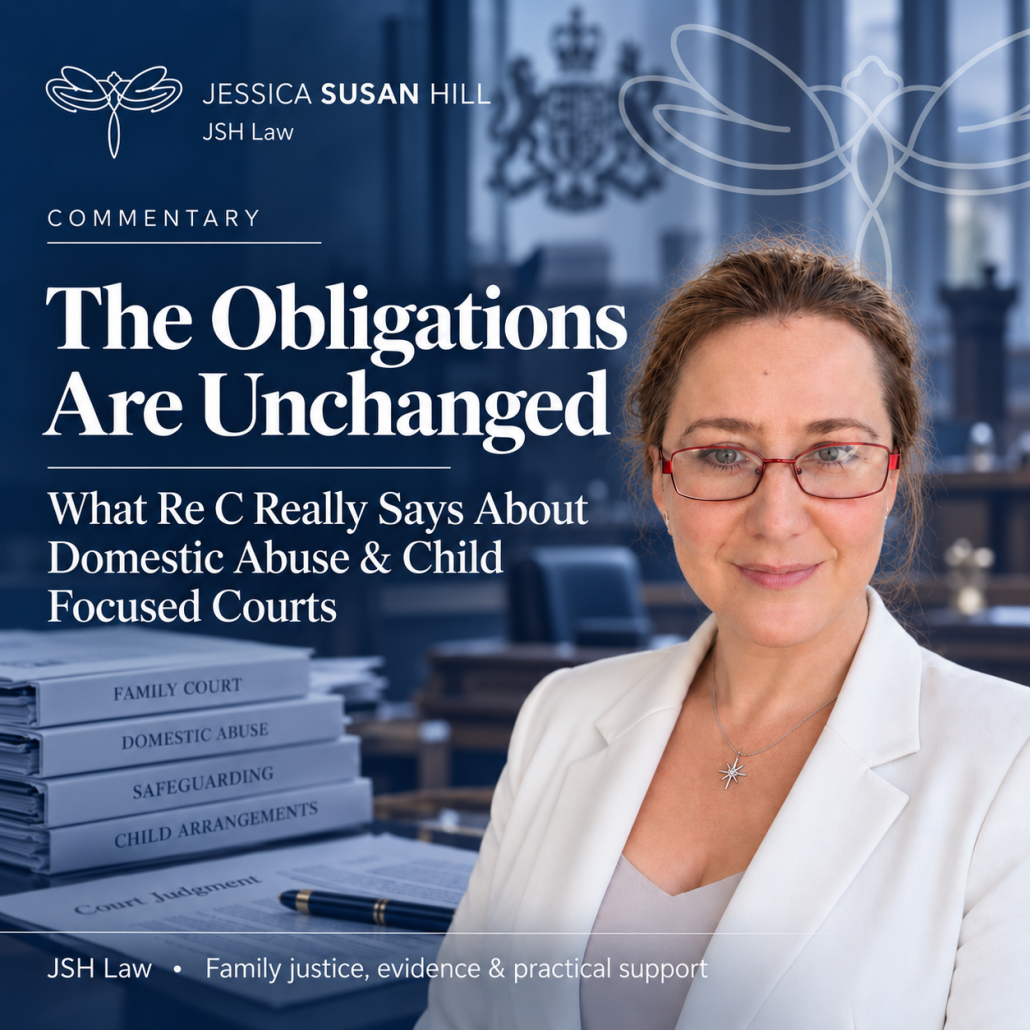
“The Obligations Are Unchanged”: What Re C Really Says About Domestic Abuse in Child Focused Courts
“The obligations imposed on the Family Court where domestic abuse is alleged or established are unchanged.”
That sentence from Re C (Child Arrangements Orders; Domestic Abuse; Child Focused Court) [2026] EWCA Civ 1216 is already attracting attention.
It is easy to read it as saying that nothing has changed.
That is not what the Court of Appeal said.
Sir Stephen Cobb, President of the Family Division, said something considerably more important:
the procedure may change, the culture may change and the court model may change — but the legal obligations owed where domestic abuse is alleged or established do not become weaker because a case is being dealt with more quickly or more informally.
That matters.
But it does not answer the separate question of whether those obligations are being implemented consistently in practice.
“Unchanged” should not mean unreformed.
It should mean that reform cannot dilute safeguarding.
The key point from Re C
The Child Focused Court model has changed the procedure and culture of private children proceedings.
It is intended to be less adversarial, more investigative and more focused on the lived experience of children and victim-survivors of domestic abuse.
But it has not replaced the underlying law.
The welfare of the child remains paramount. Practice Direction 12J still applies. The established law on domestic abuse, coercive control, welfare and fact-finding still applies. A faster process is not permission to apply a lower safeguarding standard.
Five things to understand about the judgment
1. Re C does not say domestic abuse safeguards are unnecessary.
It says they continue to apply within the Child Focused Court model.
2. Re C does not say fact-finding hearings are obsolete.
The question remains whether findings are necessary to provide a safe and reliable basis for assessing risk and welfare.
3. Admissions are not automatically enough.
Limited admissions may still leave the court without the factual picture needed to understand coercive or controlling behaviour.
4. Agreement must be genuine and informed.
A streamlined model cannot turn agreement into a procedural shortcut where domestic abuse is relevant.
5. The Court of Appeal did not rule that the Child Focused Court model works perfectly.
It expressly said the appeal was not concerned with the merits of the model itself.
What did Re C actually say?
Re C was the first Court of Appeal judgment to consider a decision made under the Child Focused Court model.
The case concerned four children and a significant history of domestic abuse.
The father had previously admitted a range of abusive behaviours, including controlling behaviour towards the mother and behaviour which had affected the children.
Later proceedings were dealt with under the Child Focused Court process.
A Child Impact Report recommended that direct contact should stop.
The first-instance judge did not follow that recommendation in full.
Instead, the judge ordered limited supervised direct contact subject to safeguards.
The mother appealed on a number of grounds.
Her case included arguments that:
- the father’s domestic abuse and post-separation behaviour had not been properly evaluated;
- the judge should not have departed from the professional recommendation;
- the proceedings had been dealt with too summarily;
- the Child Focused Court approach had restricted her ability to present her case properly;
- the judge should have dealt differently with parental responsibility and protective orders; and
- a section 91(14) restriction should not have been imposed upon her.
The Court of Appeal dismissed most of the appeal.
It concluded that the first-instance judge had properly understood the established domestic-abuse history, considered PD12J and was entitled on the evidence to order limited supervised contact.
But the appeal was not dismissed completely.
The mother succeeded in challenging the section 91(14) order made against her.
What does “the obligations are unchanged” really mean?
The most important passage comes from the Court of Appeal’s general observations about the Child Focused Court model.
The court identified two propositions which must be read together.
| What has changed? | What has not changed? |
|---|---|
| The procedural model | The Children Act 1989 welfare framework |
| A less conventionally adversarial approach | The court’s obligations under PD12J |
| Earlier information gathering | The need to analyse domestic abuse properly |
| Greater reliance on Child Impact Reports | Judicial responsibility for deciding welfare and disputed facts |
| A problem-solving and investigative culture | The requirement for procedural fairness |
This is why the word unchanged should not be read as a defence of the status quo.
It is better understood as a statement about legal continuity.
The new court process cannot sidestep the substantive safeguards which already exist.
That is potentially important for victim-survivors.
If a new procedure is designed to reduce delay, reduce hearings and resolve disputes earlier, the danger is obvious:
efficiency can become pressure.
Re C makes clear that efficiency does not replace PD12J.
What does the judgment not mean?
There is a risk that a single sentence from a judgment becomes detached from everything around it.
So it is worth being very clear.
“The obligations are unchanged” does not mean:
- the Family Court has nothing left to reform;
- domestic abuse is always identified or assessed correctly;
- every Child Focused Court hearing is procedurally fair;
- fact-finding hearings are no longer necessary;
- a limited admission automatically gives the court enough information;
- Cafcass recommendations must always be accepted;
- Cafcass recommendations can replace judicial findings;
- speed is more important than effective participation; or
- the Court of Appeal has endorsed every aspect of the Child Focused Court model.
Indeed, Sir Stephen Cobb expressly said the appeal was not concerned with the merits of the Child Focused Court model itself.
The question before the Court of Appeal was whether the principles had been applied lawfully and fairly in this particular case.
That distinction matters.
The real problem: law on paper versus implementation
This is where criticism of the Family Court remains legitimate.
The existence of a legal obligation does not prove that the obligation is consistently delivered.
PD12J can say that domestic abuse must be identified and properly analysed.
That does not automatically mean every allegation of coercive control will be recognised accurately in every courtroom.
A court procedure can require meaningful participation.
That does not automatically mean every frightened or traumatised parent will feel able to explain their case.
A rule can require holistic assessment.
That does not guarantee that professionals will stop reducing a pattern of behaviour to disconnected incidents.
This is not an abstract concern.
Rights of Women intervened in Re C precisely because of concerns about implementation.
It acknowledged improvements within the Child Focused Court model, including better early information and more children being heard.
But it also raised concerns that some survivors report:
- being rushed;
- not having sufficient time to prepare;
- not having enough opportunity to explain their position;
- limited admissions being treated as sufficient when they may minimise the alleged pattern; and
- language such as “high conflict” or “toxicity” obscuring domestic abuse.
That is the issue JSH Law has repeatedly described as the implementation gap.
The right rule badly implemented can still produce an unsafe result.
The answer is not necessarily another rule.
Sometimes the harder work is ensuring the existing rule is recognised, evidenced and applied properly.
Has your domestic-abuse evidence been reduced to “conflict”?
One of the most difficult problems for a litigant in person is not simply gathering evidence.
It is showing the court the difference between:
- ordinary parental disagreement;
- individual unpleasant incidents;
- post-separation abuse;
- a pattern of coercive or controlling behaviour; and
- behaviour which affects the child’s welfare or the safety of arrangements.
JSH Law can provide defined-scope support with:
- domestic-abuse chronologies;
- evidence audits;
- schedules of allegations and responses;
- witness-statement preparation;
- C1A preparation support;
- Child Impact Report and Cafcass response documents;
- position statements;
- hearing preparation; and
- appeal paperwork where appropriate.
Re C does not abolish fact-finding — it reinforces the test of necessity
Another part of the judgment deserves careful attention.
Not every allegation of domestic abuse requires a separate fact-finding hearing.
That is not new.
The relevant question is whether findings are necessary to provide a reliable basis for assessing risk and making the welfare decision.
PD12J directs the court to consider matters including:
- whether admissions already provide a sufficient factual basis;
- whether other evidence provides a sufficient factual basis;
- whether the disputed allegations would materially affect the issues before the court;
- what evidence would be needed to resolve the allegations; and
- whether a separate fact-finding hearing would be necessary and proportionate.
The January 2026 amendments to PD12J also make the need for holistic analysis particularly clear.
Where a schedule or table is used, it can include examples of an alleged pattern of coercive and controlling behaviour so that the judge can consider the alleged abuse holistically rather than focusing only on isolated incidents.
The question is not simply: “Was something admitted?”
The question is whether the admissions, evidence and existing findings give the court a sufficiently reliable factual foundation to assess harm, future risk and welfare safely.
Why limited admissions need scrutiny
This is one of the most important parts of Re C for domestic-abuse cases.
Rights of Women warned against limited admissions being treated as a convenient substitute for findings where those admissions minimise the alleged abuse or fail to address the alleged pattern.
Cafcass and Cafcass Cymru made a similar point.
The Court of Appeal accepted that an incomplete factual picture may be insufficient for an accurate assessment of risk or a safe welfare outcome.
Example
An alleged perpetrator may admit:
“I sent too many messages after separation.”
But the allegation may actually be that the messages formed part of a wider pattern involving:
- monitoring;
- threats;
- intimidation;
- financial pressure;
- using the children to obtain information;
- repeated boundary breaches; and
- litigation used as a continuation of control.
The admission may therefore be relevant.
But it may not resolve the issue the court needs to understand.
This is why an admission should not become a box-ticking exercise.
Agreement must be genuine and informed
There is another sentence in Re C which deserves at least as much attention as the “unchanged obligations” quotation.
The President accepted the submission of Rights of Women that judges and magistrates should satisfy themselves that an agreement is genuine and informed.
That is important within a model which actively encourages earlier resolution.
Agreement can be beneficial.
It can reduce conflict, delay, cost and the emotional burden upon children.
But agreement in a domestic-abuse case needs careful scrutiny.
A person saying “yes” does not automatically establish that:
- they feel safe;
- they understand the proposed order;
- they have had adequate time to consider it;
- they understand the practical consequences;
- fear has not influenced their decision;
- economic pressure is not operating;
- coercive control is not affecting their decision-making; or
- they have had a meaningful opportunity to participate.
This is precisely why procedural reform cannot be measured only by how quickly cases close.
A faster Family Court is not automatically a safer Family Court
The Child Focused Court model has been promoted partly because of its ability to reduce delay.
Delay matters.
Children should not spend unnecessary months or years living inside unresolved parental litigation.
Victim-survivors should not be repeatedly retraumatised by unnecessary hearings.
But speed creates its own risk if it becomes the dominant measure of success.
A hearing can be short because the issues were identified brilliantly.
Or it can be short because somebody was not heard.
A case can resolve early because the evidence was gathered properly.
Or it can resolve early because a party felt unable to resist an unsafe proposal.
Those are not the same thing.
The correct question is not simply: “How quickly did the case finish?”
It is: “Was the child-focused decision reached safely, fairly and on a sufficient evidential foundation?”
That is why the Court of Appeal’s insistence that the substantive domestic-abuse obligations remain unchanged should be treated as a safeguard, not a defence of poor practice.
What does Re C mean for Cafcass and Child Impact Reports?
Re C also reinforces an important distinction between professional assessment and judicial decision-making.
The Family Court is not bound to follow Cafcass or Cafcass Cymru.
A Child Impact Report is influential evidence.
It is not the judgment.
The court remains responsible for deciding the child’s welfare.
But there is an equally important point in the opposite direction.
A Cafcass assessment cannot silently convert disputed allegations into established facts.
Re C refers directly to Re D (Change of Circumstances: Domestic Abuse Allegations) [2026] EWCA Civ 969.
In Re D, the Court of Appeal held that problems arise where a welfare recommendation materially depends upon disputed allegations being treated as true even though the court has made no findings.
If disputed abuse becomes material to the professional recommendation, the question of whether fact-finding is required may need to be revisited.
The correct analysis is therefore neither:
“Cafcass said it, therefore the judge must follow it.”
nor:
“The judge can ignore Cafcass because it is only a recommendation.”
The real questions are:
- What evidence underpins the recommendation?
- What is allegation?
- What is admitted?
- What has been judicially found?
- What remains disputed?
- Has the welfare checklist actually been applied?
- Does the recommendation depend upon facts the court has never determined?
The mother’s appeal did succeed on section 91(14)
It is also inaccurate to describe Re C simply as a complete rejection of the mother’s case.
The Court of Appeal allowed her appeal against the section 91(14) order insofar as it applied to her.
A section 91(14) order restricts a person’s ability to make further Children Act applications without first obtaining permission.
The first-instance judge had imposed the restriction upon both parents.
The Court of Appeal concluded that the necessary analysis had not been carried out in relation to the mother.
Sir Stephen Cobb said it was wrong to equate her litigation conduct or contribution to the continuation of proceedings with that of the father.
That is a significant point.
In domestic-abuse cases, apparent symmetry can itself become misleading.
Two people may both have made applications.
Two people may both be involved in continuing litigation.
That does not automatically mean their conduct, motivation, risk or responsibility is equivalent.
What should a litigant in person take from Re C?
1. Identify the actual domestic-abuse issue early
Do not rely only on labels such as “toxic”, “high conflict” or “controlling”. Explain the behaviour and its pattern.
2. Separate allegations, admissions and findings
A judge needs to know which facts are already established and which remain disputed.
3. Explain why unresolved facts matter
A fact-finding hearing is not ordered simply because allegations exist. Explain why determining them is necessary for risk, welfare or the order sought.
4. Read the Child Impact Report critically
Identify what evidence supports each recommendation and whether the report treats disputed material as established.
5. Do not assume the court must follow Cafcass
But if asking the court to depart from a professional recommendation, explain the evidential and welfare basis for doing so.
6. Record post-separation abuse properly
Do not assume historic findings tell the court everything it needs to know about current risk.
7. If agreement is proposed, understand it before agreeing
Ask what the order will actually mean in practice.
8. If participation is difficult, say so
Trauma, disability, communication difficulty and domestic abuse can affect effective participation. Appropriate directions and measures may need to be considered.
9. Make the welfare link
Domestic-abuse evidence is not simply evidence of wrongdoing between adults. Explain its relevance to the child’s safety, emotional wellbeing and proposed arrangements.
10. Make the court’s job easier
A clear chronology, focused schedule, evidence map and concise position statement can make a complex pattern easier to understand.
Apply the JSH Law Six-Question Check
Re C is a good example of why the JSH Law Six-Question Check matters.
Where does the domestic-abuse information come from?
Is it allegation, admission, professional opinion or judicial finding?
Is an incident being viewed alone when it forms part of a wider pattern?
Has each party had a fair opportunity to understand and respond?
What does the behaviour mean for the child’s safety and welfare?
What does the court actually need to decide or protect against?
This is particularly useful where a case contains a mixture of historic findings, new allegations, professional concerns and proposed agreements.
“Unchanged” should be a floor, not a ceiling
Re C should not be used to argue that the Family Court’s treatment of domestic abuse does not need to improve.
Nor should it be represented as the Court of Appeal abandoning reform.
The judgment says something more precise.
The Child Focused Court model may alter procedure dramatically.
It may reduce hearings.
It may collect information earlier.
It may become less conventionally adversarial.
It may resolve cases faster.
But none of those changes permits the court to downgrade its existing responsibilities where domestic abuse is alleged or established.
That is the legal position.
The policy challenge is harder:
Can the Family Court make those obligations real in every case — not merely leave them written correctly in the rules?
That is where scrutiny should now be focused.
The standard is not simply whether the Family Court has the right rules.
It is whether a child and victim-survivor can see those rules operating in the decisions which affect their lives.
Need help presenting domestic-abuse evidence clearly?
JSH Law provides defined-scope family-court support for litigants in person in England and Wales.
Depending on the agreed scope, support can include:
- domestic-abuse and post-separation abuse chronologies;
- evidence organisation and source mapping;
- schedules of allegations and responses;
- witness-statement preparation support;
- Child Impact Report and Cafcass analysis;
- position statements;
- PD12J-focused case preparation;
- appeal paperwork;
- court-bundle preparation support; and
- hearing preparation and McKenzie Friend support where appropriate.
Related JSH Law analysis
Primary and official sources
- Re C (Child Arrangements Orders; Domestic Abuse; Child Focused Court) [2026] EWCA Civ 1216 — Court of Appeal
- Practice Direction 12J — Child Arrangements and Contact Orders: Domestic Abuse and Harm
- Practice Direction 36Z / PD12B (Pilot) — Private Law Reform: Investigative Approach
- Ministry of Justice — Child Focused Courts national rollout announcement
- Ministry of Justice — Private Law Pathfinder: Understanding the Experience of Children and Families
- Domestic Abuse Commissioner — Everyday Business: Family Court Review and Reporting Mechanism
 © 2026 JSH Law Ltd. All rights reserved.
 jsh law ltd
 JSH Law Ltd














 © 2026 JSH Law Ltd
 © 2026 JSH Law Ltd. All rights reserved.
Leave a Reply
Want to join the discussion?Feel free to contribute!