
 © 2026 JSH Law Ltd. All rights reserved.
9,300 Domestic Abusers Set for Release: What Victims Need to Know
Reports that thousands of domestic abuse perpetrators may be released from prison have understandably caused fear and anger. For victims and children, release is not simply a sentencing statistic. It can mean renewed contact, stalking, intimidation, pressure through family court proceedings and the return of coercive control. The real question is not only when offenders are released, but whether victims are warned, listened to and properly protected before that release takes place.

Domestic abuse | Early release | Victim safety | Family justice
“9,300 Domestic Abusers Set to Be Released”: Victim Safety Cannot Be an Afterthought
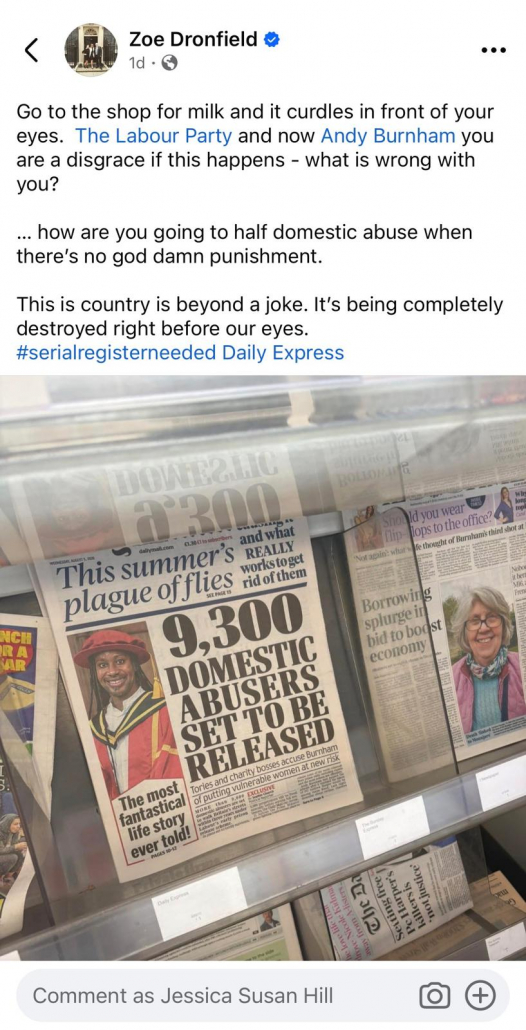
A newspaper front page shared by domestic abuse campaigner Zoe Dronfield has exposed a question that cannot be answered with political slogans or reassuring press releases: when perpetrators of domestic abuse leave prison, who is making sure victims and children are warned, protected and heard?
Image and inspiration credit
This article was prompted by a photograph and social media post shared by domestic abuse survivor, author and campaigner Zoe Dronfield. Image credit: Zoe Dronfield. Permission should be obtained directly from Zoe before reproducing her photograph on the JSH Law website.
In this article
- What the “9,300 domestic abusers” headline appears to mean
- Why the reported figure requires careful examination
- Why release on licence does not automatically mean victim safety
- How coercive control and post-separation abuse can continue after imprisonment
- What an offender’s release may mean in family court proceedings
- What victims can do when release is expected
- Why Zoe Dronfield’s work on serial perpetrators matters
A headline that will frighten victims — and understandably so
On 5 August 2026, the Daily Express carried the front-page headline: “9,300 domestic abusers set to be released.”
Beneath it, the newspaper reported warnings that vulnerable women could be placed at renewed risk. Zoe Dronfield photographed the front page and responded publicly, questioning how the Government could claim that it intended to halve domestic abuse while thousands of perpetrators were reportedly due to leave prison.
Her anger will be immediately recognisable to many survivors.
For a victim, an offender’s release is not an abstract discussion about prison capacity, sentencing reform or the management of the prison population. It may mean the return of unwanted messages, surveillance, stalking, threats, third-party contact, pressure through children, renewed litigation or an unexpected appearance outside the victim’s home, workplace or child’s school.
It may also reopen trauma that the victim has barely begun to process.
Victims are often expected to absorb this news calmly, update professionals, review court orders, improve home security, protect their children and prepare evidence — all while being told that the perpetrator will be “managed in the community”.
That phrase may sound reassuring inside a policy document. It can feel very different to the person who knows what the perpetrator is capable of.
The reported figure must be examined carefully
The seriousness of the safeguarding concern does not mean that the headline should be repeated without scrutiny.
At the time of writing, JSH Law has not identified a publicly accessible Ministry of Justice document setting out the figure of 9,300 in precisely the same terms used by the newspaper.
That means the number should be described as a reported figure unless its source, methodology, relevant period and definition are confirmed.
There are several important questions:
- Does the figure cover England and Wales?
- What period of release does it cover?
- Does it include ordinary statutory releases as well as accelerated or early releases?
- Does it refer to people convicted of a specific domestic abuse offence?
- Does it include offenders convicted of assault, criminal damage, harassment or another offence committed in a domestic context?
- Does it include people assessed by probation as presenting a domestic abuse risk even where domestic abuse was not the index offence?
These are not technical distractions. They determine what the headline actually tells us.
Domestic abuse is not a single offence category
Domestic abuse may be reflected in convictions for assault, stalking, harassment, controlling or coercive behaviour, strangulation or suffocation, threats, criminal damage, sexual offences or breaches of protective orders. A case may be recorded as domestic abuse-related through a flag attached to the underlying offence rather than through one universal offence label.
A perpetrator may therefore be serving a sentence for assault or criminal damage even though the offending formed part of a much wider pattern of coercive control.
Looking only at the formal offence title can seriously understate the risk.
Release from prison does not necessarily mean the sentence has ended
It is important to explain the legal position accurately.
In many cases, release from custody does not mean that an offender has completed the sentence or is free from all restrictions. The offender may continue serving the sentence in the community on licence.
Licence conditions can potentially regulate:
- where the offender lives;
- contact with a victim or child;
- entry into an exclusion zone;
- attendance at specified appointments or programmes;
- reporting to probation;
- electronic monitoring;
- and other conduct necessary to manage identified risks.
An offender who breaches licence conditions may be recalled to prison.
But this is where the reassuring legal description collides with family reality.
A licence condition only protects a victim when:
- the risk has been properly understood;
- the condition is clearly and carefully drafted;
- the victim knows that the condition exists;
- the victim knows where to report a breach;
- professionals recognise the behaviour as a breach;
- agencies share information quickly;
- and effective action follows before the situation escalates.
A condition written on paper is not a safety plan. Protection depends on whether the condition reflects the real pattern of abuse and whether somebody acts when it is breached.
Domestic abuse cannot be managed as a series of isolated incidents
Domestic abuse is often cumulative and patterned.
It may involve physical violence, but it may also involve stalking, coercive control, financial abuse, monitoring, humiliation, intimidation, threats, interference with employment, manipulation of children and the strategic use of legal proceedings.
Separation does not necessarily end that pattern. It may intensify it.
Imprisonment can temporarily interrupt a perpetrator’s direct access to the victim, but it does not automatically remove the underlying desire to control.
Abuse may continue from prison through:
- telephone calls or letters;
- relatives, friends or associates;
- social media and digital accounts;
- pressure involving children;
- requests for personal information;
- or applications and correspondence connected to family proceedings.
On release, the perpetrator may resume the pattern while presenting each new act as innocent, accidental or child-focused.
One message asking about a child may look harmless when read in isolation. It may look entirely different when placed beside previous threats, fifty unwanted messages, location monitoring, repeated breaches, third-party pressure and a history of using the child to obtain information about the victim.
Safeguarding professionals must see the pattern, not merely the latest incident.
Good behaviour in prison does not prove safety outside prison
Any release system that places weight on an offender’s behaviour in custody must recognise an obvious limitation: compliance inside a controlled institution is not the same as safe behaviour within an intimate or family relationship.
A perpetrator may comply with prison rules while continuing to blame the victim, minimising the offence, denying the wider pattern and planning to re-establish control after release.
Domestic abuse risk assessment must therefore look beyond disciplinary behaviour in custody.
It should consider:
- the history and escalation of the abuse;
- stalking, fixation or obsessive behaviour;
- threats made before or during imprisonment;
- previous breaches of bail, injunctions or court orders;
- access to weapons;
- strangulation or suffocation allegations or convictions;
- threats of suicide, homicide or child removal;
- the use of children as messengers or sources of information;
- the victim’s own assessment of the danger;
- and evidence of similar behaviour towards previous partners.
The question is not simply, “Has he behaved in prison?”
The safeguarding question is whether the perpetrator presents a continuing risk to a particular victim, child or future partner when the institutional controls are removed.
What the Probation Inspectorate has already found
Concerns about release planning are not based only on survivor fear or newspaper commentary.
In October 2025, His Majesty’s Inspectorate of Probation published an evaluation of the Probation Service’s work to combat domestic abuse.
Where people were being released from prison, inspectors found sufficient pre-release work addressing domestic abuse in only 22 of the 38 relevant cases.
Appropriate licence conditions had been applied in 66% of relevant cases.
The inspectorate also found weaknesses in multi-agency information, contingency planning and the identification of the work being undertaken by other organisations.
Those findings matter because the public is repeatedly reassured that offenders released from custody will be supervised and managed by probation.
Supervision cannot be assumed to be effective simply because a case has been allocated to a probation officer.
The quality of the assessment, planning, information-sharing, licence conditions and response to breaches is what determines whether supervision provides meaningful protection.
Electronic monitoring may help — but tagging is not a complete answer
The Government has announced expanded electronic monitoring and more intensive supervision for offenders considered to present serious risks.
The Domestic Abuse Perpetrators on Licence scheme requires eligible adult offenders assessed as presenting a domestic abuse risk to wear an electronic tag after release where this is considered necessary and proportionate as part of licence planning.
The scheme began in two probation regions in 2023. Official Ministry of Justice information published in 2026 stated that it was operating in eight regions and was due to extend across all twelve probation regions in England and Wales by September 2026.
This is potentially useful. Electronic monitoring can help establish an offender’s location, support an exclusion zone and identify certain forms of non-compliance.
But a tag cannot detect:
- coercive messages sent through another person;
- pressure applied through children;
- false or vexatious reports;
- digital surveillance;
- financial abuse;
- manipulation through family proceedings;
- or psychological intimidation carried out without entering a prohibited location.
Technology is a risk-management tool. It is not a substitute for skilled domestic abuse assessment, victim consultation and decisive enforcement.
Victims need information before release — not after something has gone wrong
One of the most frightening features of an offender’s release is uncertainty.
A victim may not know:
- whether release has been confirmed;
- the expected release date;
- where the offender will live;
- whether direct or indirect contact is prohibited;
- whether an exclusion zone has been imposed;
- whether electronic monitoring will be used;
- what conduct should be reported as a breach;
- which probation team is responsible;
- or what to do outside office hours.
Eligible victims may receive information through the Victim Contact Scheme. A Victim Liaison Officer may provide information about the sentence and release process and can seek the victim’s views about licence conditions.
Victims should not assume that probation, police, Cafcass, social workers or the family court automatically possess the full history.
Relevant information may be fragmented across:
- criminal proceedings;
- police incident logs;
- restraining or non-molestation order proceedings;
- family court bundles;
- Cafcass records;
- children’s services files;
- medical evidence;
- school safeguarding records;
- messages, emails and call logs;
- and reports involving previous partners.
The practical challenge is often to bring those pieces together so that the pattern becomes visible.
What an offender’s release may mean in the family court
The release of a parent or former partner from prison may have immediate consequences for private children proceedings.
The released person may seek:
- direct or indirect contact with a child;
- the reinstatement or extension of previous contact;
- a variation of an existing child arrangements order;
- information about the child’s home, school or activities;
- the removal of protective restrictions;
- or renewed communication with the victim parent.
The family court’s paramount consideration when determining a question about a child’s upbringing is the child’s welfare.
Where domestic abuse is raised, the court must apply the relevant legal framework, including Practice Direction 12J.
The court should not limit its analysis to the name of the criminal offence or the fact that the perpetrator has served a custodial sentence.
It may need to examine:
- the facts underlying the conviction;
- the wider pattern of domestic abuse;
- the impact on the child and victim parent;
- whether the child has been used to monitor, pressure or punish the victim;
- the perpetrator’s insight, accountability and understanding of harm;
- compliance with previous criminal and family court orders;
- the terms of the offender’s licence;
- the existence of any restraining or protective order;
- and whether arrangements can operate without exposing the child or victim to an unmanageable risk of harm.
Release does not automatically change a family court order
Release from prison does not automatically revive suspended contact, cancel a prohibited steps order, remove a non-molestation order or vary a child arrangements order. Equally, a family court order does not authorise conduct prohibited by a restraining order, bail condition or licence condition. Every relevant order must be read carefully and together.
The danger of disguising control as child-focused communication
Post-separation abuse is frequently presented as a parenting dispute.
A perpetrator may claim that repeated contact is necessary because of the child. Requests for school information, photographs, medical details, addresses, travel plans or direct communication may be framed as ordinary parental involvement.
Sometimes they are legitimate requests. Sometimes they are part of a continuing pattern of monitoring and control.
The distinction cannot be decided by reading one message in isolation.
Professionals need to consider:
- the frequency and tone of communications;
- whether existing communication arrangements are being respected;
- whether the information is genuinely needed for the child;
- whether the child is being questioned about the other parent;
- whether third parties are being used;
- whether requests escalate after boundaries are set;
- and whether the communication causes fear because of the established history.
Child-focused language does not automatically make conduct child-focused.
What should a victim do when an abuser may be released?
The correct response will depend on the level of risk, the sentence, the existing orders and the circumstances of the child. The following is general information rather than legal advice on an individual case.
1. Confirm what is actually known
Distinguish between a rumour, an estimated date, media reporting and formal notification. Record who provided the information and when.
2. Contact the Victim Contact Scheme
Where eligible, ask to speak to the Victim Liaison Officer. Request clear information about the release process and ask whether your concerns about licence conditions and exclusion zones have been recorded.
3. Provide updated risk information
Tell the relevant professionals about recent threats, stalking, third-party contact, family court activity, access to weapons, previous breaches and any specific statements about what the perpetrator intends to do after release.
4. Review every current order
Check the terms and expiry dates of any:
- non-molestation order;
- occupation order;
- restraining order;
- child arrangements order;
- prohibited steps order;
- specific issue order;
- bail condition;
- or other protective direction.
5. Seek urgent advice where protection is inadequate
Depending on the circumstances, it may be necessary to consider an application for a non-molestation order, an urgent variation of child arrangements, a prohibited steps order or directions dealing with communication and disclosure of information.
6. Inform the child’s school or nursery where appropriate
Provide copies of relevant orders, confirm who may collect the child and agree what staff should do if the perpetrator attends or requests information.
7. Review digital security
Change passwords, enable two-factor authentication, review location sharing, check linked devices and consider whether a child’s telephone, tablet, gaming account or social media account may reveal location or private information.
8. Prepare an evidence-led chronology
A useful chronology should record:
- the date and time;
- what happened;
- the words used;
- the method of contact;
- whether a child or third party was involved;
- the order or condition potentially breached;
- witnesses;
- where it was reported;
- the incident or reference number;
- and the impact on the victim and child.
9. Make a practical safety plan
Specialist domestic abuse services and Independent Domestic Violence Advisers can help with safety planning, housing, reporting, protective measures and communication with criminal justice agencies.
10. Treat immediate danger as an emergency
Call 999 where there is an immediate risk. Do not place yourself or a child in danger to collect evidence. Safety comes first.
Why Zoe Dronfield’s work matters
Zoe Dronfield is a domestic abuse survivor, author and campaigner whose work has focused on coercive control, stalking, serial perpetrators and institutional failures across the criminal and family justice systems.
Zoe has spoken publicly about surviving a serious domestic violence attack and about the further trauma she experienced while navigating family court proceedings.
Her book, Mind Over Manipulators, examines abusive relationships, manipulation, coercive control and the struggle to be properly heard by institutions.
A central feature of Zoe’s campaigning is the need to identify serial and repeat perpetrators.
This matters because official records are often organised by incident, victim, offence, police force or court case.
One partner may know only what happened to her. A police force may hold reports made in one geographical area. The family court may see only the documents placed in its bundle. Probation may concentrate on the index offence. A later partner may report similar conduct without knowing that others have already raised the same concerns.
Each organisation can therefore hold one fragment of the picture while nobody identifies the pattern.
Serial perpetration may include:
- similar allegations or findings involving different partners;
- repeated stalking after separation;
- the same threats or methods of intimidation;
- repeated breaches of protective measures;
- the use of litigation against successive victims;
- and the repeated portrayal of victims as unstable, malicious or obstructive.
Allegations must always be distinguished from proven facts, admissions, convictions and judicial findings. Fairness and proper investigation remain essential.
But safeguarding systems must also be capable of recognising repeated warning signs. Waiting for each victim to be harmed in isolation is not a credible prevention strategy.
Zoe’s work is valuable because she refuses to allow domestic abuse to be reduced to disconnected incidents, administrative categories or faceless statistics.
Readers can explore Zoe’s books, interviews, campaigning and social media work through her official Linktree page.
JSH Law’s view: victims deserve facts, protection and accountability
There are two mistakes that must be avoided.
The first is to dismiss victim concern by explaining that offenders remain “on licence” and will be supervised in the community.
Licence supervision is not a magic shield. It protects victims only where the assessment is accurate, the conditions are workable, the victim has been consulted and breaches produce an effective response.
The second mistake is to repeat a frightening headline without establishing what the number means.
The public should be told clearly:
- how the reported figure was calculated;
- which offenders are included;
- which release provisions apply;
- which offences or categories are excluded;
- how victims will be notified;
- what risk assessment will take place;
- how probation will be resourced;
- what electronic monitoring can and cannot do;
- and what action will follow a breach.
Transparency is not a public relations extra. It is part of safeguarding.
Victims should not learn that a perpetrator has been released through gossip, social media or an unexpected encounter. They should receive timely information, meaningful consultation and a safety plan built around the actual pattern of abuse.
The political debate about prison capacity and sentencing will continue.
For victims, however, the urgent questions are practical:
- When is the perpetrator being released?
- What restrictions will apply?
- Does probation understand the full history?
- Are the existing family court arrangements safe?
- Does the child’s school know what to do?
- Is an urgent application required?
- Who will respond if contact is made or a condition is breached?
Those questions should be answered before release wherever possible — not after the victim or child has been placed at renewed risk.
Useful resources
- GOV.UK: Get support as a victim of crime
- Victim Contact Scheme guidance
- HM Inspectorate of Probation: evaluation of the Probation Service’s response to domestic abuse
- Ministry of Justice: electronic monitoring statistics and technical information
- Domestic Abuse Commissioner: Zoe Dronfield’s account
- Zoe Dronfield: books, campaigns and official links
- National Domestic Abuse Helpline
- Paladin National Stalking Advocacy Service
- National Stalking Helpline
Important legal disclaimer
This article provides general information about law, procedure and safeguarding in England and Wales. It is not legal advice and should not be treated as a substitute for advice on an individual case. Release provisions, licence conditions, protective orders and family court remedies depend on the facts, the offence, the sentence, the applicable statutory framework and the orders already in force. In an emergency, call 999.
Concerned about an offender’s release or renewed family court action?
JSH Law provides practical, evidence-led and trauma-informed support to litigants in person dealing with domestic abuse, coercive control, stalking, post-separation abuse and child safeguarding concerns.
We can help you:
- organise messages, police records, reports and other evidence;
- prepare an incident chronology or pattern-of-behaviour schedule;
- review existing protective and family court orders;
- draft statements, position statements and applications;
- respond to Cafcass or professional reports;
- prepare for urgent, interim or contested hearings;
- and present the evidence clearly, calmly and in a form that helps the court identify the safeguarding issues.
The purpose is not to make inflammatory allegations or produce an emotional document that can be dismissed. It is to show the pattern, the evidence, the impact on the child and the practical protection required.
 © 2026 JSH Law Ltd. All rights reserved.
 JSH LAW LTD












 © 2026 JSH Law Ltd. All rights reserved.
Leave a Reply
Want to join the discussion?Feel free to contribute!