
The JSH Law Legal Tech Test: Which Platforms Actually Improve Access to Justice?
Legal technology is not automatically access to justice. A platform may look simple, generate polished documents and promise to reduce legal costs—but the real test is whether it helps an ordinary person protect their position without being misled, exposed or given false confidence. The JSH Law Legal Tech Test will examine that question properly.
JSH Law Legal Technology Review Series
The JSH Law Legal Tech Test: Which Platforms Actually Improve Access to Justice?
Published 3 August 2026 | Research current at the date of publication
Legal technology should not be judged by how impressive its artificial intelligence sounds. It should be judged by whether a real person can use it to understand the process, protect their position and reach the right next step without being misled, exposed or priced out.
Legal technology is spreading rapidly across the justice system. Some platforms draft court documents. Some organise evidence, track deadlines or manage communication between separated parents. Others offer legal research and litigation analysis that remains largely available only to firms, barristers and well-funded clients.
That growth matters. Used well, technology can reduce cost, delay and procedural confusion. Used badly, it can give a frightened or inexperienced person false confidence in a document, deadline or legal route that has never been properly checked.
JSH Law is therefore launching a continuing review series: The JSH Law Legal Tech Test. We will examine the websites, apps, court services and AI platforms that claim to make law easier, cheaper or more accessible. The first full review will be CaseCraft AI, a platform aimed at people bringing or defending small claims in England and Wales.
In this article
- Why legal technology needs an access-to-justice test
- Why CaseCraft AI will be reviewed first
- The JSH Law 100-point scoring system
- The first 15 platforms in the review queue
- Family justice and co-parenting technology
- Evidence, bundles and professional legal AI
- What to check before using any legal-tech service
Legal technology is not automatically access to justice
A clear questionnaire can be genuinely valuable. It can prompt a user to identify dates, parties, sums, documents and missing evidence. Automated reminders can prevent a deadline from disappearing inside an inbox. A well-designed platform can turn an intimidating process into a sequence of manageable tasks.
But a smoother interface does not remove legal complexity. It can simply conceal it.
The small claims track, for example, is normally used for many straightforward claims worth no more than £10,000. That is not the whole rule. Different thresholds and exceptions apply to some personal injury cases; certain claims are not normally allocated to the track; and allocation remains a case-management decision for the court. The official framework is found in CPR Part 26 and its accompanying practice direction.
A platform can generate a polished-looking claim form and still fail the user if it does not identify limitation, jurisdiction, the correct defendant, a mandatory pre-action step, an unsuitable cause of action, a counterclaim or an enforcement problem. In law, presentation is not reliability.
The central question
Does the technology reduce the user’s legal and procedural risk—or merely make the process feel easier?
We will also distinguish between a regulated law firm, an unregulated technology provider, a charity, a government court service and a general-purpose AI tool. They do not carry the same duties, redress arrangements or consumer protections. A familiar design and confident language must never be mistaken for regulation.
Why CaseCraft AI will be reviewed first
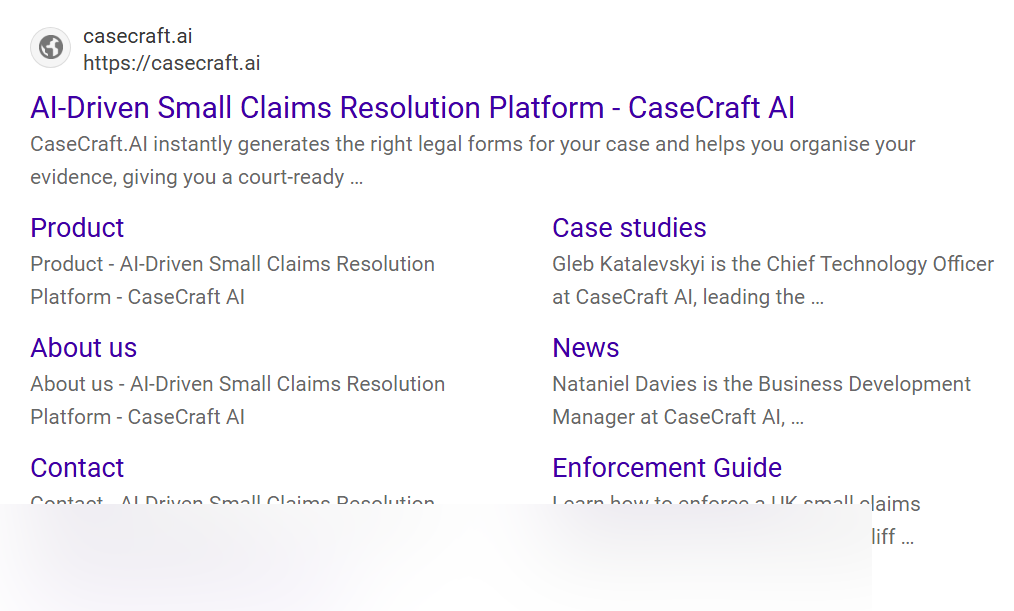
CaseCraft is an unusually useful starting point because it is not simply offering a chatbot or a document template. Its website presents an end-to-end small-claims workflow for claimants and defendants: guided information gathering, document generation, evidence organisation, filing, deadline tracking and support with settlement and enforcement.
Its public-facing proposition is attractive. It says a user can begin without paying a traditional hourly legal fee and that a success-based commission applies to a favourable outcome. Its website also identifies Sterling Lawyers Ltd, SRA number 630147, as the regulated firm providing legal services through the platform.
That combination—AI automation, court documents, a success fee and a regulated legal-services relationship—raises exactly the questions this series is designed to investigate.
What the full CaseCraft review will test
- which claims and defences the platform accepts, rejects or refers for human review;
- whether its eligibility questions identify limitation, jurisdiction, track-allocation and pre-action issues;
- what documents it produces and whether they are factually accurate, properly pleaded and usable;
- how counterclaims, multiple parties, disputed facts and cases that become more complex are handled;
- which company contracts with the user and when a solicitor-client relationship begins;
- the total price, including onboarding charges, commission, court fees, hearing fees and enforcement fees;
- whether a commission becomes payable on an award that is never recovered;
- what human checking, complaints process, insurance and Legal Ombudsman route apply;
- how uploaded evidence and personal data are stored, used and deleted; and
- whether a vulnerable, disabled or digitally excluded user can obtain meaningful human assistance.
An early reason for careful scrutiny
Before conducting a hands-on test, a desk review of CaseCraft’s public pages already shows why legal-tech terms must be read rather than inferred from a headline.
The main website currently advertises a 15% success fee. CaseCraft’s terms, stated to have been updated on 27 July 2026, also refer to a £15 onboarding fee, court fees paid in advance and a 15% commission in specified claimant and defendant outcomes. The terms say that, in some claimant cases, commission may remain payable even if an award cannot be enforced. However, other public CaseCraft promotional or editorial pages visible at the date of review have referred to a 10% fee.
There is also wording that deserves clarification about the contracting and regulatory structure. The terms describe the agreement as being with Sterling Lawyers Ltd trading as CaseCraft, while the website footer describes CaseCraft AI Ltd as the platform operator and Sterling Lawyers Ltd as a separate, independent affiliate providing legal services.
This is not a finding that the service is unsafe or that any particular fee will be charged. The terms presented during the actual sign-up journey, the scope accepted by the regulated firm and the individual client documentation will matter. It is, however, a clear reason to test price transparency and regulatory accountability carefully in the full review.
JSH Law will invite CaseCraft to clarify those points and, if possible, provide a demonstration or review account. Any substantive response will be included fairly. The final article will state whether it is based on a hands-on test, a guided demonstration or public information only.
The JSH Law 100-point legal-tech test
Every reviewed platform will be assessed against the same core standard. A product will not receive a high score merely because it is fast, attractive or powered by a sophisticated model. The scoring gives the greatest weight to reliability, accountability and the treatment of sensitive information.
| Test | Weight | What we will examine |
|---|---|---|
| Legal and procedural reliability | 20 | Accuracy, jurisdiction, deadlines, legal tests, forms, authorities, warnings and escalation of uncertainty. |
| Practical usefulness | 15 | Whether the product helps a user complete the real task, not merely generate text. |
| Regulation and accountability | 15 | Provider identity, regulated status, scope, insurance, complaints, redress and responsibility for errors. |
| Privacy and data security | 15 | Data controller, hosting, retention, deletion, model training, third-party access and treatment of sensitive evidence. |
| Accessibility and ease of use | 10 | Plain English, disability access, digital confidence, mobile use and clarity when something goes wrong. |
| Price and value | 10 | Total cost, additional fees, renewal, cancellation, recoverability and value compared with free or human alternatives. |
| Human assistance | 10 | When human review is available, who provides it, their qualifications and whether urgent escalation works. |
| Safeguarding and trauma awareness | 5 | Recognition of abuse, coercion, vulnerability, unsafe joint working, litigation misuse and risk to children. |
| Total | 100 | A published score supported by reasons, limitations and evidence. |
Three evidence labels
Every article will carry one of the following labels so readers know what has—and has not—been independently verified:
JSH Law used the service through a structured test journey.
The provider demonstrated the platform and answered questions.
The review relies on public pages, terms, policies, official records and other identified sources.
Where a live service requires a real legal problem, payment, identity verification or the upload of personal evidence, we will not pretend to have completed a transaction that did not occur. Any test case will use fictional or properly anonymised material.
The first 15 platforms in the JSH Law review queue
The opening series will compare commercial products with regulated services, court systems, charities and public legal-information projects. That comparison matters. Sometimes the best access-to-justice technology is not the product with the largest AI claim. It is the service that knows its limits and gets the user safely to the next step.
| Order | Platform | The question JSH Law will answer |
|---|---|---|
| 1 | CaseCraft AI | Can an AI-led platform make bringing or defending a small claim genuinely safer and simpler—and are its price, regulation and limits clear? |
| 2 | Garfield | What difference does an SRA-regulated AI debt-recovery model make to accountability and user protection? |
| 3 | CourtNav | Can a free guided service help a domestic-abuse survivor prepare an injunction application without losing the safety of human legal review? |
| 4 | Valla | Does combining case-management tools, templates and pay-as-you-go human coaching create a workable model for self-represented tribunal users? |
| 5 | amicable | When is one service for a separating couple efficient, and when do conflict, imbalance or domestic abuse require separate advice? |
| 6 | OurFamilyWizard | Can recorded co-parenting communication reduce conflict, or can a high-conflict user turn the app into another channel of pressure and surveillance? |
| 7 | Advicenow | What does effective digital help for litigants in person look like when it is designed around explanation rather than AI marketing? |
| 8 | Lawhive | Does an AI-enabled consumer law-firm model widen affordable access to a lawyer while preserving quality and individual judgment? |
| 9 | Resolver | Can guided complaints and record-keeping resolve consumer disputes before court becomes necessary? |
| 10 | Support Through Court | Which parts of court support still depend on a calm, trained human being listening to the person behind the paperwork? |
| 11 | Online Civil Money Claims | Is the government’s online money-claim route genuinely designed around the needs and limitations of litigants in person? |
| 12 | Online divorce | Does a simpler divorce application risk users assuming that children, finances, housing and safeguarding have also been resolved? |
| 13 | Legal Aid Checker | Does the digital eligibility journey help vulnerable applicants find a provider, or does it merely tell them that help might exist? |
| 14 | Rocket Lawyer | What does a consumer actually receive from a legal-document subscription, AI assistance and access to a lawyer? |
| 15 | LawDepot | When is a self-generated legal document useful, and when does a template hide the need for advice or bespoke drafting? |
Family justice and co-parenting technology need a different test
Family technology cannot be assessed as though every case involves two safe, equally powerful adults who simply need a better shared calendar.
In a cooperative separation, a co-parenting app may centralise dates, expenses, messages and child-related information. In a case involving coercive control, stalking, harassment or litigation abuse, the same functions can have a very different effect. Read receipts can become a demand for immediate compliance. Location tools can create fear. An immutable record can protect one parent—or supply the other with a new arena for performative, controlling communication.
The test is not whether an app encourages a polite tone. It is whether its design understands power, safety and the difference between ordinary disagreement and abuse.
If AI can guide someone through a small money claim, the family-justice question is unavoidable: why are parents still expected to organise years of safeguarding evidence, identify patterns of coercive behaviour and comply with complex directions with so little structured support?
The family and separation watchlist will therefore include amicable co-parenting, 2houses, TalkingParents, AppClose, Settify and Class Legal’s Capitalise.
Where a product is principally built or marketed for another jurisdiction, we will say so. A claim that an app is used in American courts does not establish its evidential status, procedural suitability or judicial treatment in England and Wales.
Evidence, bundles and professional legal AI
The next group exposes a growing inequality of arms. Professional teams increasingly have access to tools that can search large document sets, build chronologies, identify contradictions, create bundles and accelerate legal research. An unrepresented person may still be copying messages into a spreadsheet at two o’clock in the morning.
Our evidence and litigation reviews will consider platforms including TrialView, Opus 2, Legora, Thomson Reuters Case Center, Bundledocs and Casedo.
Professional legal-AI reviews will include Lexis+ with Protégé, CoCounsel Legal UK, Vincent by vLex, Harvey, Luminance, Genie AI, Spellbook, Clio and LEAP.
The purpose is not to demand that an enterprise product be sold to every litigant. It is to ask a policy question: if technology can make complex evidence understandable for a commercial team, which parts of that capability could be made safe and affordable for people navigating child arrangements, domestic abuse, housing or employment proceedings alone?
The general AI tools people are already using
We will also test ChatGPT, Claude, Gemini, Perplexity, Microsoft Copilot and NotebookLM. These are not substitutes for a lawyer, but people are already using them to understand orders, draft statements, summarise evidence and ask legal questions.
They will be tested against the same fictional case materials and controlled questions. We will examine fabricated authorities, missing jurisdictional caveats, false certainty, source quality, confidentiality warnings, handling of contradictory evidence and whether the system recognises when a safeguarding issue needs human help.
Before using any legal-tech platform: ten questions to ask
- Who is the contracting party? Record the company name, address and registration details.
- Is anyone providing a regulated legal service? Check the regulator’s register yourself and identify the exact firm.
- What is included? “Guidance”, “document preparation”, “legal advice” and “representation” are not the same service.
- What is the full cost? Include subscription, onboarding, percentage fees, court fees, hearing fees, expert fees and enforcement.
- When does payment become due? A favourable order is not necessarily money recovered.
- Who checks the output? Ask whether review is automated, administrative, legally qualified or supervised by a regulated professional.
- What happens when the case stops being simple? Look for a clear escalation, referral and exit process.
- What happens to the evidence? Check storage, retention, deletion, overseas transfers, model training and third-party processors.
- What remedy exists if it goes wrong? Find the complaints route, ombudsman, insurance position and governing law.
- Is it safe for this particular case? Consider domestic abuse, coercive control, child data, confidentiality, capacity, disability and digital exclusion.
Legal files may contain health information, allegations of abuse, sexual information, children’s details and criminal-offence data. The Information Commissioner’s Office guidance on AI and data protection emphasises lawfulness, transparency, fairness, accuracy, security, data minimisation and accountability. “Secure” is not a complete privacy explanation.
What genuine access-to-justice technology should look like
The best legal technology will not try to erase professional judgment. It will use technology for what technology does well: structure, prompts, consistency, search, reminders, comparison and organisation. It will use trained human beings for what still requires judgment: disputed facts, legal strategy, risk, credibility, vulnerability, proportionality and safeguarding.
It will be clear about who is responsible. It will not hide a material fee in a long document or describe an uncertain outcome as inevitable. It will not assume that every user is confident, safe, literate, represented or able to pay. It will make the court’s job easier by helping the user present the relevant facts and evidence—not by producing more polished noise.
That is the standard this series will apply.
Do you use a legal-tech platform?
JSH Law wants to hear from litigants in person, practitioners, charities and platform providers. Tell us what worked, what failed, what the service cost and what you wish you had known before relying on it. Providers are welcome to offer a demonstration and respond to the review questions.
Contact JSH LawResearch and source note
This launch article is a desk-based assessment and editorial roadmap, not a completed product review or endorsement. Public websites and terms can change. Pricing and contractual terms should be checked immediately before purchase.
JSH Law has not received payment for including the platforms in this article and the order is editorial, not a ranking or recommendation. Any future commercial relationship, complimentary access or provider-assisted demonstration relevant to a review will be disclosed.
Important: This article provides general legal information and commentary for England and Wales. It is not legal advice and does not create a solicitor-client relationship. The correct procedure and suitability of any service depend on the facts, the documents, the court or tribunal, the terms in force and the remedy sought. Obtain appropriate legal advice where you are unsure, where a deadline is approaching, or where the case involves significant loss, domestic abuse, safeguarding, children, capacity or complex evidence.