
 © 2026 JSH Law Ltd. All rights reserved.
Pressured Into Swinging? UK Consent and Court Guide
Being married, joining a swingers’ website or sending apparently enthusiastic messages does not automatically prove free consent. This practical guide explains how to report sexual coercion, preserve digital evidence, challenge a no-further-action decision, seek protection and present relevant allegations in the Family Court.
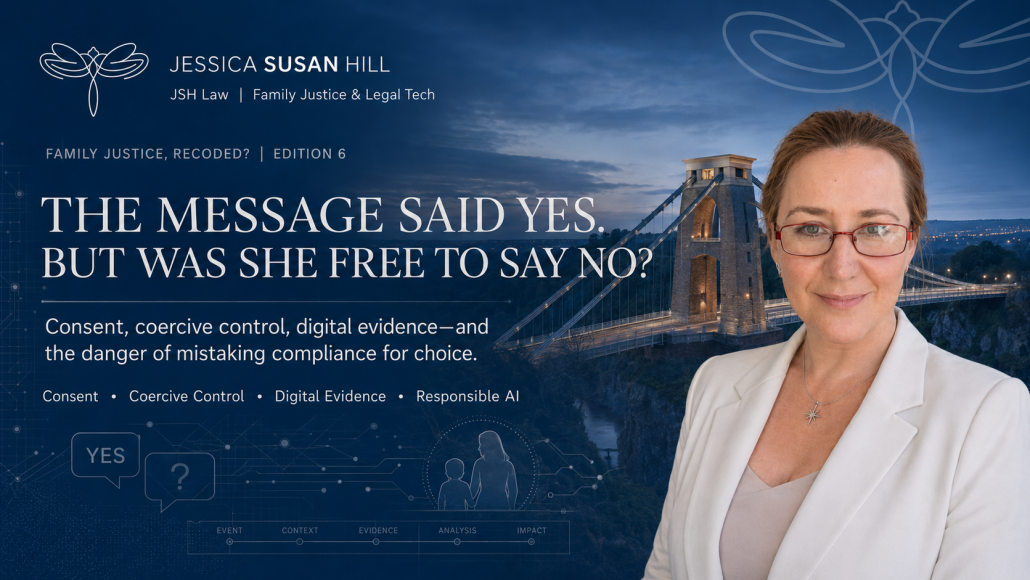
Consent, coercive control and court evidence
Pressured into swinging or sex with strangers? Consent, reporting and court options in England and Wales
Being married, registering on a swingers’ website, attending an encounter or sending apparently enthusiastic messages does not automatically prove free consent. This guide explains what the law asks, how to report sexual abuse or coercive control, how to preserve digital evidence, what to do after a “no further action” decision, and how the same history may be relevant in the Family Court.
Jurisdiction: England and Wales. Law and links checked: 29 July 2026.
The short answer
In England and Wales, sexual consent means agreeing by choice while having the freedom and capacity to make that choice. Compliance, appeasement, a previous “yes”, participation in a sexual lifestyle, or a message that looks enthusiastic when read alone is not necessarily consent to a particular act with a particular person at a particular time.
Pressure is not automatically a criminal offence. The precise words, conduct, surrounding pattern, effect on you, sexual act, other person’s knowledge and the date of the conduct all matter. Depending on the evidence, possible issues include rape, assault by penetration, sexual assault, causing a person to engage in sexual activity without consent, controlling or coercive behaviour, harassment, assault, or an intimate-image offence. Police and prosecutors must assess the elements of each offence; a Family Court applies a different process and standard of proof.
1. What the BBC Swingers investigation changes—and what it does not
BBC Radio Wales’ Swingers, presented by Catrin Nye, reported Ruth O’Grady’s account that her former husband pressured her into a swinging lifestyle and that she had sex with strangers more than 100 times. The reporting examined extensive WhatsApp material, including 711 pages containing 321,983 words. O’Grady described messages which, outside the relationship’s wider context, could look willing or enthusiastic.
The programme and subsequent reporting brought a difficult evidential issue into public view: a person experiencing coercive control may organise, facilitate or appear to agree to conduct as a way of managing risk, avoiding conflict or surviving within the relationship. That does not mean every unhappy, reluctant or later-regretted encounter is a crime. It means the evidence must be assessed in context rather than by treating a selected message as a complete answer to consent.
BBC follow-up reporting said that around 50 women contacted the broadcaster after the series and that the FabSwingers website was mentioned in 329 police records since 2023. Reports or allegations are not proof of criminal liability. FabSwingers has said that it has moderation and safety measures and has disputed suggestions that it is indifferent to abuse. O’Grady’s former husband was given an opportunity to respond to the allegations and did not respond; the reported police investigation did not result in a charge. There has been no court finding determining the allegations described in the programme.
This article is not about condemning consensual non-monogamy or swinging between adults who choose it freely. It is about what happens when apparent participation is said to have been secured through fear, threats, humiliation, monitoring, financial dependency, punishment, sexual pressure or a wider course of controlling behaviour.
2. What consent means in law
Consent is a choice made with freedom and capacity
Section 74 of the Sexual Offences Act 2003 states that a person consents if they agree by choice and have the freedom and capacity to make that choice. In the offences of rape, assault by penetration, sexual assault and causing sexual activity without consent, the prosecution must also address whether the defendant reasonably believed the complainant consented. In deciding whether that belief was reasonable, the jury considers all the circumstances, including any steps taken to find out whether the complainant consented.
The current Crown Prosecution Service guidance on rape and sexual offences makes several points that are particularly important in coercion cases:
- There is no legal requirement for a complainant to have communicated a refusal.
- Submission is not the same thing as consent.
- Consent must relate to the specific sexual act and can be withdrawn at any time.
- Psychological coercion can be relevant to whether there was free agreement.
- A relationship, marriage, prior sex or earlier consent does not establish consent on another occasion.
Why an apparently willing message may not settle the question
A message such as “I can’t wait”, a profile created in the complainant’s name, or practical arrangements for a meeting can be relevant evidence. But it must be tested against the whole evidential picture. Relevant questions can include:
- Who suggested the encounter, wrote the message or controlled the account?
- Was there an earlier refusal, hesitation, condition or attempt to withdraw?
- What happened when the person had resisted on previous occasions?
- Were there threats involving children, housing, money, reputation, private images or violence?
- Was the person monitored, isolated, deprived of sleep, intoxicated, frightened or financially dependent?
- Did a pleasant message function as appeasement or an attempt to reduce an anticipated consequence?
- What did the partner and any other participant know, and what steps did each take to check consent?
Context is not a licence to ignore an inconvenient message. Equally, a message must not be stripped of the conversation, relationship history and events around it. A reliable account confronts both the supporting and apparently contradictory material and explains why each item matters.
Pressure, persuasion and criminal proof are not identical
A partner may behave selfishly, manipulate another person or create an unhealthy sexual dynamic without every incident satisfying the elements of a particular criminal offence. Criminal guilt must be proved beyond reasonable doubt. The issue is not resolved by a label such as “coercion” alone; investigators need the acts, words, dates, surrounding conduct, impact and evidence.
Conversely, an absence of physical force, injury or an express verbal “no” does not prevent an investigation. The central question for a sexual offence is whether there was agreement by choice with freedom and capacity, together with the defendant’s reasonable belief in consent where the offence requires it.
Sexual abuse can also be domestic abuse
The Domestic Abuse Act 2021 recognises physical or sexual abuse, violent or threatening behaviour, controlling or coercive behaviour, economic abuse, and psychological or emotional abuse between personally connected people. The behaviour can be a single incident or a course of conduct. That civil definition is relevant to safeguarding and Family Court practice, but it does not remove the need to prove the separate elements of any criminal charge.
3. Which criminal offences may be relevant?
The correct offence depends on the facts and the law in force when the conduct happened. The table below is an orientation guide, not a charging decision.
| Possible legal issue | Conduct it may cover | Important qualification |
|---|---|---|
| Rape: section 1, Sexual Offences Act 2003 | Intentional penile penetration where the complainant did not consent and there was no reasonable belief in consent. | Rape has a specific statutory definition. Other forms of penetration may fall under assault by penetration. |
| Assault by penetration: section 2 | Intentional sexual penetration of the vagina or anus with a body part or object, without consent and without reasonable belief in consent. | The prosecution must prove every statutory element. |
| Sexual assault: section 3 | Intentional sexual touching without consent and without reasonable belief in consent. | Touching has a broad statutory meaning, but the facts still have to prove the offence. |
| Causing a person to engage in sexual activity without consent: section 4 | Intentionally causing another person to engage in sexual activity where they do not consent and there is no reasonable belief in consent. | This may be relevant where a partner is said to have caused sexual activity with somebody else. Liability always turns on the evidence and precise statutory elements. |
| Controlling or coercive behaviour: section 76, Serious Crime Act 2015 | A repeated or continuous course of controlling or coercive behaviour in an intimate or family relationship which has the required “serious effect”. | The statutory relationship, knowledge and serious-effect tests must be met. The offence was extended to certain post-separation conduct from 5 April 2023; that extension is not retrospective. |
| Sharing or threatening to share intimate images: section 66B, Sexual Offences Act 2003 | Depending on intent and date, sharing an intimate photograph or film without consent, or threatening to share one. | Section 66B applies to relevant conduct on or after 31 January 2024. Earlier conduct is assessed under the law then in force. A threat may be an offence even if the image does not exist. |
| Harassment, stalking, assault or other offences | Repeated unwanted contact, surveillance, threats, violence or related conduct. | These offences have their own definitions and defences. Do not assume one label covers the whole history. |
What about the strangers or other participants?
Each person’s potential liability is assessed individually. A third party may genuinely have believed the person consented, or the evidence may support a different conclusion. For a sexual offence, the investigation will consider what that participant knew, what they observed, what was said, and what steps they took to establish consent. A partner’s alleged pressure does not automatically make every participant guilty, but nor does a website profile automatically provide reasonable belief in consent to everything that later happened.
If the conduct predates 1 May 2004, the Sexual Offences Act 2003 may not be the governing law. Historical allegations can still be reported, but investigators must apply the offence in force at the time.
For controlling or coercive behaviour, the required “serious effect” means either causing fear on at least two occasions that violence will be used, or causing serious alarm or distress which has a substantial adverse effect on usual day-to-day activities. Examples of day-to-day impact may be relevant evidence, but the statutory test and the defendant’s knowledge still have to be proved.
4. What to do now: safety, health, evidence and reporting
You do not have to decide every legal route at once. A useful order is safety first, healthcare where needed, preservation of evidence, specialist support, then a considered decision about reporting or court action.
If the risk is current
- Call 999 if you or a child is in immediate danger.
- Use a safe device if your phone, email, location or browsing may be monitored.
- Do not announce that you are gathering evidence if doing so could increase the risk.
- Ask the police or a domestic-abuse service for safety planning, including risks around separation.
- If safe, change important passwords, end unknown sessions and enable two-factor authentication. Consider a new email address that the other person cannot access.
If an assault was recent
Seek medical help promptly. The Government’s rape and sexual-assault reporting guidance explains immediate reporting and evidence options. A SARC may be able to arrange a forensic medical examination and preserve samples while you decide whether to involve the police. If possible after a very recent assault, avoid washing or changing clothes until you have received advice—but your wellbeing comes first, and washing does not prevent you from reporting.
If the conduct was months or years ago
There is no general time limit for reporting rape or another sexual offence to the police. Delay is common and is not, by itself, proof that an allegation is untrue. Tell the police why you are reporting now and, if relevant, what prevented you reporting earlier. The date still matters because it decides which criminal law applies and may affect available evidence.
5. How to report to the police
A victim reports an alleged crime; the state, through the police and Crown Prosecution Service, decides whether a criminal case should be charged and prosecuted. You do not have to fund the prosecution or apply for criminal legal aid as the complainant.
A clear way to start the report
“I want to report sexual offences and a pattern of controlling or coercive behaviour by my current/former partner. I appeared to participate in encounters, but I say that I did not have freedom to choose. I was afraid that [briefly identify the threatened or experienced consequence]. The conduct happened between approximately [dates]. There are full message exports, platform data and [identify other evidence]. I need a safe method and time for police contact.”
Use your own words. You do not need to identify the correct statutory offence. Avoid trying to make the report sound more legally sophisticated than the facts.
Information that helps at the outset
- Your safe contact details and whether messages, calls or post could put you at risk.
- The broad date range, locations and names or usernames of the people involved.
- One or two clear examples of sexual conduct you say was not freely chosen.
- The consequences you feared or experienced when you resisted.
- Whether children were present, overheard events or experienced their effects.
- Whether there are weapons, stalking, strangulation, threats, escalating behaviour or separation risk.
- Where the original devices, accounts, messages, images and platform records are held.
- Any risk that data will be deleted and any platform preservation request already made.
Ask for a crime or incident reference and the officer’s contact details. Ask whether a specialist sexual-offence or domestic-abuse investigator will be involved and for a referral to an Independent Sexual Violence Adviser (ISVA), if appropriate. An ISVA can provide independent practical support; they do not decide whether a charge is brought.
Do not wait for a perfect evidence pack
A concise initial account is enough to begin a report. It is better to preserve material and identify where it is than to spend months producing a polished dossier while data disappears or risk escalates. Tell the officer if you have more material and ask how they want it supplied. Keep a log of what you provide, to whom, when and in what format.
6. How to preserve messages, accounts and other digital evidence
Digital evidence can show both an individual incident and the environment in which a decision was made. It can also contain material that appears inconsistent with your account. Preserve first; analyse on a working copy.
Preserve the original context
- Keep the original phone, computer and storage media safe where possible.
- Export complete conversations with dates, times and attachments, rather than relying only on screenshots.
- Keep original image, audio and video files with their available metadata.
- Record the platform name, profile URL, usernames, account identifiers and relevant dates.
- Download account data through the platform’s legitimate export function, if safe and available.
- Save emails and documents in their native format as well as producing readable copies.
- Keep an untouched master copy and use a duplicate for highlighting, redaction or court preparation.
- Record when and how each export was made. Do not change file dates, crop originals or overwrite source files.
Ask the platform to preserve records
Report the relevant account or content using the platform’s official route and ask it to preserve account, login, message, upload and moderation records because a police report or legal proceeding is contemplated. Save the ticket number and the exact request. A user’s preservation request does not guarantee retention or disclosure; the police may need to make the appropriate formal request.
Does the website become legally responsible?
Not automatically. The fact that a service was used, or was mentioned in police material, does not by itself establish that the operator committed an offence or owes damages. A potential claim against a platform can raise different issues about the operator’s acts and knowledge, contractual terms, data protection, content reporting, causation, jurisdiction and limitation. Preserve the platform’s response and moderation history, but obtain specialist advice before threatening or issuing a claim. A complaint to the platform is not a substitute for reporting an alleged sexual offence to police.
Keep the account lawful and safe
Do not guess another person’s password, install surveillance software, impersonate them, provoke a response, or ask a witness to adopt your version. Do not circulate intimate images to friends or upload them to a public AI service. Tell police that relevant images exist and ask for a safe, lawful transfer method. Never create, copy or transmit unlawful child sexual material.
Build a chronology without losing the source
A chronology is an index, not a substitute for the underlying evidence. A useful working structure is:
| Date/time | What happened | Boundary, hesitation or request | Response or consequence | Impact | Source reference | Witness/other record |
|---|---|---|---|---|---|---|
| 12–13 May 2024 | Partner proposed and arranged meeting through account. | Message at 18:42: “I don’t want to go tonight.” | Threat concerning housing; later friendly message confirming attendance. | Fear, no sleep, missed work next day. | WhatsApp export, chat A, lines/time stamps; original phone retained. | Contemporaneous message to sibling; employment absence record. |
The example is illustrative. Use neutral language. If a message looks consensual, include it and explain its sequence and significance rather than omitting it. Distinguish what you remember, what a record proves, what another person said, and what you infer.
Useful evidence may come from outside the sexual encounters
- Messages showing rules, monitoring, punishment, threats or pressure.
- Location, travel, calendar, booking or payment records.
- Medical, counselling or SARC records.
- Work absence, performance or occupational-health records showing impact.
- Bank statements or benefits records relevant to financial control.
- Contemporaneous disclosures to friends, family or professionals.
- Police call-outs, body-worn video, incident logs or previous reports.
- Evidence of account control, device access, deleted content or threats involving images.
Evidence of impact can support a coercive-control investigation, but distress is not a substitute for proving the conduct. Equally, an absence of medical records or an immediate disclosure does not automatically disprove abuse.
7. What may happen in a criminal investigation
- Initial report and risk assessment. Police should record the allegation, assess immediate safeguarding and decide which specialist team should investigate.
- Your account. You may be asked for a detailed written or video-recorded interview. Say when you are unsure. Correct mistakes promptly; do not fill gaps by guessing.
- Evidence gathering. Police may seek devices, platform records, medical material, witnesses, financial records, previous incidents and evidence from the suspect. Ask what is being taken, obtain a receipt and explain any material you need for daily life.
- Charging decision. Depending on the offence and evidence, police may decide no further action or refer the case to the CPS. The CPS applies its evidential and public-interest tests.
- Court. If charged, the defendant is presumed innocent unless proved guilty. A complainant is normally a prosecution witness, not a party conducting the case.
Privacy and support at a criminal trial
A person who alleges a qualifying sexual offence normally has automatic lifelong anonymity under the Sexual Offences (Amendment) Act 1992, subject to statutory exceptions. Ask police or a qualified lawyer how it applies to your particular allegation, especially where the report is limited to a non-sexual or intimate-image offence.
Tell the police and ISVA about communication needs, disability, trauma, fear of the defendant and any risk created by attending court. Depending on eligibility and the court’s decision, special measures may include screens, a live link, a recorded interview as evidence-in-chief or pre-recorded cross-examination. Special measures support the giving of evidence; they do not predetermine guilt.
8. What to do after a no-further-action decision
First identify who made the decision. The review route and deadline differ.
| Decision-maker | Review route | Usual timing | Practical first step |
|---|---|---|---|
| Police, where the case was not referred to the CPS | Police Victims’ Right to Review: scheme information | Request the review within three months of the decision. A late request may be considered under the scheme. | Ask for the written decision, reasons, review form or route, and confirmation of the deadline. |
| Crown Prosecution Service | CPS Victims’ Right to Review: scheme information | The CPS says a request should ordinarily be made within 10 working days of the decision letter. A later request can be submitted, but one made more than three months after the decision was communicated is unlikely to be accepted without exceptional circumstances. | Use the details in the CPS letter. You do not have to provide legal submissions or have a lawyer to request a review. |
A useful review request identifies the decision, asks for the whole decision to be reconsidered and points precisely to any material evidence or context you believe was missed. It should not simply repeat every allegation or accuse the decision-maker of bias. Ask your ISVA for support with the process. A review is not an appeal against an acquittal and does not guarantee a charge.
9. Children and the Family Court
Sexual coercion and controlling behaviour may also be relevant to child arrangements, parental responsibility, contact safety and a child’s welfare. This is a different jurisdiction from the criminal court.
The court is concerned with welfare and risk
Under section 3 of the Domestic Abuse Act 2021, a child who sees, hears or experiences the effects of domestic abuse and is related to the victim or perpetrator is also recognised as a victim of domestic abuse. A child does not need to have witnessed a sexual act. They may have experienced fear, conflict, disrupted care, secrecy, threats, a parent’s distress or the consequences of control.
In child-arrangements proceedings, Practice Direction 12J requires the court to address domestic-abuse allegations relevant to welfare and risk. The court decides whether a fact-finding hearing is necessary and proportionate; one is not automatic. The Court of Appeal in Re H-N and Others (Children) stressed that a pattern may be more significant than isolated incidents and that the court should focus on allegations necessary to determine welfare and risk.
Criminal and family outcomes can differ
A criminal court asks whether the prosecution has proved an offence beyond reasonable doubt. A Family Court determines disputed facts on the balance of probabilities and then considers welfare and risk. A police decision not to charge, a CPS no-further-action decision or the absence of a criminal complaint does not automatically prevent the Family Court from considering the alleged conduct. Equally, an allegation is not a finding, and the Family Court must decide disputed facts fairly.
Forms and information the court may need
- If starting or responding to private child-arrangements proceedings, use the current Form C1A where allegations of harm or domestic abuse need to be raised, together with the correct main application or response route.
- If an existing case needs an urgent application or directions, the appropriate form may be C2. Check the order, the Family Procedure Rules and court guidance rather than assuming the form.
- If revealing your address or contact details would create a risk, consider Form C8 and avoid placing the protected information elsewhere in a statement or attachment.
- State the findings or protective directions sought and explain their relevance to the child. Do not file every intimate detail merely because it exists.
- If relying on an exemption from a Mediation Information and Assessment Meeting (MIAM), identify the applicable exemption and evidence under the current rules.
Participation and protection inside the Family Court
Tell the court at the earliest opportunity if domestic abuse affects your ability to participate or give evidence. Part 3A and Practice Direction 3AA require the court to consider participation directions. Depending on the circumstances, arrangements may include separate waiting areas, screens, a video link, adjusted arrival times, a different courtroom layout, ground rules or other measures.
In some cases direct cross-examination in person is prohibited. The court may appoint a publicly funded qualified legal representative to conduct specified questioning if the statutory conditions are met. That appointment is for the questioning directed by the court; it is not general representation for the whole case. An IDVA or ISVA may also be able to attend in accordance with Practice Direction 27C.
Repeated applications used as a continuation of abuse may justify consideration of a section 91(14) order, which restricts further Children Act applications without permission. Such an order is protective, not punitive, and depends on the circumstances.
10. Non-molestation and occupation orders
If protection is needed from a current or former partner or another “associated person”, the Family Court can consider:
- a non-molestation order, which can prohibit violence, threats, harassment, intimidation, contact or other specified conduct; and
- an occupation order, which regulates who may live in or enter a home and, in some cases, the surrounding area.
The application is made on Form FL401. There is no court fee. The supporting statement should set out the key history, current risk, significant recent events, any risk to children and the precise protection sought. If the application needs to be made without notifying the respondent first, explain the urgency and why notice may create danger, deter you from pursuing the application or defeat its purpose. The court decides whether a without-notice order is justified and will usually list a later hearing.
Consider Form C8 if contact details must be withheld. A breach of a non-molestation order without reasonable excuse is a criminal offence. Keep a sealed copy, understand its exact terms, and report alleged breaches promptly. An order is not a substitute for an emergency call when danger is immediate.
11. Criminal injuries compensation and civil claims
Criminal Injuries Compensation Authority
A person injured by a violent crime in Great Britain, including sexual assault, may be able to apply to the Criminal Injuries Compensation Authority (CICA). The Government application guidance says the crime must be reported to the police and an application should normally be made as soon as reasonably practicable, usually within two years. Exceptions can apply, including in some sexual-abuse cases. Do not wait for a trial to finish before checking the deadline. A conviction is not essential, but CICA decides whether the statutory scheme is satisfied and may consider cooperation, conduct and other eligibility rules.
The application itself is free. Be careful about paid claims-management services that imply they can guarantee an award. Keep the police reference, medical information, loss evidence and CICA correspondence. Obtain advice promptly if the usual time limit has passed or the application is refused.
A civil claim against a perpetrator or another defendant
A civil damages claim may sometimes be possible, but it is not the same as a criminal prosecution, Family Court application or CICA claim. Limitation, the defendant’s ability to pay, evidential issues, costs risk, service, insurance and the psychological burden all matter. Personal-injury claims commonly engage a three-year limitation period, subject to different rules and a possible judicial discretion in some cases. Obtain specialist advice urgently rather than assuming that an old claim is either automatically in time or automatically barred.
12. Does this qualify for legal aid?
It may. “Legal aid for a sexual-abuse or coercive-control case” is not one single test. Scope, evidence, financial eligibility and merits depend on the proceeding for which help is needed.
| What you need help with | Legal-aid position in outline | What to do |
|---|---|---|
| Reporting a crime or acting as a prosecution witness | You do not apply for legal aid to fund the police or CPS prosecution. The prosecution is brought by the state. ISVA support is free and independent of the prosecution. | Ask police or a SARC for an ISVA referral. Seek separate qualified advice if you need advice about privacy, another proceeding or your own legal exposure. |
| Non-molestation or occupation order | These protective injunction proceedings are within civil legal-aid scope, subject to the applicable means and merits rules. For an order protecting a person from domestic abuse, the Legal Aid Agency can waive the usual upper financial eligibility limits, although a contribution may still be required. | Contact a family legal-aid provider promptly and say if the application is urgent. Do not assume that being above an ordinary income threshold ends the enquiry. |
| Private child-arrangements or related family proceedings | Usually requires prescribed evidence of domestic abuse or child abuse, plus means and merits eligibility. The evidence rules are technical; a general account without an approved form of evidence may not be enough. | Use the current Government legal-aid evidence guide and ask an authorised evidence provider for the prescribed letter or record. |
| Civil damages claim arising from a sexual offence | Paragraph 39 of Schedule 1 to LASPO can bring civil legal services for a victim in relation to a sexual offence within scope. Means, merits, proportionality and the particular claim still have to be assessed. | Ask a solicitor experienced in sexual-abuse civil claims about legal aid, limitation and other funding methods without delay. |
| Exceptional case outside ordinary scope | Exceptional Case Funding may be available in limited circumstances where failure to fund would breach, or risk breaching, Convention or retained enforceable rights. It is not a general hardship discretion. | Ask a legal-aid specialist whether an application is realistically available on your facts. |
Evidence for legal aid in a private family case
The Legal Aid Agency’s private family evidence guidance, version 15 (15 June 2026) lists the evidence that can be accepted. Depending on the route, examples include:
- an arrest, caution, charge or conviction for a relevant domestic-abuse offence;
- a protective injunction, undertaking or relevant Family Court finding;
- specified evidence from a doctor, other health professional or referral to specialist support;
- evidence from a MARAC, IDVA, ISVA or approved domestic-abuse support organisation;
- specified evidence from a local authority, housing officer or other public authority; or
- evidence relevant to child protection or abuse under the applicable route.
A police report which ended without an arrest, caution or charge may not, by itself, satisfy the arrest/caution/charge evidence category. Another permitted route—such as an appropriate ISVA, healthcare or specialist-service letter—may be available. The evidence must contain the information the regulations require. Government sample evidence letters can help the professional provide the correct details.
Financial eligibility
Financial rules change. Under the civil legal-aid means guidance current from April 2026, receipt of Universal Credit can passport the income assessment, but capital is still assessed. For non-passported applicants, the ordinary upper figures include £2,657 gross monthly income, £733 disposable monthly income and £8,000 disposable capital, subject to detailed allowances, aggregation and exceptions. A person may qualify but have to pay a contribution.
Do not self-reject based on a headline figure. The type of case, household circumstances, disputed resources, property, benefits and the domestic-abuse protective-order rules can change the result. Use the Government’s legal-aid checker and ask a legal-aid provider to assess scope, evidence, means and merits.
13. A practical evidence-to-court toolkit
A court needs relevant evidence linked to an issue it must decide. It rarely needs hundreds of unexplained screenshots. The following structure helps a litigant in person turn a large history into a usable case presentation.
Step 1: Separate preservation from presentation
Preserve the complete material. For a hearing, select only what is relevant to the pleaded allegations, welfare issue, risk or order sought. Keep a clear reference back to the complete source.
Step 2: Define the decision
Write one sentence identifying what the court must decide. For example: whether specific domestic-abuse allegations require findings because they affect the safety and structure of child contact. This keeps the evidence focused on a judicial decision, not simply the history’s emotional weight.
Step 3: Use an allegation-and-evidence schedule only if directed
| No. | Date/period | Specific alleged act | Evidence reference | Response | Relevance to child/risk | Finding sought |
|---|---|---|---|---|---|---|
| 1 | May–July 2024 | Concise fact capable of being admitted or denied—not a broad label. | Statement §; exhibit page; full export reference; third-party record. | Space for the other party’s concise response. | Explain the welfare or future-risk issue. | A precise factual proposition. |
Do not create a sprawling schedule if the court has ordered a different format. Follow the current order and local directions.
Step 4: Make the statement readable and provable
- Identify the relationship, children, current orders and purpose of the statement.
- Give a short overview of the alleged pattern and why it is relevant.
- Set out the necessary incidents in chronological numbered paragraphs.
- For each incident, distinguish the act, your response, the consequence, impact and supporting source.
- Address apparently inconsistent conduct, including friendly or sexual messages, directly and factually.
- Explain the child’s experience without attributing adult conclusions to the child.
- End with the directions or orders sought and why they are proportionate.
- Use the required statement of truth and comply with page limits, filing dates and service directions.
Step 5: Test every important sentence
Ask: Is this something I saw, heard or experienced? Is it supported by a document? Is it what another person told me? Or is it my inference? The answer determines how it should be written and evidenced. Avoid asserting that an allegation “proves” a criminal offence when no court has made that finding.
JSH Law’s existing resources on chronologies and timelines and organising evidence and exhibits provide further practical structure for litigants in person.
14. Privacy, publication and the careful use of AI
Do not litigate the case on social media
Public posts can identify a complainant, another alleged victim or a child; alert a suspect to evidence; affect safety; breach a Family Court reporting restriction; or be used as evidence. Sexual-offence anonymity protects the complainant from being identified by others, but it does not give anyone a general right to publish allegations, private images, confidential documents or information from children proceedings.
Information from Family Court proceedings may only be shared within the rules, orders and statutory exceptions. Check the current Government guidance on sharing information outside Family Court and the terms of every order before disclosing documents to a journalist, campaign group, friend or online service.
AI can organise, but it cannot decide consent
Automated sentiment analysis may label appeasing or sexual language as “positive” without understanding fear, irony, a threat in another thread or a consequence established over months. AI may help create a first-pass index or identify dates, but every output must be checked against the original. It should not decide whether a person consented, whether a witness is truthful or which allegation a court should find.
- Do not upload unredacted Family Court papers, intimate images, medical records or children’s data to a public AI tool.
- Use anonymised working copies and the minimum necessary extract.
- Check every quotation, date, source reference and legal citation manually.
- Disclose AI use if a court direction, professional duty or the circumstances require it.
- Keep the human-authored final document consistent with your own evidence and understanding.
Which route does what?
| Route | Main purpose | Who makes the decision? | Key point |
|---|---|---|---|
| Police/CPS and criminal court | Investigate and, where the tests are met, prosecute an offence. | Police, CPS, then criminal court. | Guilt must be proved beyond reasonable doubt. |
| Family Court—children | Determine facts necessary for child welfare and manage future risk. | Family Court. | Facts are determined on the balance of probabilities; welfare is paramount. |
| Non-molestation/occupation order | Provide personal or housing-related protection. | Family Court. | Can be urgent; no court fee for FL401. |
| CICA | Tariff compensation for eligible criminal injury. | Criminal Injuries Compensation Authority. | Usually apply within two years and report to police; no conviction is required. |
| Civil damages claim | Seek compensation from a legally responsible defendant. | Civil court or settlement. | Limitation, evidence, funding, costs and enforceability need specialist assessment. |
Frequently asked questions
1. I said yes and helped arrange the encounters. Can it still have been sexual abuse?
Potentially, yes. The legal question is whether you agreed by choice with freedom and capacity at the time of the specific act. Messages and arrangements are relevant, but they must be assessed with the surrounding pattern, feared consequences and the other person’s reasonable belief in consent. Participation does not automatically prove consent, and an allegation does not automatically prove an offence.
2. Does marriage or a long relationship amount to consent?
No. Marriage, a relationship, earlier sex or previous participation in swinging does not provide continuing consent. Consent is specific and can be withdrawn.
3. I never said “no”. Can I still report?
Yes. There is no legal requirement to have communicated a refusal. Explain what you did, what you feared, how the other person behaved and why you say you did not have freedom to choose.
4. Can I report sexual offences that happened years ago?
Yes. There is no general time limit for reporting rape or another sexual offence to the police. Report as soon as you feel able and identify any surviving records. The law applied will depend on when the conduct occurred.
5. Are the other people automatically offenders if my partner coerced me?
No. Each person’s conduct, knowledge and reasonable belief in consent must be assessed individually. Tell police what each participant said, saw and did, including any steps taken to check your consent.
6. What if the police take no further action?
Ask for the written decision and identify whether it was made by police or the CPS. A police Victims’ Right to Review request should normally be made within three months. The CPS asks for a request within 10 working days of its decision letter so that it can act promptly. Ask an ISVA for support.
7. Do I need a solicitor to report to the police?
No. You can report directly, and you do not need a lawyer to ask for a Victims’ Right to Review. Independent legal advice may still be useful where there are linked family proceedings, privacy issues, a civil claim or a risk that you may be treated as a suspect in relation to other conduct.
8. Will I qualify for legal aid?
Possibly. Protective injunctions are within scope, and private family cases may be covered where the prescribed domestic-abuse or child-abuse evidence, means and merits tests are met. A civil claim relating to a sexual offence can also be within scope under paragraph 39 of Schedule 1 to LASPO. Eligibility is case-specific and a contribution may be required.
9. Is a police report enough evidence for family legal aid?
Not always. A report which did not lead to an arrest, caution or charge may not satisfy that particular evidence category. Another prescribed form of evidence, such as a compliant ISVA, healthcare or specialist domestic-abuse service letter, may be available.
10. Can I get an urgent protective order and is there a court fee?
Form FL401 can be used to seek a non-molestation order, an occupation order or both, and there is no court fee. A without-notice application may be possible where the court is satisfied that the legal test is met. Explain the urgency and risk clearly and consider Form C8 if your address must be protected.
11. Do I need a criminal charge before raising this in the Family Court?
No. The Family Court can determine relevant disputed facts on the balance of probabilities. A charge, conviction or police report is not a prerequisite, although the court will assess the evidence fairly and an allegation is not the same as a finding.
12. Which Family Court form should I use?
Form C1A is used to provide information about harm and domestic abuse when making or responding to certain Children Act applications. C100, C2, a response form, FL401 or C8 may also be relevant, depending on what proceeding already exists and what order or direction is needed. Check the current order and official form guidance.
13. Does a child have to witness the sexual conduct for it to matter?
No. A child who sees, hears or experiences the effects of domestic abuse can be a victim under the Domestic Abuse Act 2021. Explain the actual effect on the child rather than assuming an effect or exposing the child to unnecessary adult detail.
14. What if intimate images were uploaded or used to threaten me?
Preserve the URL, username, date, messages and platform report without republishing the image. Tell police. For relevant conduct on or after 31 January 2024, section 66B of the Sexual Offences Act 2003 may apply to sharing or threatening to share intimate images without consent, depending on the facts and intent. Earlier conduct is governed by the law then in force.
15. Can I claim compensation without a conviction?
A CICA award does not require a conviction, but the statutory eligibility and evidence requirements still apply. The incident must normally be reported to police and the application is usually required within two years, subject to exceptions. A separate civil claim also does not depend automatically on a criminal conviction, but limitation and costs need urgent specialist advice.
16. Can AI analyse all my messages and prove coercive control?
AI can help index dates or group material, but it cannot reliably decide consent, coercion or credibility. Sentiment labels can misunderstand appeasement and context. Keep the originals, verify every output, protect confidential data and let the court assess the evidence.
How JSH Law can support a litigant in person
If this history is relevant to a Family Court case, JSH Law can provide practical litigation support with:
- turning a long history into a focused chronology;
- organising messages and exhibits while retaining clear source references;
- preparing a workable allegation schedule where the court has directed one;
- structuring statements, position statements and hearing notes in the litigant’s own case;
- identifying gaps, contradictions and apparently “friendly” messages that need to be addressed;
- preparing for Cafcass discussions and court hearings; and
- helping a litigant understand orders, deadlines and the practical presentation of their evidence.
JSH Law does not investigate crimes, decide whether an offence was committed, guarantee findings or replace a police officer, ISVA, regulated solicitor or barrister. For support with the presentation of your own Family Court case, use the JSH Law contact page.
Primary law and official guidance
- Sexual Offences Act 2003, section 74: consent
- CPS: Rape and Sexual Offences prosecution guidance
- CPS: Controlling or coercive behaviour guidance
- Home Office: Controlling or coercive behaviour statutory guidance
- GOV.UK: Report rape or sexual assault
- NHS: Help after rape and sexual assault
- Family Procedure Rules, Practice Direction 12J
- Family Procedure Rules, Part 3A: vulnerable persons
- GOV.UK: Legal aid and domestic abuse
- Legal Aid Agency: private family evidence requirements, version 15
- GOV.UK: Claim compensation for a criminal injury
- Police Victims’ Right to Review
- CPS Victims’ Right to Review
Background reporting: BBC Sounds, Swingers; BBC News, original investigation; BBC News, follow-up reporting.