
 © 2026 JSH Law Ltd. All rights reserved.
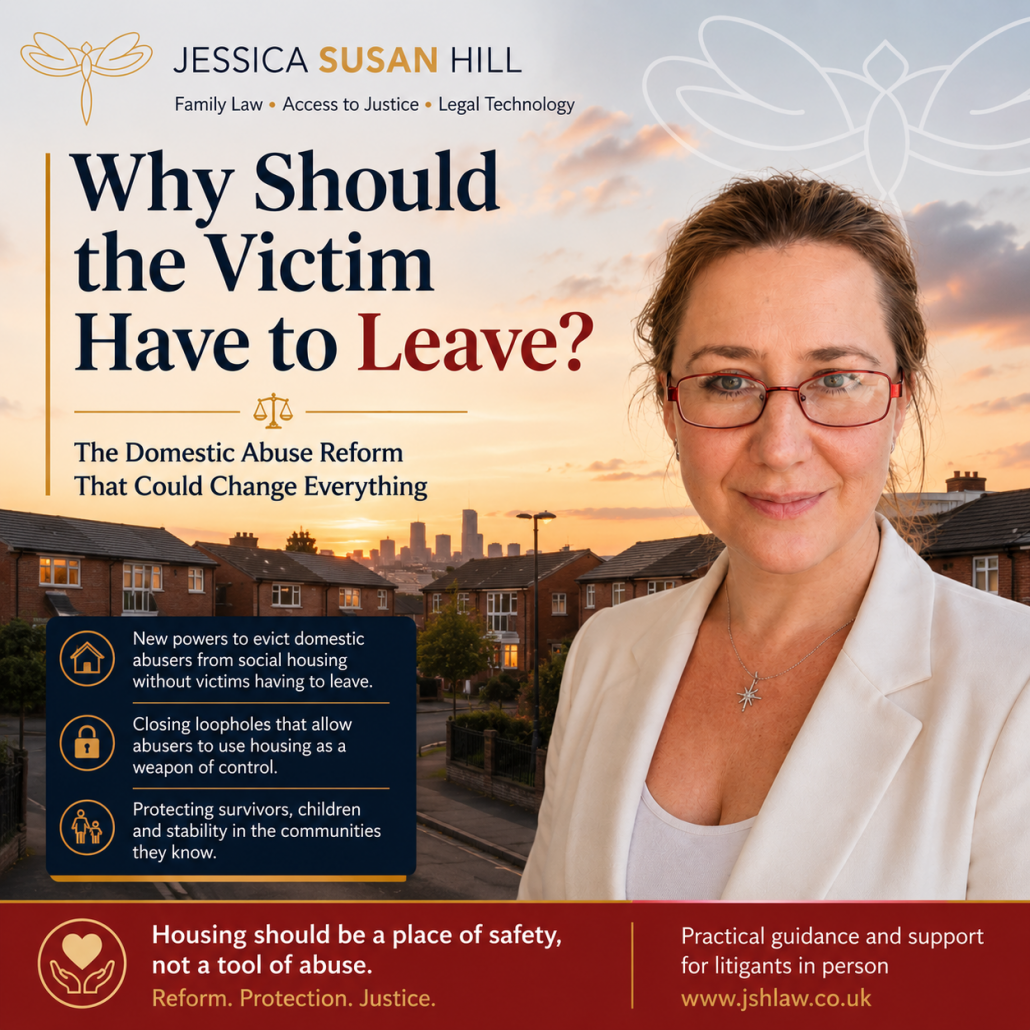
Why Should the Victim Have to Leave? The Domestic Abuse Housing Reform That Could Change Everything
For too long, survivors of domestic abuse have been forced into an impossible choice: stay in danger, or leave behind the home, school run, work, healthcare, neighbours, family support and community that help keep life stable. The Government’s proposed Social Housing Bill asks a long-overdue question: why should the victim be the one expected to leave? If implemented properly, this reform could mark an important shift — from uprooting survivors to holding perpetrators accountable.
Domestic Abuse | Social Housing | Access to Justice
Why Should the Victim Have to Leave? The Social Housing Bill, Domestic Abuse and the Right to Stay Safe at Home
For too long, survivors of domestic abuse have been forced into an impossible choice: stay in danger or leave the home, community, school, work, healthcare and support network that helped them survive. The Government’s proposed Social Housing Bill seeks to change that by giving landlords and courts new powers to remove perpetrators from social housing without requiring the victim to leave first.
The question we should have been asking all along
Why has the person experiencing the abuse so often been the one expected to leave?
That question goes to the heart of domestic abuse, housing insecurity and access to justice. If the survivor leaves, they may lose far more than a roof over their head. They may lose proximity to school, work, healthcare, family, friends, neighbours, community support and the ordinary stability that helps a person recover after abuse.
The proposed reforms recognise something important: experiencing domestic abuse should not automatically mean losing your home.
What is the Government proposing?
The Government has announced that its landmark Social Housing Bill will give landlords and courts new powers to evict perpetrators of domestic abuse from social homes, without the victim having to leave first.
According to the Government’s announcement, the proposed protections are designed to deal with a deeply unfair position in the current system. At present, landlords can only evict a perpetrator after the victim has already left the home. In joint tenancies, the victim may have to end the tenancy entirely, potentially leaving themselves homeless.
The proposed Bill also aims to close a loophole where an abuser can serve a Notice to Quit and use the tenancy itself as a weapon to make the victim homeless. Under the proposed reforms, a Notice to Quit served by a perpetrator would not end the social housing joint tenancy while relevant court proceedings are ongoing.
In joint tenancy cases, courts would also be able to transfer the tenancy into the victim’s sole name. Where staying in the property is not appropriate, the court may be able to require the landlord to provide suitable alternative accommodation where available.
The practical shift
The policy direction is clear: the survivor should not automatically be the one displaced. Where safe and appropriate, the perpetrator should be removed and the victim should be able to remain in the home and community they know.
The Government has said that around 15,000 households in England were forced to find a new social home last year because of domestic abuse. That is not a marginal issue. It is a major housing, safety and justice problem.
Why have survivors so often been expected to leave?
In domestic abuse cases, the survivor is often told to “get out”, “go somewhere safe”, “stay with family”, “go to refuge”, “move area” or “start again”.
Sometimes leaving is necessary. Some homes are not safe. Some perpetrators are dangerous. Some situations require urgent relocation, emergency accommodation, refuge space, police involvement, injunctions or safeguarding intervention.
But the problem is that leaving has too often become the default expectation placed on the person experiencing the abuse, rather than the person causing the harm.
That approach can punish the survivor. It can mean:
- losing the family home;
- children changing school;
- loss of childcare arrangements;
- loss of local support networks;
- increased isolation;
- disruption to work or benefits;
- problems accessing healthcare;
- loss of community ties;
- moving into temporary or unsuitable accommodation;
- being placed far away from friends and family;
- financial instability; and
- being forced to rebuild life from crisis, rather than from safety.
The hidden unfairness
When the survivor is expected to leave, the perpetrator may remain in the property while the victim and children carry the practical, emotional and financial consequences of the abuse. That is not survivor-centred justice.
The proposed reforms are therefore important because they challenge a long-standing structural imbalance. They ask whether the system should be quicker, clearer and more willing to remove the person causing harm, rather than uprooting the person trying to escape it.
Housing as a weapon of coercive control
Domestic abuse is not only physical violence. It can include coercive and controlling behaviour, emotional abuse, economic abuse, intimidation, isolation and threats.
Housing can be part of that control.
A perpetrator may use housing to:
- threaten homelessness;
- refuse to leave the property;
- control access to keys, bills or documents;
- prevent the survivor from contacting the landlord;
- damage the property and blame the survivor;
- create rent arrears as a form of economic abuse;
- use a joint tenancy to maintain control;
- threaten to serve a Notice to Quit;
- refuse to cooperate with housing applications;
- use the children’s home as leverage; or
- force the survivor into an impossible choice between safety and homelessness.
This is why tenancy reform matters. If the tenancy itself can be weaponised, then housing law becomes part of the safeguarding landscape.
Housing is not neutral in domestic abuse cases
A home can be a place of safety, but it can also be a site of control. The law must be able to distinguish between protecting a tenancy and protecting the person who is being abused within it.
Why this matters for children
Domestic abuse does not only affect adults. Children who live in homes where domestic abuse occurs are impacted by the abuse, the fear, the instability and the aftermath.
When a survivor is forced to leave, children may also be forced to leave:
- their bedroom;
- their school;
- their friends;
- their routines;
- their healthcare providers;
- their local family support;
- their pets;
- their safe adults;
- their sense of familiarity; and
- their community.
In some cases, relocation is essential. Safety comes first. But where the survivor and children can remain safely in the home, it may reduce disruption and help recovery.
Stability matters after trauma. A child who has already experienced fear, conflict or coercive control may need routine, school continuity and familiar support more than ever.
A child-centred question
If the perpetrator is the source of harm, why should the child and protective parent automatically be the ones uprooted? The answer should depend on safety, evidence and practicality — not outdated assumptions.
The family court connection
Housing instability often appears alongside family court proceedings. A parent experiencing domestic abuse may be dealing with:
- a non-molestation order application;
- an occupation order application;
- child arrangements proceedings;
- Cafcass safeguarding enquiries;
- allegations of coercive control;
- disputes about where children should live;
- supervised contact requests;
- fact-finding hearings;
- police involvement;
- local authority involvement;
- housing applications; and
- urgent welfare concerns.
The family court may be asked to make orders about children while housing is unstable. That can complicate everything. A parent without secure accommodation may be unfairly perceived as less stable, even where the housing instability was caused by abuse.
This is why the housing reforms matter beyond housing law. They may affect how survivors are able to participate in family proceedings, how quickly children regain stability, and whether perpetrators can continue using housing insecurity as leverage.
For litigants in person
If housing is part of the abuse dynamic, say so clearly. Do not treat it as a side issue. Explain how threats about the tenancy, homelessness, rent arrears, access to the home or pressure to leave connect to coercive control, child arrangements and safeguarding.
The detail and implementation will matter
The proposed reforms are encouraging, but the detail will matter enormously.
The key questions include:
- How quickly will landlords act when domestic abuse is reported?
- What evidence will be required?
- Will survivors be believed at an early stage?
- How will risk be assessed?
- What safeguards will exist against misuse?
- How will courts balance tenancy rights, safety and evidence?
- Will landlords receive proper domestic abuse training?
- What happens where the perpetrator contests the allegations?
- How will children’s needs be assessed?
- What alternative accommodation will be available where staying is unsafe?
- How will local authorities avoid simply moving the victim by another route?
- Will survivors have access to legal advice?
The law can create a route. But the route must work in real life.
Survivors should not be trapped in slow, confusing or evidentially impossible processes. If the system requires survivors to prove too much too early, without support, the reform may fail the very people it is designed to protect.
A good law badly implemented will not protect survivors
Landlords, courts, police, domestic abuse services, local authorities and family justice professionals will need joined-up processes. Otherwise survivors may still be passed between systems while the perpetrator remains in control.
Practical steps for survivors and litigants in person
If domestic abuse and housing are connected in your situation, it is important to start recording the housing element clearly.
Practical checklist
-
Keep a timeline.
Record incidents involving threats to the tenancy, pressure to leave, rent arrears, property damage, lock changes, intimidation at the home or threats about homelessness. -
Preserve messages.
Keep texts, WhatsApps, emails, voicemails and letters showing threats, admissions, intimidation or housing-related control. -
Contact the landlord or housing provider safely.
Ask whether they have a domestic abuse policy and whether they can refer you to a specialist housing or safeguarding officer. -
Ask about tenancy options.
If you are in a joint tenancy, ask what options exist if domestic abuse is involved. -
Seek specialist domestic abuse support.
A domestic abuse service may be able to help with safety planning, evidence, housing advocacy and referrals. -
Consider protective orders.
Depending on the facts, a non-molestation order or occupation order may be relevant. Get legal advice where possible. -
Tell the family court if housing is part of the risk picture.
If the other party is using the home, tenancy or homelessness as control, explain that clearly in your statement. -
Keep children’s stability visible.
Explain the impact of housing disruption on school, health, contact arrangements, routines and emotional wellbeing. -
Do not leave without advice if you can safely obtain it first.
In an emergency, safety comes first. But where there is time, get advice before ending a tenancy or leaving permanently.
Suggested wording for a housing provider
Subject: Urgent domestic abuse and tenancy safety concern
Dear [Housing Officer / Landlord],
I am contacting you because domestic abuse is affecting my housing situation. I am concerned about my safety and/or the safety and stability of my children.
The other tenant/occupier has [briefly explain: threatened to make me homeless / used the tenancy to control me / refused to leave / threatened a Notice to Quit / caused rent arrears / damaged the property / intimidated me at the home].
Please confirm what domestic abuse policy or safeguarding procedure applies, and whether this can be referred urgently to a specialist housing officer or safeguarding lead.
I would also be grateful if you could confirm what options may be available to protect my tenancy and prevent the perpetrator using the housing situation to further control or displace me.
Please treat this as confidential and take care when contacting me, as unsafe communication may increase risk.
Kind regards,
[Name]
What wider reform should look like
The Social Housing Bill is an important step, but it should be part of a wider domestic abuse and housing strategy.
1. Housing providers need specialist domestic abuse training
Frontline housing staff must understand coercive control, economic abuse, trauma, risk escalation and how perpetrators may manipulate tenancy processes.
2. Survivors need access to legal advice
Tenancy rights, occupation orders, homelessness duties, family court proceedings and safeguarding can overlap. Survivors should not have to navigate that alone.
3. Courts need clear evidence routes
If tenancy transfer or eviction depends on court proceedings, the process must be clear, timely and accessible.
4. Private renters must not be left behind
The current announcement focuses on social housing. But domestic abuse affects private renters too. Housing insecurity in the private rented sector remains a major access-to-safety issue.
5. Children’s stability must be central
Housing decisions should consider the child’s school, routines, community, medical care, emotional security and relationship with the protective parent.
6. Perpetrators must not be allowed to weaponise process
Any new process must anticipate delay tactics, retaliatory allegations, threats, intimidation and procedural manipulation.
7. Data must be collected and published
We need to know how often the new powers are used, whether they work, how long they take, whether survivors remain safely housed, and whether outcomes differ across regions and landlords.
Practical summary
- The proposed Bill is welcome. It recognises that survivors should not automatically be the ones forced out.
- Housing can be part of coercive control. Tenancies, rent, notices, keys and homelessness threats can all be weaponised.
- Children’s stability matters. Leaving home may mean losing school, friends, healthcare and support.
- The detail will matter. Evidence requirements, landlord training and court processes must work in practice.
- Private renters remain a concern. The current proposals focus on social housing.
- Survivors should keep records. Housing-related threats and control should be documented carefully.
- Family court statements should not ignore housing abuse. If housing is being used as control, explain it clearly.
Need help organising your family court case?
If domestic abuse, housing instability, child arrangements or safeguarding issues are part of your family court case, JSH Law may be able to help you prepare in a structured and practical way.
Support may include chronology preparation, position statements, document organisation, Cafcass report review, safeguarding issue mapping, hearing preparation and McKenzie Friend support where appropriate.
JSH Law does not replace urgent safeguarding support, emergency legal advice or regulated representation. If you are in immediate danger, contact the police or an appropriate domestic abuse support service.
Final thought: safety should not mean homelessness
The principle behind the proposed reform is simple but powerful:
The person experiencing domestic abuse should not automatically be the person forced to leave home.
That does not mean every survivor will be able to remain safely in every property. Some situations will still require relocation. Some risks will be too high. Some homes will not be safe.
But the starting point matters. The system should not make the survivor carry the housing penalty for the perpetrator’s abuse.
Domestic abuse is not only a criminal justice issue. It is a family justice issue, a housing issue, a child welfare issue, a poverty issue and an access-to-justice issue.
If this reform is implemented properly, it could help survivors and children stay connected to the communities, schools, healthcare and support networks that make recovery possible.
Useful links and further reading
- GOV.UK: Domestic abusers to be evicted under new landmark housing law
- GOV.UK: Domestic abuse — how to get help
- GOV.UK: Apply for a non-molestation or occupation order
- Domestic Abuse Commissioner
- Women’s Aid
- National Domestic Abuse Helpline
- Domestic Abuse Housing Alliance
- Shelter: Domestic abuse and homelessness
Regulatory & Editorial Notice
This article is provided for general public legal education and commentary only. It is not legal advice and should not be relied upon as a substitute for advice from a qualified solicitor, barrister, housing adviser or other authorised legal professional on the facts of an individual case.
JSH Law is not regulated by the Solicitors Regulation Authority and does not conduct reserved legal activities. Support is provided to litigants in person in a practical, procedural and document-preparation capacity. Where formal legal advice, advocacy, conduct of litigation, rights of audience, appeal advice, housing advice or regulated representation are required, readers should seek assistance from an appropriately authorised professional.
Domestic abuse can involve immediate risk. If you or a child are in immediate danger, call 999. If it is not safe to speak, follow emergency guidance for silent calls where available. For non-emergency support, contact a specialist domestic abuse service, housing adviser, solicitor or local authority.
References to government announcements, public commentary and third-party organisations are included for public-interest discussion and access-to-justice analysis. Legislative proposals may change as a Bill progresses through Parliament.
 © 2026 JSH Law Ltd. All rights reserved.
 © 2026 JSH Law Ltd. All rights reserved.
Leave a Reply
Want to join the discussion?Feel free to contribute!