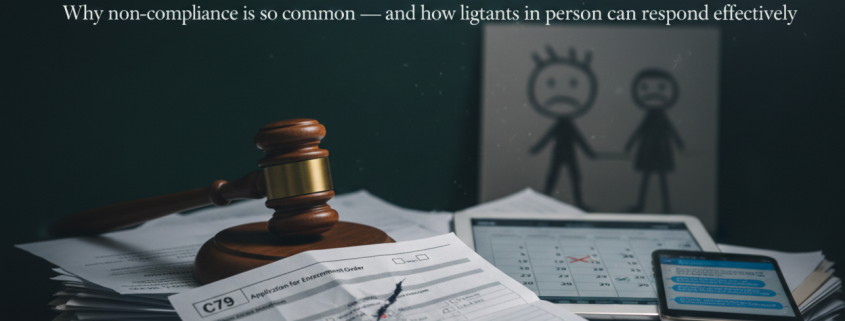
Why non-compliance is so common — and how litigants in person can respond effectively
Introduction: When a court order exists — but nothing changes
For many parents, obtaining a Child Arrangements Order feels like the end of the battle. The court has made a decision. Arrangements are set out clearly. The expectation is that life will now move forward.
Yet for a significant number of parents, the reality is very different.
Contact does not resume. Time is reduced, restricted, or cancelled altogether. Excuses multiply. Weeks turn into months. And despite the existence of a court order, one parent finds themselves effectively shut out of their child’s life.
This is where enforcement becomes necessary — and where many litigants in person feel lost, frustrated, and disillusioned.
This article explains how enforcement works, why it is often misunderstood, where parents go wrong, and how a structured approach can help litigants in person respond without escalating conflict or damaging credibility.
What enforcement of a Child Arrangements Order actually means
Enforcement is the process by which the court is asked to intervene because an existing order is not being complied with.
This is done through a C79 application.
The court is not re-deciding what arrangements should be. It is considering whether:
an order has been breached
the breach is established
there was a reasonable excuse
enforcement action is appropriate
Understanding this distinction is critical.
Many parents approach enforcement as an opportunity to re-argue the merits of their case. That is rarely effective.
Why enforcement is so difficult in practice
Enforcement in family court is procedurally demanding and emotionally draining.
Parents often encounter:
repeated breaches with minimal consequences
shifting justifications for non-compliance
informal variation without court approval
reluctance by courts to escalate sanctions early
delays that compound harm
For litigants in person, these challenges are magnified by uncertainty about what the court expects to see in an enforcement application.
Common mistakes litigants in person make when enforcing contact
1. Treating enforcement as a continuation of the original dispute
The court is not revisiting history. It is assessing compliance.
Lengthy narratives about the relationship breakdown often distract from the central issue: whether the order has been breached.
2. Failing to evidence breaches clearly
Courts require specificity.
Dates, times, what was ordered, what occurred instead — vague assertions are rarely sufficient.
Many litigants assume the court will “know what has been happening.” It will not, unless it is clearly evidenced.
3. Escalating emotionally rather than procedurally
Understandably, parents feel angry and hurt. But enforcement applications framed in emotive language often weaken credibility rather than strengthen it.
The court is assessing behaviour, not distress.
4. Delaying enforcement for too long
Some parents tolerate non-compliance for months before acting, hoping matters will resolve.
By the time enforcement is sought, patterns of non-compliance may already be entrenched — and harder to address.
What the court is actually looking for on a C79
When considering enforcement, the court focuses on:
the clarity of the original order
the extent and frequency of breaches
any alleged reasonable excuse
the impact on the child
whether enforcement action would be proportionate
Parents who present their case around these factors are far more likely to be taken seriously.
The myth of automatic enforcement
There is a common misconception that once a breach is shown, enforcement automatically follows.
In reality, family courts are cautious. They prioritise welfare and proportionality and often attempt less intrusive measures before imposing sanctions.
This can be deeply frustrating for parents — but understanding this reality allows litigants in person to prepare strategically rather than react emotionally.
The importance of documenting breaches properly
Effective enforcement depends on clear records.
This includes:
maintaining a contact log
preserving messages and cancellations
recording attempts to comply with the order
avoiding confrontational communication
Well-organised evidence allows the court to see patterns, not just isolated incidents.
When variation and enforcement overlap
Sometimes non-compliance arises because circumstances have changed — but no variation application has been made.
Courts may be reluctant to enforce rigidly where an order no longer reflects reality.
Litigants in person often struggle to know whether to pursue enforcement, variation, or both.
This is an area where early procedural clarity can prevent wasted applications and further delay.
How enforcement affects children — and why courts tread carefully
While enforcement is about compliance, courts remain focused on children’s welfare.
They are mindful that:
sanctions may increase conflict
children can be placed under pressure
rigid enforcement may not resolve underlying issues
This explains why enforcement can feel slow or ineffective — but it also highlights why clear, measured applications are essential.
When support with enforcement can make a difference
Support can be particularly valuable where:
breaches are ongoing and disputed
communication has broken down
previous enforcement attempts have failed
allegations are raised in response to enforcement
a parent feels unheard or overwhelmed
Structured support helps parents focus on process, not emotion.
How I support litigants in person with enforcement applications
I support parents seeking to enforce Child Arrangements Orders by helping them:
understand whether enforcement is appropriate
structure evidence clearly and chronologically
approach the C79 application in a focused way
prepare for what the court is likely to consider
avoid common pitfalls that undermine enforcement
I do not promise outcomes, and I do not escalate conflict.
My role is to help litigants in person engage with enforcement proceedings in a way that protects their credibility and keeps the focus where the court expects it to be.
A message to parents facing repeated non-compliance
If you are dealing with ongoing breaches of a Child Arrangements Order, your frustration is understandable.
But enforcement is not about expressing that frustration. It is about presenting a clear procedural case that the court can act upon.
Clarity, consistency, and preparation matter.
Call Me
If a Child Arrangements Order is not being complied with and you are representing yourself, structured support may help you approach enforcement with clarity and confidence.
I offer procedural support to litigants in person pursuing enforcement applications, subject to the court’s discretion.
You are welcome to get in touch to discuss whether support would be appropriate in your circumstances.
Regulatory & Editorial Notice This article is published for general information purposes only. It does not constitute legal advice and should not be relied upon as such. Every family case turns on its own facts and procedural context. Support services described are non-reserved and subject to the discretion of the court. Where legal advice is required, readers should seek assistance from a suitably qualified legal professional.
https://jshlaw.co.uk/wp-content/uploads/2026/01/Gemini_Generated_Image_emej5aemej5aemej.png8321248jessica susan hillhttps://jshlaw.co.uk/wp-content/uploads/2026/01/jsh-law-logo-new-black-300x67.pngjessica susan hill2026-01-14 18:10:042026-02-03 03:40:06Enforcing Child Contact Orders (C79): When Orders Are Ignored
Why early mistakes can shape your entire case — and how litigants in person can avoid them
Introduction: Why the C100 matters more than most parents realise
For many parents, a Child Arrangements Order application feels like a formality — a necessary step to “get into court” so that arrangements for their child can be resolved.
In reality, the C100 application is one of the most important documents you will file in your case.
For litigants in person, mistakes made at this stage often follow them for months or even years. The way issues are framed, concerns are expressed, and requests are presented at the outset can shape how the court, Cafcass, and the other party approach the case from that point onwards.
This article explains what a Child Arrangements Order is, how the C100 is used, where litigants in person most often go wrong, and how careful preparation at the start can prevent avoidable difficulties later.
What is a Child Arrangements Order?
A Child Arrangements Order is a court order that sets out:
who a child lives with
who a child spends time with
how and when that time takes place
It replaces older terminology such as “residence” and “contact,” but the practical consequences remain significant.
For parents who cannot agree arrangements privately, the C100 application is the gateway to the court’s involvement.
What the C100 application actually does
The C100 is not just an administrative form. It performs several critical functions at once:
it defines the scope of the dispute
it identifies safeguarding issues
it triggers Cafcass involvement
it frames the court’s initial understanding of the case
Once submitted, the C100 is read by professionals who have no background knowledge of your family, your history, or your intentions. The form therefore needs to be clear, proportionate, and carefully structured.
This is where many litigants in person struggle.
Common mistakes litigants in person make on the C100
1. Treating the form as a narrative statement
Many parents attempt to tell their entire story in the C100. This often results in:
excessive detail
emotional language
unfocused allegations
confusion about what is being asked
The C100 is not the place for a full history. It is a framing document.
2. Overstating or misplacing safeguarding concerns
Safeguarding questions must be answered honestly, but they must also be answered accurately.
Over-reporting concerns can escalate a case unnecessarily. Under-reporting can leave serious issues unaddressed.
Litigants in person often struggle to understand how safeguarding information will be interpreted once it leaves their hands.
3. Failing to define the order sought clearly
Courts expect parents to be able to explain what they are asking for.
Vague requests such as “fair contact” or “shared care” without practical detail can undermine credibility and delay progress.
4. Assuming mistakes can be corrected easily later
In practice, early framing often sets expectations. While courts can revisit issues, first impressions matter more than most parents realise.
The role of Cafcass after a C100 is issued
Once a C100 is filed, Cafcass will usually carry out safeguarding checks and prepare a short report for the first hearing.
What parents often do not realise is that Cafcass relies heavily on the information provided in the C100.
If the application is unclear, overly emotive, or poorly structured, that tone can be reflected in subsequent reporting.
This does not mean Cafcass is biased — it means the initial information provided carries weight.
What the court is looking for at the outset
At the early stages of a Child Arrangements case, the court is not deciding final outcomes. It is trying to establish:
what the dispute actually is
whether there are safeguarding concerns
whether interim arrangements are possible
what evidence or assessments may be required
Parents who understand this are far better placed to engage constructively with the process.
Why early clarity benefits everyone — especially children
Unfocused applications often lead to:
unnecessary escalation
prolonged proceedings
entrenched conflict
increased stress for children
Clear, proportionate applications make it easier for the court to:
identify what matters
filter out what does not
move cases forward efficiently
For litigants in person, this clarity is protective.
What litigants in person can do before submitting a C100
While legal advice may not always be accessible, there are still practical steps parents can take.
These include:
understanding what each section of the form is asking
separating emotional experience from procedural relevance
focusing on current arrangements and practical proposals
considering how safeguarding information will be read by third parties
ensuring consistency between sections of the form
Preparation at this stage is not about gaming the system. It is about engaging with it properly.
When support before issuing a C100 can help
Many parents only seek support once proceedings have already become difficult.
In practice, support before a C100 is issued can be one of the most effective interventions.
This may involve:
helping parents understand the purpose of the form
clarifying what is relevant at this stage
structuring information coherently
identifying issues that may require careful handling
Support does not replace the parent’s voice — it helps that voice be heard clearly.
How I support litigants in person with C100 applications
I support parents who are preparing to issue — or have already issued — Child Arrangements applications by helping them:
understand what the court is asking for
approach the C100 in a structured, proportionate way
avoid common procedural pitfalls
prepare for what happens after the form is filed
I do not draft applications on a parent’s behalf as a legal representative, and I do not promise outcomes.
My role is to help litigants in person engage with the process calmly, clearly, and confidently from the outset.
A message to parents considering a C100 application
If you are thinking about applying for a Child Arrangements Order, feeling uncertain does not mean you are unprepared to parent. It means you are entering a system that expects procedural clarity from people who have never been trained to provide it.
The way you start matters.
Taking time to understand the process — and seeking support where appropriate — can prevent avoidable stress and confusion later on.
Contact Me
If you are considering a Child Arrangements Order and representing yourself, early clarity can make a significant difference to how your case progresses.
I offer structured, procedural support to litigants in person preparing C100 applications, subject to the court’s discretion.
You are welcome to get in touch to discuss whether support would be appropriate in your circumstances.
Regulatory & Editorial Notice This article is published for general information purposes only. It does not constitute legal advice and should not be relied upon as such. Every family case turns on its own facts and procedural context. Support services described are non-reserved and subject to the discretion of the court. Where legal advice is required, readers should seek assistance from a suitably qualified legal professional.
https://jshlaw.co.uk/wp-content/uploads/2026/01/Gemini_Generated_Image_nq4qb9nq4qb9nq4q.png8321248jessica susan hillhttps://jshlaw.co.uk/wp-content/uploads/2026/01/jsh-law-logo-new-black-300x67.pngjessica susan hill2026-01-14 17:45:092026-02-03 03:40:38Child Arrangements Orders (C100): Getting It Right From the Start
What parents are not told — and how procedural support can change the course of a case
When parents enter private law proceedings alone
Private law children cases are among the most emotionally charged proceedings in the family court. Parents come to court not as abstract legal actors, but as mothers and fathers fighting to remain present in their children’s lives.
Since the reduction of legal aid, increasing numbers of parents navigate these proceedings without representation. They do so while facing allegations, safeguarding concerns, and complex procedural expectations — often against a represented party.
In this context, McKenzie Friend support has become both more visible and more misunderstood.
This article explains what McKenzie Friend support properly is, how it operates in private law children cases, where it adds real value, and why it can be a crucial stabilising force for litigants in person.
What is a private law children case?
Private law children cases concern disputes between individuals — usually parents — about arrangements for a child. They commonly involve applications relating to:
child arrangements (where a child lives and spends time)
parental responsibility
specific issues (education, medical treatment, travel)
prohibited steps orders
enforcement or variation of existing orders
Unlike public law cases, the state is not seeking intervention. However, safeguarding agencies such as Cafcass and local authorities may become involved if concerns are raised.
For litigants in person, this distinction is often poorly understood — yet procedurally critical.
Why private law cases are particularly difficult for litigants in person
Parents in private law proceedings face a unique combination of pressures:
high emotional stakes
ongoing relationships with the other party
allegations that may be disputed but deeply damaging
unfamiliar procedural frameworks
limited opportunity to correct early errors
Unlike criminal or civil litigation, family court hearings are less structured in appearance — but no less demanding in substance. Judges still expect clarity, relevance, proportionality, and procedural compliance.
Parents often enter court believing that “telling their story” is enough. It rarely is.
What a McKenzie Friend is — and is not
A McKenzie Friend is not a solicitor, barrister, or advocate as of right. Their role is non-reserved and supportive.
Properly understood, a McKenzie Friend may assist a litigant in person by:
providing moral support
helping with paperwork and organisation
taking notes during hearings
quietly prompting issues or questions
assisting with understanding court procedure
They do not have an automatic right to speak on a client’s behalf, conduct litigation, or give legal advice. Any further involvement is subject to the court’s permission.
This distinction matters — both ethically and practically.
Why McKenzie Friend support is often misunderstood
There remains a perception that McKenzie Friends are either unnecessary or disruptive. This perception usually arises from poor experiences, not from the concept itself.
When support is unstructured, adversarial, or oversteps boundaries, it can hinder rather than help. However, where support is disciplined, procedural, and court-respectful, it often improves hearings for everyone involved.
Judges are not opposed to assistance. They are opposed to disorder.
The real value of McKenzie Friend support in private law cases
The most effective support is quiet, focused, and strategic.
1. Helping parents stay on point
Many litigants lose focus under pressure. A McKenzie Friend can help ensure that key issues are not forgotten or drowned out by emotion.
2. Supporting document preparation
Private law cases live or die on written material. Poorly structured statements can undermine otherwise strong positions.
3. Evidence organisation
Chronologies, bundles, and supporting documents must be intelligible to the court. Disorganisation often leads to evidence being overlooked.
4. Managing courtroom pressure
Simply having a calm presence beside them allows many parents to remain composed and articulate.
5. Identifying procedural irregularities
Litigants in person frequently fail to spot procedural unfairness at the time it occurs. Support helps ensure such matters are noted and addressed appropriately.
Allegations and safeguarding: where support is most critical
Private law cases often involve allegations of domestic abuse, coercive control, or safeguarding risk. These allegations may be contested, historic, exaggerated, or misunderstood.
For litigants in person, responding effectively is extremely difficult. Emotional rebuttals can entrench concerns rather than dispel them.
Support in this context focuses on:
understanding the purpose of safeguarding frameworks
responding proportionately and evidentially
avoiding language that escalates risk perceptions
ensuring procedural fairness is preserved
This is not about minimising concerns. It is about ensuring they are handled correctly.
The importance of early support
By the time many parents seek assistance, damage has already been done:
unfocused initial statements
missed opportunities to challenge directions
narratives established without rebuttal
inappropriate concessions made under pressure
Early support does not guarantee outcomes, but it often prevents avoidable harm. It allows parents to enter proceedings with a clearer understanding of what lies ahead and how to engage productively.
Respecting the court’s discretion
A fundamental principle of effective McKenzie Friend support is respect for the court.
Permission is requested, not assumed. Boundaries are observed. The judge’s authority is acknowledged at all times.
Where further assistance is sought — such as addressing the court — this is done transparently and appropriately. There is no entitlement. There is only discretion.
This approach builds credibility rather than resistance.
When McKenzie Friend support may not be appropriate
Support is not suitable in every case. Situations where it may be limited include:
where the litigant seeks legal advice beyond scope
where conduct becomes adversarial or obstructive
where the court determines assistance would not be helpful
Ethical support includes knowing when to step back.
How I support parents in private law children cases
My work with litigants in person is grounded in procedure, preparation, and proportionality.
I support parents by:
helping them understand what the court is asking for
assisting with the structure and clarity of written material
supporting evidence organisation and case chronology
preparing parents for hearings so they feel steady and informed
attending court as a McKenzie Friend where appropriate and permitted
I do not promise outcomes. I do not inflame disputes. I do not replace legal representation.
I support parents to engage with the process in a way that protects their credibility and their children’s interests.
A message to parents navigating private law proceedings
If you are representing yourself in a private law children case, struggling does not mean you are failing. It means you are dealing with one of the most demanding processes in the legal system without training or support.
Seeking assistance is not an admission of weakness. It is a practical decision.
If you recognise the challenges described in this article, it may be time to ask whether structured support could help you navigate the process more effectively.
Contact Me
If you are a parent involved in a private law children case and representing yourself, support may help you approach the process with greater clarity and confidence.
I offer calm, procedural McKenzie Friend support for litigants in person, subject to the court’s discretion.
You are welcome to get in touch to discuss whether support would be appropriate in your circumstances.
Regulatory & Editorial Notice This article is published for general information purposes only. It does not constitute legal advice and should not be relied upon as such. McKenzie Friend services are non-reserved and subject to the discretion of the court. Every family case turns on its own facts and procedural context. Where legal advice is required, readers should seek assistance from a suitably qualified legal professional.
https://jshlaw.co.uk/wp-content/uploads/2026/01/Gemini_Generated_Image_vz2qk1vz2qk1vz2q.png8321248jessica susan hillhttps://jshlaw.co.uk/wp-content/uploads/2026/01/jsh-law-logo-new-black-300x67.pngjessica susan hill2026-01-14 17:06:052026-02-03 03:41:18McKenzie Friend Support in Private Law Children Cases
Across England and Wales, an increasing number of parents find themselves navigating the family courts without legal representation. For many, this is not a choice but a necessity. Legal aid is limited. Private representation is prohibitively expensive. And yet the stakes could not be higher: children, relationships, reputations, homes, and long-term stability all hang in the balance.
Litigants in person are routinely told that the family court is “designed to be accessible.” In practice, however, the system remains deeply procedural, expectation-heavy, and unforgiving of error. Parents are expected to understand forms, directions, evidential standards, and courtroom etiquette — often while under extreme emotional strain.
Support for litigants in person is therefore not a luxury. It is an essential safeguard against avoidable harm.
This article explains where parents most often struggle, what the court is actually looking for, and how structured, ethical support can make a material difference to outcomes.
The reality of being a litigant in person
A litigant in person is expected to do everything a represented party would do, but without training, without guidance, and without a professional buffer between themselves and the process.
In practical terms, this means parents must:
understand which application is appropriate (C100, C79, C2, etc.)
comply precisely with court directions and deadlines
prepare written statements that are relevant, proportionate, and compliant
organise evidence into coherent bundles
address the court calmly and appropriately
respond to allegations without inflaming matters
identify procedural unfairness without appearing obstructive
None of this is intuitive. Most people arrive at court distressed, exhausted, and unfamiliar with adversarial processes. The result is predictable: good parents make damaging mistakes, not because their case lacks merit, but because they do not know how to present it.
Common difficulties litigants in person face
Through repeated exposure to real cases, certain patterns appear again and again.
1. Over-disclosure and narrative dumping
Parents often believe that telling the court everything will help. In fact, lengthy emotional narratives can obscure the issues the court needs to determine and undermine credibility.
2. Misunderstanding relevance
Not all unfairness is legally relevant. Many litigants struggle to distinguish between injustice they have experienced and matters the court can properly adjudicate.
3. Procedural missteps
Missing deadlines, filing the wrong documents, or responding informally to serious allegations can all have lasting consequences.
4. Difficulty responding to allegations
False or exaggerated allegations require careful, disciplined handling. Emotional rebuttals often worsen matters.
5. Intimidation in court
Many litigants freeze when addressing a judge, forget key points, or are derailed by interruptions.
None of these issues reflect parenting ability. They reflect a lack of procedural support.
What the family court is actually looking for
Contrary to popular belief, judges are not looking for the most emotional account or the most detailed history. They are looking for clarity.
Specifically, the court is concerned with:
what decisions it must make
what evidence is relevant to those decisions
whether procedure has been followed
whether safeguarding concerns are properly addressed
whether parties can support workable arrangements for children
When litigants understand this, their cases become more focused, calmer, and more persuasive.
Support at this level is about helping parents translate lived experience into court-appropriate material — not rewriting history or inflating claims.
The danger of “figuring it out as you go”
Many litigants in person assume they can correct mistakes later. In reality, early errors often set the tone for the entire case.
Examples include:
poorly drafted initial applications
unfocused first statements
failure to challenge procedural irregularities early
allowing inaccurate narratives to take hold unopposed
Once a case direction has been set, reversing course becomes difficult. This is why early, structured support matters — even for parents who intend to remain self-represented.
What support for litigants in person properly looks like
Ethical support does not involve giving legal advice where it cannot be given, nor does it involve speaking for the client as of right. Instead, it focuses on:
explaining process and expectations
helping parents prepare documents that are clear and compliant
identifying procedural issues that may need to be raised
assisting with evidence organisation and chronology
supporting preparation for hearings and submissions
providing calm, grounded presence in court where permitted
This kind of support empowers parents to present their own cases effectively, rather than feeling overwhelmed or silenced.
The role of a McKenzie Friend and procedural support
A McKenzie Friend can assist a litigant in person by providing practical, emotional, and procedural support. This may include:
helping to structure written material
taking notes during hearings
quietly prompting key points
assisting with case organisation
helping parents remain focused and composed
Where permitted by the court, further support may be requested, but nothing is assumed. Respect for the court and its discretion is fundamental.
Why unsupported litigants are at a disadvantage
Although judges strive to ensure fairness, the system itself remains complex. A represented party benefits from:
procedural fluency
experience of evidential thresholds
familiarity with court culture
emotional distance from the dispute
A litigant in person has none of these by default. Support helps narrow that gap — not by creating an unfair advantage, but by reducing avoidable disadvantage.
When support can make the greatest difference
Support is particularly valuable at key stages, including:
before issuing an application
when responding to serious allegations
prior to fact-finding hearings
when preparing for enforcement or variation
where procedural irregularities arise
when a parent feels unable to speak effectively in court
Waiting until matters escalate is rarely beneficial. Early clarity prevents later damage.
How I support litigants in person
My work focuses on supporting parents who are navigating the family courts without representation and who want to engage properly, calmly, and effectively with the process.
I assist with:
understanding what the court is asking for
preparing focused, proportionate documents
organising evidence in a way the court can engage with
identifying procedural issues that may require attention
preparing for hearings so parents feel steady and informed
I do not promise outcomes. I do not inflame disputes. I do not replace legal representation. I support parents to present their own cases with clarity, dignity, and procedural fairness.
A final word to parents reading this
If you are a litigant in person, struggling does not mean you are failing. It means you are operating within a system that was not designed with unrepresented parents in mind.
Seeking support is not a weakness. It is a practical step towards protecting yourself and your children from avoidable harm.
If you recognise yourself in this article, it may be the right time to ask for help.
Contact Me
If you are representing yourself in the family court and feel overwhelmed, uncertain, or unheard, you do not have to navigate this alone.
I offer calm, structured support for litigants in person at all stages of family proceedings.
You are welcome to get in touch to discuss whether support would be appropriate in your situation.
Regulatory & Editorial Notice This article is published for general information purposes only. It does not constitute legal advice and should not be relied upon as such. Every family case turns on its own facts and procedural context. Support services described are non-reserved and subject to the court’s discretion. Where legal advice is required, readers should seek assistance from a suitably qualified legal professional.
https://jshlaw.co.uk/wp-content/uploads/2026/01/ChatGPT-Image-Jan-14-2026-04_05_31-PM.png10241536jessica susan hillhttps://jshlaw.co.uk/wp-content/uploads/2026/01/jsh-law-logo-new-black-300x67.pngjessica susan hill2026-01-14 16:08:302026-02-03 03:41:39Support for Litigants in Person in the Family Court – What the system expects — and where parents are most often let down.
A recent post shared by PAPA – People Against Parental Alienation recounts the death of a parent following nearly a decade of litigation in the family courts.
It is a devastating read. And it should stop every professional in this system in their tracks.
This was not a parent who disengaged. This was not a parent who posed a safeguarding risk. This was not a parent who refused to comply.
This was a parent who did everything the system asked of him—and was still ground down until there was nothing left.
A Familiar Pattern
The facts described will be painfully recognisable to many parents navigating private law proceedings:
Years of allegations, many serious, repeatedly investigated and dismissed
Ongoing disruption of contact despite findings of no safeguarding concerns
Court orders made, but not enforced
Repeated breaches met with little more than verbal criticism
A parent forced back to court again and again, simply to maintain a relationship with their children
This father lost his home, his financial stability, and ultimately his hope—not because the court found him unfit, but because the system failed to act decisively when its own orders were ignored.
The Enforcement Gap No One Wants to Own
Family courts in England and Wales routinely acknowledge that a relationship with both parents is important for a child, absent safeguarding concerns. Orders are made to reflect that principle.
But making an order is not the same as enforcing it.
What this case exposes—once again—is a persistent enforcement vacuum:
Breaches are minimised
Delay becomes normalised
Responsibility is diffused between agencies
Parents are told to “return to court” as if that is a neutral act
Each return to court carries real cost:
Financial
Emotional
Psychological
For some parents, those costs eventually become unbearable.
“It’s a Family Matter”
Perhaps the most chilling part of the account is this: after years of documented obstruction, the parent sought police assistance for harassment and persistent interference—only to be told it was “a family matter” and advised to stop pursuing it.
This response reflects a wider institutional problem. When court orders exist but are not enforced, parents are left in a legal no-man’s-land:
The court points to enforcement applications
The police defer to family proceedings
Local authorities step back once safeguarding thresholds are deemed unmet
And the parent is left carrying the entire burden alone.
This Was Preventable
Let us be clear: This was not inevitable.
A parent who complied with every instruction, adapted their life to remain available to their children, and continued to engage respectfully with the process should not be left without protection.
Children should not lose a loving parent because court orders were treated as optional.
When systems repeatedly confirm there is no safeguarding risk, yet allow ongoing obstruction to continue unchecked, the harm becomes institutional.
Why This Matters
This is not about one case. It is about a pattern.
Until parental alienation and persistent obstruction are properly recognised, until court orders are meaningfully enforced, and until agencies stop passing responsibility sideways, tragedies like this will continue.
And they will continue quietly—until another name is added to a memorial.
A Final Word
This father’s children have lost a parent not because he failed them, but because the systems designed to protect family relationships failed to intervene when it mattered most.
That loss will echo far beyond this moment.
We owe it to those children—and to every parent still fighting—to do better.
If you are navigating prolonged family court proceedings and feel worn down by delay, non-enforcement, or repeated obstruction, you are not weak for feeling the strain. These processes are inherently draining, and support matters.
At JSH Law, we believe sunlight, accountability, and enforceability are essential if family justice is to mean anything at all.
We will continue to speak openly about these failures—because silence is part of how they persist.
Regulatory & Editorial Notice
This article constitutes independent legal commentary on matters of public interest arising from content published by a third party, namely PAPA – People Against Parental Alienation.
JSH Law is not associated with, does not act for, and does not endorse any organisation, campaign, demonstration, or fundraising activity referenced or linked in the original third-party material. No donations are requested, facilitated, or processed by JSH Law.
The content of this article is provided for informational and commentary purposes only. It does not constitute legal advice, does not create a solicitor-client relationship, and should not be relied upon as a substitute for independent legal advice tailored to individual circumstances.
Any factual assertions relating to individual cases are drawn solely from publicly available material and are addressed in a generalised and anonymised manner. No findings of fact, liability, or wrongdoing are asserted against any individual, authority, or agency.
JSH Law reserves the right to amend or withdraw this commentary where necessary to ensure ongoing regulatory compliance and professional standards.
https://jshlaw.co.uk/wp-content/uploads/2026/01/ChatGPT-Image-Jan-8-2026-02_32_57-PM.png10241536jessica susan hillhttps://jshlaw.co.uk/wp-content/uploads/2026/01/jsh-law-logo-new-black-300x67.pngjessica susan hill2026-01-08 14:40:012026-02-03 03:41:58When the System Wears a Parent Down: A Preventable Tragedy in the Family Courts
If you are thinking about making a court application because you are worried about your own safety or your child’s safety, there is something important you need to understand before you file any paperwork.
Many parents come to court believing they have already “done the right thing”. They have spoken to professionals. They have reported concerns internally. They have followed guidance. They have tried to resolve matters without conflict.
And yet, once proceedings begin, they are shocked to discover that the court does not view those actions as safeguarding in the way they expected.
This blog is written to help you avoid that position.
It is not about blame. It is not about criticising organisations. It is about helping you understand how safeguarding is assessed in family court, so you can protect yourself and your children properly before you apply.
The Mistake Many Litigants in Person Make
One of the most common and understandable mistakes litigants in person make is assuming that internal processes equal protection.
Parents often rely on:
schools
faith communities
counsellors or therapists
community leaders
charities
pastoral or welfare support
internal safeguarding or complaint procedures
These routes feel safe. They feel responsible. They feel collaborative.
But the family court does not decide cases based on good intentions. It decides cases based on risk, evidence, reporting, and protective action.
This is where many parents are caught out.
Policy Is Not the Same as Protection
A key distinction in family court is the difference between policy and practice.
An organisation may have:
safeguarding policies
training modules
internal reporting routes
helplines or escalation processes
That does not automatically mean:
the risk was properly assessed
the right authority was informed
the child was safeguarded
the situation was escalated appropriately
evidence was preserved
From a court’s perspective, internal handling often looks like delay, even when it was done in good faith.
Judges and Cafcass officers are not asking:
“Did the organisation have a policy?”
They are asking:
“What was done to protect the child, and when?”
What the Family Court Actually Looks For
When safeguarding concerns are raised, the court focuses on a small number of core questions:
Was the risk identified clearly?
Was it reported to the appropriate statutory authority?
Was action taken promptly?
Was the child protected from further harm?
Is there independent evidence?
Is there a clear safeguarding trail?
If concerns were kept “in house” for months or years, the court may struggle to understand why external safeguarding routes were not used earlier, even where the parent believed they were doing the right thing.
This is particularly important in cases involving:
domestic abuse
coercive control
child sexual abuse
emotional or psychological harm
grooming or boundary violations
Pastoral Support Is Not Safeguarding
One of the hardest things for parents to hear is this:
Pastoral care is not safeguarding.
Supportive conversations, counselling, prayer, mediation, welfare checks, or internal reviews may feel meaningful — and emotionally they are — but they do not replace statutory safeguarding action.
Family court operates on the basis that:
abuse is a child protection issue, not a relational issue
safety comes before reconciliation
risk management comes before repair
When abuse is addressed primarily through counselling or internal resolution, courts often see that as misunderstanding the nature of the risk, even where intentions were good.
Why Internal Handling Can Weaken a Case (Unintentionally)
Parents are often shocked to discover that internal handling can unintentionally undermine their credibility, not strengthen it.
This can happen when:
abuse is disclosed but not reported externally
safeguarding is delayed while people “wait and see”
perpetrators remain in close contact with children
records are informal or incomplete
concerns are framed as “relationship difficulties” rather than harm
responsibility is diffused across multiple people
None of this means you are at fault. It means the system does not operate the way many parents assume it does.
Cafcass and Safeguarding: What Parents Don’t Expect
Cafcass officers are trained to assess risk through a statutory safeguarding lens.
When they review a case, they will often ask:
Why wasn’t this reported to children’s services?
When did the parent first become concerned?
What protective steps were taken?
Who was informed?
Is there a paper trail?
Was the child still exposed to risk?
If the answer is primarily “the organisation was dealing with it”, Cafcass may not treat that as safeguarding in the legal sense.
This is one of the most painful moments for litigants in person — realising too late that they relied on the wrong process.
This Does Not Mean You Failed
It is important to say this clearly:
You did not fail your child by trusting professionals or institutions.
Most parents act in good faith. Most parents are trying to avoid conflict. Most parents are trying to do the “right” thing. Most parents do not want court.
The problem is not you. The problem is that internal systems are not designed for court scrutiny.
Family court operates to a different standard.
The Risk of Waiting Until “Things Get Worse”
Many parents delay issuing proceedings because they hope:
the situation will improve
the other parent will change
counselling will help
professionals will intervene
the organisation will act
Unfortunately, delay can be interpreted by the court as:
acceptance of the risk
tolerance of harm
lack of urgency
inconsistent concern
This is particularly dangerous where children are involved.
Courts expect parents to act protectively, even when that feels uncomfortable or confrontational.
What You Should Do Before You Apply to Court
If you are considering making an application, these steps matter:
Get clarity on safeguarding thresholds Understand what constitutes a safeguarding issue in law, not just in policy.
Ensure appropriate reporting has occurred This may include police or children’s services, depending on the risk.
Document everything properly Dates, disclosures, responses, actions taken, and outcomes.
Stop relying solely on internal handling Internal processes can support safeguarding — but they cannot replace it.
Seek independent advice before issuing This can prevent serious mistakes that are difficult to undo later.
Why Early Advice Matters
Once proceedings start, it is much harder to correct course.
Statements are scrutinised. Timelines are questioned. Decisions are analysed. Delays are examined.
Early advice can help you:
present concerns clearly and proportionately
avoid undermining your own case
protect your credibility
ensure safeguarding is framed correctly
reduce unnecessary conflict
This is not about escalating matters unnecessarily. It is about protecting yourself and your child legally and practically.
You Are Not Alone — and It Is Not Too Late
Many litigants come to court feeling ashamed, confused, or frightened.
They worry they have:
waited too long
trusted the wrong people
done the wrong thing
misunderstood safeguarding
The reality is this:
You are not the first. You are not weak. You are not irresponsible. You are navigating a system most people never expect to enter.
What matters now is getting clear, calm, informed guidance before you issue.
How I Can Help
I support litigants in person who are:
considering making a family court application
dealing with safeguarding concerns
unsure whether what has happened will stand up in court
worried about Cafcass involvement
frightened of getting it wrong
My role is not to inflame conflict or push people into court unnecessarily. My role is to help you understand how the court will view your situation, so you can make informed decisions.
Making Contact
If you are thinking about applying to court and are unsure whether safeguarding has been handled properly, speak to someone before you file.
A short conversation now can prevent serious difficulties later.
You deserve clarity. Your child deserves protection. And you deserve support that is grounded in reality, not assumptions.
If this blog resonates with you, get in touch before you issue.
Not Sure What to Do Next?
If you’re reading this because you’re worried about safety and considering a court application, you don’t have to work this out alone.
Many people reach out at this stage simply to sense-check:
whether safeguarding has been handled properly
whether they’re about to make avoidable mistakes
what the court is likely to focus on
and what their options really are before issuing proceedings
You do not need to have all the answers. You do not need to be ready to go to court. You do not need to commit to anything by getting in touch.
This is about clarity — before things escalate.
What Happens When You Contact Me
When you submit the form:
your message is read reminder-free and confidentially
you’ll receive a calm, straightforward response
I’ll let you know whether I can help and what the next sensible step is
there is no pressure to proceed
If court action isn’t appropriate yet, I’ll tell you. If safeguarding needs attention first, I’ll explain why. If you’re already on the right track, I’ll confirm that too.
Who This Is For
This contact form is suitable if you are:
a parent or carer worried about a child’s safety
considering a family court application
unsure how Cafcass or the court will view what’s happened so far
trying to do the right thing, but feeling overwhelmed
If that’s you, you’re in the right place.
https://jshlaw.co.uk/wp-content/uploads/2026/01/ChatGPT-Image-Jan-7-2026-04_18_31-PM.png10241536jessica susan hillhttps://jshlaw.co.uk/wp-content/uploads/2026/01/jsh-law-logo-new-black-300x67.pngjessica susan hill2026-01-07 16:46:392026-02-03 03:42:13Before You Apply to Court: When ‘Internal Safeguarding’ Isn’t Enough
For decades, the family courts have operated in a space that is both necessary and uncomfortable: decisions of the highest consequence, made largely out of public view. On 30 January 2023, that began to shift. As reported by BBC News, a new transparency pilot allowed journalists to report on family court proceedings in a way that had not previously been possible. It was presented as a step towards accountability. But for parents and litigants in person, the real significance runs deeper—because scrutiny is not just about visibility, it is about whether the system can be properly trusted.
Why Family Court Transparency Matters: What the 30 January 2023 Reporting Pilot Meant for Parents and Litigants in Person
For years, one of the deepest frustrations for families caught up in the family justice system has been this: life-changing decisions are made behind closed doors, yet the people most affected often come away feeling unheard, disoriented, and unable to explain what has happened to them. That is why the 30 January 2023 transparency pilot in the family courts mattered so much. It was not simply a procedural reform for journalists. It was a recognition that secrecy, however well-intentioned, can also shield poor process, weak accountability, and profound injustice. For parents and litigants in person, that moment marked something important: the beginning of a more serious public conversation about what really happens in family court.
Key takeaways for litigants in person
1. Greater transparency in family court is not about sensationalism. It is about accountability, scrutiny and public confidence.
2. The family court deals with some of the most serious and intimate decisions the state can make about children and families.
3. For too long, many parents have felt unable to challenge what happened because the system has been too closed for meaningful scrutiny.
4. Journalists being allowed to report from family court was an important step, but it was never a complete answer on its own.
5. Litigants in person still need to be organised, informed and strategically prepared. Transparency helps, but it does not remove the need to present your case properly.
If you need strategic support with your family court case, chronology, statement, position statement, bundle preparation or hearing preparation, you can book a short initial call below.
What changed on 30 January 2023?
On 30 January 2023, a reporting pilot began in family courts in Leeds, Carlisle and Cardiff. Accredited journalists were to be allowed to report on proceedings in a way that had not previously been possible in any meaningful sense. The intention was to enable closer scrutiny of the family courts, the conduct of local authorities, and the broader decision-making machinery operating in cases involving children.
That may sound modest. In reality, it was significant.
The family courts decide some of the most sensitive issues the law can ever touch: whether a child should be removed from their family, whether parents should be restricted in seeing their children, whether allegations of neglect, abuse, coercion or risk are made out, and whether the state should intervene permanently in family life. These are not minor procedural questions. They are fundamental decisions with lifelong consequences.
Yet despite the seriousness of those decisions, family proceedings have long existed in a space where privacy and secrecy have become difficult to disentangle. Privacy for children is essential. That is not in dispute. But privacy for children is not the same thing as insulation of institutions from scrutiny.
Why this mattered so much
The strongest part of the reporting around the pilot was not simply that a rule was changing. It was the explanation of why scrutiny mattered in the first place.
One of the families referenced in the coverage was that of Liz Anstey, who described the family court process as surreal, traumatic and deeply confusing. She spoke of not knowing who was who, of hearings being adjourned, and of struggling to understand what was going on. That description will resonate with far too many parents.
It should not be normal for people to come out of proceedings affecting their children feeling as though they have fallen into a procedural rabbit hole. Yet many do.
For litigants in person especially, family court can feel like a system with its own language, its own hidden rules, and its own hierarchy of professionals speaking over the lives of ordinary people. Even where the legal process is attempting to do justice, the lived experience can still be one of disempowerment.
That is why scrutiny matters. Not because every complaint made by every parent will be justified. Not because every judicial decision is wrong. But because a justice system that cannot be properly observed will always struggle to command confidence.
The long road to transparency
The 2023 pilot did not appear out of nowhere. It followed decades of pressure, criticism and frustration.
There have been repeated calls over many years for family courts to be opened up to greater scrutiny. Those calls grew louder after cases in which serious errors or alleged miscarriages of justice became publicly known. The concern was never simply that family proceedings were private. The concern was that a private system can become a system in which accountability is too weak, patterns are too difficult to identify, and public understanding is distorted by the absence of real information.
As the article explains, there were previous attempts to increase transparency. In 2009, journalists were allowed into family court hearings, but the practical effect was limited. The rules were too unclear. Reporting remained heavily constrained. Journalists could attend, but not in a way that made meaningful public reporting realistic in most cases.
That distinction is important.
There is a world of difference between being nominally allowed into a courtroom and being able to report in a way that actually informs the public. If a journalist cannot identify the local authority, cannot speak to the family, cannot explain the core facts, and cannot describe the decision in a coherent way, then what exists is not real open justice. It is a carefully managed appearance of it.
Why “private” should never mean “beyond scrutiny”
Family cases are heard in private for good reason. Children must be protected. Their identities, welfare and futures must not be exposed to public harm. That principle is sound and necessary.
But there has always been a dangerous slippage in public debate: the assumption that because proceedings are private, detailed scrutiny is somehow inappropriate or impossible.
That is wrong.
The justice system should be capable of doing two things at once: protecting children’s anonymity while also allowing the conduct of professionals and institutions to be examined. Those aims are not contradictory. In fact, they should sit together. If anything, a system making decisions about vulnerable children should attract more careful scrutiny, not less.
The transparency debate has never really been about whether children should be named. They should not. It has been about whether the operation of the system itself should remain largely shielded from view.
That is where the reporting pilot mattered. It accepted, at least in principle, that anonymity for the child can coexist with proper public-interest reporting.
Why this issue matters to litigants in person
For litigants in person, the transparency issue is not abstract. It affects confidence, fairness and the perceived legitimacy of the whole process.
Parents representing themselves often feel that professionals enter the room with authority already attached to them. Cafcass officers, local authority social workers, experts, guardians, counsel and judges all operate within a system they understand. The parent may be the only person in the room trying to navigate it in real time.
When that process is then almost entirely shielded from outside scrutiny, the parent’s sense of powerlessness can intensify. Even where there are legal remedies, appeals or complaint routes, those mechanisms can be difficult, expensive, slow and procedurally complex. Many families do not have the resources to pursue them.
Transparency does not solve that problem entirely. But it changes the climate. It creates at least the possibility that poor practice, inconsistency, or systemic patterns may be seen and discussed.
And that matters, because courts and agencies behave differently when they know their conduct may be observed and reported.
The limits of transparency
It is also important to be realistic. Transparency is not a cure-all.
Allowing journalists to report on cases does not automatically prevent bad decisions. It does not guarantee that all families will be treated fairly. It does not eliminate the structural disadvantages faced by litigants in person. And it does not remove the emotional and procedural pressure of family proceedings.
In some respects, transparency may even expose a further uncomfortable truth: that the problem was never only secrecy. It was also resources, culture, delay, evidential inconsistency, and the enormous discretionary power exercised within a stressed and overburdened system.
But transparency still matters because without it, those deeper problems are easier to ignore.
A closed system can always reassure itself that it is functioning well. A scrutinised system has to show its workings.
The human cost of family court decisions
One of the most powerful features of the earlier article was its reminder that family court reporting is not simply about legal principle. It is about human consequence.
There is a tendency in legal systems to become desensitised to process. Adjournments become routine. bundles become routine. directions become routine. expert reports become routine. But for the family living through the case, none of it is routine.
When a child is removed, when contact is suspended, when allegations are made, when a case drags on, when a hearing ends in tears outside court, those events are not procedural footnotes. They are pivotal moments in people’s lives.
That is one of the reasons meaningful reporting matters. It restores some human visibility to a system that can otherwise become dominated by anonymised process and professional shorthand.
It forces a wider public to confront what family justice actually does.
The issue of confidence in the system
Sir Andrew McFarlane’s observation at the time that there was “an absence of confidence” in the family courts due to a “vacuum of information” was, in my view, a strikingly honest one.
Confidence in family justice cannot be manufactured by insisting that the public should simply trust it. Trust has to be earned. And in any justice system, trust depends in part on visibility.
Where information is too scarce, rumour fills the gap. Where reporting is too constrained, suspicion hardens. Where people are told that everything is being done properly but cannot see how, confidence erodes.
That does not mean every criticism is well-founded. It means opacity is a poor foundation for legitimacy.
What parents should take from this
If you are a parent or grandparent involved in family proceedings, this issue should matter to you even if no journalist ever attends your hearing.
It matters because it signals a broader recognition that the family justice system cannot remain culturally closed if it wants public trust.
It matters because it validates something many families have been saying for years: that the system can feel inaccessible, confusing and unaccountable.
And it matters because it underlines the importance of presenting your case in a way that is clear, disciplined and evidence-led. In a more transparent system, the quality of process becomes more visible. That means your own preparation matters too.
If you are self-representing, ask yourself:
Can I explain my case clearly?
Do I have a proper chronology?
Have I distinguished fact from allegation?
Have I focused on the child’s welfare rather than only my own grievances?
Do I understand what order I am asking the court to make and why?
Transparency may shine more light on the system, but you still need to be ready to stand in that light with a properly prepared case.
My own view
I have long taken the view that privacy for children must be preserved, but that this should never be used as a reason to avoid examination of how the family courts actually operate.
The stakes are simply too high.
When the state intervenes in family life, when children are removed, when contact is curtailed, when professional opinions shape outcomes, and when judicial discretion carries lifelong consequences, accountability is not optional. It is essential.
The 30 January 2023 pilot was important because it represented a serious move away from the idea that family justice can rely on closed-room legitimacy. It accepted that if the public is to have confidence in the system, the system must be prepared to be seen.
That does not weaken justice. It strengthens it.
Final thoughts
The family courts deal with some of the most painful and consequential decisions in the legal system. They will never be easy places. Nor should they become spectacles.
But neither should they remain so closed that only fragments of truth emerge, and only after years of campaigning, appeals, or extraordinary effort.
The 2023 transparency pilot mattered because it recognised that accountability and child protection can coexist. It recognised that secrecy is not the same as safety. And it offered, at least in part, a route towards a family justice system that could be better understood, better scrutinised and, perhaps in time, better trusted.
For litigants in person, that was and remains a development worth paying close attention to.
Need help preparing for family court?
If you are facing private children proceedings and need clear, strategic support, book a
15-minute initial consultation to discuss your case, your next steps, and how to approach proceedings with greater confidence.
Practical litigation support. Clear strategy. Confidence before your next hearing.
Regulatory & Editorial Notice: This article is published by JSH Law Ltd for general information, commentary and public legal education only. JSH Law Ltd is not a firm of solicitors and does not provide reserved legal activities or regulated legal services. Nothing in this article constitutes legal advice, representation, or the formation of a solicitor-client relationship. Family court cases turn on their own facts, evidence, judicial evaluation and procedural history. Readers should obtain advice tailored to their own circumstances before taking or refraining from any step in litigation. Commentary on public reporting, court reform, institutions or third-party materials is editorial in nature and is presented in good faith on the basis of sources believed to be reliable at the time of publication.
https://jshlaw.co.uk/wp-content/uploads/2026/02/ChatGPT-Image-Feb-3-2026-03_26_42-AM.png10241536jessica susan hillhttps://jshlaw.co.uk/wp-content/uploads/2026/01/jsh-law-logo-new-black-300x67.pngjessica susan hill2025-04-03 14:49:002026-04-03 14:51:43Why Family Court Transparency Matters: What the 30 January 2023 Reporting Pilot Meant for Parents and Litigants in Person
As more people navigate family court proceedings without legal representation, McKenzie Friends are becoming an increasingly visible part of the system. For many litigants in person, they offer practical support at a time when it is most needed. But while the right support can make a real difference, the wrong support can create serious and often irreversible consequences. Understanding that distinction—and where the risks lie—is now essential for anyone managing their own case.
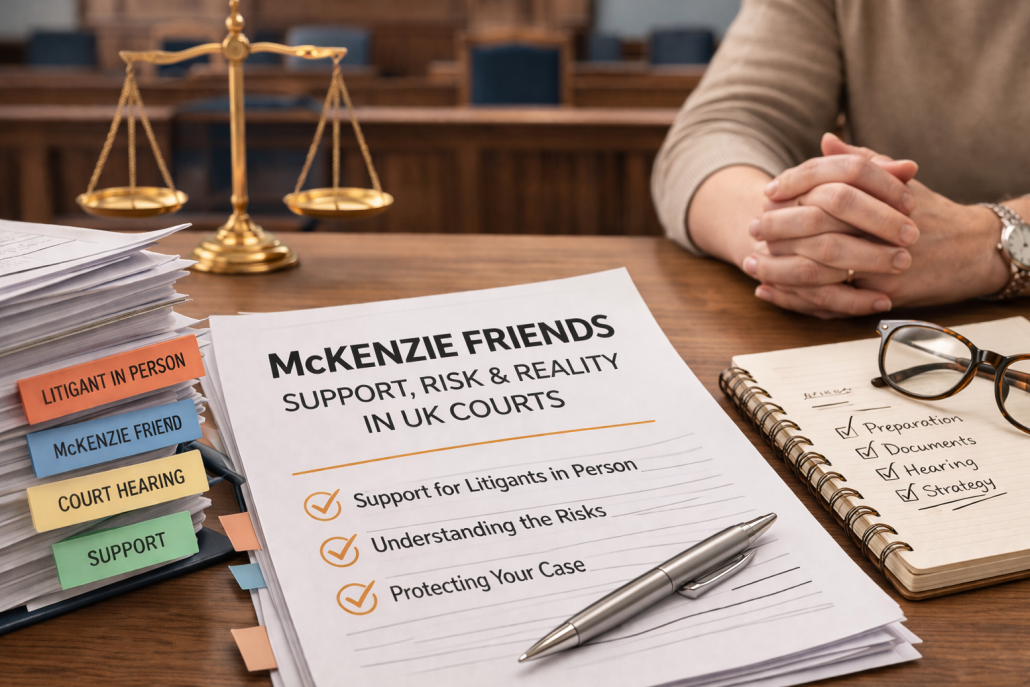
The Rise of McKenzie Friends: Support, Risk, and the Reality in UK Courts | JSH Law
Key Takeaways for Litigants in Person
McKenzie Friends can provide valuable support, but they are not legal representatives.
They operate outside formal regulation and oversight.
There is a wide variation in quality and experience.
Understanding their role — and its limits — is essential.
Used properly, they can strengthen a case. Used incorrectly, they can create risk.
The Rise of McKenzie Friends: Support, Risk, and the Reality in UK Courts
Over the past decade, the landscape of the family courts has changed significantly.
Increasing numbers of people are now navigating proceedings without legal representation. The reasons are well understood — rising legal costs, reduced access to legal aid, and the practical reality that many simply cannot afford traditional representation.
In response, a growing number of litigants in person have turned to McKenzie Friends for support.
For many, that support can be the difference between managing a case and becoming overwhelmed by it.
But as their presence in the courts has increased, so too has the need to properly understand what they are — and what they are not.
—
What Is a McKenzie Friend?
The concept of a McKenzie Friend originates from case law and is now an established part of court practice in England and Wales.
At its simplest, a McKenzie Friend is someone who provides support to a litigant in person during legal proceedings.
That support can include:
Taking notes in court
Helping organise documents
Assisting with preparation
Providing quiet guidance during hearings
They may sit beside you in court and help you stay focused and organised.
But their role is limited.
They are not your representative.
They do not automatically have the right to address the court, they cannot sign documents on your behalf, and they do not conduct litigation.
This distinction is fundamental.
—
Why Their Use Has Increased
The increase in the use of McKenzie Friends is not accidental.
It reflects a wider shift in access to justice.
Legal representation is, in many cases, expensive. For some, it is simply out of reach.
At the same time, the complexity of family proceedings has not reduced.
The result is a growing number of individuals who are expected to manage legally complex situations without formal support.
In that context, it is entirely understandable that people seek assistance where they can find it.
McKenzie Friends have emerged as part of that response.
—
The Benefit — and Why It Matters
When used properly, a McKenzie Friend can provide genuine value.
They can:
Help you stay organised
Improve how your case is prepared
Support you during stressful hearings
Provide clarity where the process feels overwhelming
For many litigants in person, particularly in emotionally demanding cases, that support is not just helpful — it is essential.
It can increase confidence, improve presentation, and make the process more manageable.
—
The Other Side of the Picture
However, the growth of this sector has also highlighted a more difficult reality.
There is no single standard for who can act as a McKenzie Friend.
Unlike solicitors or barristers, they are not subject to:
Formal qualification requirements
Regulatory oversight
Mandatory professional insurance
This creates a wide variation in the quality of support available.
Some individuals operate with care, structure, and a clear understanding of their role.
Others may not.
—
Where Risk Can Arise
The risk is not simply about competence.
It is about structure.
Problems tend to arise where the boundary between support and control becomes unclear.
For example:
Where decisions are effectively made for the litigant
Where communication is handled on their behalf
Where the case begins to feel as though it is being “run” by someone else
This is rarely intentional.
It often develops gradually.
But when it happens, it can affect both the integrity and the perception of the case.
There is also a very real, practical cost where support is poorly structured. What may initially appear to be a cheaper or more accessible option can, in some cases, lead to significant financial and personal loss. This can arise where a McKenzie Friend has little or no legal experience, offers services without clear boundaries, or operates without any form of professional accountability. Warning signs can include a lack of onboarding or written agreement, no clear explanation of their role, no insurance, and a tendency to take control rather than support. In those circumstances, mistakes are not just procedural—they can affect outcomes. Poorly drafted documents, missed deadlines, or misguided strategic decisions can result in prolonged proceedings, increased costs, and in some cases, irreversible damage to a person’s position. The reality is that in litigation, the consequences of getting it wrong are not theoretical—they are measured in time, money, and outcomes that cannot always be undone.
—
The Variation in Experience
Another factor to consider is the variation in experience across the sector.
Some McKenzie Friends bring years of practical exposure to court processes.
Others may have very limited experience.
Without formal standards, it can be difficult for a litigant to distinguish between the two.
This places an additional responsibility on those seeking support to ask the right questions and make informed decisions.
—
Practical Safeguards
If you are considering using a McKenzie Friend, there are some simple steps that can help protect your position:
Ask about their experience and background
Understand clearly what they will and will not do
Ensure you remain in control of your case at all times
Keep all arrangements clear and documented
Be cautious of anyone presenting themselves as a substitute for a solicitor
These steps are not about limiting support.
They are about ensuring that support is used properly.
—
The Balance That Needs to Be Struck
There is a clear tension within this space.
On one hand, access to justice requires that people are able to obtain support.
On the other, there is a need to ensure that support does not become something it is not intended to be.
Finding that balance is essential.
Support should strengthen your position, not compromise it.
—
Final Thoughts
The rise of McKenzie Friends reflects a system under pressure.
It also reflects the adaptability of those navigating it.
For litigants in person, the key is not whether to seek support.
It is how that support is structured.
Used correctly, it can be a significant advantage.
Used without clarity, it can introduce unnecessary risk.
Understanding that distinction is one of the most important steps you can take in protecting your case.
—
Need Structured Support With Your Case?
If you are navigating proceedings as a litigant in person and want clear, structured support that strengthens your case while keeping you in control, you can book an initial consultation below.
—
Regulatory & Editorial Notice:
JSH Law Ltd is not a firm of solicitors and does not provide regulated legal services.
This article is for general information and commentary only and does not constitute legal advice.
https://jshlaw.co.uk/wp-content/uploads/2026/02/ChatGPT-Image-Feb-3-2026-03_26_42-AM.png10241536jessica susan hillhttps://jshlaw.co.uk/wp-content/uploads/2026/01/jsh-law-logo-new-black-300x67.pngjessica susan hill2025-02-06 09:09:002026-04-06 09:21:36The Rise of McKenzie Friends: Support, Risk, and the Reality in UK Courts | JSH Law

 JSH LAW LTD
 JSH LAW LTD
 JSH LAW LTD
 jsh law ltd
 JSH Law Ltd
 jsh law ltd